Browsing as Guest. Progress, bookmarks and attempts are disabled.
Log in to track your work.
Nov 2008 p3 q5
1438
The polynomial \(4x^3 - 4x^2 + 3x + a\), where \(a\) is a constant, is denoted by \(p(x)\). It is given that \(p(x)\) is divisible by \(2x^2 - 3x + 3\).
(i) Find the value of \(a\).
(ii) When \(a\) has this value, solve the inequality \(p(x) < 0\), justifying your answer.
Solution
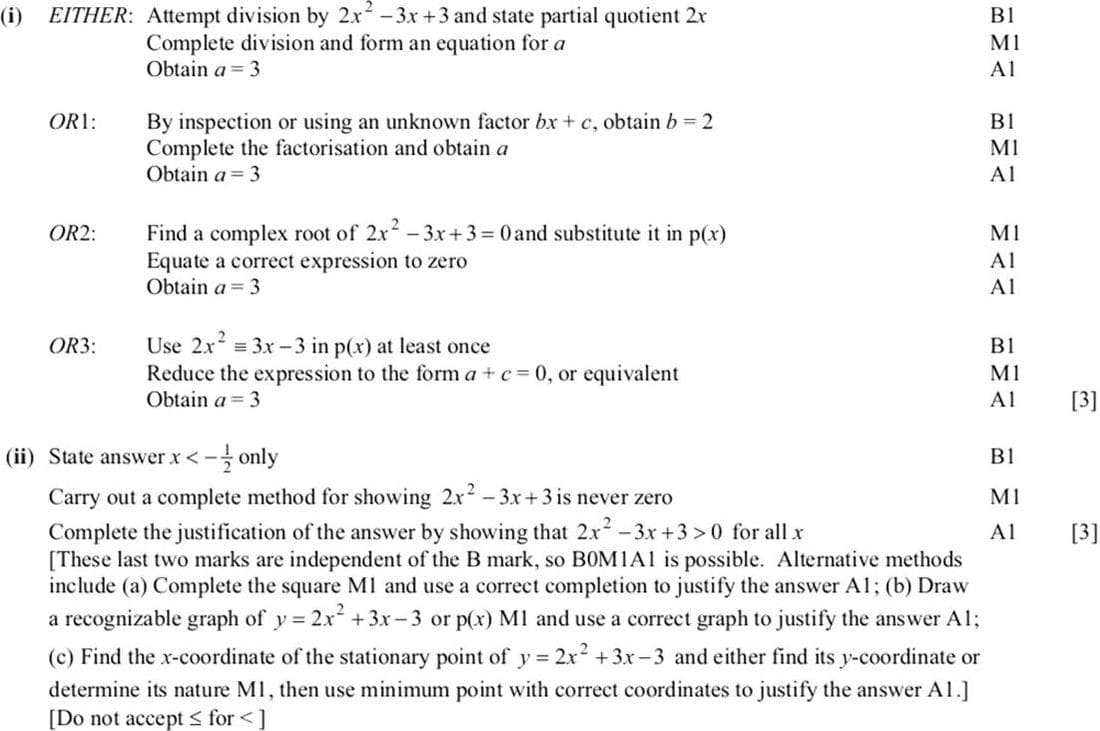
(i) To find the value of \(a\), we perform polynomial division of \(4x^3 - 4x^2 + 3x + a\) by \(2x^2 - 3x + 3\). The division should result in a remainder of zero since \(p(x)\) is divisible by \(2x^2 - 3x + 3\).
Performing the division, we find that the remainder is zero when \(a = 3\).
(ii) With \(a = 3\), the polynomial becomes \(4x^3 - 4x^2 + 3x + 3\). We need to solve the inequality \(p(x) < 0\).
Since \(2x^2 - 3x + 3\) is never zero and always positive, we analyze the sign of \(p(x)\) by considering the roots of the polynomial.
The inequality \(p(x) < 0\) holds when \(x < -\frac{1}{2}\), as justified by the behavior of the polynomial and its derivative.