9709 P32 - Jun 2013 - Q4
1428
The polynomial \(ax^3 - 20x^2 + x + 3\), where \(a\) is a constant, is denoted by \(p(x)\). It is given that \((3x + 1)\) is a factor of \(p(x)\).
(i) Find the value of \(a\).
(ii) When \(a\) has this value, factorise \(p(x)\) completely.
Solution
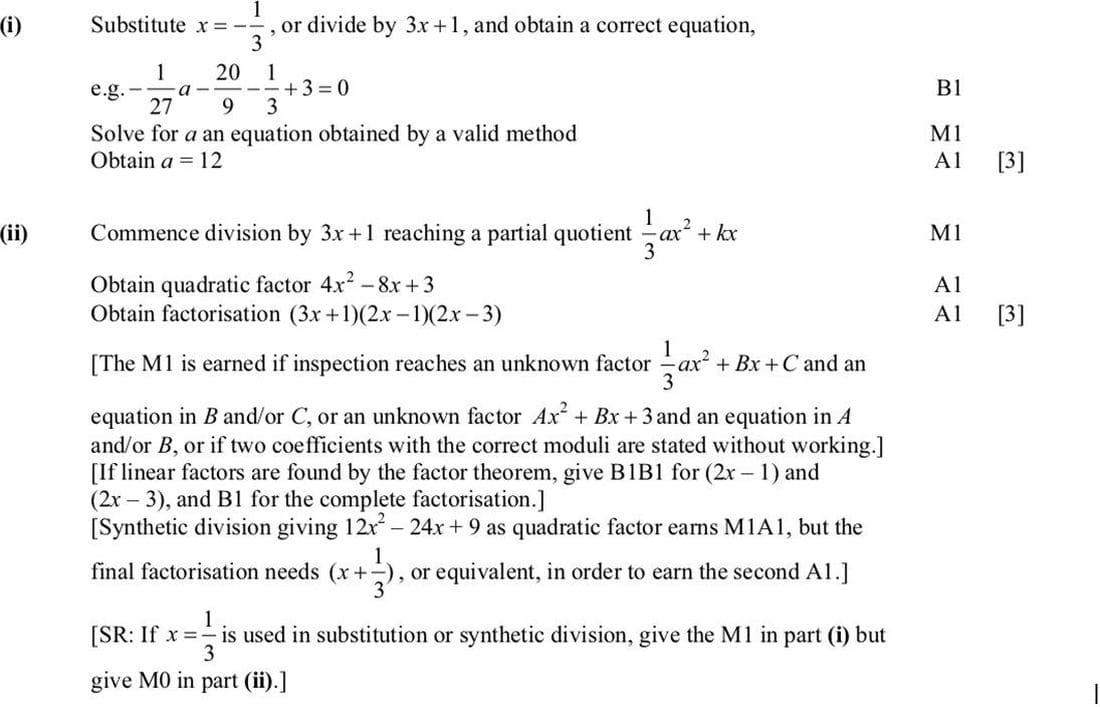
(i) Since \((3x + 1)\) is a factor of \(p(x)\), substituting \(x = -\frac{1}{3}\) into \(p(x)\) should yield zero:
\(a\left(-\frac{1}{3}\right)^3 - 20\left(-\frac{1}{3}\right)^2 + \left(-\frac{1}{3}\right) + 3 = 0\)
\(-\frac{a}{27} - \frac{20}{9} - \frac{1}{3} + 3 = 0\)
Solving for \(a\):
\(-\frac{a}{27} = \frac{20}{9} + \frac{1}{3} - 3\)
\(-\frac{a}{27} = \frac{20}{9} + \frac{3}{9} - \frac{27}{9}\)
\(-\frac{a}{27} = -\frac{4}{9}\)
\(a = 12\)
(ii) With \(a = 12\), the polynomial becomes \(12x^3 - 20x^2 + x + 3\). Divide by \(3x + 1\) to find the quadratic factor:
Perform polynomial division to get \(4x^2 - 8x + 3\).
Factor the quadratic:
\(4x^2 - 8x + 3 = (2x - 1)(2x - 3)\)
Thus, the complete factorisation is \((3x+1)(2x-1)(2x-3)\).