Past Exam Questions
← Back0606 P22 - Jun 2023 - Q7 - 12 marks
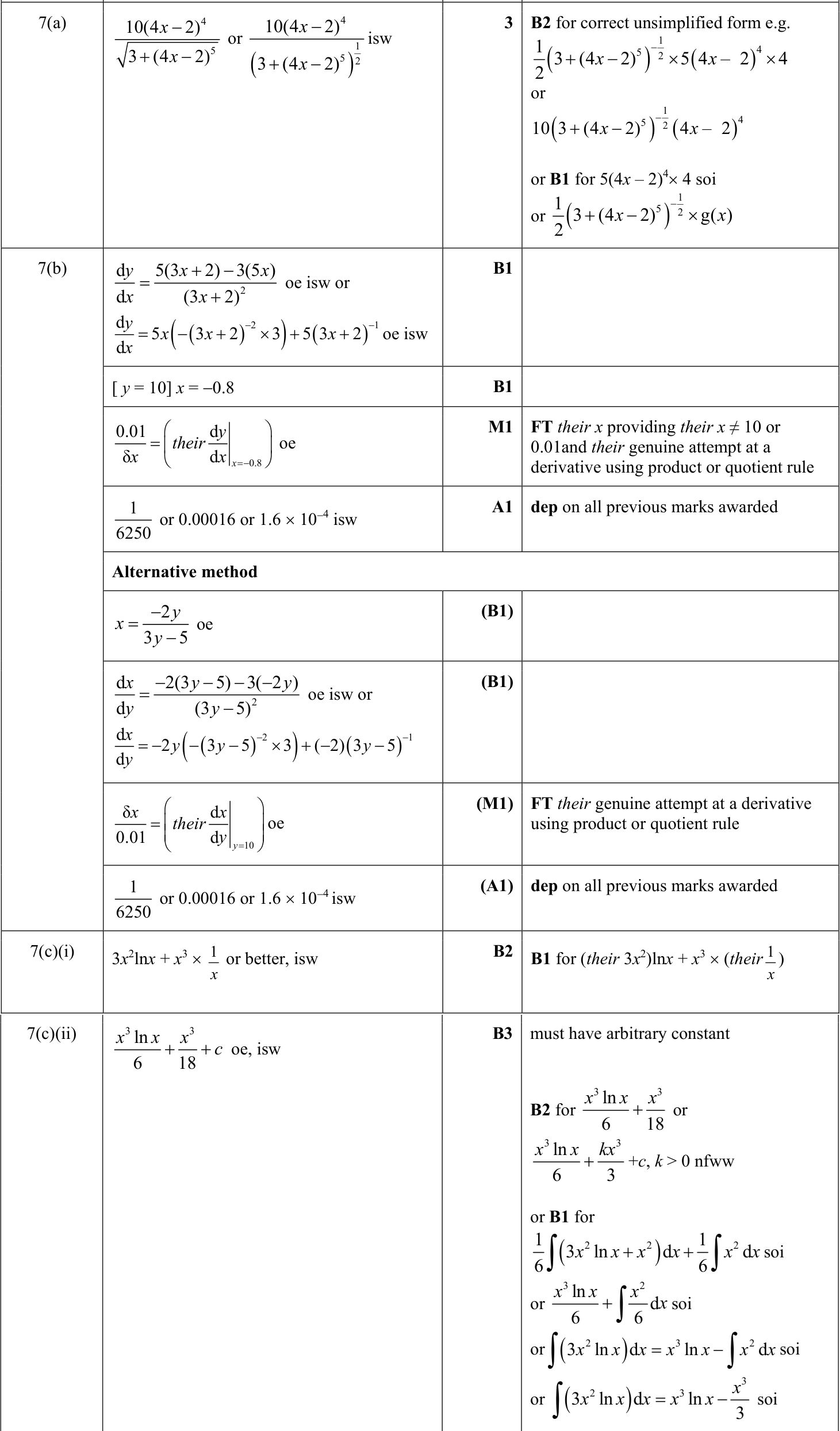
(a) \(f(x)=\sqrt{3+(4x-2)^5}\), where \(x\gt 1\). Find an expression for \(f'(x)\), giving your answer as a simplified algebraic fraction.
(b) Variables \(x\) and \(y\) are related by the equation
\(y=\frac{5x}{3x+2}.\)
Using differentiation, find the approximate change in \(x\) when \(y\) increases from \(10\) by the small amount \(0.01\).
(c)(i) Differentiate \(y=x^3\ln x\) with respect to \(x\).
(c)(ii) Hence find
\(\int\frac{x^2}{6}(2+3\ln x)\,dx.\)
0606 P21 - Jun 2020 - Q12 - 13 marks
(a) Find the \(x\)-coordinates of the stationary points of the curve
\(y=e^{3x}(2x+3)^6.\)
(b) A curve has equation \(y=f(x)\) and has exactly two stationary points. Given that
\(f''(x)=4x-7,\qquad f'(0.5)=0,\qquad f'(3)=0,\)
use the second derivative test to determine the nature of each of the stationary points of this curve.
(c) A solid cuboid has height \(h\) and a rectangular base measuring \(4x\) by \(x\). The volume of the cuboid is \(40\text{ cm}^3\). Given that \(x\) and \(h\) can vary and that the surface area of the cuboid has a minimum value, find this value.


0606 P23 - Jun 2020 - Q11 - 7 marks
In this question all lengths are in centimetres.
The volume, \(V\), of a cone of height \(h\) and base radius \(r\) is given by
\(V=\frac13\pi r^2h.\)
The diagram shows a large hollow cone from which a smaller cone of height \(180\) and base radius \(90\) has been removed. The remainder has been fitted with a circular base of radius \(90\) to form a container for water. The depth of water in the container is \(w\) and the surface of the water is a circle of radius \(R\).
(a) Find an expression for \(R\) in terms of \(w\) and show that the volume \(V\) of the water in the container is given by
\(V=\frac{\pi}{12}(w+180)^3-486000\pi.\)
(b) Water is poured into the container at a rate of \(10000\text{ cm}^3\text{ s}^{-1}\). Find the rate at which the depth of the water is increasing when \(w=10\).


0606 P11 - Jun 2017 - Q10 - 8 marks
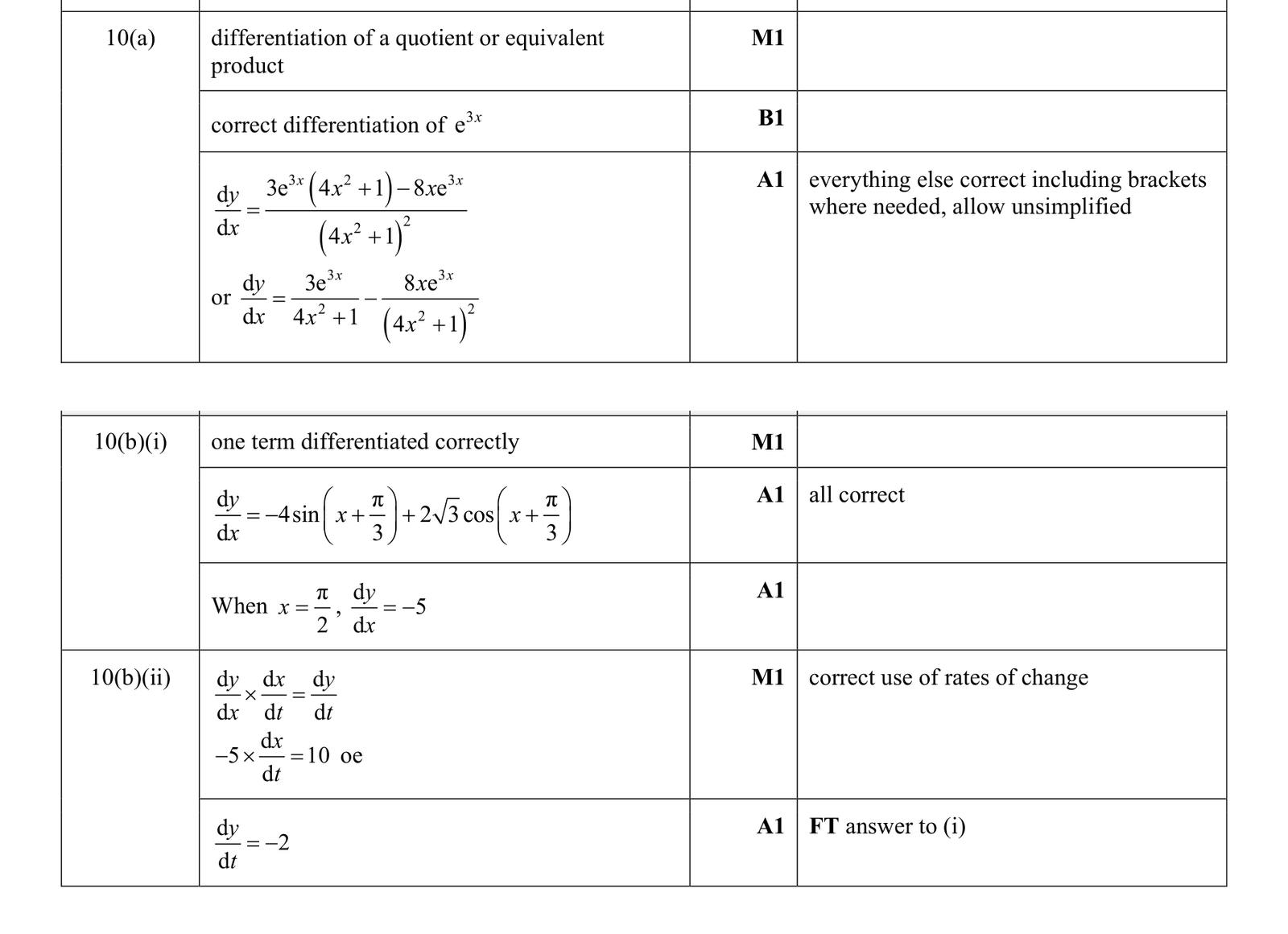
(a) Given that \(y=\dfrac{e^{3x}}{4x^2+1}\), find \(\dfrac{dy}{dx}\).
(b) Variables \(x\), \(y\), and \(t\) are such that
\(y=4\cos\left(x+\frac{\pi}{3}\right)+2\sqrt3\sin\left(x+\frac{\pi}{3}\right)\)
and \(\dfrac{dy}{dt}=10\).
(i) Find \(\dfrac{dy}{dx}\) when \(x=\dfrac{\pi}{2}\).
(ii) Find \(\dfrac{dx}{dt}\) when \(x=\dfrac{\pi}{2}\).
0606 P13 - Nov 2017 - Q8 - 8 marks
It is given that \(y=(x-4)(3x-1)^{\frac53}\).
(i) Show that \(\dfrac{dy}{dx}=(3x-1)^{\frac23}(Ax+B)\), where \(A\) and \(B\) are constants to be found.
(ii) Hence find, in terms of \(h\), the approximate change in \(y\) when \(x\) increases from \(3\) to \(3+h\), where \(h\) is small.

9231 P21 - Nov 2019 - Q1 - 5 marks
A particle \(P\) is moving in a circle of radius 2 m . At time \(t\) seconds, its velocity is \((t-1)^{2} \mathrm{~m} \mathrm{~s}^{-1}\). At a particular time \(T\) seconds, where \(T>0\), the magnitude of the radial component of the acceleration of \(P\) is \(8 \mathrm{~m} \mathrm{~s}^{-2}\). Find the magnitude of the transverse component of the acceleration of \(P\) at this instant.

9231 P21 - Jun 2019 - Q1 - 4 marks
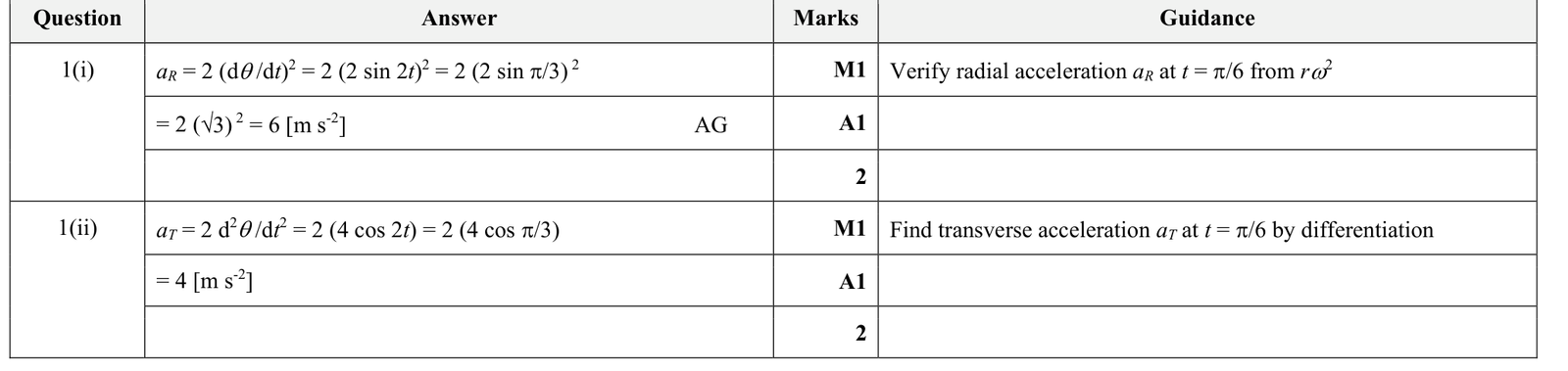
A particle \(P\) moves along an arc of a circle with centre \(O\) and radius 2 m . At time \(t\) seconds, the angle POA is \(\theta\), where \(\theta=1-\cos 2 t\), and \(A\) is a fixed point on the arc of the circle.
(i) Show that the magnitude of the radial component of the acceleration of \(P\) when \(t=\frac{1}{6} \pi\) is \(6 \mathrm{~m} \mathrm{~s}^{-2}\).
(ii) Find the magnitude of the transverse component of the acceleration of \(P\) when \(t=\frac{1}{6} \pi\).
9231 P21 - Nov 2017 - Q1 - 4 marks
A particle \(P\) is moving in a circle of radius 0.8 m . At time \(t \mathrm{~s}\) its velocity is \(\left(8-p t+t^{2}\right) \mathrm{m} \mathrm{s}^{-1}\), where \(p\) is a constant. The magnitude of the transverse component of the acceleration of \(P\) when \(t=2\) is zero. Find the magnitude of the radial component of the acceleration of \(P\) when \(t=2\).

9231 P23 - Jun 2018 - Q1 - 3 marks
A particle \(P\) is moving in a fixed circle of radius 0.8 m . At time \(t\) s its velocity is \(\left(t^{2}-t+2\right) \mathrm{m} \mathrm{s}^{-1}\). Find the magnitudes of the radial and the transverse components of the acceleration of \(P\) when \(t=2\).

9231 P31 - Nov 2025 - Q2 - 4 marks
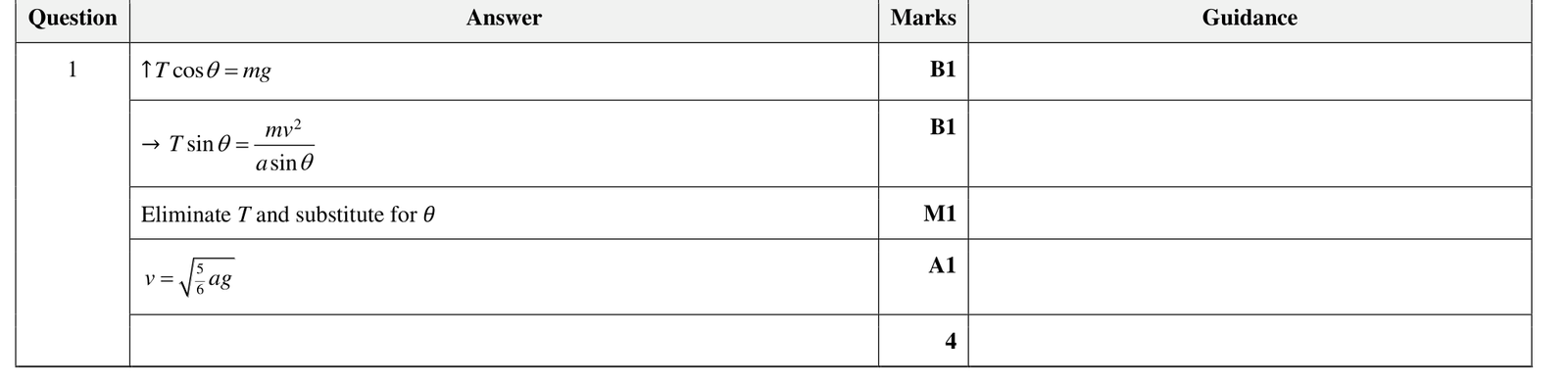
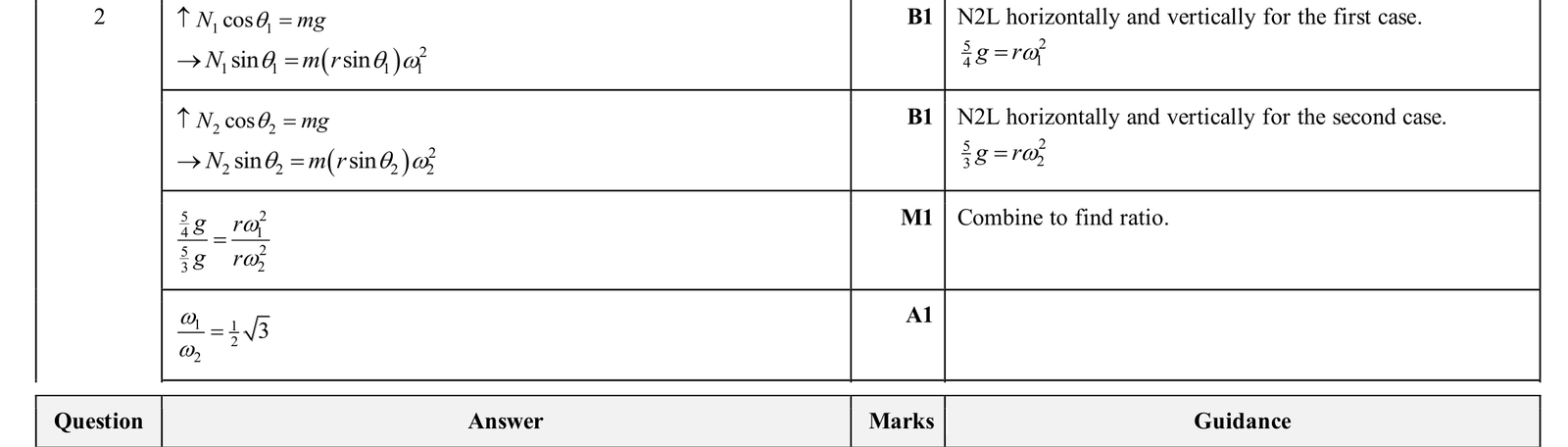
A particle \(P\) of mass \(m\) is moving in a horizontal circle with angular speed \(\omega_{1}\) on the smooth inner surface of a hemispherical shell of radius \(r\). The angle between the upward vertical and the normal reaction of the surface on \(P\) is \(\theta_{1}\), where \(\tan \theta_{1}=\frac{3}{4}\).
When the angular speed is increased to \(\omega_{2}\), the angle between the upward vertical and the normal reaction of the surface on \(P\) becomes \(\theta_{2}\), where \(\tan \theta_{2}=\frac{4}{3}\). Find the ratio \(\frac{\omega_{1}}{\omega_{2}}\).
9231 P32 - Nov 2025 - Q1 - 4 marks
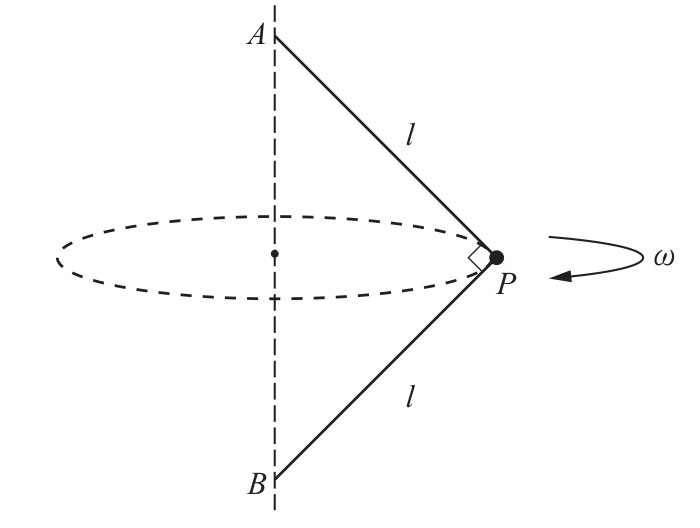
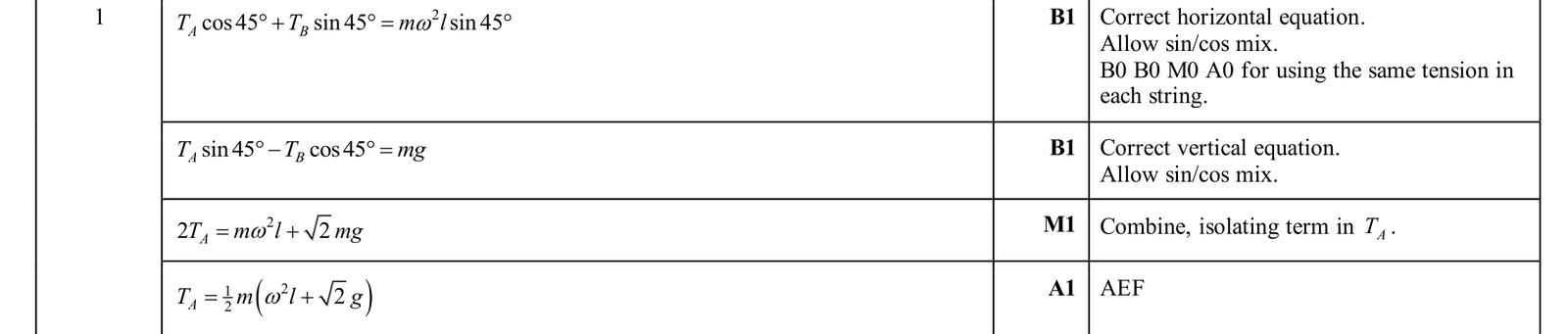
A particle \(P\) of mass \(m\) is attached to two light inextensible strings each of length \(l\). The end of one string is attached to a fixed point \(A\) and the end of the other string is attached to a fixed point \(B\), with \(A\) vertically above \(B\). Angle \(A P B\) is a right angle. The particle \(P\) rotates in a horizontal circle at a constant angular speed \(\omega\) with both strings taut (see diagram).
Find the tension in string \(A P\) in terms of \(m, g, l\) and \(\omega\).
9231 P34 - Nov 2025 - Q1 - 5 marks
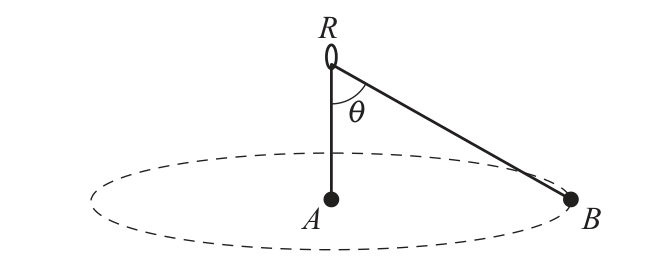
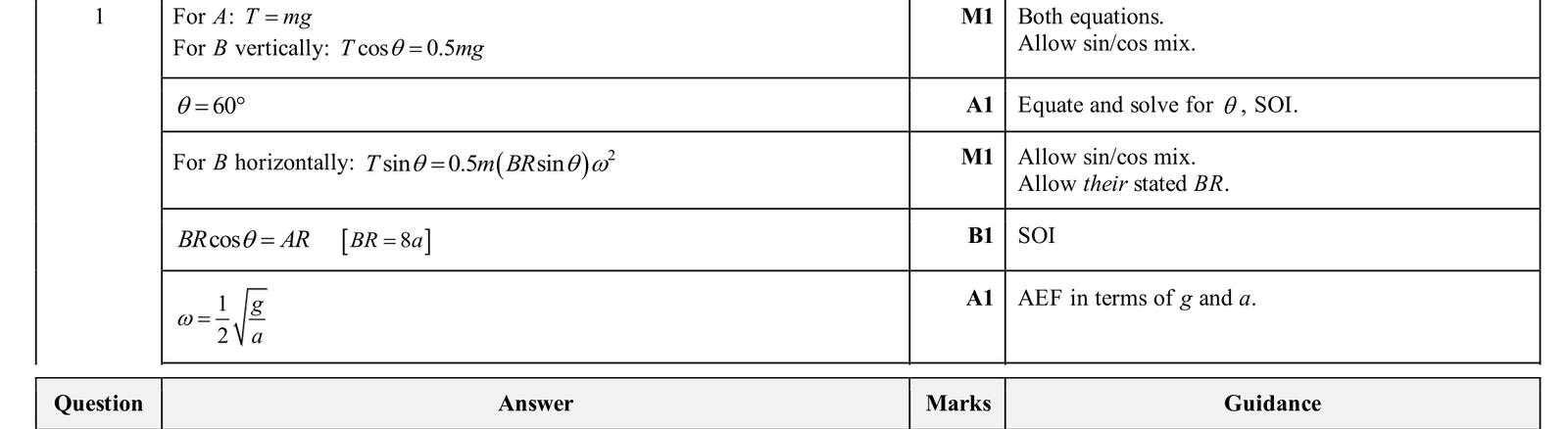
A light inextensible string of length \(12 a\) is threaded through a fixed smooth ring \(R\). One end of the string is attached to a particle \(A\) of mass \(m\). The other end of the string is attached to a particle \(B\) of mass 0.5 m . Particle \(A\) hangs in equilibrium vertically below the ring. Particle \(B\) moves with constant angular speed \(\omega\) in a horizontal circle with particle \(A\) at its centre. The angle between \(A R\) and \(B R\) is \(\theta\) (see diagram).
Express \(\omega\) in terms of \(g\) and \(a\).
9231 P31 - Jun 2025 - Q3 - 7 marks
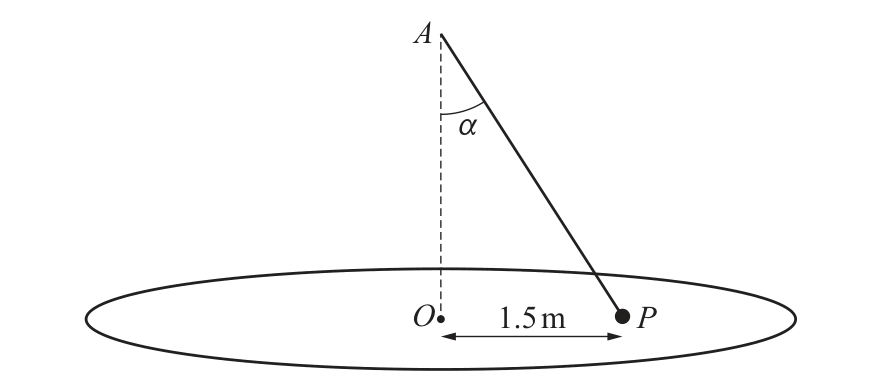
A rough horizontal disc rotates with constant angular speed \(\omega\,\text{rad s}^{-1}\). A particle \(P\) of mass \(1.6\) kg is at distance \(1.5\) m from the centre \(O\), attached to a point \(A\) vertically above \(O\) by a light elastic string. The natural length is \(2\) m, the modulus of elasticity is \(32\) N, and the coefficient of friction is \(0.5\). The particle is on the point of slipping in the direction \(OP\).
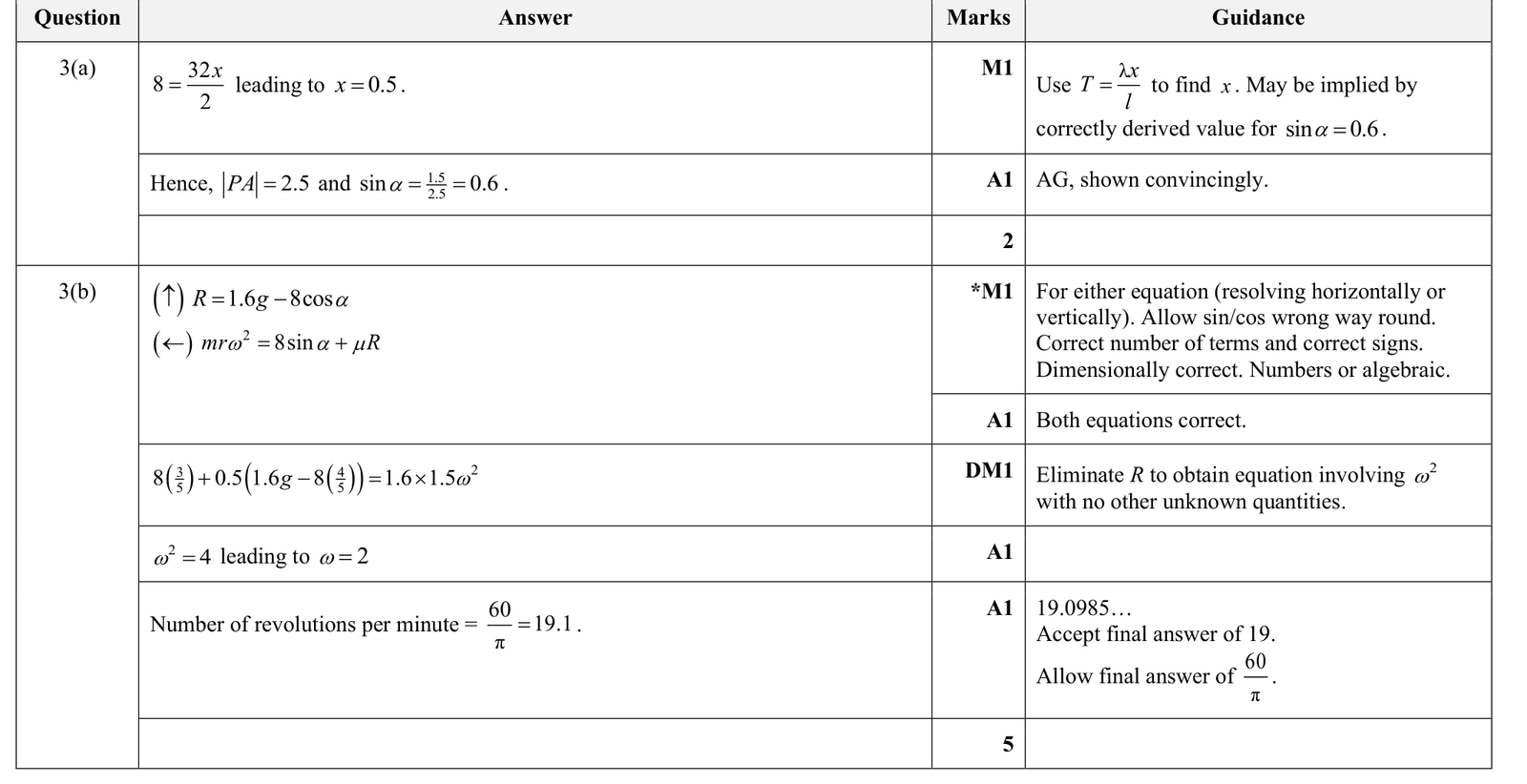
(a) Given that the tension is \(8\) N, show that \(\sin\alpha=0.6\).
(b) Find the number of revolutions per minute made by the disc and the particle.
9231 P33 - Jun 2025 - Q1 - 3 marks
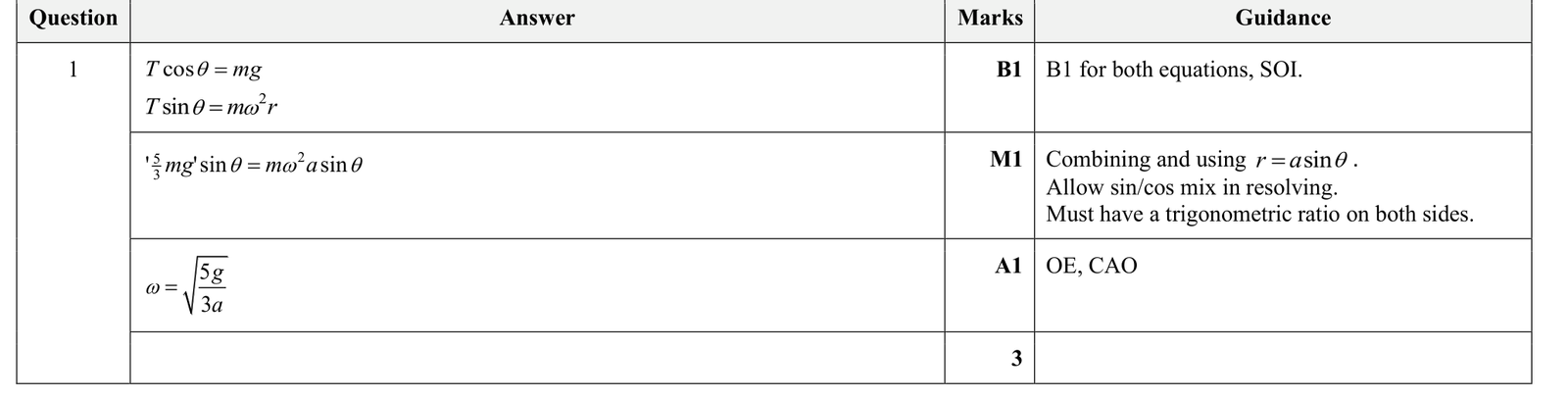
A particle \(P\) of mass \(m\) is attached to one end of a light inextensible string of length \(a\). The other end is attached to a fixed point \(O\). The particle moves in a horizontal circle with constant angular speed \(\omega\), and the string is inclined at angle \(\theta\) to the downward vertical. Given \(\tan\theta=\frac43\), find \(\omega\) in terms of \(a\) and \(g\).
9231 P34 - Jun 2025 - Q4 - 6 marks
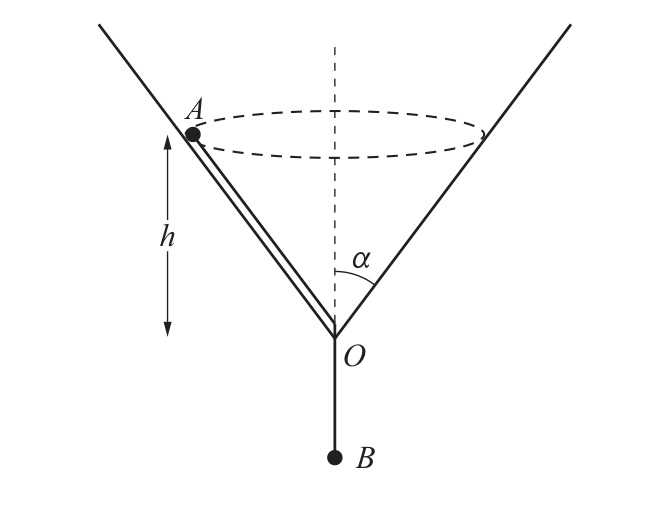
A hollow cone with a smooth inner surface is fixed with its vertex \(O\) downwards. The semi-vertical angle of the cone is \(\alpha\), where \(\tan\alpha=\dfrac34\). A light inextensible string has a particle \(A\) of mass \(m\) attached to one end and a particle \(B\) of mass \(m\) attached to the other end. The string passes through a small hole in the cone at \(O\).
Particle \(B\) hangs in equilibrium below \(O\). Particle \(A\) is on the inner surface of the cone at a height \(h\) above the level of \(O\) and moves in horizontal circles with constant angular speed \(\omega\).
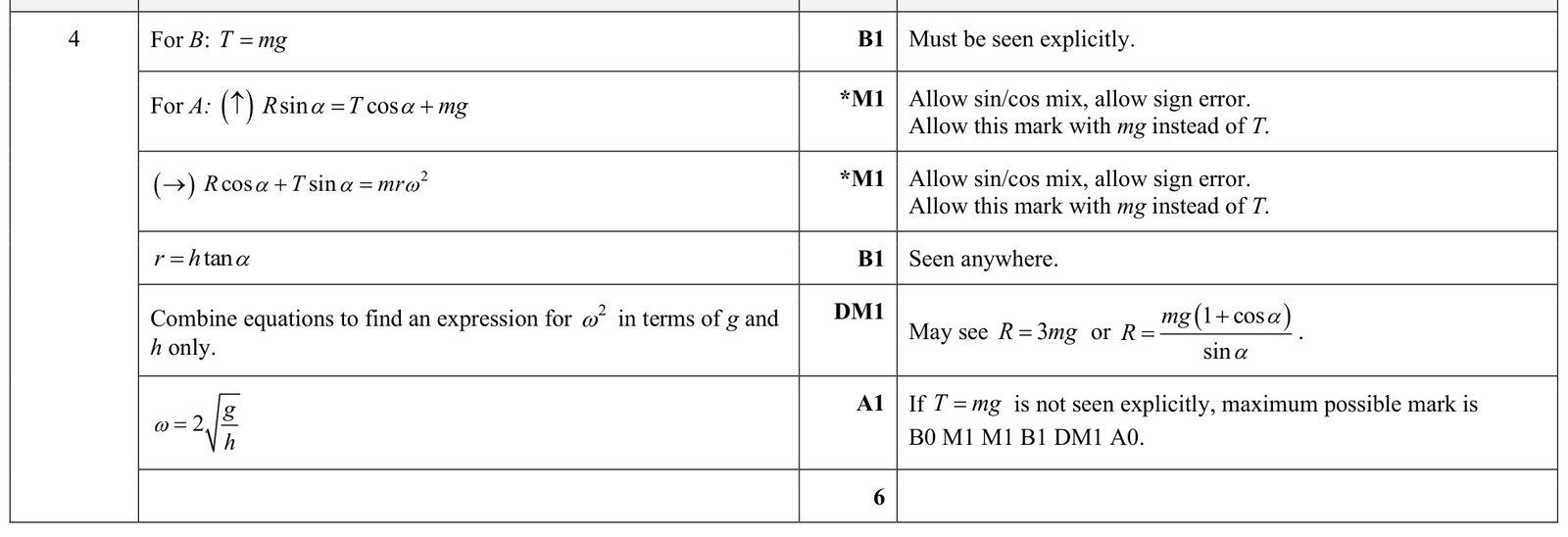
Find \(\omega\) in terms of \(g\) and \(h\).
9231 P31 - Nov 2024 - Q6 - 8 marks
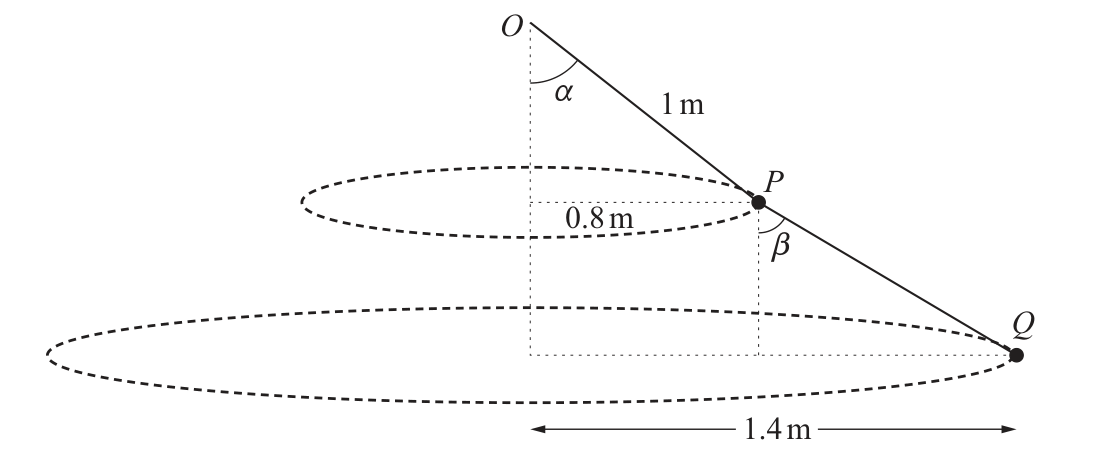
A particle \(P\) of mass \(0.05\,\text{kg}\) is attached to one end of a light inextensible string of length \(1\) m. The other end is attached to a fixed point \(O\). A particle \(Q\) of mass \(0.04\,\text{kg}\) is attached to one end of a second light inextensible string, whose other end is attached to \(P\).
The particle \(P\) moves in a horizontal circle of radius \(0.8\) m with angular speed \(\omega\,\text{rad s}^{-1}\). The particle \(Q\) moves in a horizontal circle of radius \(1.4\) m with the same angular speed. The centres of the circles are vertically below \(O\), and \(O\), \(P\), and \(Q\) are always in the same vertical plane. The strings \(OP\) and \(PQ\) make constant angles \(\alpha\) and \(\beta\) respectively with the vertical.
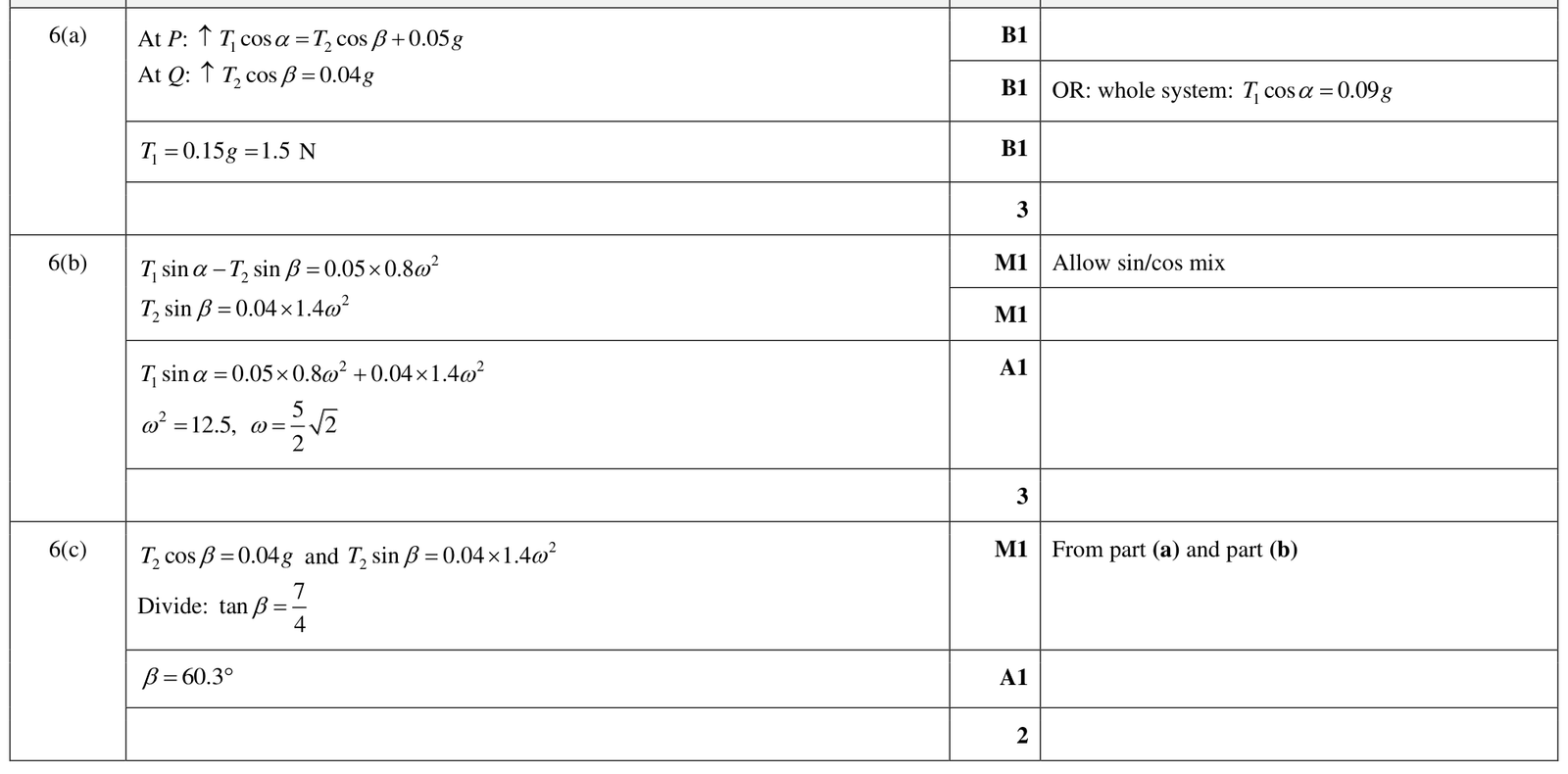
(a) Find the tension in the string \(OP\).
(b) Find \(\omega\).
(c) Find \(\beta\).
9231 P32 - Nov 2024 - Q1 - 3 marks
A particle of mass \(2\,\text{kg}\) is attached to one end of a light elastic string of natural length \(0.8\) m and modulus of elasticity \(100\) N. The other end is attached to a fixed point \(O\) on a smooth horizontal surface.
The particle moves in a horizontal circle about \(O\), with the string taut and with constant angular speed \(5\,\text{rad s}^{-1}\). Find the extension of the string.

9231 P31 - Jun 2024 - Q5 - 7 marks
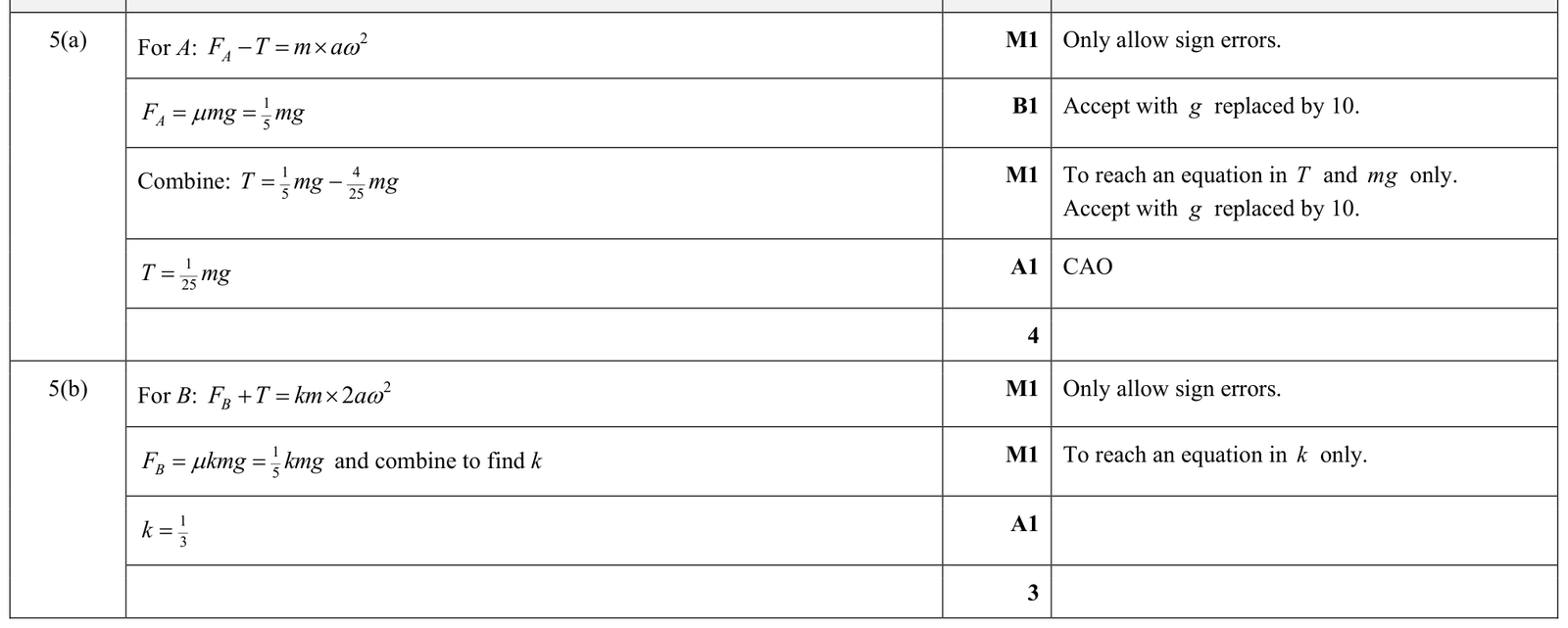
Two particles \(A\) and \(B\), of masses \(m\) and \(km\) respectively, are connected by a light inextensible string of length \(a\). The particles are placed on a rough horizontal circular turntable with the string taut and lying along a radius of the turntable.
Particle \(A\) is at a distance \(a\) from the centre of the turntable, and particle \(B\) is at a distance \(2a\) from the centre. The coefficient of friction between each particle and the turntable is \(\dfrac15\).
When the turntable rotates with angular speed \(\dfrac25\sqrt{\dfrac ga}\), the system is in limiting equilibrium.
(a) Find the tension in the string, in terms of \(m\) and \(g\).
(b) Find \(k\).
9231 P33 - Jun 2024 - Q2 - 6 marks
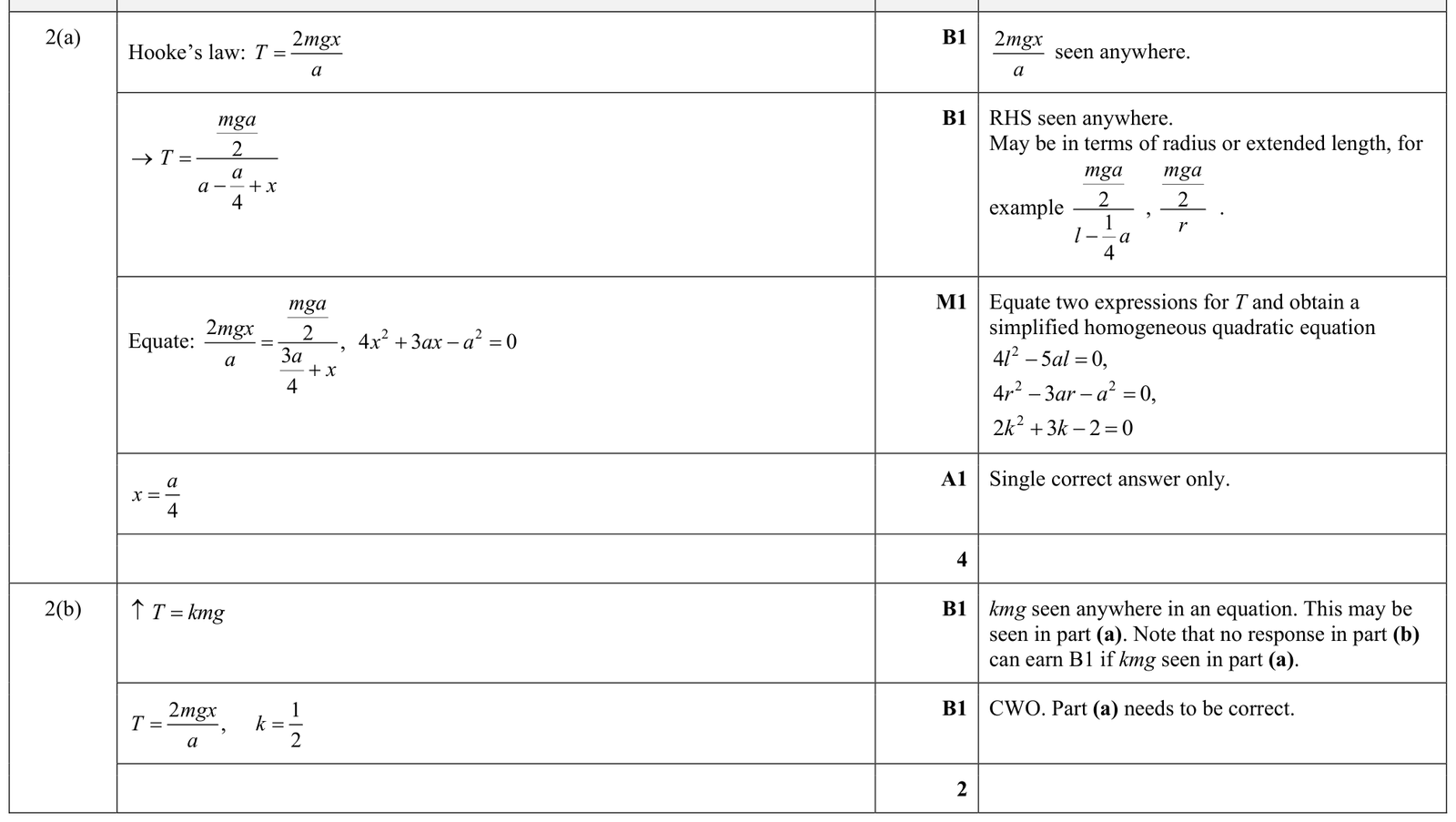
A particle \(P\) of mass \(m\) is attached to one end of a light elastic string of natural length \(a\) and modulus of elasticity \(2mg\). A particle \(Q\) of mass \(km\) is attached to the other end.
Particle \(P\) lies on a smooth horizontal table. The string has part of its length in contact with the table and then passes through a small smooth hole \(H\) in the table.
Particle \(P\) moves in a horizontal circle on the surface of the table with constant speed \(\sqrt{\dfrac12ga}\). Particle \(Q\) hangs in equilibrium vertically below the hole with \(HQ=\dfrac14a\).
(a) Find, in terms of \(a\), the extension in the string.
(b) Find \(k\).
9231 P32 - Nov 2023 - Q1 - 4 marks
One end of a light inextensible string of length \(a\) is attached to a fixed point \(O\). The other end of the string is attached to a particle of mass \(m\). The string is taut and makes an angle \(\theta\) with the downward vertical through \(O\), where \(\cos\theta=\dfrac23\). The particle moves in a horizontal circle with speed \(v\).
Find \(v\) in terms of \(a\) and \(g\).