Model a fixed number of independent trials and calculate the number of successes.
By the end of this lesson
- Recognise when a binomial model is appropriate.
- Calculate exact, cumulative and complementary probabilities.
- Use the binomial mean and variance and interpret the results.
- Translate probability wording into the correct integer event.
Before you begin: Independent events and complementary probabilities; Combinations and factorial notation; Mean and variance of a discrete random variable.
1. Recognising a binomial experiment
A binomial variable counts successes in a fixed number of trials. A success is simply the outcome you decide to count: a faulty component can be a success in the mathematical model. Define the variable in words before writing a distribution. For example, $X$ might count faulty components among 20 independently produced components.
- The number of trials, $n$, is fixed in advance.
- Each trial has two categories: success and failure.
- The trials are independent: one outcome does not change another trial's probability.
- The success probability, $p$, is constant on every trial.
Key formula
Model and possible values
$n$ is a positive integer and $0\le p\le1$. Write $q=1-p$ for the failure probability.
Check these assumptions against the situation. Sampling without replacement from a small finite group usually changes the success probability and creates dependence. An exact binomial model then fails. A large population can sometimes justify an approximation, but that needs a reason; the word “random” alone does not establish independence.
2. The probability of exactly r successes
One particular sequence containing $r$ successes and $n-r$ failures has probability $p^r(1-p)^{n-r}$. There are $\binom nr$ different positions for those successes. Add the probabilities of these mutually exclusive sequences by multiplying by the combinations factor.
Key formula
Binomial probability
Use integer $r$ with $0\le r\le n$ and a valid binomial model. Remember $0!=1$.
Worked example
Worked example 1: exactly two wins
An electronic game has independent rounds, each with win probability $0.4$. Six rounds are played. Find the probability of exactly two wins.
Let $X$ count wins. There are six independent trials with constant success probability, so $X\sim\mathrm B(6,0.4)$.
Substitute the number of trials, wins and failures.
\[P(X=2)=\binom62(0.4)^2(0.6)^4\]The 15 combinations count all possible positions of the two wins.
\[P(X=2)=15(0.16)(0.1296)=0.31104\]
3. Cumulative probabilities and complements
A cumulative probability adds probabilities for several possible counts. Because the values are integers, wording such as “more than” and “at least” changes the first included value. Write that value down before choosing a sum or calculator command.
| Wording | Event | Useful equivalent |
|---|---|---|
| At most $k$ | $X\le k$ | $\sum_{r=0}^{k}P(X=r)$ |
| Fewer than $k$ | $X<k$ | $X\le k-1$ |
| At least $k$ | $X\ge k$ | $1-P(X\le k-1)$ |
| More than $k$ | $X>k$ | $1-P(X\le k)$ |
Worked example
Worked example 2: at least two late deliveries
In an illustrative model, eight deliveries are independent and each is late with probability $0.25$. Find the probability that at least two are late.
Let $X\sim\mathrm B(8,0.25)$. The complement of “at least two” is “zero or one”.
Calculate the shorter complementary sum.
\[P(X\ge2)=1-\left[(0.75)^8+8(0.25)(0.75)^7\right]\]Evaluate without rounding the two terms early.
\[P(X\ge2)=0.6329193115\ldots\]
4. Mean, variance and standard deviation
The mean is the long-run average success count over many repetitions of the entire experiment. It need not be a possible individual count. Variance measures spread around that mean; standard deviation expresses the spread in the same units as $X$.
Key formula
Binomial moments
These formulas apply when $X\sim\mathrm B(n,p)$.
Worked example
Worked example 3: interpreting the spread
Each of 20 seeds independently fails to germinate with probability $0.1$. Let $F$ count failures. Find its mean, variance and standard deviation.
Define failure to germinate as a success in the probability model: $F\sim\mathrm B(20,0.1)$.
Apply the moment formulas.
\[\operatorname E(F)=20(0.1)=2,\qquad \operatorname{Var}(F)=20(0.1)(0.9)=1.8\]Take the square root of the variance.
\[\operatorname{SD}(F)=\sqrt{1.8}=1.3416\ldots\]
If the mean and variance of a non-degenerate binomial model are known, dividing variance by mean gives $1-p$. You can then recover $p$ and $n$. Check that the resulting $n$ is an integer and $p$ lies between 0 and 1.
5. Reading a binomial distribution
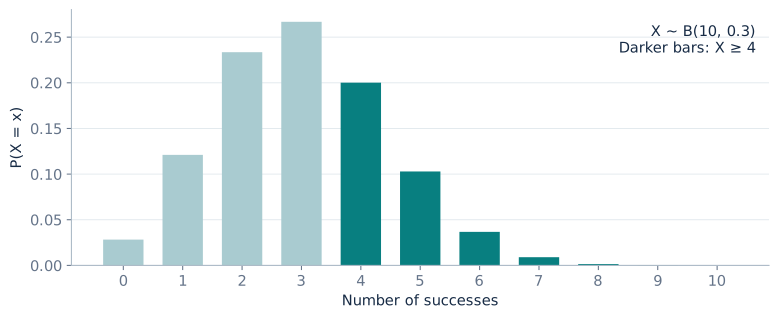
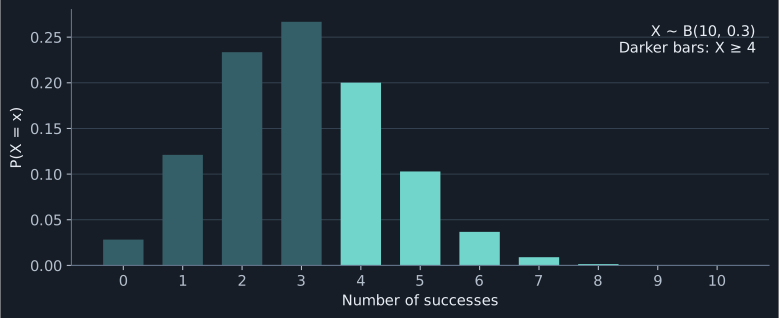
Each bar gives the probability of one count, and all bar probabilities sum to 1. The mean is $np=3$, but it is not a boundary splitting the probability equally. For $p$ below one half the distribution can have a longer right tail. The binomial support always stops at $n$, regardless of the shape.
6. A reliable solution method
- Define the counted success and write $X\sim\mathrm B(n,p)$.
- Check that the model assumptions match the context.
- Translate the wording into an integer event.
- Choose the exact formula, a cumulative sum or a complement.
- Keep extra precision during working, then interpret the result.
Practice
Try each question before opening its worked solution.
Question 1
$X\sim\mathrm B(10,0.3)$. Find (a) $P(X=4)$ and (b) $P(X\ge4)$.
Show worked solution
For the exact count, use four successes and six failures.
\[P(X=4)=\binom{10}{4}(0.3)^4(0.7)^6=0.200120949\]For the upper tail, exclude counts zero through three.
\[P(X\ge4)=1-\sum_{r=0}^{3}\binom{10}{r}(0.3)^r(0.7)^{10-r}=0.3503892816\]
Question 2
Twelve independent trials each have success probability $0.2$. Find the probability of at least one success.
Show worked solution
Let $X\sim\mathrm B(12,0.2)$. The complementary event is no successes.
Every trial must fail for that event.
\[P(X\ge1)=1-P(X=0)=1-(0.8)^{12}=0.9312805233\ldots\]
Question 3
Stretch: a binomial variable has mean 6 and variance 4.2. Find $n$ and $p$.
Show worked solution
Write the two moment equations.
\[np=6,\qquad np(1-p)=4.2\]Divide the variance equation by the mean equation.
\[1-p=\frac{4.2}{6}=0.7,\qquad p=0.3\]Substitute into the mean equation.
\[n=\frac6{0.3}=20\]
Question 4
A bag contains 3 red and 7 blue counters. Four counters are drawn without replacement. Explain why a binomial model for the red count is not exact. If each counter is replaced and the bag mixed after each draw, give the model, mean and variance.
Show worked solution
Without replacement, the next red probability depends on earlier colours; the trials are dependent.
With replacement and mixing, each draw has red probability $3/10$ independently, so $R\sim\mathrm B(4,0.3)$.
Apply the moments.
\[\operatorname E(R)=4(0.3)=1.2,\qquad \operatorname{Var}(R)=4(0.3)(0.7)=0.84\]
Change from a fixed number of trials to waiting until the first success.