Past Exam Questions
← Back9231 P32 - Nov 2022 - Q1 - 4 marks
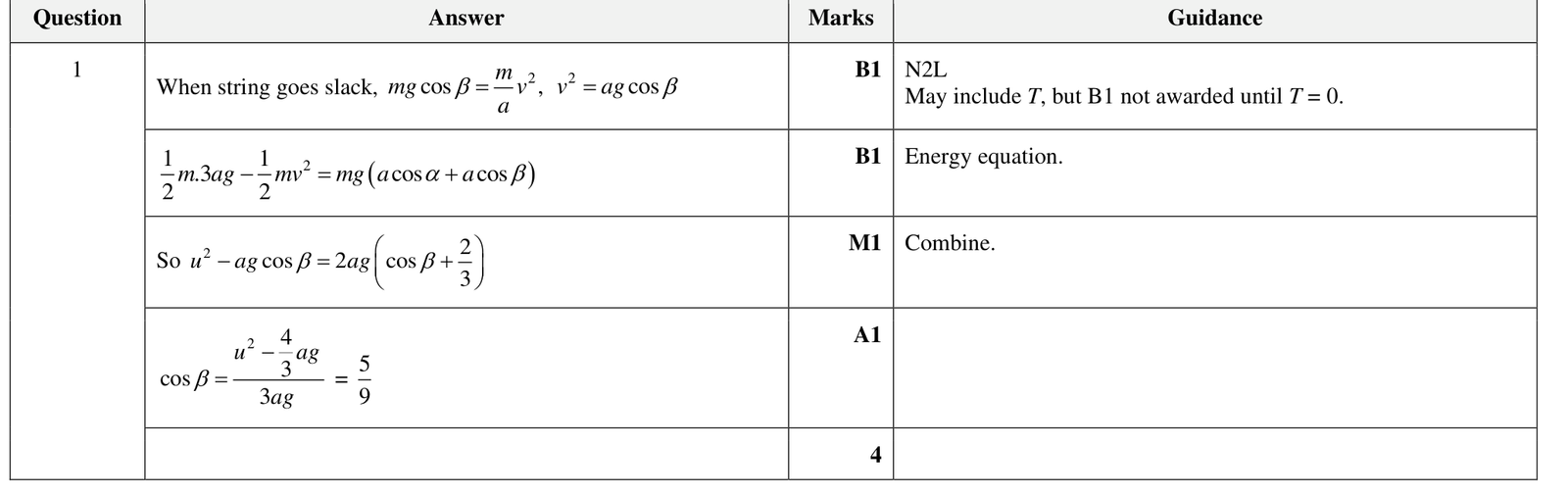
A particle \(P\) of mass \(m\) is attached to one end of a light inextensible string of length \(a\). The other end of the string is attached to a fixed point \(O\). The string is held taut with \(O P\) making an angle \(\alpha\) with the downward vertical, where \(\cos \alpha=\frac{2}{3}\). The particle \(P\) is projected perpendicular to \(O P\) in an upwards direction with speed \(\sqrt{3 a g}\). It then starts to move along a circular path in a vertical plane.
Find the cosine of the angle between the string and the upward vertical when the string first becomes slack.
9231 P31 - Jun 2021 - Q5 - 8 marks
A particle \(P\) of mass \(m\) is attached to one end of a light inextensible string of length \(a\). The other end of the string is attached to a fixed point \(O\). The particle completes vertical circles with centre \(O\). The points \(A\) and \(B\) are on the path of \(P\), both on the same side of the vertical through \(O . O A\) makes an angle \(\theta\) with the downward vertical through \(O\) and \(O B\) makes an angle \(\theta\) with the upward vertical through \(O\).
The speed of \(P\) when it is at \(A\) is \(u\) and the speed of \(P\) when it is at \(B\) is \(\sqrt{a g}\). The tensions in the string at \(A\) and \(B\) are \(T_{A}\) and \(T_{B}\) respectively. It is given that \(T_{A}=7 T_{B}\).
Find the value of \(\theta\) and find an expression for \(u\) in terms of \(a\) and \(g\).

9231 P33 - Jun 2021 - Q4 - 8 marks
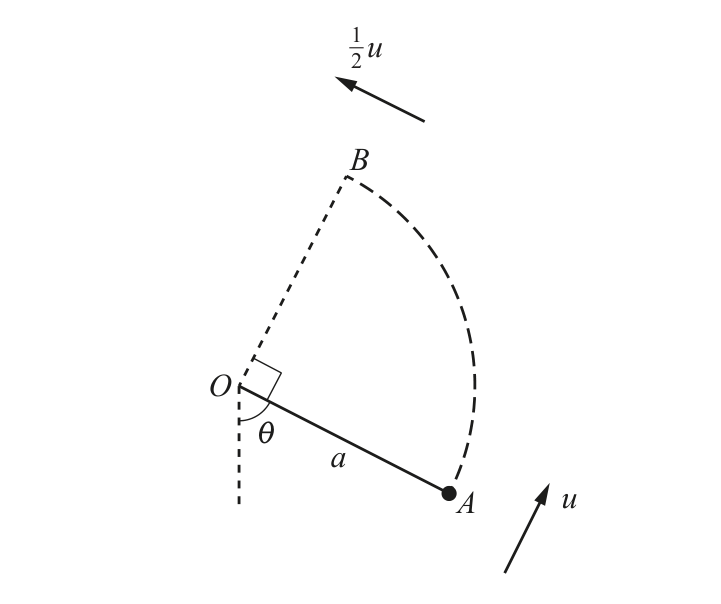
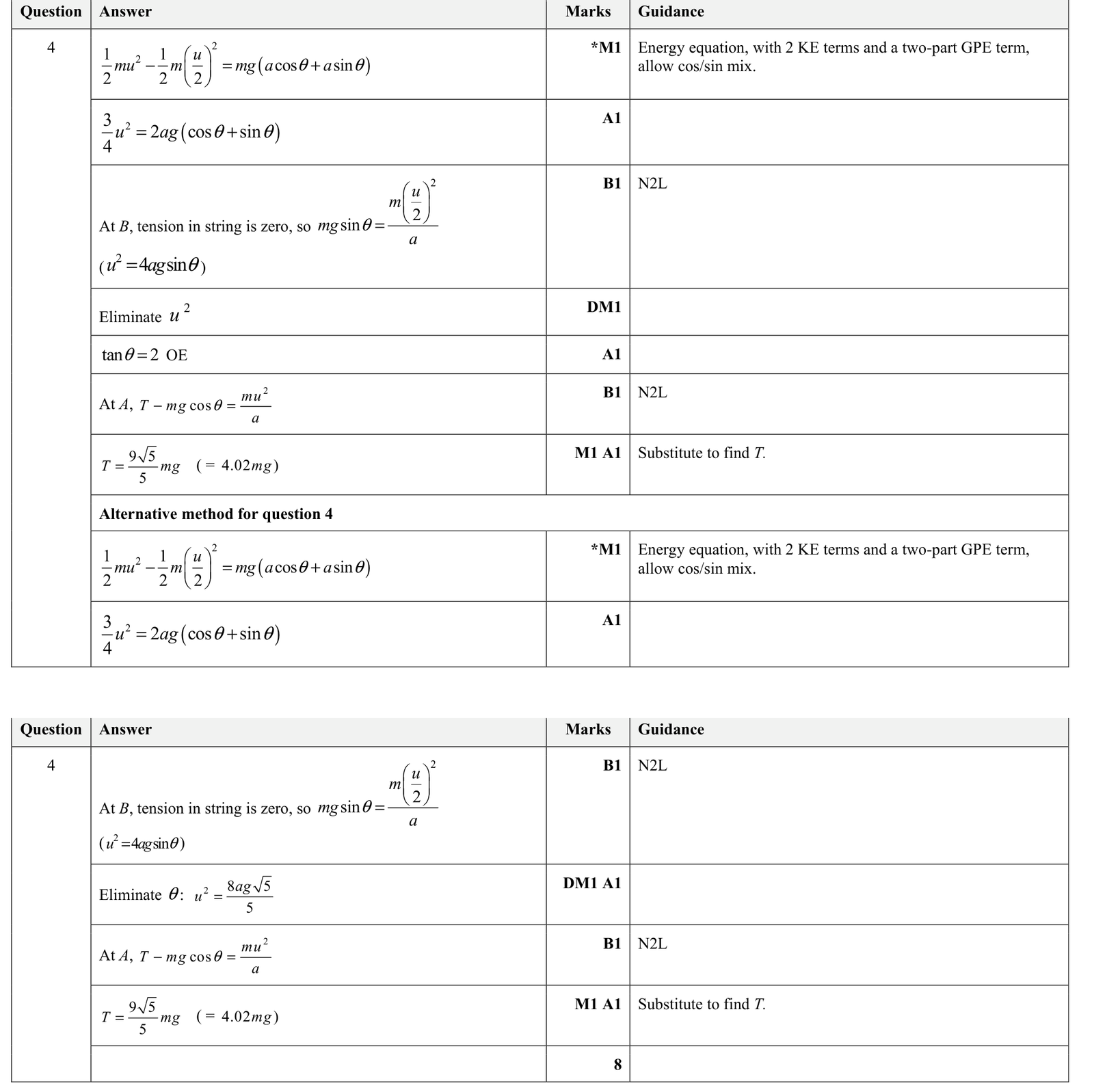
A particle of mass \(m\) is attached to one end of a light inextensible string of length \(a\). The other end of the string is attached to a fixed point \(O\). The particle is initially held with the string taut at the point \(A\), where \(O A\) makes an angle \(\theta\) with the downward vertical through \(O\). The particle is then projected with speed \(u\) perpendicular to \(O A\) and begins to move upwards in part of a vertical circle. The string goes slack when the particle is at the point \(B\) where angle \(A O B\) is a right angle. The speed of the particle when it is at \(B\) is \(\frac{1}{2} u\) (see diagram).
Find the tension in the string at \(A\), giving your answer in terms of \(m\) and \(g\).
9231 P31 - Nov 2021 - Q6 - 8 marks
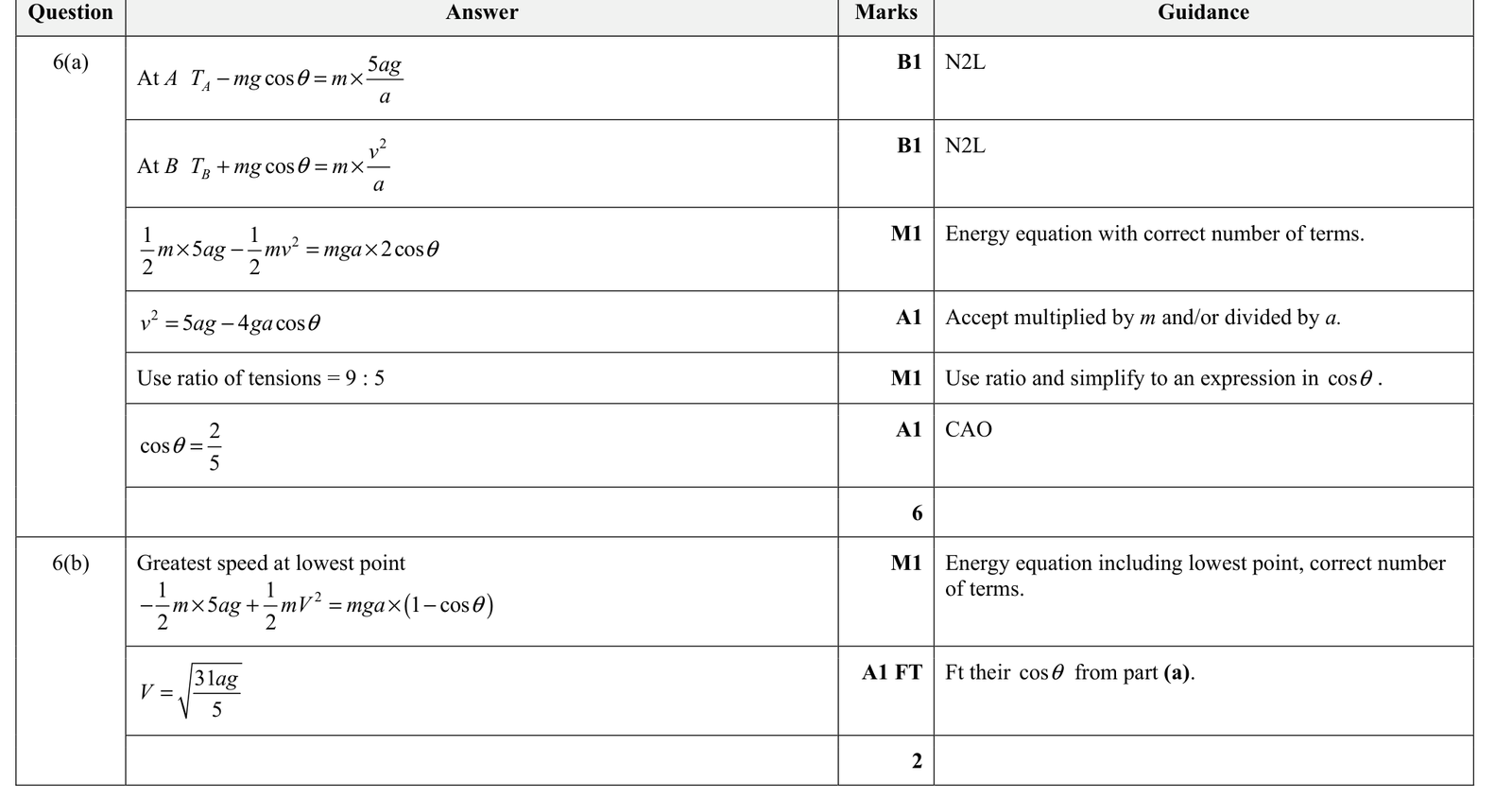
A particle \(P\), of mass \(m\), is attached to one end of a light inextensible string of length \(a\). The other end of the string is attached to a fixed point \(O\). The particle \(P\) moves in complete vertical circles about \(O\) with the string taut. The points \(A\) and \(B\) are on the path of \(P\) with \(A B\) a diameter of the circle. \(O A\) makes an angle \(\theta\) with the downward vertical through \(O\) and \(O B\) makes an angle \(\theta\) with the upward vertical through \(O\). The speed of \(P\) when it is at \(A\) is \(\sqrt{5 a g}\).
The ratio of the tension in the string when \(P\) is at \(A\) to the tension in the string when \(P\) is at \(B\) is \(9: 5\).
(a) Find the value of \(\cos \theta\).
(b) Find, in terms of \(a\) and \(g\), the greatest speed of \(P\) during its motion.
9231 P31 - Jun 2020 - Q7 - 10 marks
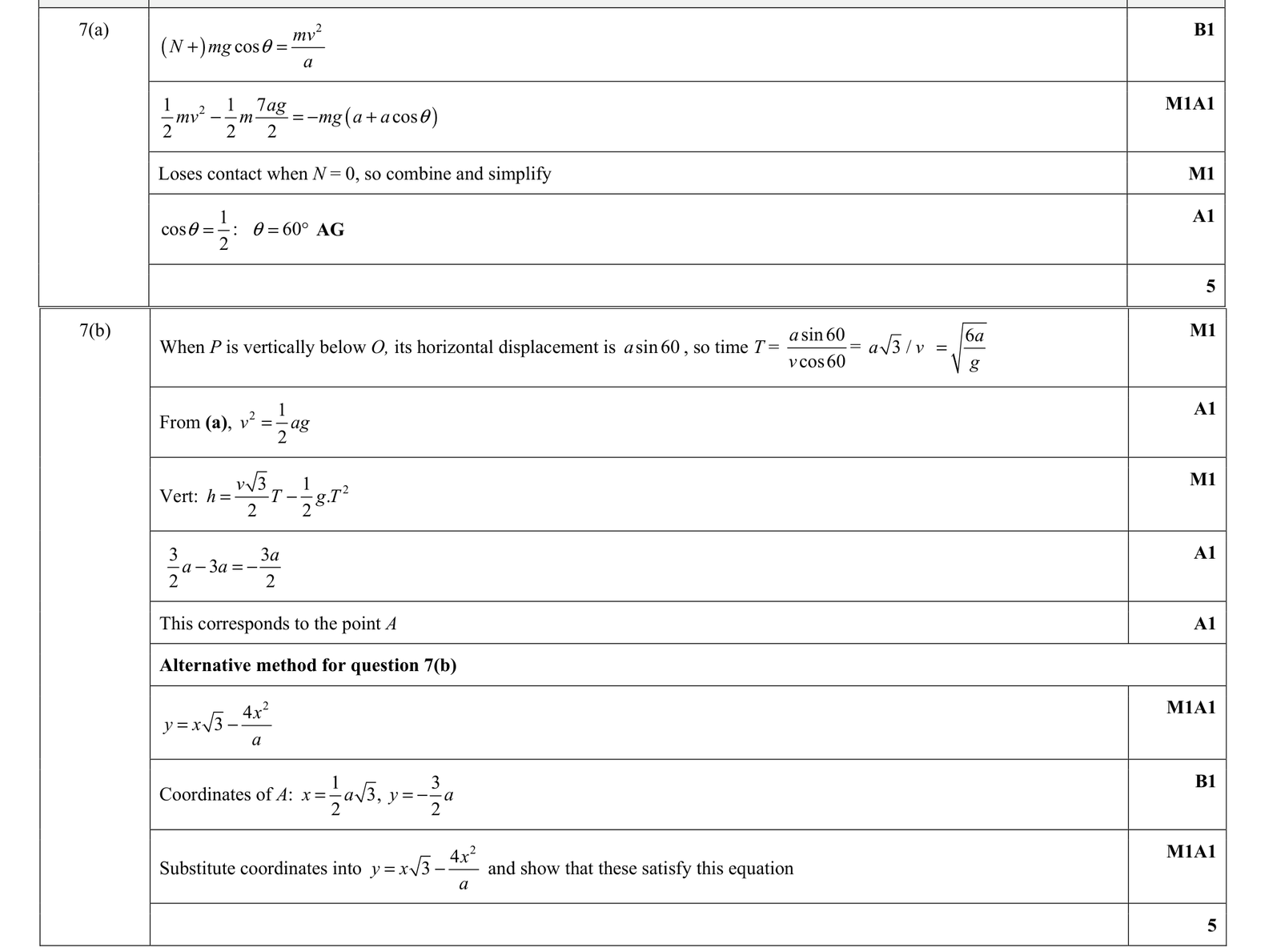
A hollow cylinder of radius \(a\) is fixed with its axis horizontal. A particle \(P\), of mass \(m\), moves in part of a vertical circle of radius \(a\) and centre \(O\) on the smooth inner surface of the cylinder. The speed of \(P\) when it is at the lowest point \(A\) of its motion is \(\sqrt{\frac{7}{2} g a}\).
The particle \(P\) loses contact with the surface of the cylinder when \(O P\) makes an angle \(\theta\) with the upward vertical through \(O\).
(a) Show that \(\theta=60^{\circ}\).
(b) Show that in its subsequent motion \(P\) strikes the cylinder at the point \(A\).
9231 P33 - Jun 2020 - Q3 - 6 marks
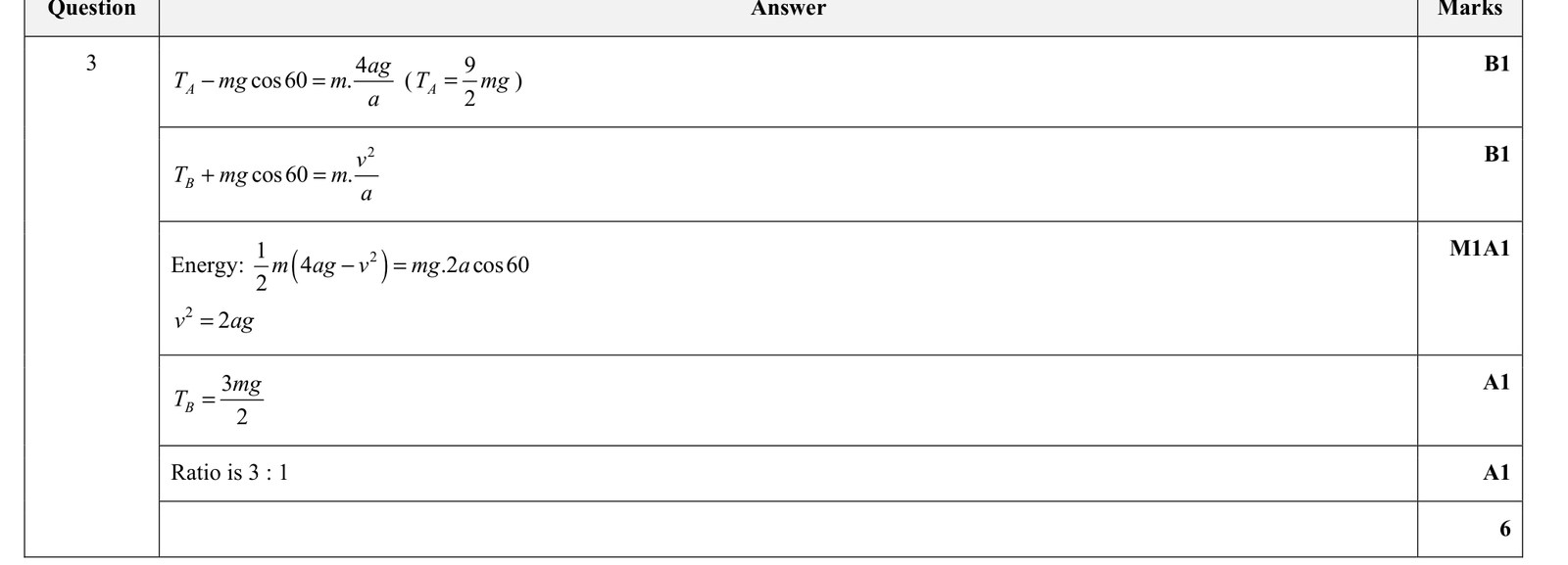
A particle \(Q\) of mass \(m\) is attached to a fixed point \(O\) by a light inextensible string of length \(a\). The particle moves in complete vertical circles about \(O\). The points \(A\) and \(B\) are on the path of \(Q\) with \(A B\) a diameter of the circle. \(O A\) makes an angle of \(60^{\circ}\) with the downward vertical through \(O\) and \(O B\) makes an angle of \(60^{\circ}\) with the upward vertical through \(O\). The speed of \(Q\) when it is at \(A\) is \(2 \sqrt{a g}\).
Given that \(T_{A}\) and \(T_{B}\) are the tensions in the string at \(A\) and \(B\) respectively, find the ratio \(T_{A}: T_{B}\).
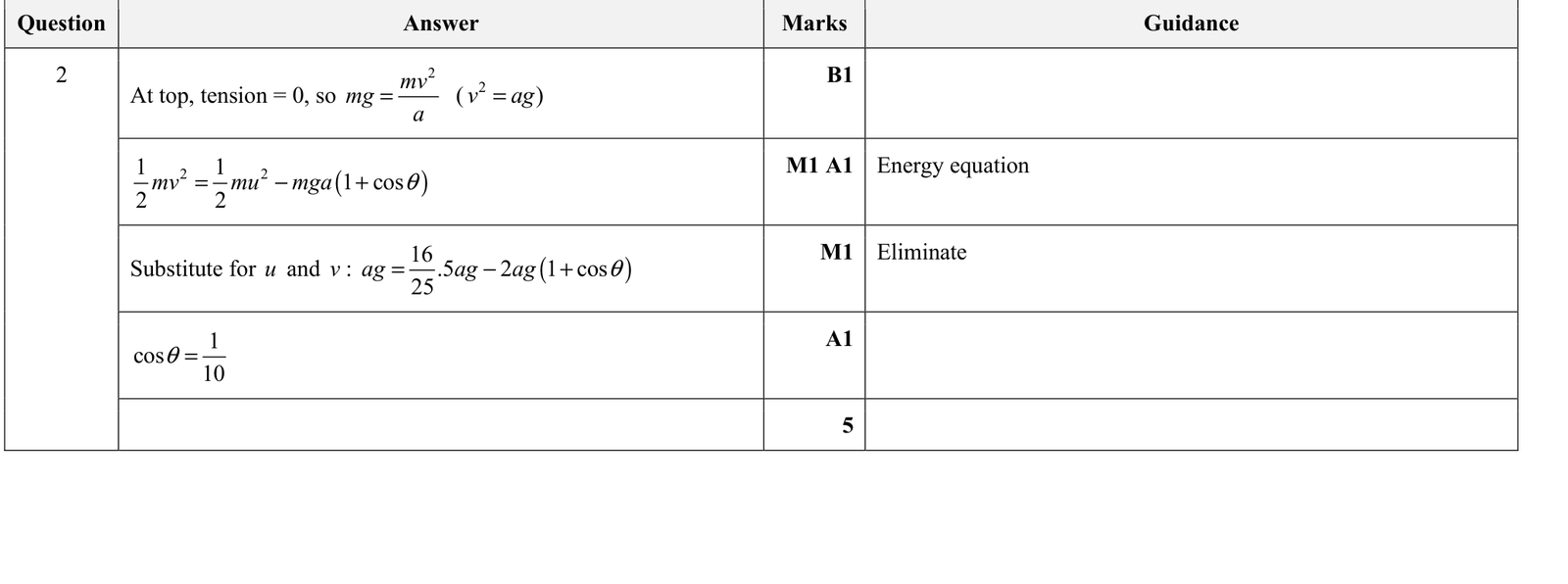
9231 P31 - Nov 2020 - Q2 - 5 marks
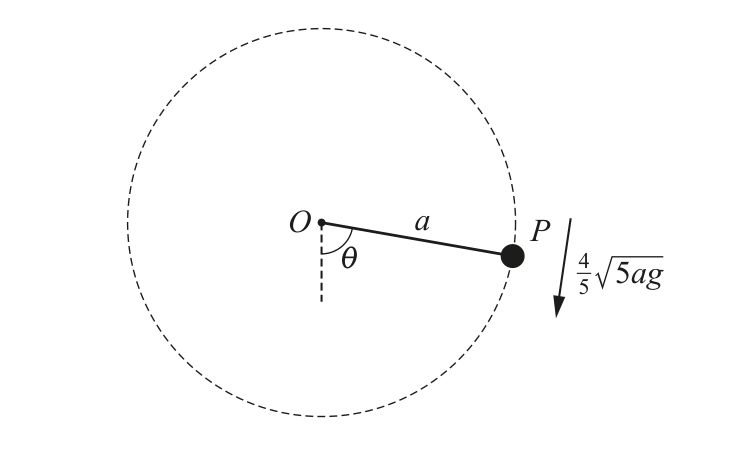
A particle \(P\) is attached to one end of a light inextensible string of length \(a\). The other end of the string is attached to a fixed point \(O\). The particle \(P\) is held with the string taut and making an angle \(\theta\) with the downward vertical. The particle \(P\) is then projected with speed \(\frac{4}{5} \sqrt{5 a g}\) perpendicular to the string and just completes a vertical circle (see diagram).
Find the value of \(\cos \theta\).
9231 P32 - Nov 2020 - Q1 - 5 marks
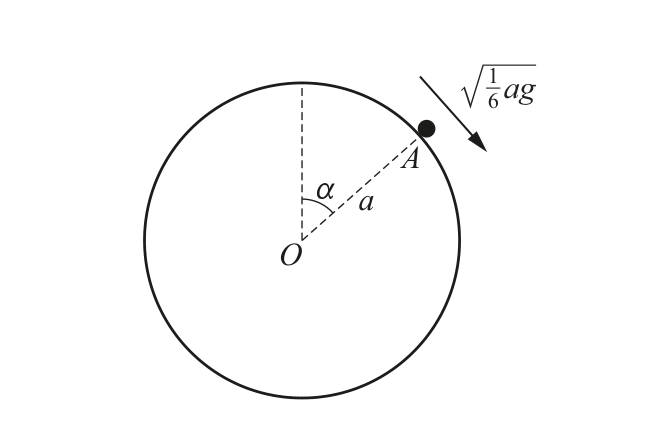
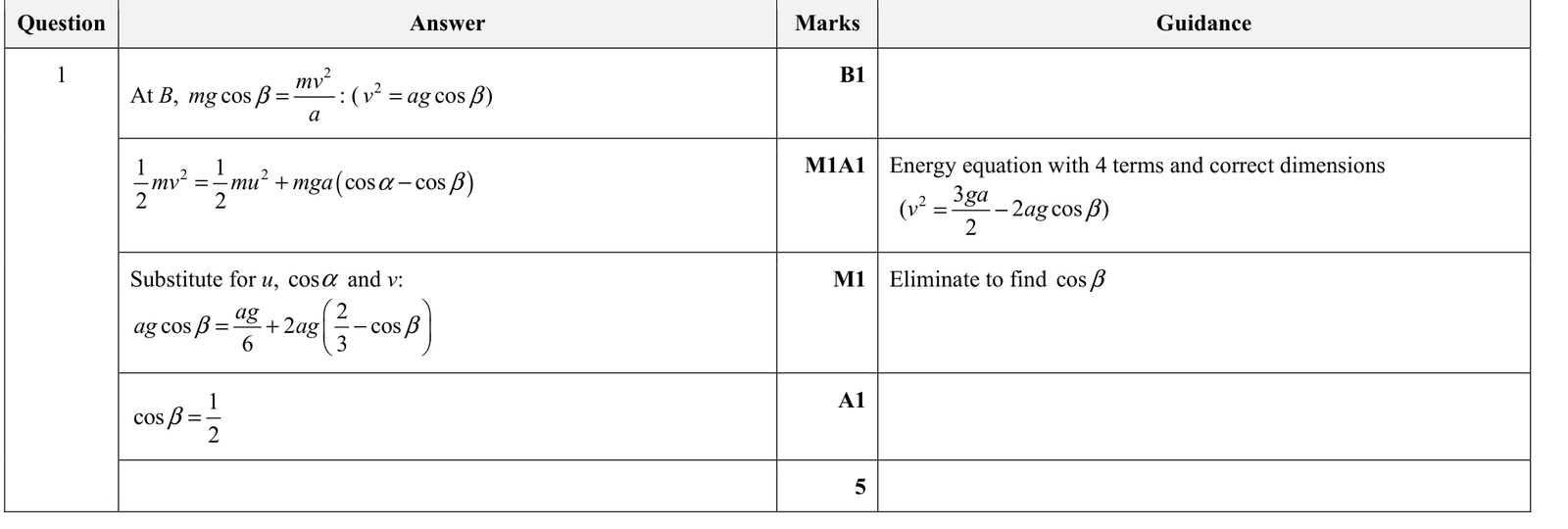
A fixed smooth solid sphere has centre \(O\) and radius \(a\). A particle of mass \(m\) is projected downwards with speed \(\sqrt{\frac{1}{6} a g}\) from the point \(A\) on the surface of the sphere, where \(O A\) makes an angle \(\alpha\) with the upward vertical through \(O\) (see diagram). The particle moves in part of a vertical circle on the surface of the sphere. It loses contact with the sphere at the point \(B\), where \(O B\) makes an angle \(\beta\) with the upward vertical through \(O\).
Given that \(\cos \alpha=\frac{2}{3}\), find the value of \(\cos \beta\).
0606 P12 - Nov 2025 - Q9 - 12 marks
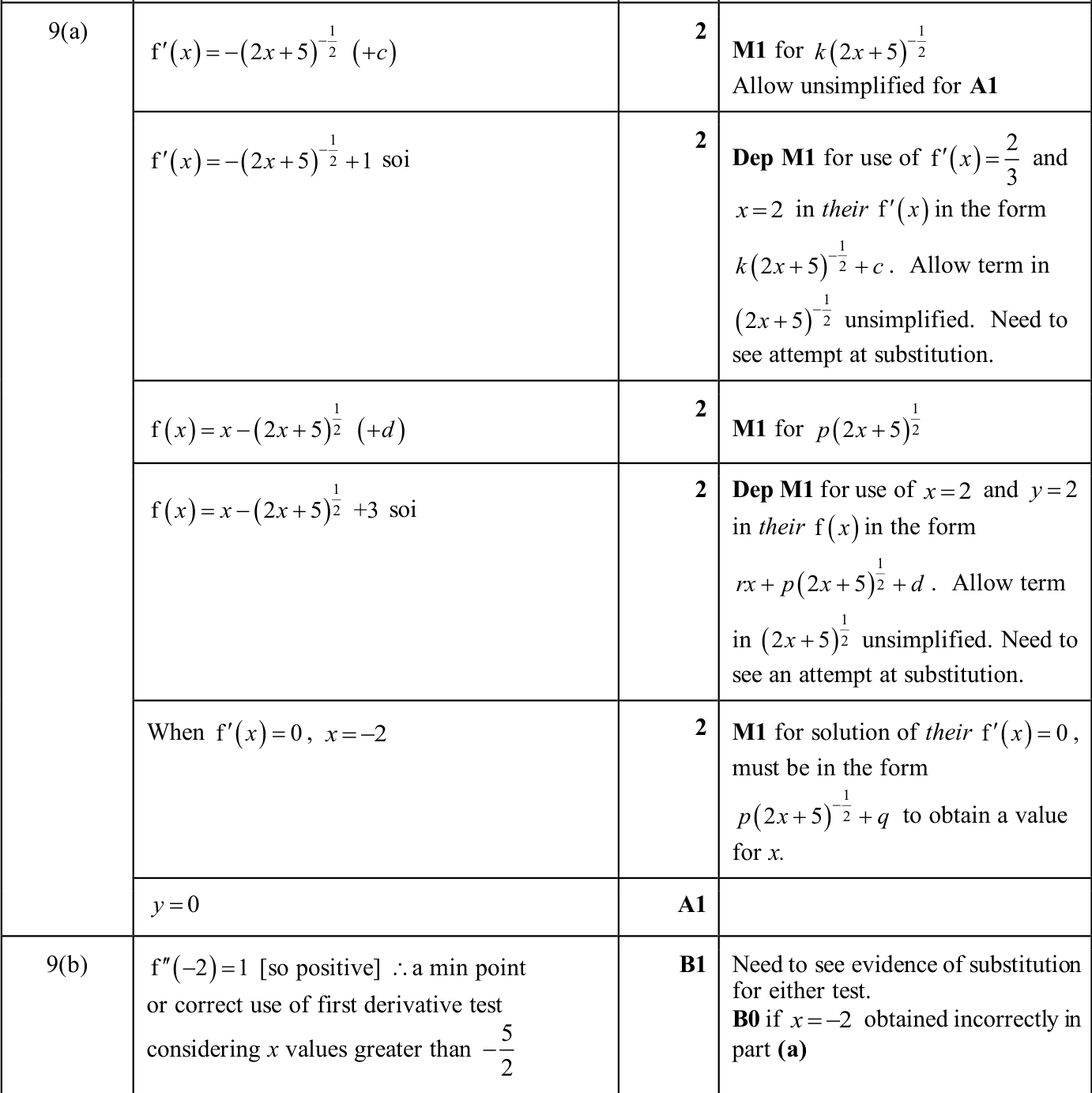
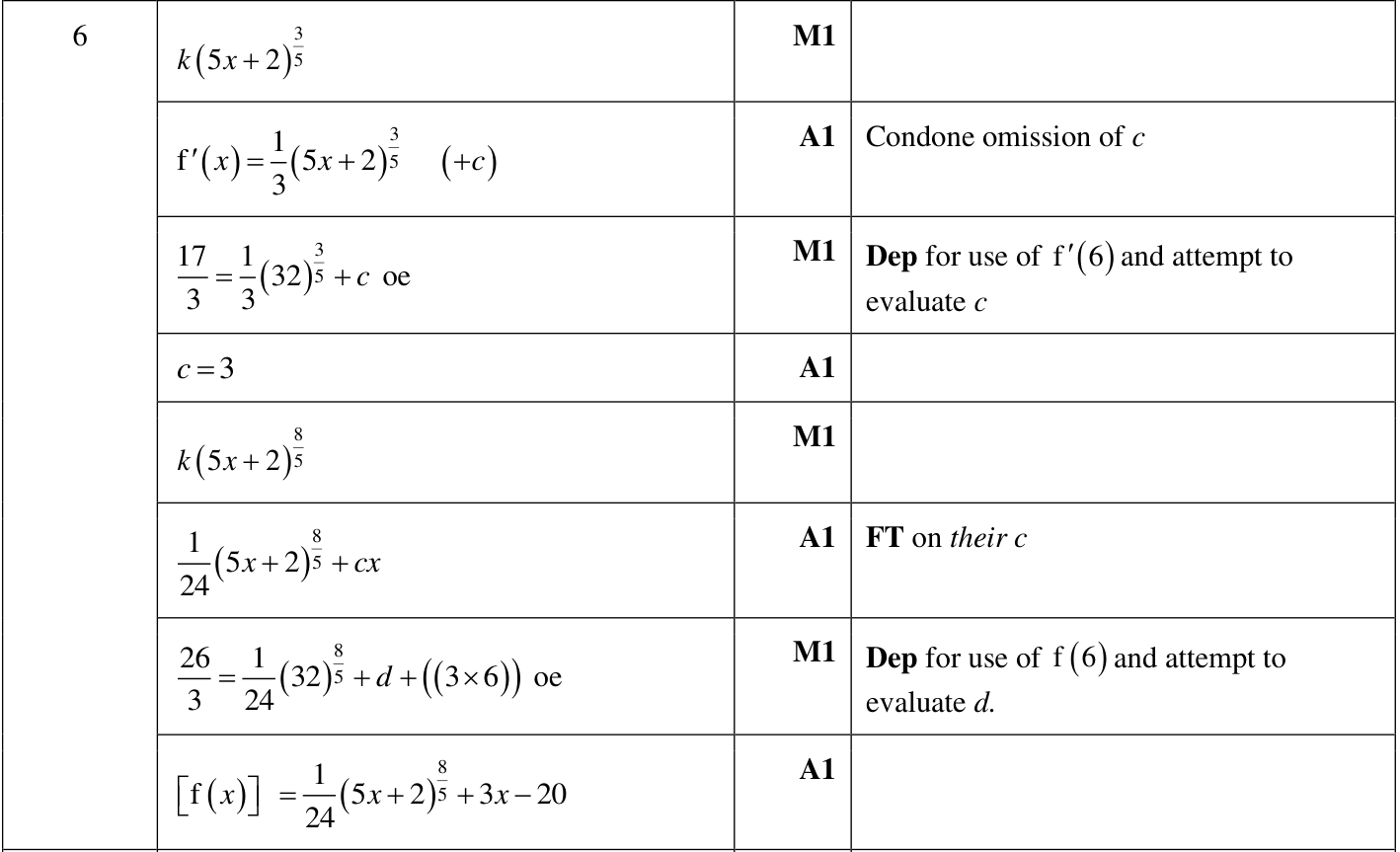
A curve \(y=\mathrm{f}(x)\) is such that \(\mathrm{f}''(x)=(2x+5)^{-\frac32}\). The curve has gradient \(\frac23\) at the point \((2,2)\).
(a) Find the coordinates of the stationary point on the curve.
(b) Determine the nature of this stationary point.
0606 P12 - Mar 2023 - Q6 - 8 marks
Given that
\(f''(x)=(5x+2)^{-2/5},\qquad f'(6)=\frac{17}{3}\)
and
\(f(6)=\frac{26}{3},\)
find an expression for \(f(x)\).
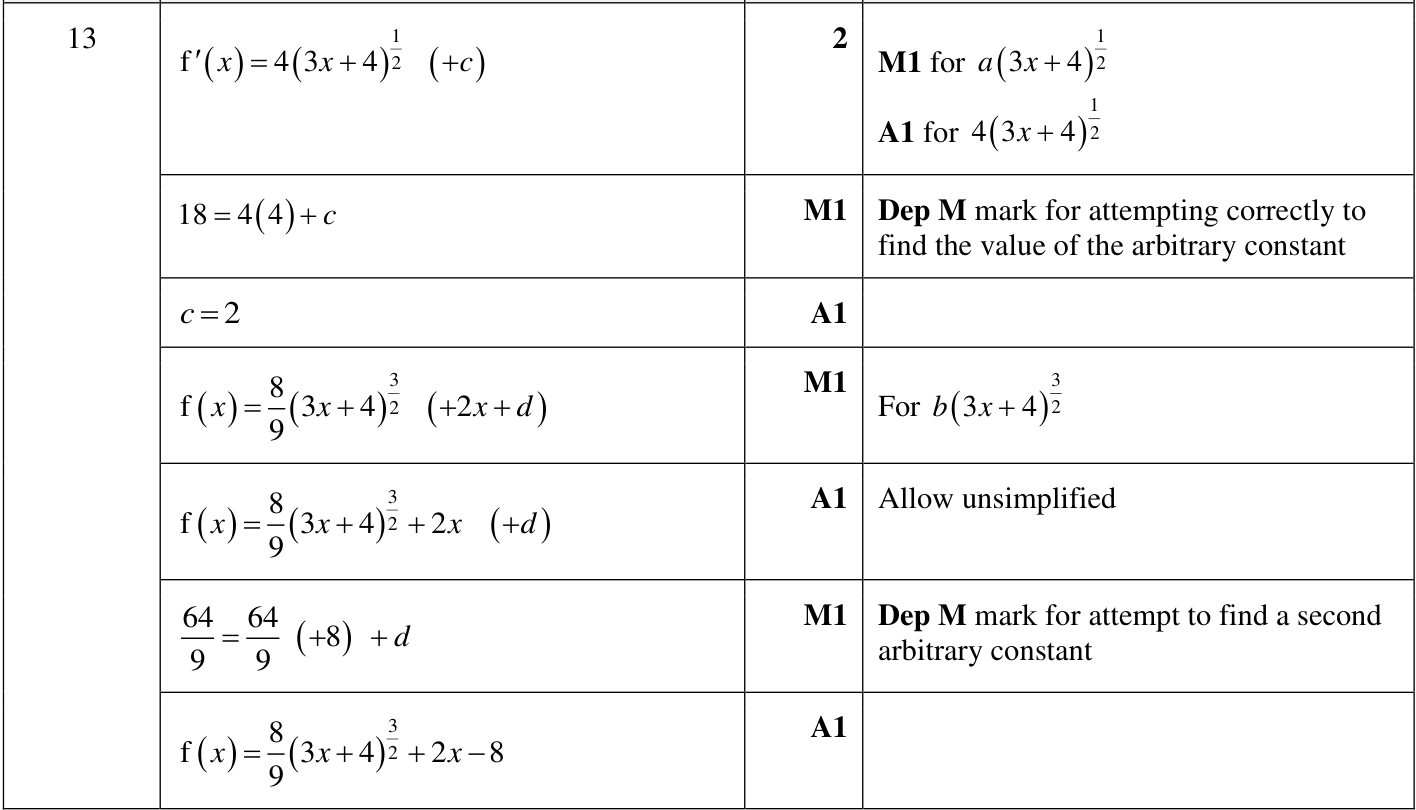
0606 P11 - Nov 2022 - Q13 - 8 marks
Given that
\(f''(x)=6(3x+4)^{-\frac12},\)
\(f'(4)=18\)
and
\(f(4)=\frac{512}{9},\)
find \(f(x)\).
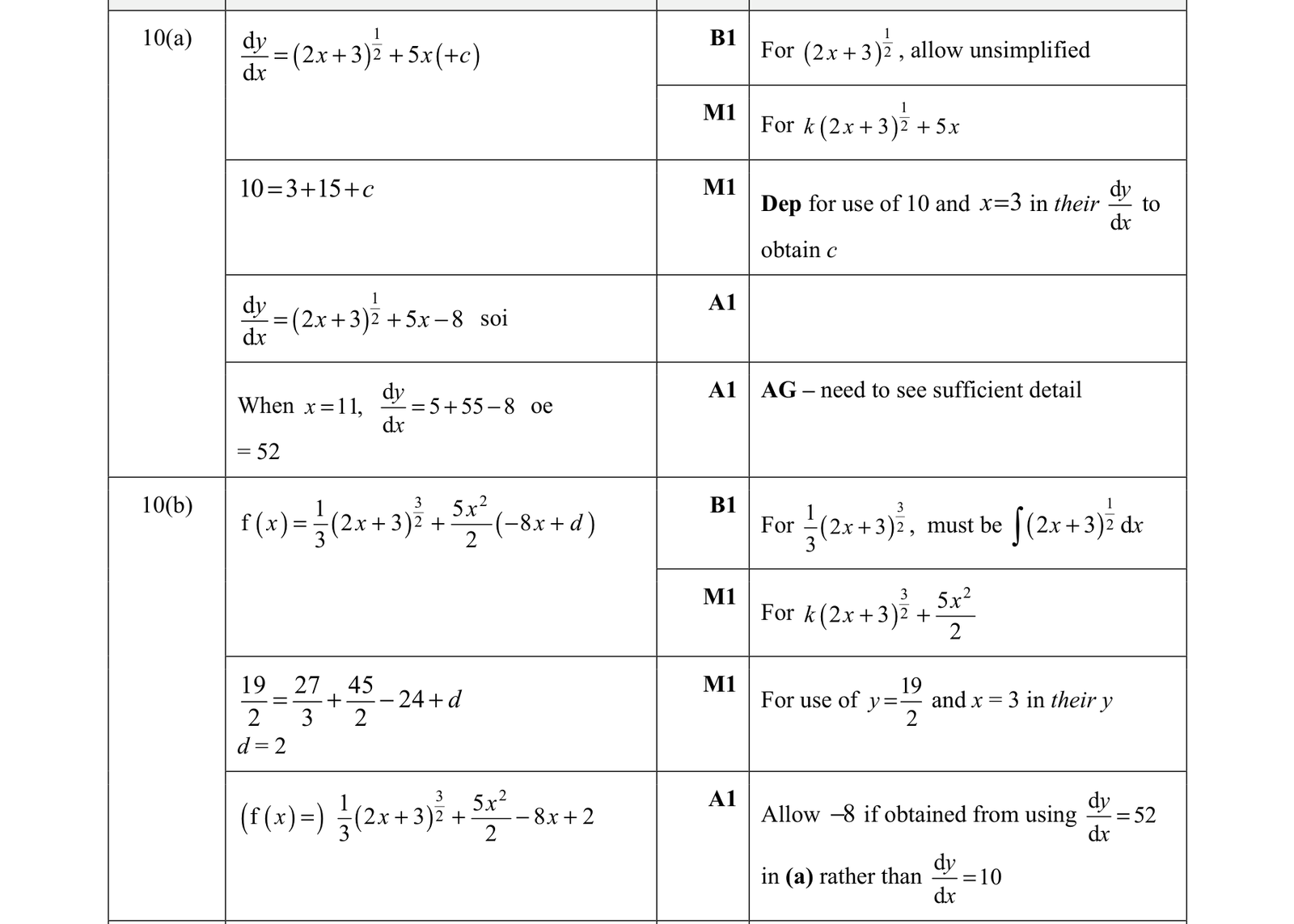
0606 P13 - Nov 2021 - Q10 - 9 marks
A curve with equation \(y=\mathrm f(x)\) is such that
\(\frac{d^2y}{dx^2}=(2x+3)^{-\frac12}+5\)
for \(x\gt 0\). The curve has gradient \(10\) at the point \(\left(3,\frac{19}{2}\right)\).
(a) Show that, when \(x=11\), \(\frac{dy}{dx}=52\).
(b) Find \(\mathrm f(x)\).
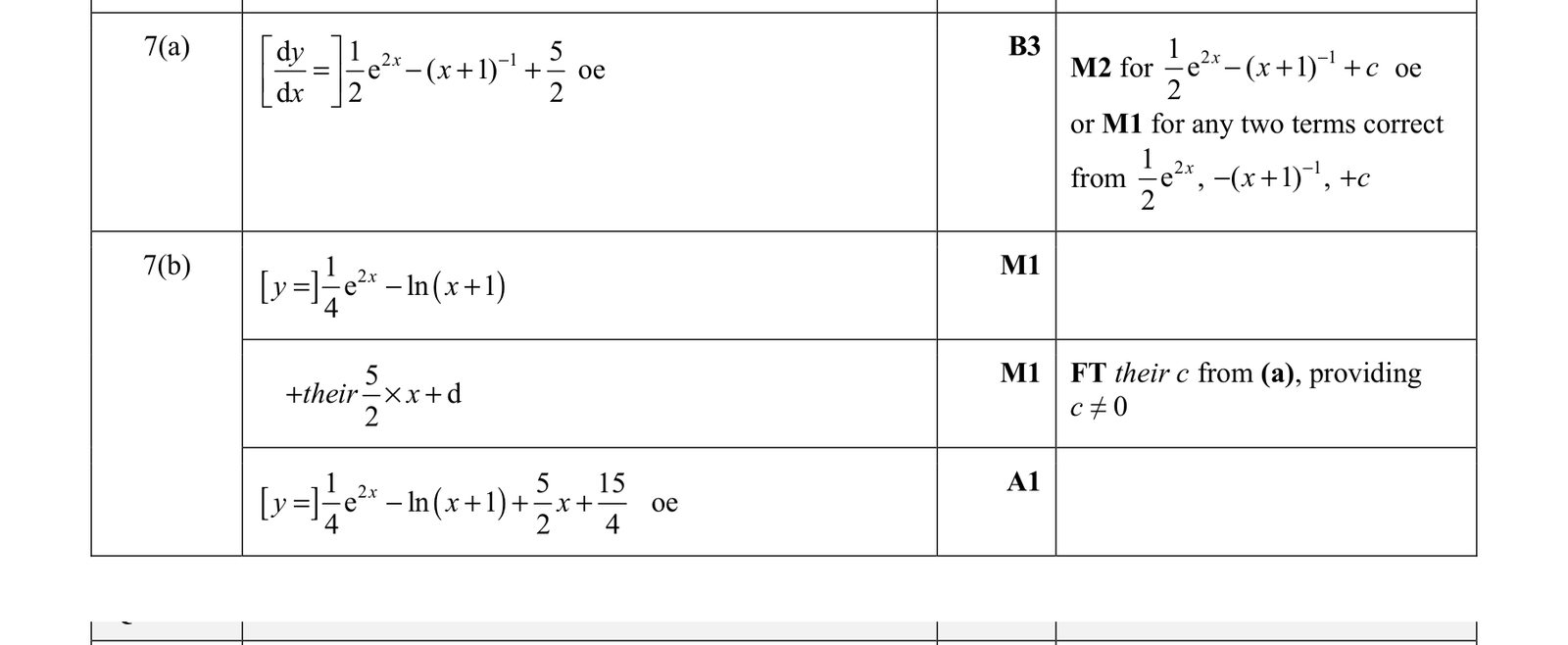
0606 P22 - Nov 2021 - Q7 - 6 marks
It is given that
\(\frac{d^2y}{dx^2}=e^{2x}+\frac1{(x+1)^2}\)
for \(x\gt -1\).
(a) Find an expression for \(\frac{dy}{dx}\), given that \(\frac{dy}{dx}=2\) when \(x=0\).
(b) Find an expression for \(y\), given that \(y=4\) when \(x=0\).
0606 P11 - Jun 2020 - Q11 - 8 marks
A curve is such that
\(\frac{d^2y}{dx^2}=5\cos2x.\)
This curve has a gradient of \(\frac34\) at the point \(\left(-\frac{\pi}{12},\frac{5\pi}{4}\right)\). Find the equation of this curve.

0606 P11 - Nov 2019 - Q12 - 8 marks
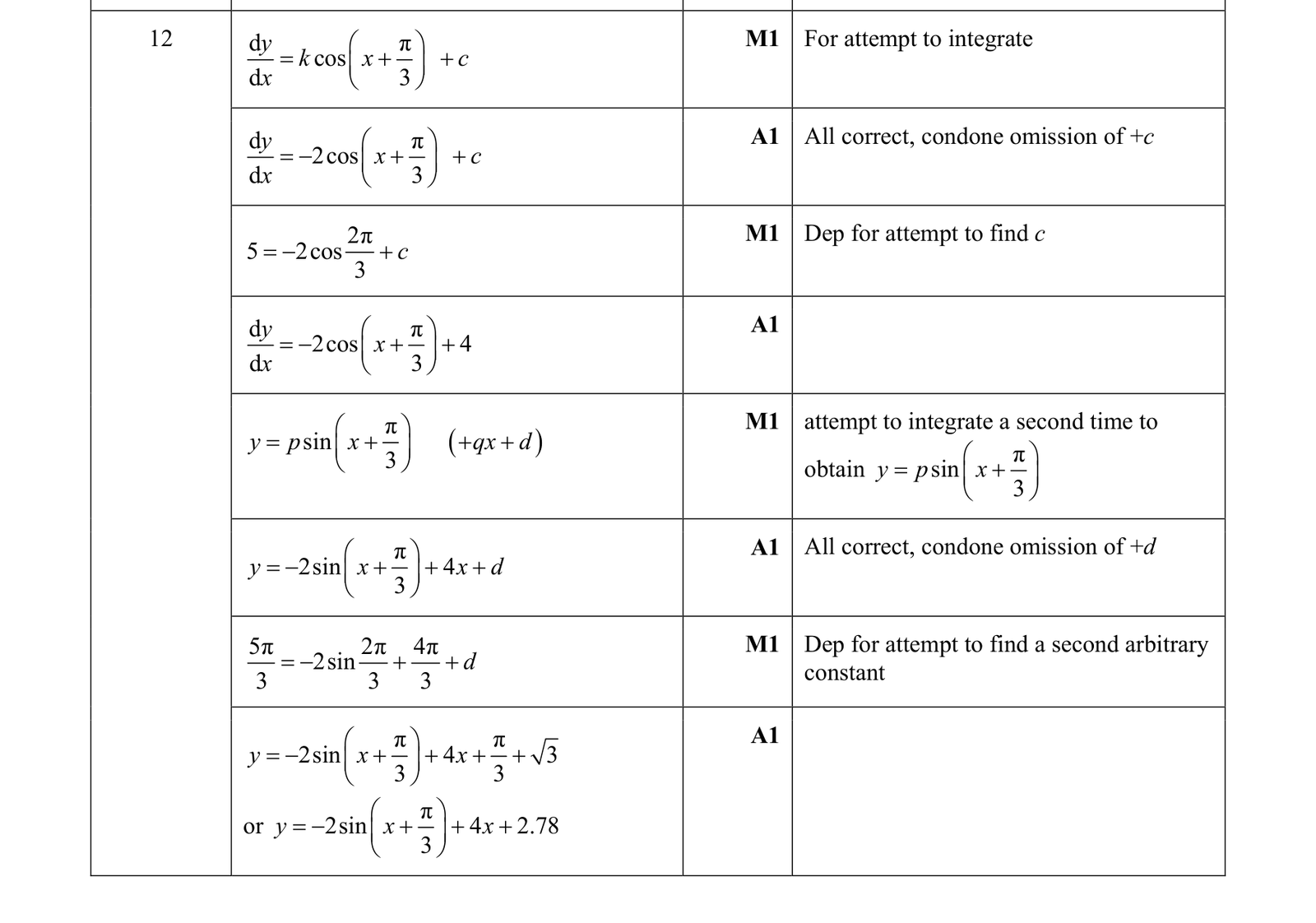
A curve is such that
\(\frac{d^2y}{dx^2}=2\sin\left(x+\frac{\pi}{3}\right).\)
Given that the curve has a gradient of \(5\) at the point \(\left(\frac{\pi}{3},\frac{5\pi}{3}\right)\), find the equation of the curve.
0606 P12 - Nov 2019 - Q11 - 8 marks
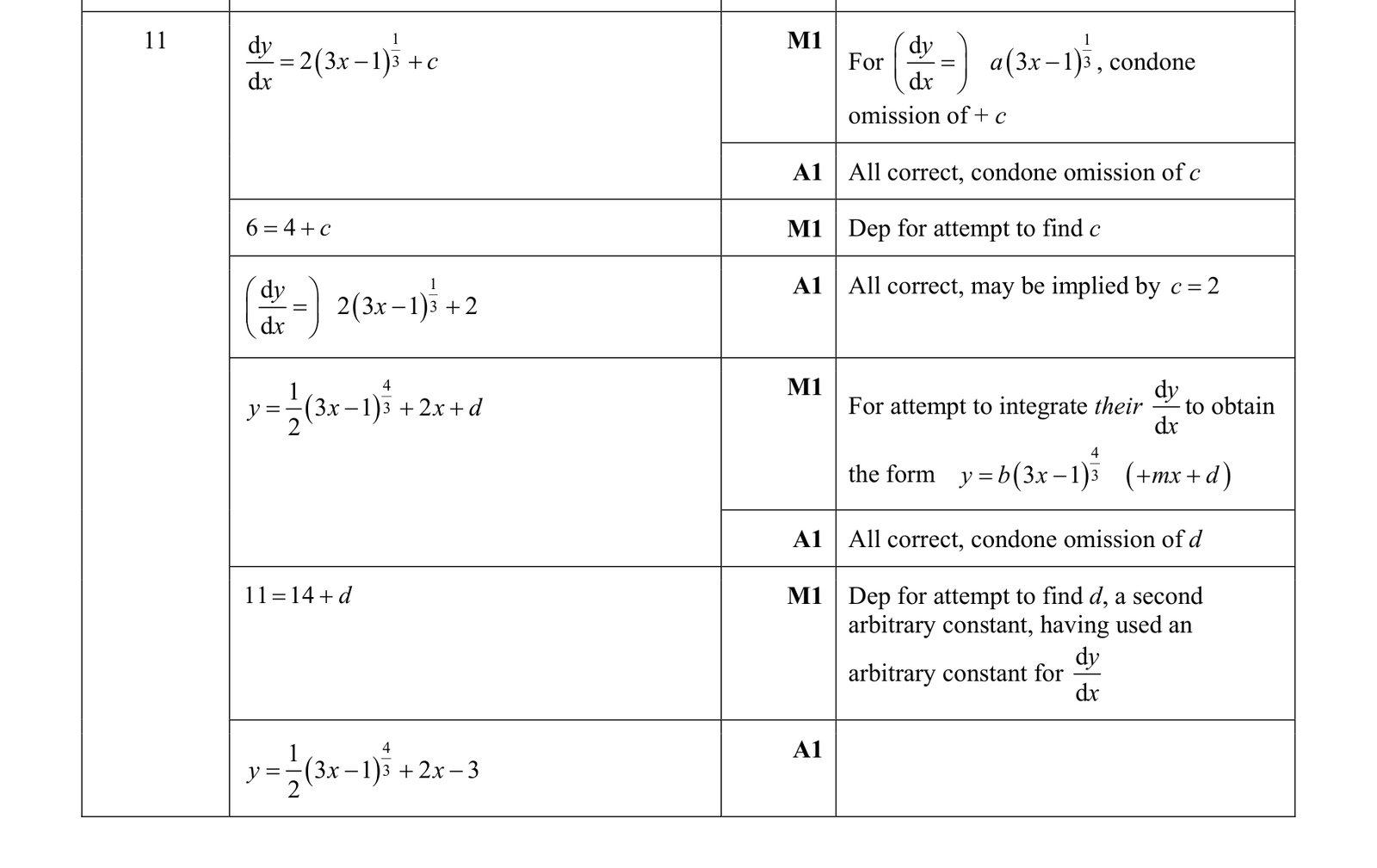
A curve is such that
\(\frac{d^2y}{dx^2}=2(3x-1)^{-\frac23}.\)
Given that the curve has a gradient of \(6\) at the point \((3,11)\), find the equation of the curve.
0606 P11 - Jun 2018 - Q12 - 8 marks
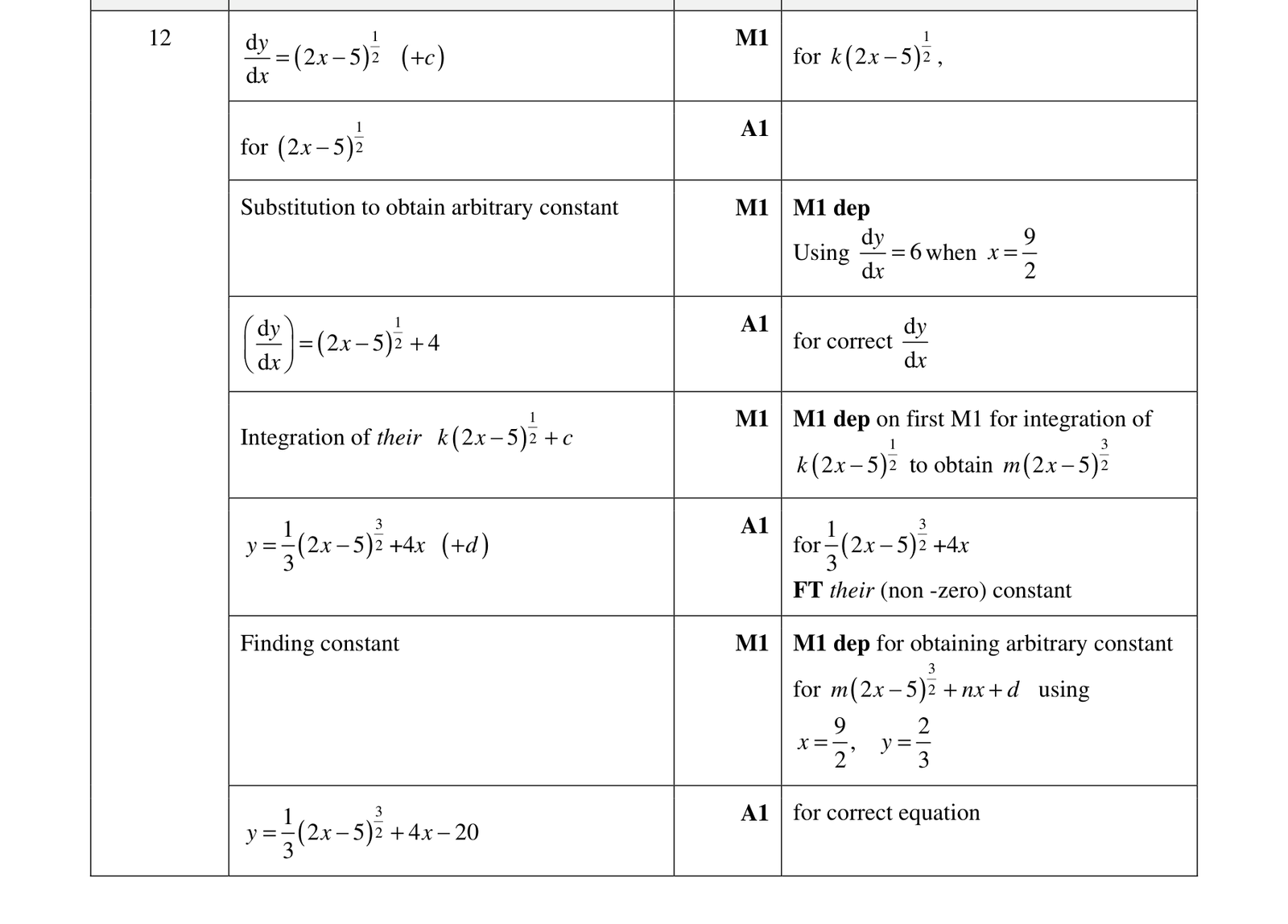
A curve is such that
\(\frac{d^2y}{dx^2}=(2x-5)^{-1/2}.\)
Given that the curve has a gradient of \(6\) at the point \(\left(\dfrac92,\dfrac23\right)\), find the equation of the curve.
0606 P13 - Jun 2018 - Q12 - 8 marks
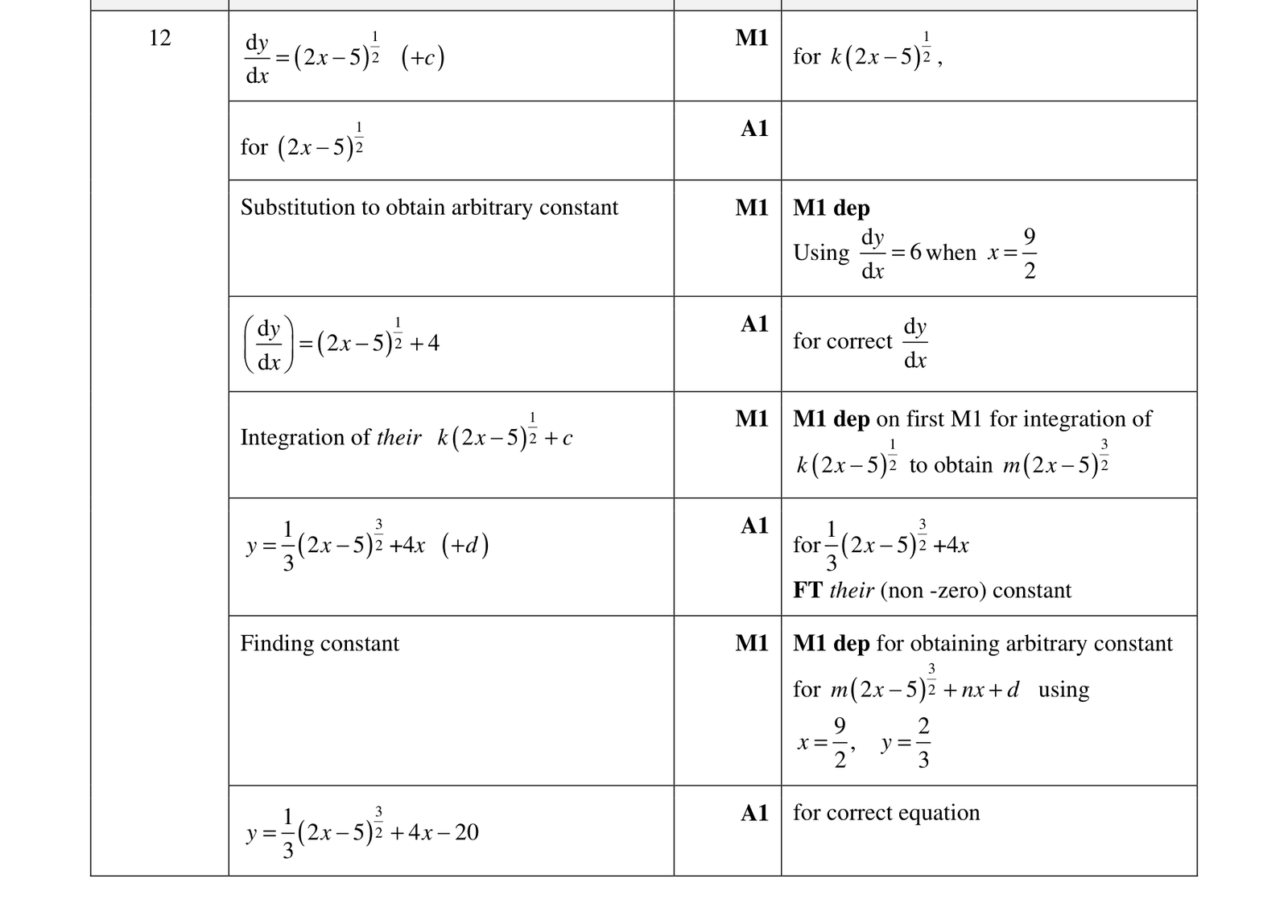
A curve is such that
\(\frac{d^2y}{dx^2}=(2x-5)^{-1/2}.\)
Given that the curve has a gradient of \(6\) at the point \(\left(\dfrac92,\dfrac23\right)\), find the equation of the curve.
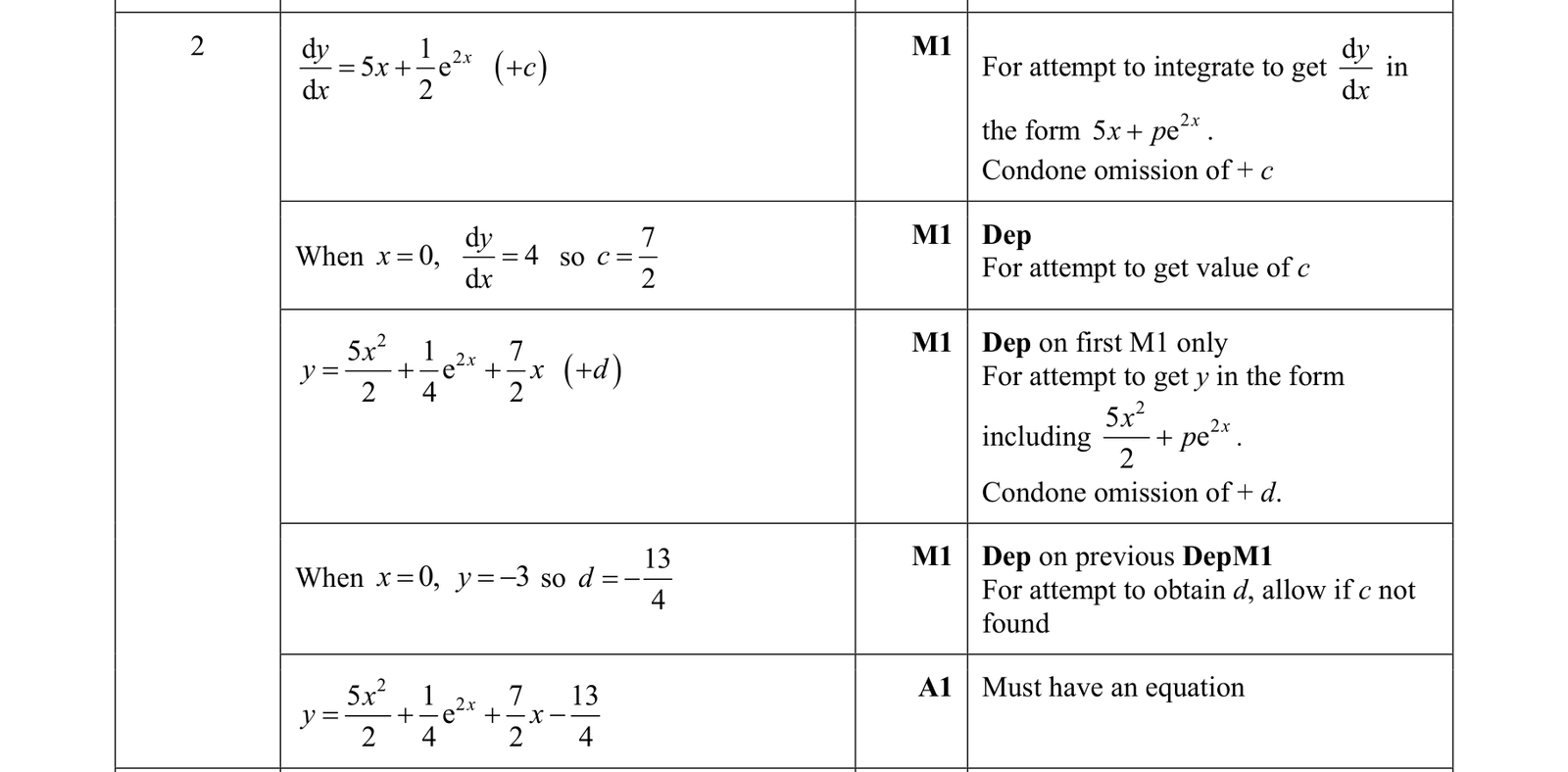
0606 P12 - Nov 2018 - Q2 - 5 marks
Find the equation of the curve which has a gradient of \(4\) at the point \((0,-3)\) and is such that
\(\frac{d^2y}{dx^2}=5+e^{2x}.\)
0606 P23 - Nov 2018 - Q4 - 6 marks
\(\frac{d^2y}{dx^2}=2x+\frac{3}{(x+1)^4}.\)
(i) Find \(\dfrac{dy}{dx}\), given that \(\dfrac{dy}{dx}=1\) when \(x=1\).
(ii) Find \(y\) in terms of \(x\), given that \(y=3\) when \(x=1\).