Past Exam Questions
← Back9231 P12 - Nov 2025 - Q6 - 14 marks
(a) The plane \(\Pi\) has equation \(x+3y+2z=1\). Find the perpendicular distance from the origin \(O\) to \(\Pi\).
(b) Relative to \(O\), points \(A,B,C\) have position vectors \(-\mathbf j+2\mathbf k\), \(2\mathbf i-\mathbf k\), and \(2\mathbf i-\mathbf j-\mathbf k\). Find the acute angle between the planes \(OAB\) and \(\Pi\).
(c) Find an equation for the common perpendicular to the lines \(OC\) and \(AB\).
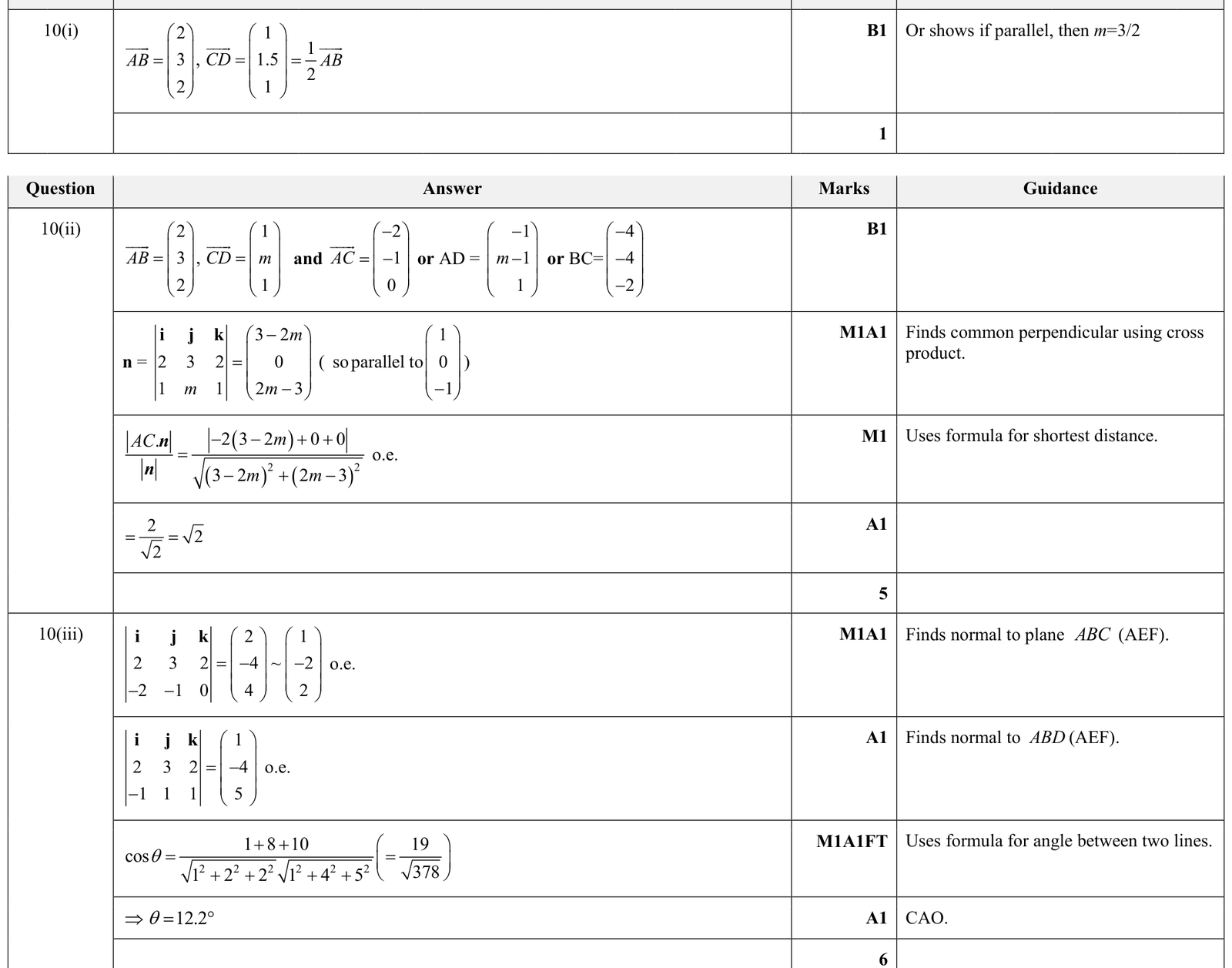
9231 P12 - Nov 2018 - Q10 - 12 marks
The position vectors of the points \(A, B, C, D\) are
\(\mathbf{i}+\mathbf{j}+3 \mathbf{k}, \quad 3 \mathbf{i}+4 \mathbf{j}+5 \mathbf{k}, \quad-\mathbf{i}+3 \mathbf{k}, \quad m \mathbf{j}+4 \mathbf{k},\)
respectively, where \(m\) is a constant.
(i) Show that the lines \(A B\) and \(C D\) are parallel when \(m=\frac{3}{2}\).
(ii) Given that \(m \neq \frac{3}{2}\), find the shortest distance between the lines \(A B\) and \(C D\).
(iii) When \(m=2\), find the acute angle between the planes \(A B C\) and \(A B D\), giving your answer in degrees.
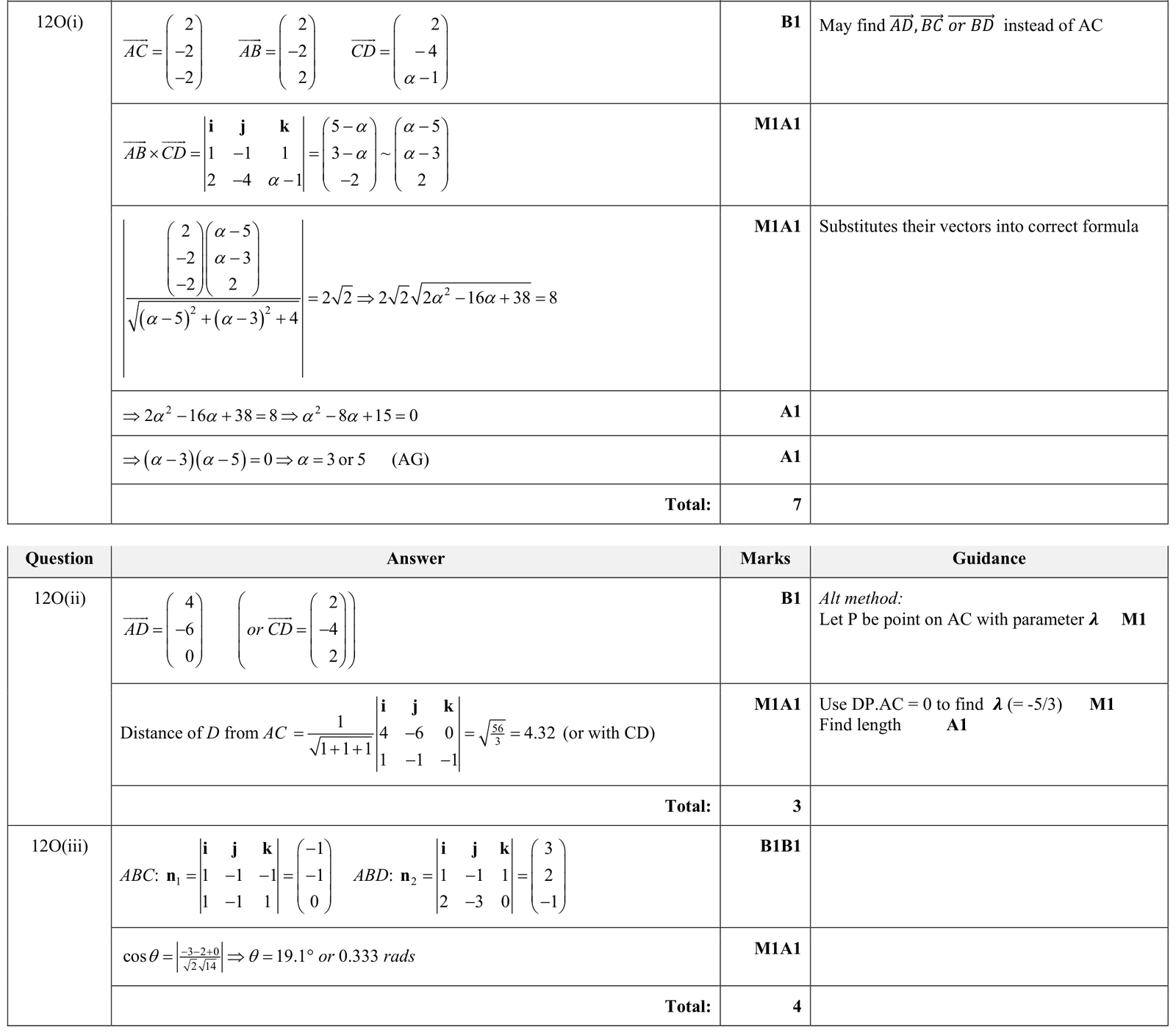
9231 P11 - Jun 2017 - Q12O - 14 marks
The position vectors of the points \(A\), \(B\), \(C\), \(D\) are \(\mathbf{i}+\mathbf{j}+3\mathbf{k}\), \(3\mathbf{i}-\mathbf{j}+5\mathbf{k}\), \(3\mathbf{i}-\mathbf{j}+\mathbf{k}\), and \(5\mathbf{i}-5\mathbf{j}+\alpha\mathbf{k}\), respectively, where \(\alpha\) is a positive integer.
It is given that the shortest distance between the line \(AB\) and the line \(CD\) is equal to \(2\sqrt2\).
(i) Show that the possible values of \(\alpha\) are \(3\) and \(5\).
(ii) Using \(\alpha=3\), find the shortest distance of the point \(D\) from the line \(AC\), giving your answer correct to 3 significant figures.
(iii) Using \(\alpha=3\), find the acute angle between the planes \(ABC\) and \(ABD\), giving your answer correct to 3 significant figures.
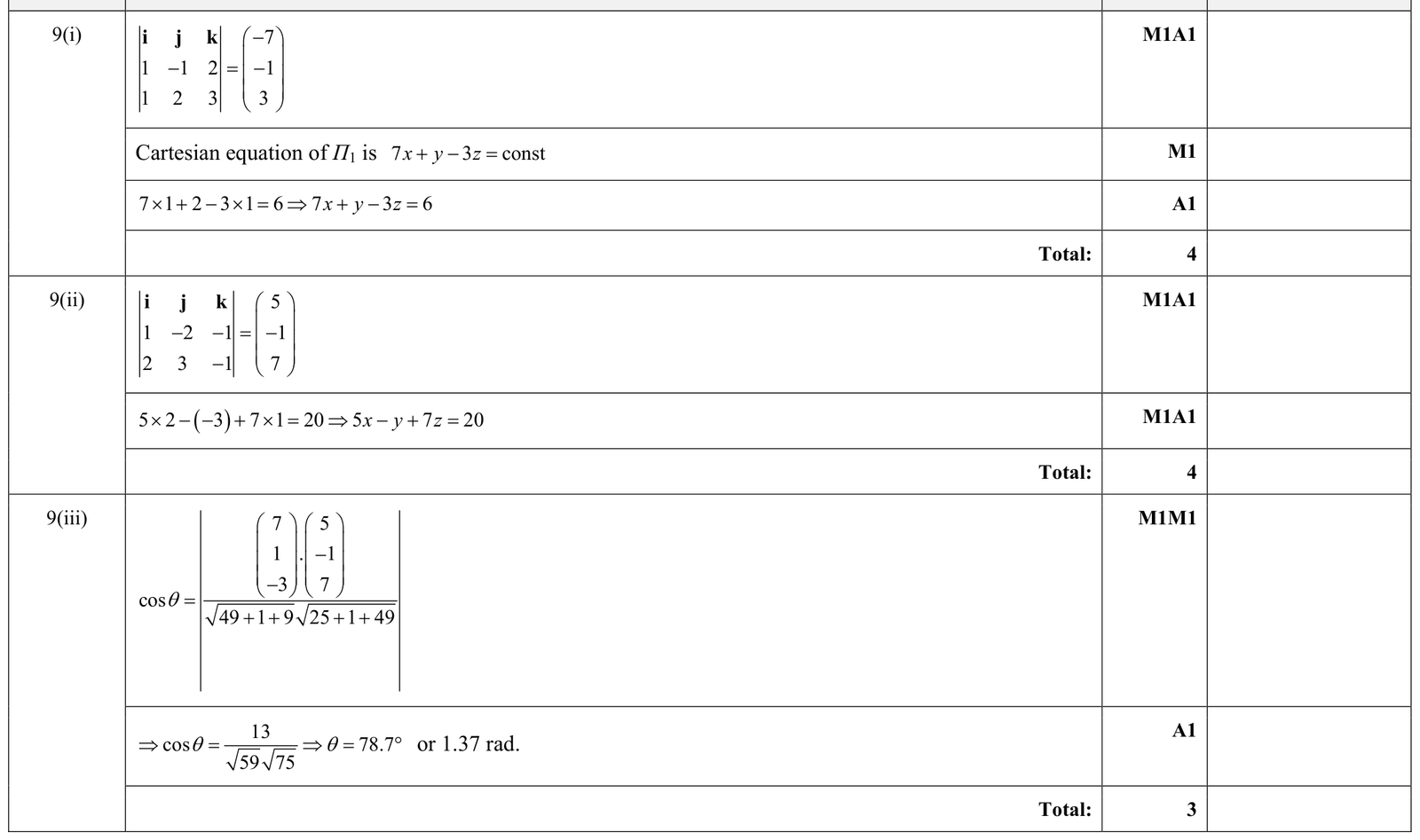
9231 P13 - Jun 2017 - Q9 - 11 marks
The plane \(\Pi_{1}\) passes through the points \((1,2,1)\) and \((5,-2,9)\) and is parallel to the vector \(\mathbf{i}+2 \mathbf{j}+3 \mathbf{k}\).
(i) Find the cartesian equation of \(\Pi_{1}\).
The plane \(\Pi_{2}\) contains the lines
\(\mathbf{r}=2 \mathbf{i}-3 \mathbf{j}+\mathbf{k}+\lambda(\mathbf{i}-2 \mathbf{j}-\mathbf{k}) \quad \text { and } \quad \mathbf{r}=2 \mathbf{i}-3 \mathbf{j}+\mathbf{k}+\mu(2 \mathbf{i}+3 \mathbf{j}-\mathbf{k}) .\)
(ii) Find the cartesian equation of \(\Pi_{2}\).
(iii) Find the acute angle between \(\Pi_{1}\) and \(\Pi_{2}\).
9231 P13 - Jun 2014 - Q11O - 14 marks
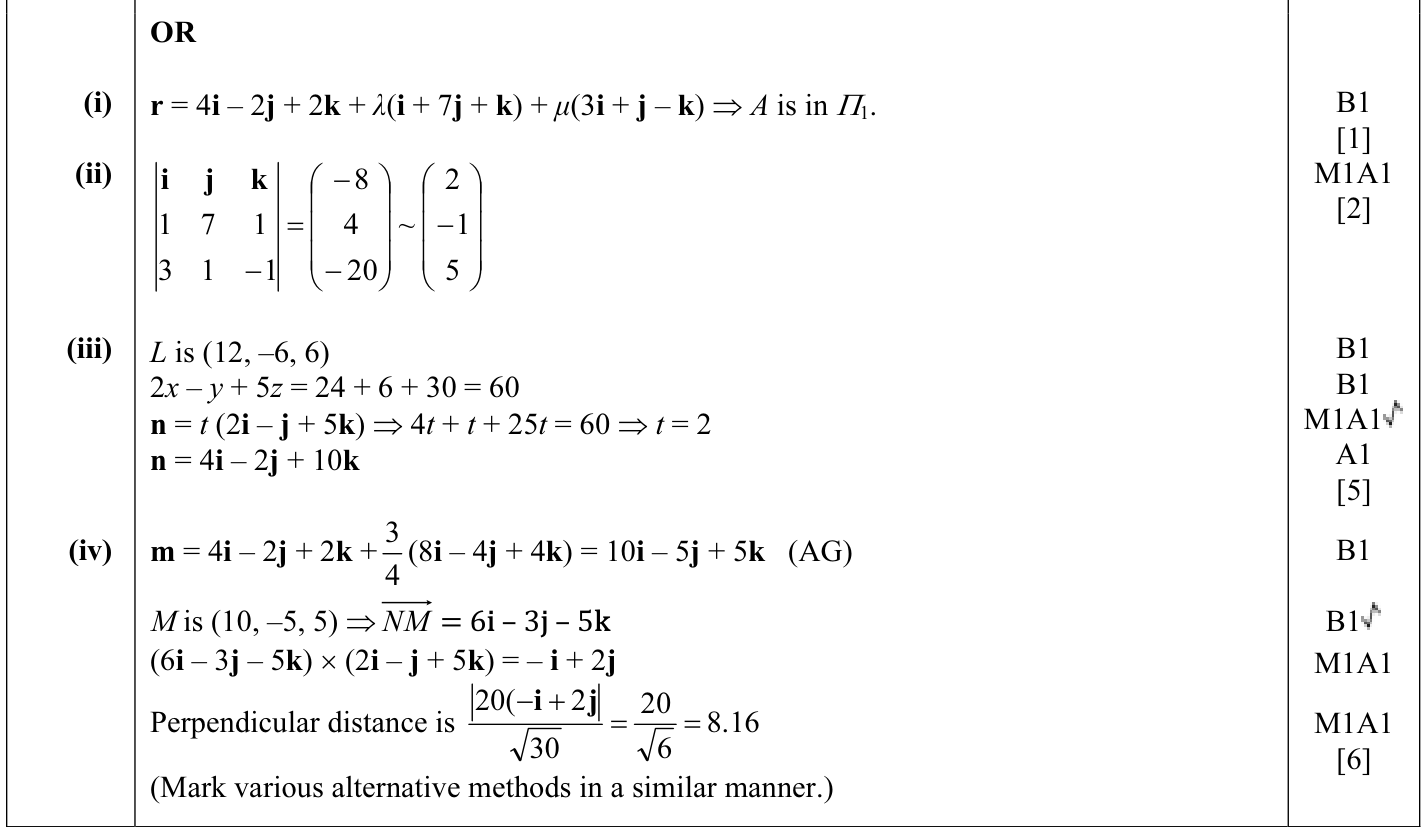
With respect to an origin \(O\), the point \(A\) has position vector \(4\mathbf{i}-2\mathbf{j}+2\mathbf{k}\) and the plane \(\Pi_1\) has equation
\(\mathbf{r}=(4+\lambda+3\mu)\mathbf{i}+(-2+7\lambda+\mu)\mathbf{j}+(2+\lambda-\mu)\mathbf{k},\)
where \(\lambda\) and \(\mu\) are real. The point \(L\) is such that \(\overrightarrow{OL}=3\overrightarrow{OA}\), and \(\Pi_2\) is the plane through \(L\) which is parallel to \(\Pi_1\). The point \(M\) is such that \(\overrightarrow{AM}=3\overrightarrow{ML}\).
(i) Show that \(A\) is in \(\Pi_1\).
(ii) Find a vector perpendicular to \(\Pi_2\).
(iii) Find the position vector of the point \(N\) in \(\Pi_2\) such that \(ON\) is perpendicular to \(\Pi_2\).
(iv) Show that the position vector of \(M\) is \(10\mathbf{i}-5\mathbf{j}+5\mathbf{k}\), and find the perpendicular distance of \(M\) from the line through \(O\) and \(N\), giving your answer correct to 3 significant figures.
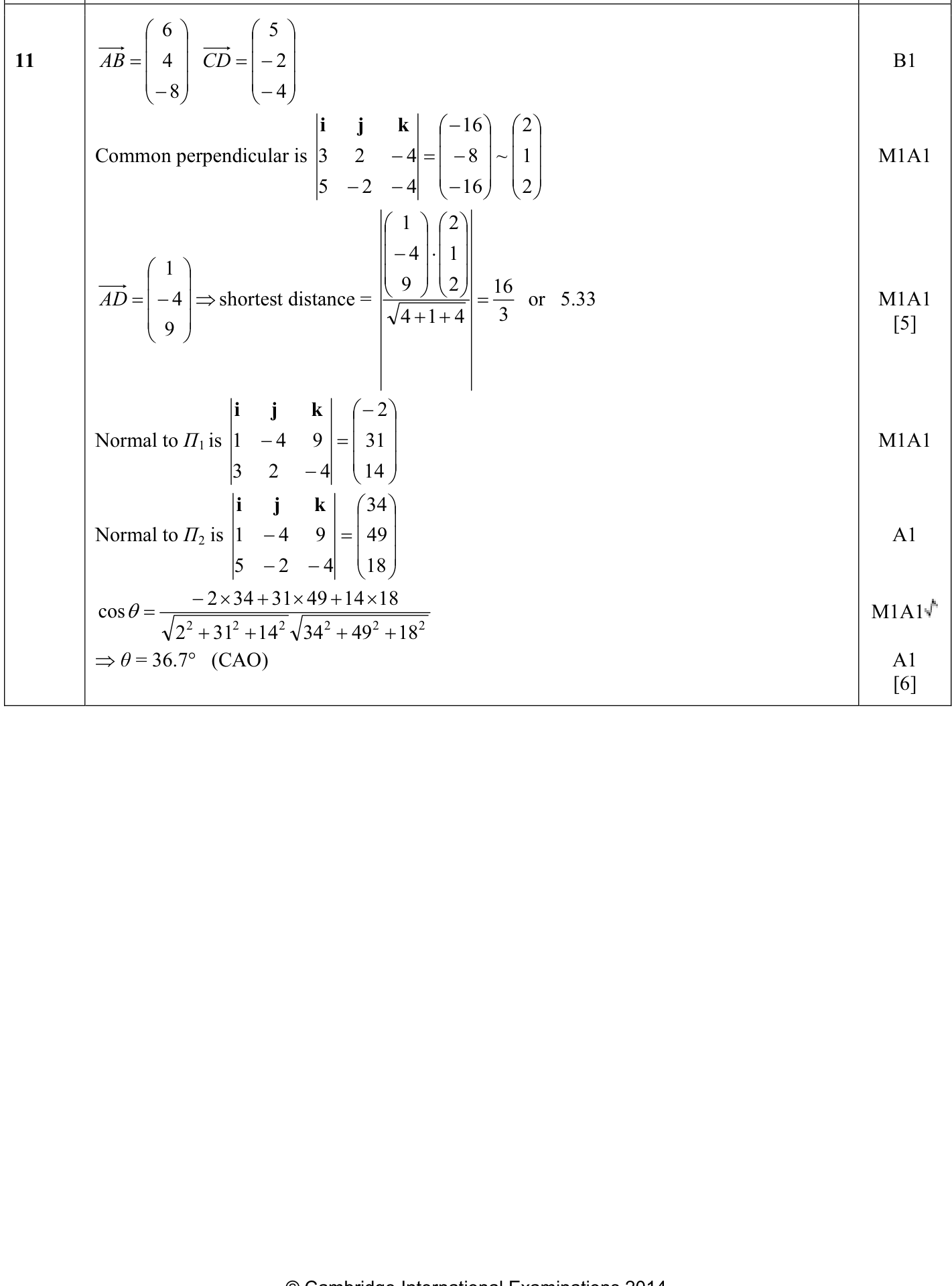
9231 P11 - Jun 2014 - Q11 - 11 marks
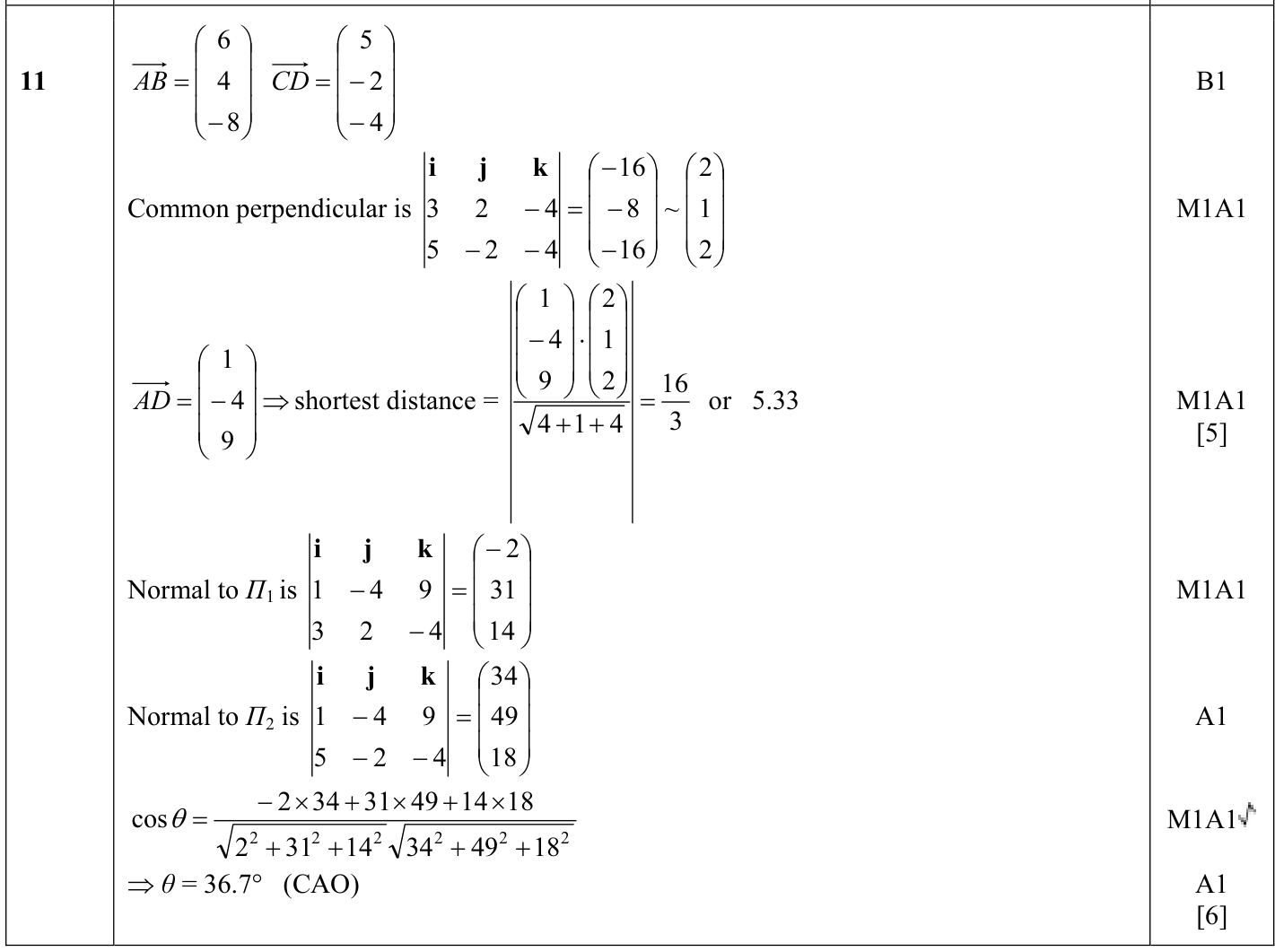
The line \(l_{1}\) passes through the points \(A(2,3,-5)\) and \(B(8,7,-13)\). The line \(l_{2}\) passes through the points \(C(-2,1,8)\) and \(D(3,-1,4)\). Find the shortest distance between the lines \(l_{1}\) and \(l_{2}\).
The plane \(\Pi_{1}\) passes through the points \(A, B\) and \(D\). The plane \(\Pi_{2}\) passes though the points \(A, C\) and \(D\). Find the acute angle between \(\Pi_{1}\) and \(\Pi_{2}\), giving your answer in degrees.
9231 P11 - Nov 2015 - Q11E - 14 marks
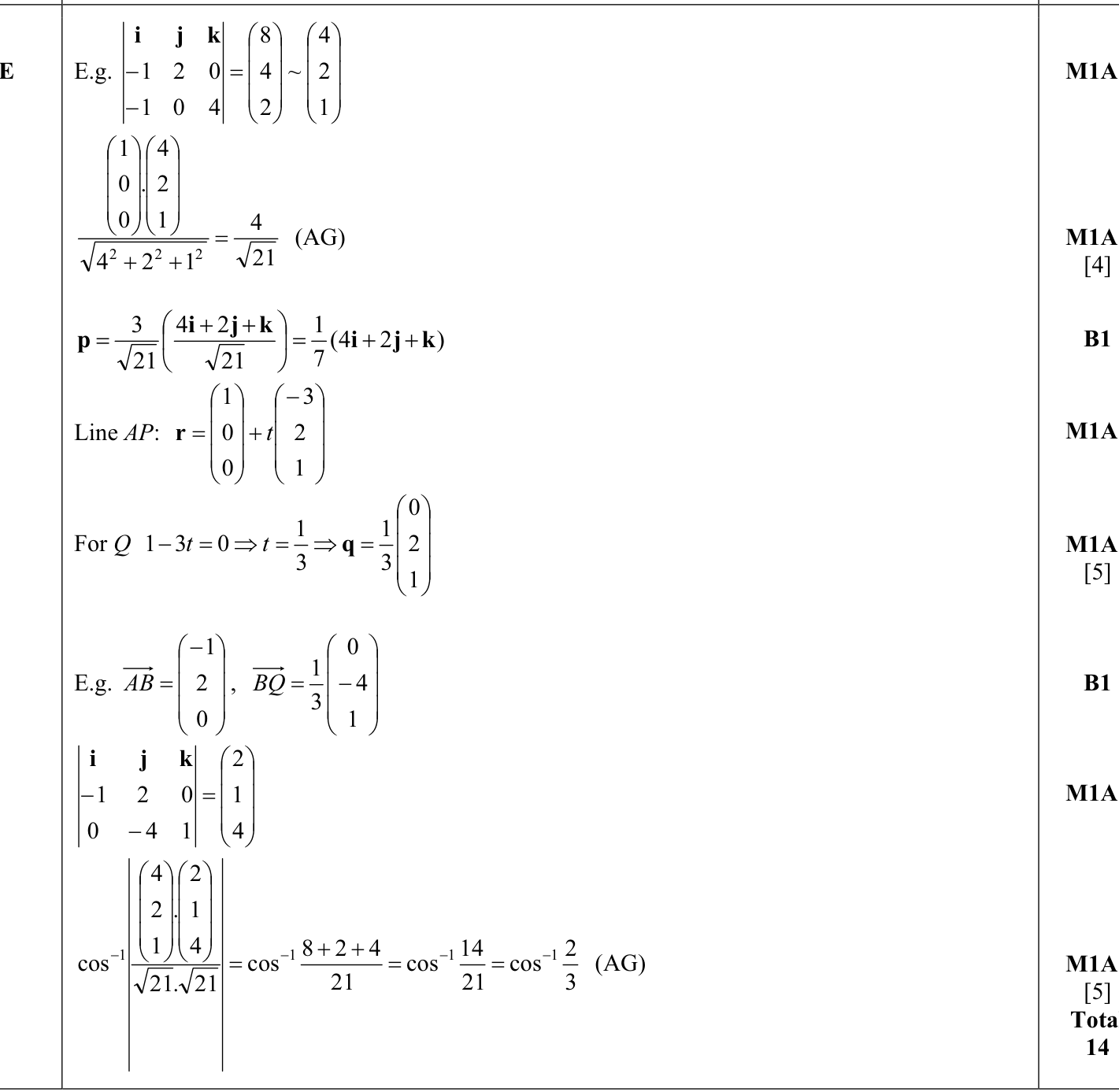
The points \(A\), \(B\) and \(C\) have position vectors \(\mathbf{i}\), \(2\mathbf{j}\) and \(4\mathbf{k}\) respectively, relative to an origin \(O\). The point \(N\) is the foot of the perpendicular from \(O\) to the plane \(ABC\). The point \(P\) on the line segment \(ON\) is such that \(OP=\frac{3}{4}ON\). The line \(AP\) meets the plane \(OBC\) at \(Q\).
Find a vector perpendicular to the plane \(ABC\), and show that the length of \(ON\) is \(\frac{4}{\sqrt{21}}\).
Find the position vector of \(Q\).
Show that the acute angle between the planes \(ABC\) and \(ABQ\) is \(\cos^{-1}\left(\frac{2}{3}\right)\).
9231 P13 - Jun 2015 - Q8 - 10 marks
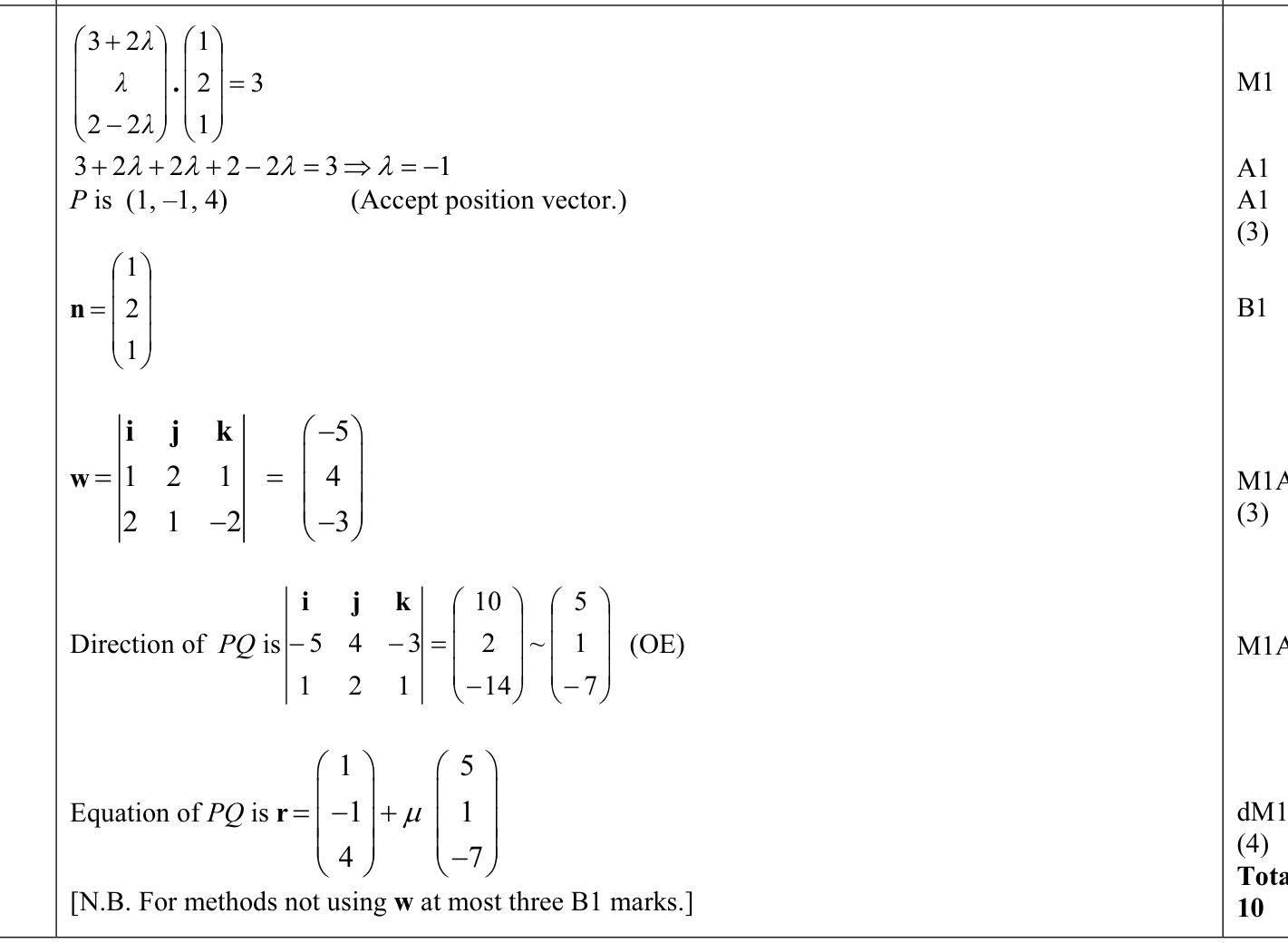
A line, passing through the point \(A(3,0,2)\), has vector equation \(\mathbf{r}=3 \mathbf{i}+2 \mathbf{k}+\lambda(2 \mathbf{i}+\mathbf{j}-2 \mathbf{k})\). It meets the plane \(\Pi\), which has equation \(\mathbf{r} \cdot(\mathbf{i}+2 \mathbf{j}+\mathbf{k})=3\), at the point \(P\). Find the coordinates of \(P\).
Write down a vector \(\mathbf{n}\) which is perpendicular to \(\Pi\), and calculate the vector \(\mathbf{w}\), where
\(\mathbf{w}=\mathbf{n} \times(2 \mathbf{i}+\mathbf{j}-2 \mathbf{k}) .\)
The point \(Q\) lies in \(\Pi\) and is the foot of the perpendicular from \(A\) to \(\Pi\). Use the vector \(\mathbf{w}\) to determine an equation of the line \(P Q\) in the form \(\mathbf{r}=\mathbf{u}+\mu \mathbf{v}\).
9231 P11 - Jun 2015 - Q11O - 14 marks
OR
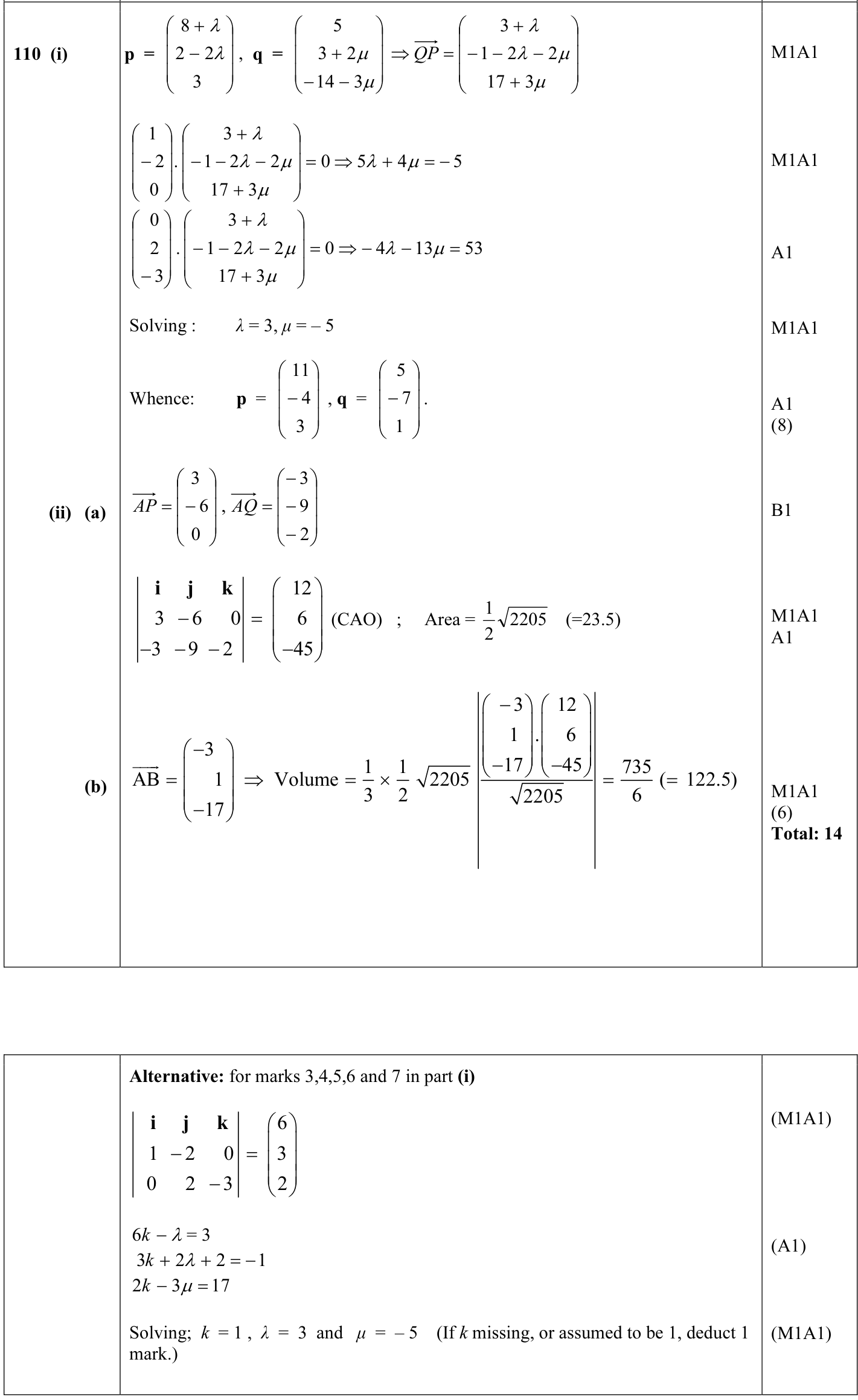
The lines \(l_1\) and \(l_2\) have equations
\(\mathbf r=8\mathbf i+2\mathbf j+3\mathbf k+\lambda(\mathbf i-2\mathbf j)\)
and
\(\mathbf r=5\mathbf i+3\mathbf j-14\mathbf k+\mu(2\mathbf j-3\mathbf k)\).
The point \(P\) on \(l_1\) and the point \(Q\) on \(l_2\) are such that \(PQ\) is perpendicular to both \(l_1\) and \(l_2\). Find the position vector of \(P\) and the position vector of \(Q\).
The points with position vectors \(8\mathbf i+2\mathbf j+3\mathbf k\) and \(5\mathbf i+3\mathbf j-14\mathbf k\) are denoted by \(A\) and \(B\), respectively. Find
(i) \(\overrightarrow{AP}\times\overrightarrow{AQ}\) and hence the area of triangle \(APQ\),
(ii) the volume of the tetrahedron \(APQB\).
9231 P11 - Nov 2016 - Q11E - 14 marks
EITHER
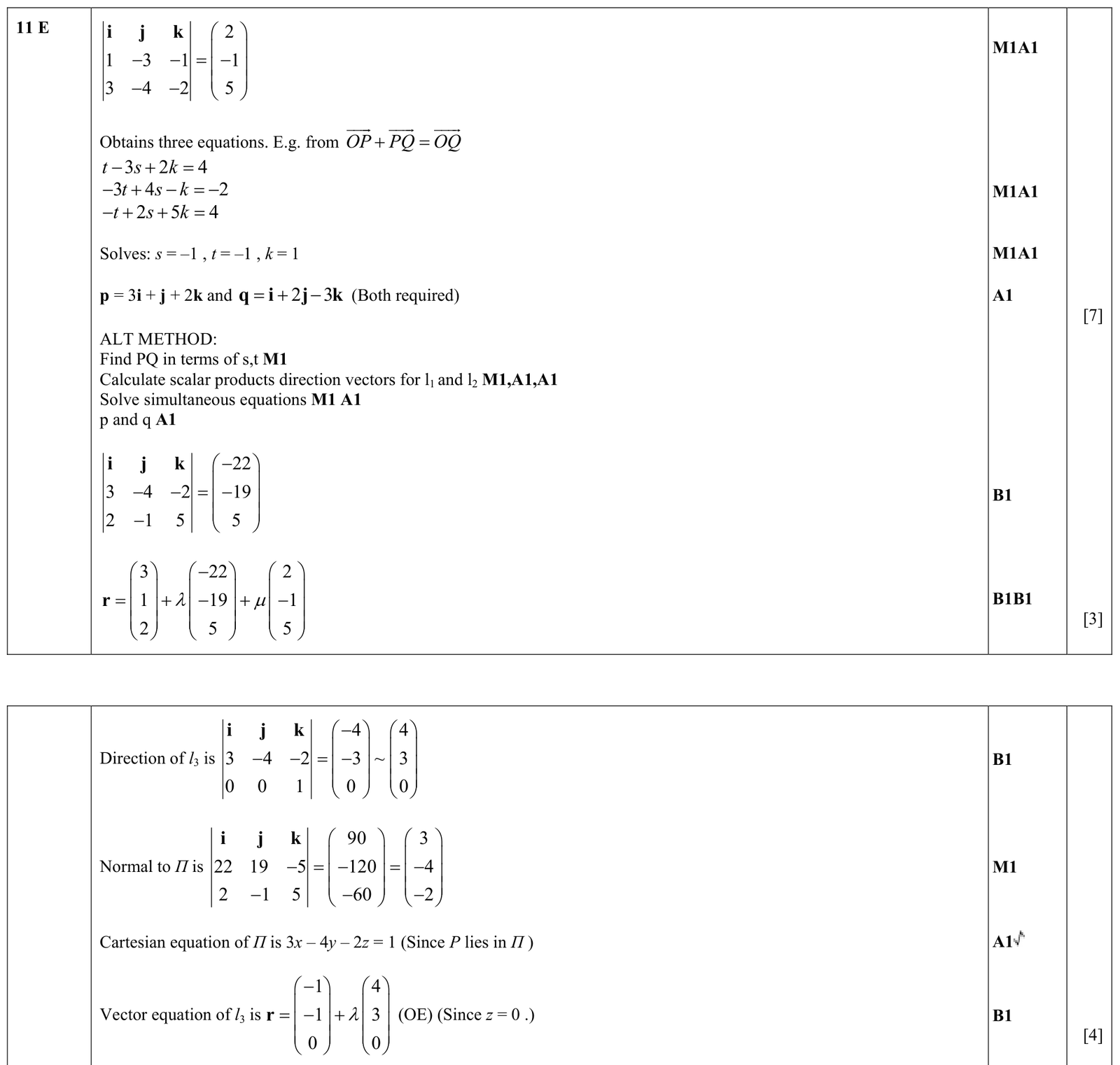
The lines \(l_1\) and \(l_2\) have equations
\(\mathbf r=6\mathbf i-3\mathbf j+s(3\mathbf i-4\mathbf j-2\mathbf k)\quad\text{and}\quad \mathbf r=2\mathbf i-\mathbf j-4\mathbf k+t(\mathbf i-3\mathbf j-\mathbf k)\)
respectively. The point \(P\) on \(l_1\) and the point \(Q\) on \(l_2\) are such that \(PQ\) is perpendicular to both \(l_1\) and \(l_2\). Show that the position vector of \(P\) is \(3\mathbf i+\mathbf j+2\mathbf k\) and find the position vector of \(Q\).
Find, in the form \(\mathbf r=\mathbf a+\lambda\mathbf b+\mu\mathbf c\), an equation of the plane \(\Pi\) which passes through \(P\) and is perpendicular to \(l_1\).
The plane \(\Pi\) meets the plane \(\mathbf r=p\mathbf i+q\mathbf j\) in the line \(l_3\). Find a vector equation of \(l_3\).
9231 P13 - Jun 2016 - Q11O - 14 marks
OR
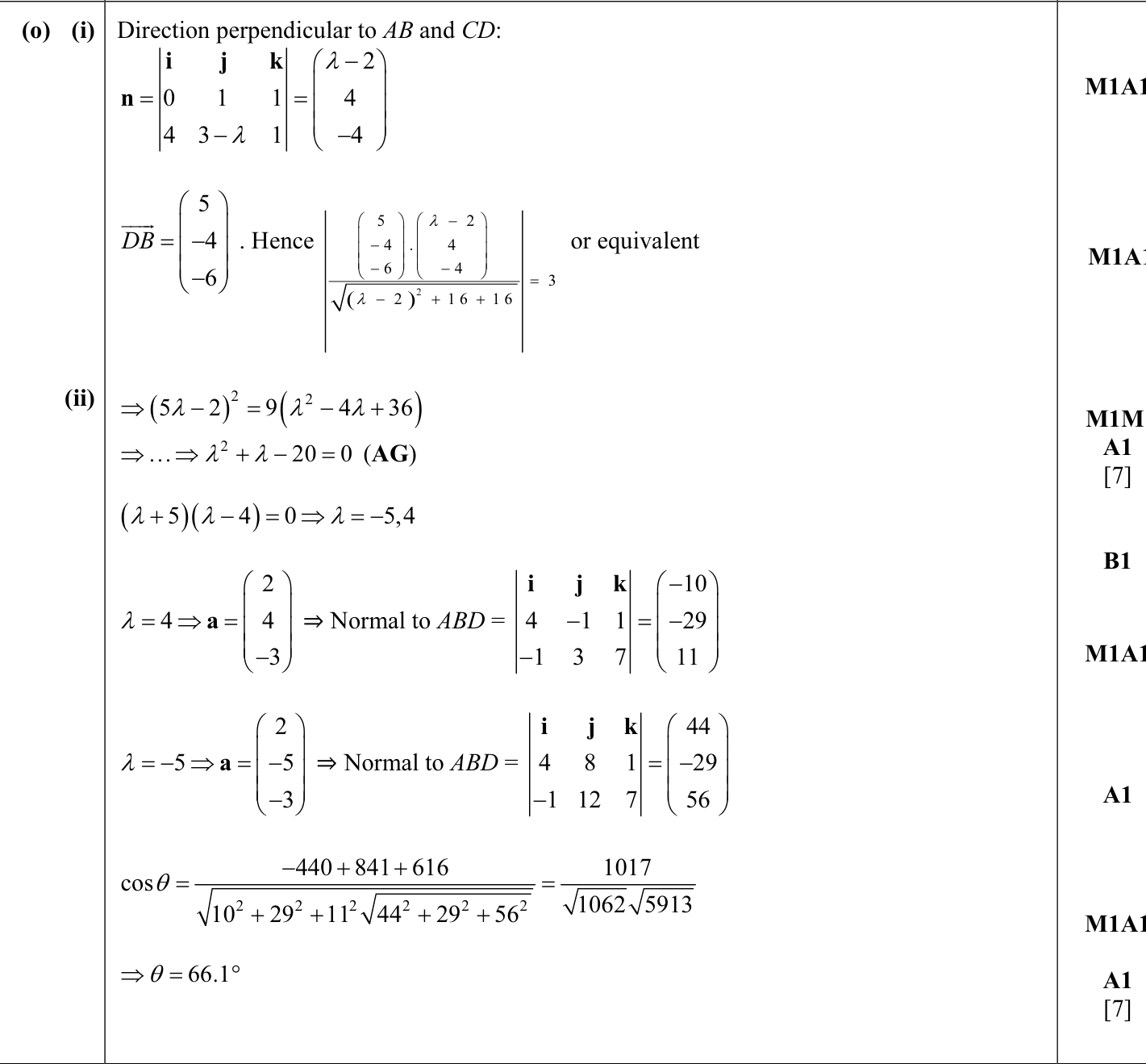
The position vectors of the points \(A\), \(B\), \(C\), and \(D\) are
\(\mathbf a=2\mathbf i+\lambda\mathbf j-3\mathbf k,\quad \mathbf b=6\mathbf i+3\mathbf j-2\mathbf k,\quad \mathbf c=\mathbf i+2\mathbf j-\mathbf k,\quad \mathbf d=\mathbf i+7\mathbf j+4\mathbf k\)
respectively. It is given that the shortest distance between the lines \(AB\) and \(CD\) is \(3\).
(i) Show that \(\lambda^2+\lambda-20=0\).
(ii) The planes \(p_1\) and \(p_2\) are the planes through \(A\), \(B\), and \(D\) corresponding to the two values of \(\lambda\) satisfying the equation in part (i). Find the acute angle between \(p_1\) and \(p_2\).
9231 P11 - Jun 2016 - Q8 - 14 marks
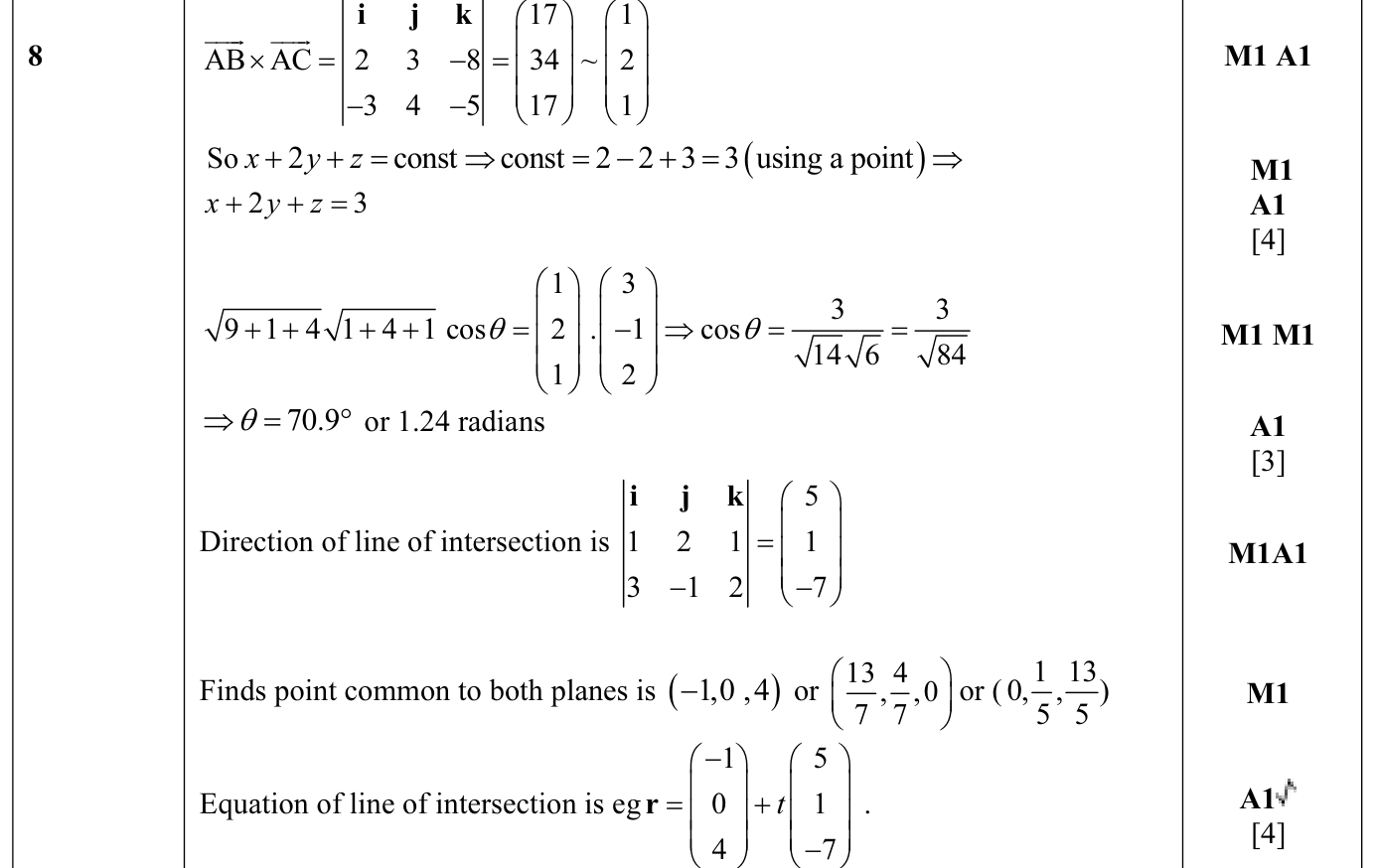
Find a cartesian equation of the plane \(\Pi_{1}\) passing through the points with coordinates \((2,-1,3)\), \((4,2,-5)\) and \((-1,3,-2)\).
The plane \(\Pi_{2}\) has cartesian equation \(3 x-y+2 z=5\). Find the acute angle between \(\Pi_{1}\) and \(\Pi_{2}\).
Find a vector equation of the line of intersection of the planes \(\Pi_{1}\) and \(\Pi_{2}\).
9231 P11 - Nov 2017 - Q6 - 9 marks
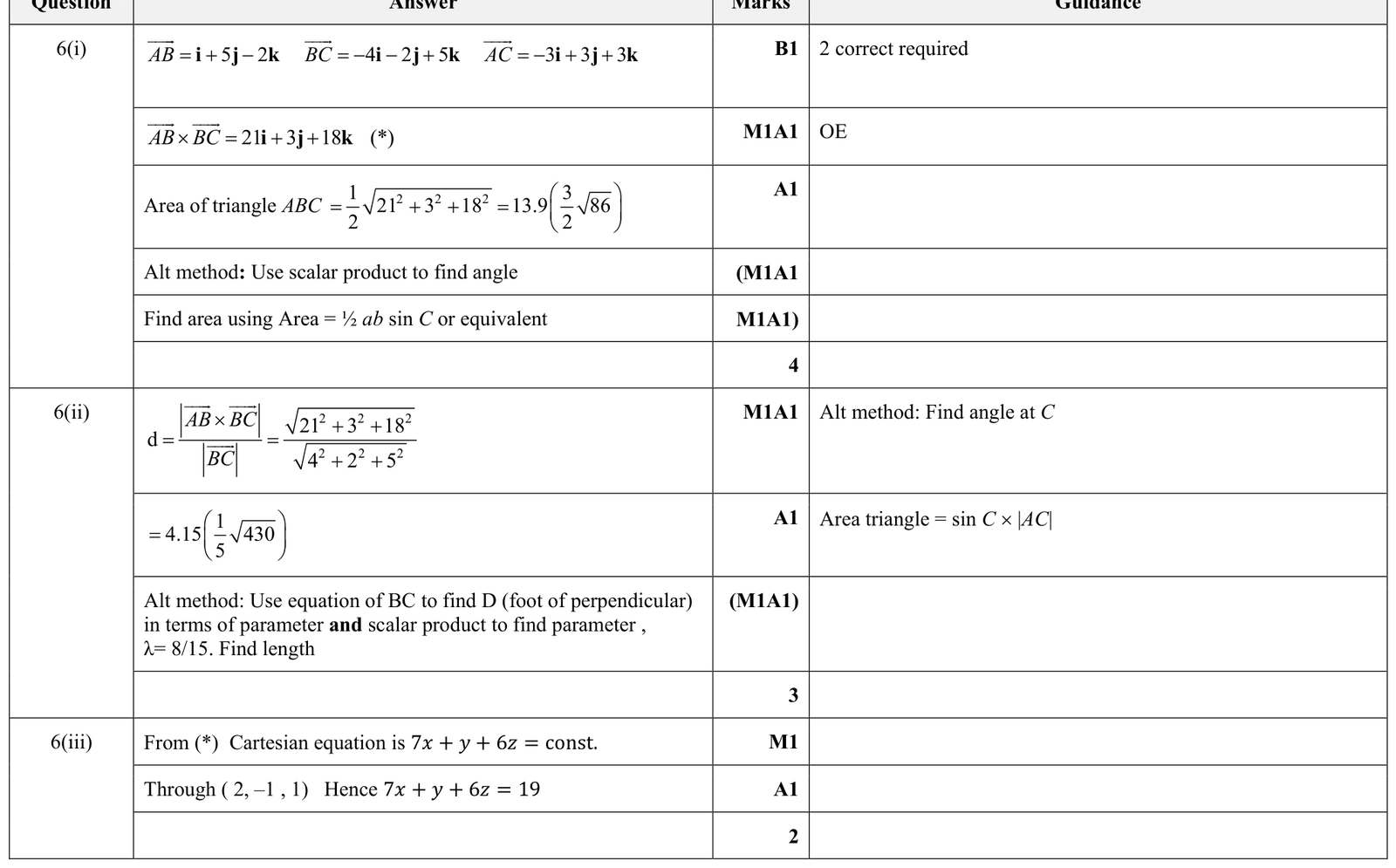
The points \(A, B\) and \(C\) have position vectors \(2 \mathbf{i}-\mathbf{j}+\mathbf{k}, 3 \mathbf{i}+4 \mathbf{j}-\mathbf{k}\) and \(-\mathbf{i}+2 \mathbf{j}+4 \mathbf{k}\) respectively.
(i) Find the area of the triangle \(A B C\).
(ii) Find the perpendicular distance of the point \(A\) from the line \(B C\).
(iii) Find the cartesian equation of the plane through \(A, B\) and \(C\).
9231 P12 - Nov 2014 - Q10 - 12 marks
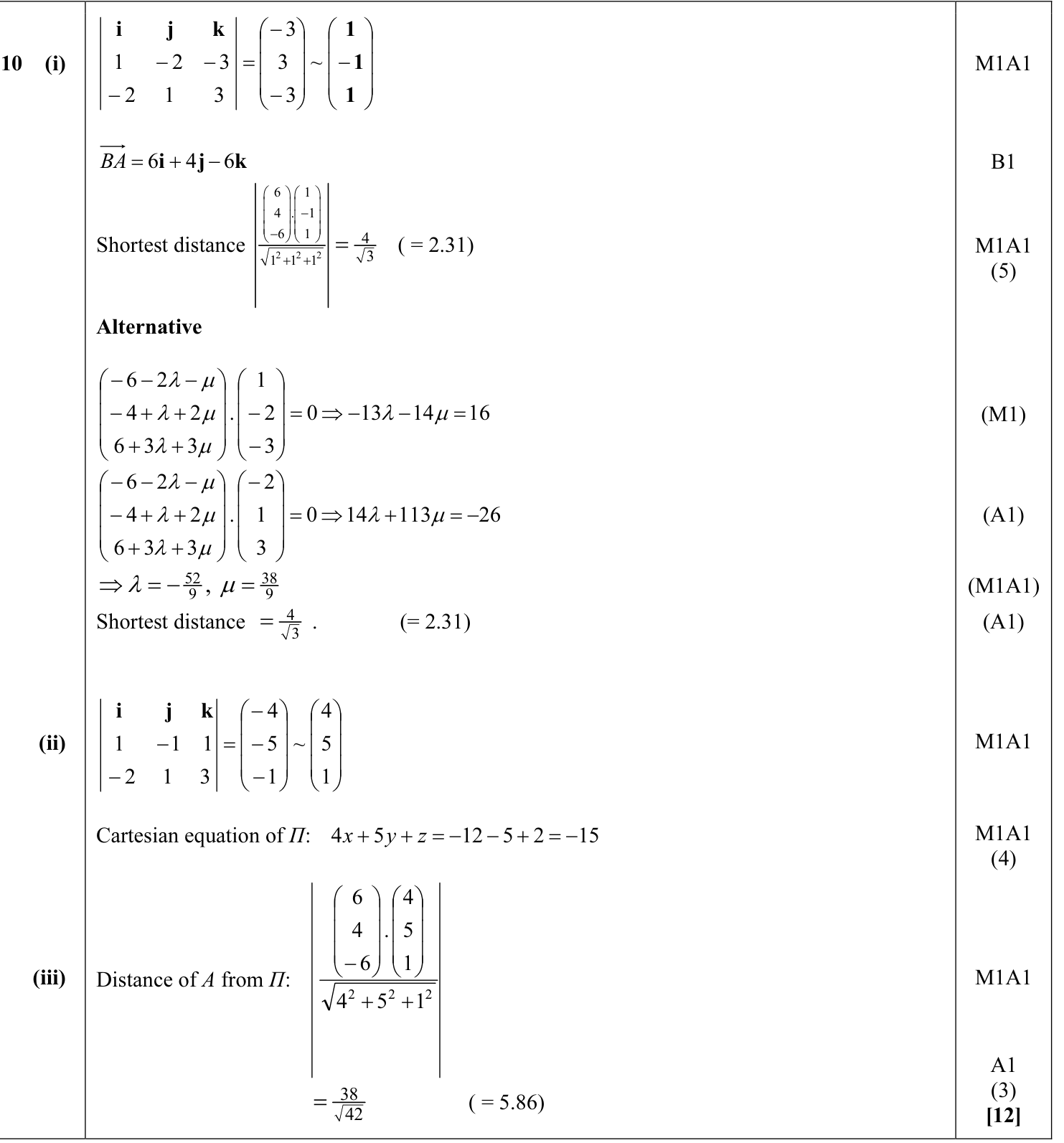
The line \(l_{1}\) is parallel to the vector \(\mathbf{i}-2 \mathbf{j}-3 \mathbf{k}\) and passes through the point \(A\), whose position vector is \(3 \mathbf{i}+3 \mathbf{j}-4 \mathbf{k}\). The line \(l_{2}\) is parallel to the vector \(-2 \mathbf{i}+\mathbf{j}+3 \mathbf{k}\) and passes through the point \(B\), whose position vector is \(-3 \mathbf{i}-\mathbf{j}+2 \mathbf{k}\). The point \(P\) on \(l_{1}\) and the point \(Q\) on \(l_{2}\) are such that \(P Q\) is perpendicular to both \(l_{1}\) and \(l_{2}\). Find
(i) the length \(P Q\),
(ii) the cartesian equation of the plane \(\Pi\) containing \(P Q\) and \(l_{2}\),
(iii) the perpendicular distance of \(A\) from \(\Pi\).
9231 P11 - Nov 2014 - Q10 - 12 marks
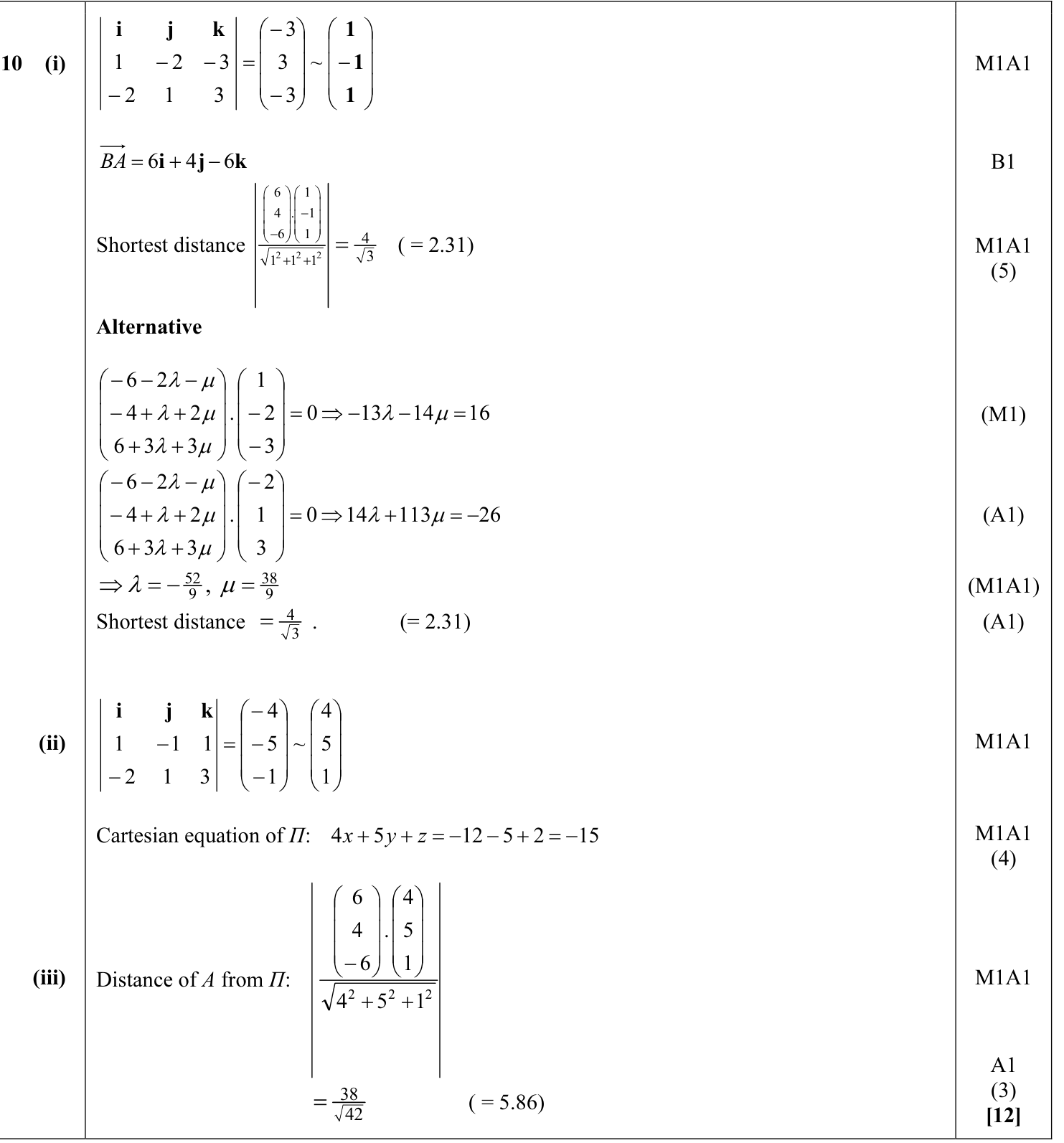
The line \(l_{1}\) is parallel to the vector \(\mathbf{i}-2 \mathbf{j}-3 \mathbf{k}\) and passes through the point \(A\), whose position vector is \(3 \mathbf{i}+3 \mathbf{j}-4 \mathbf{k}\). The line \(l_{2}\) is parallel to the vector \(-2 \mathbf{i}+\mathbf{j}+3 \mathbf{k}\) and passes through the point \(B\), whose position vector is \(-3 \mathbf{i}-\mathbf{j}+2 \mathbf{k}\). The point \(P\) on \(l_{1}\) and the point \(Q\) on \(l_{2}\) are such that \(P Q\) is perpendicular to both \(l_{1}\) and \(l_{2}\). Find
(i) the length \(P Q\),
(ii) the cartesian equation of the plane \(\Pi\) containing \(P Q\) and \(l_{2}\),
(iii) the perpendicular distance of \(A\) from \(\Pi\).
9231 P11 - Nov 2013 - Q8 - 10 marks
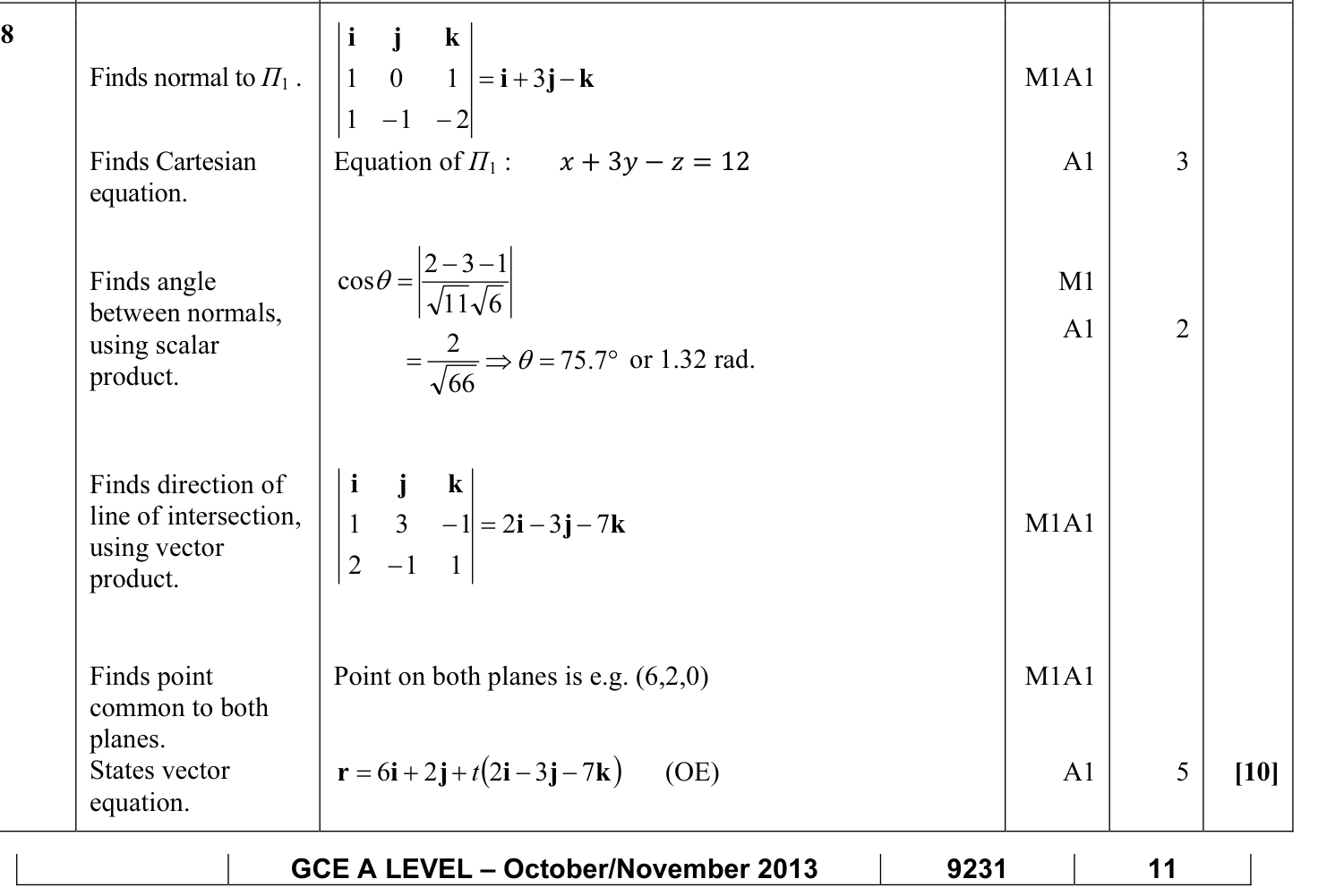
The plane \(\Pi_{1}\) has equation \(\mathbf{r}=\left(\begin{array}{r}2 \\ 3 \\ -1\end{array}\right)+s\left(\begin{array}{l}1 \\ 0 \\ 1\end{array}\right)+t\left(\begin{array}{r}1 \\ -1 \\ -2\end{array}\right)\). Find a cartesian equation of \(\Pi_{1}\).
The plane \(\Pi_{2}\) has equation \(2 x-y+z=10\). Find the acute angle between \(\Pi_{1}\) and \(\Pi_{2}\).
Find an equation of the line of intersection of \(\Pi_{1}\) and \(\Pi_{2}\), giving your answer in the form \(\mathbf{r}=\mathbf{a}+\lambda \mathbf{b}\).
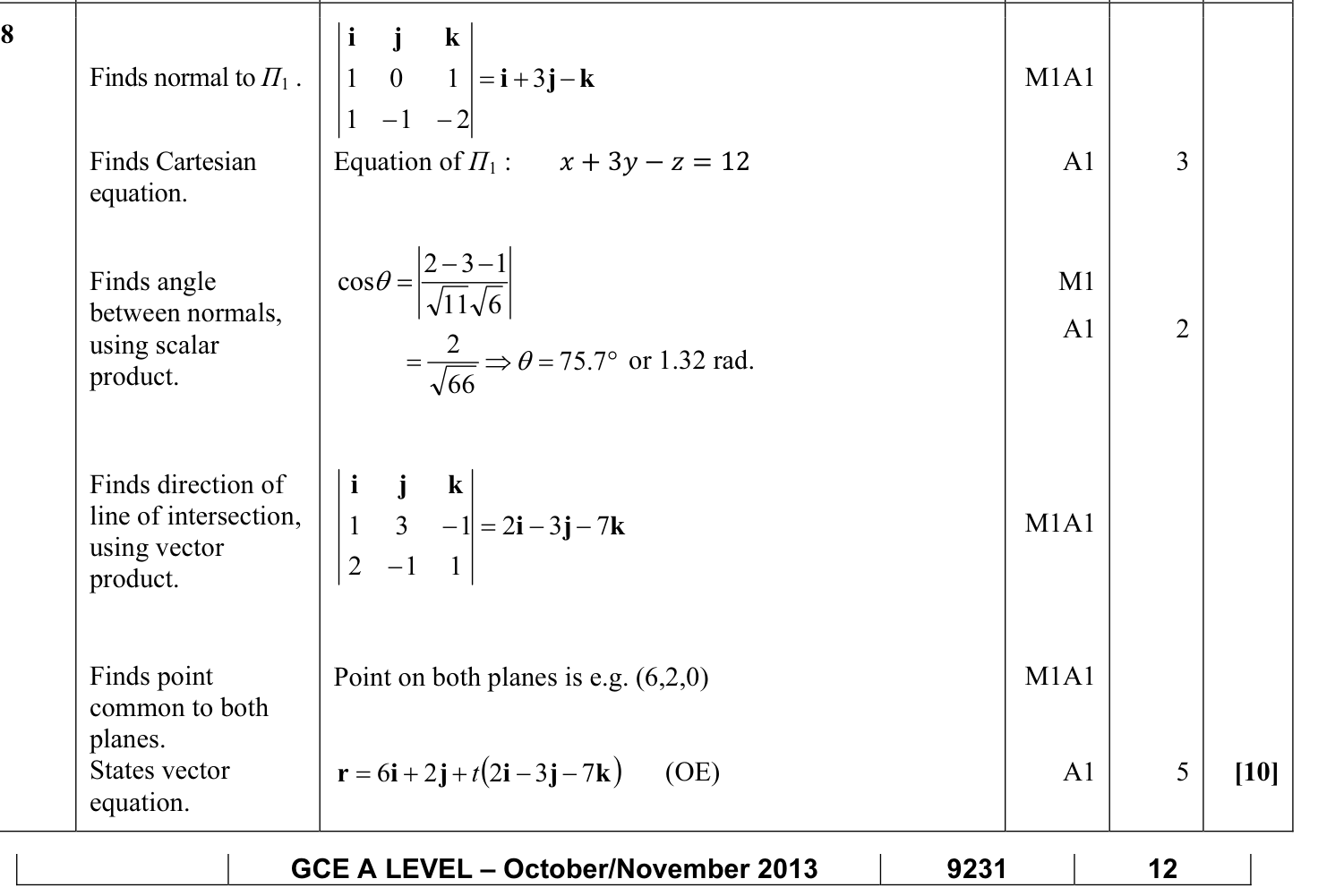
9231 P12 - Nov 2013 - Q8 - 10 marks
The plane \(\Pi_{1}\) has equation \(\mathbf{r}=\left(\begin{array}{r}2 \\ 3 \\ -1\end{array}\right)+s\left(\begin{array}{l}1 \\ 0 \\ 1\end{array}\right)+t\left(\begin{array}{r}1 \\ -1 \\ -2\end{array}\right)\). Find a cartesian equation of \(\Pi_{1}\).
The plane \(\Pi_{2}\) has equation \(2 x-y+z=10\). Find the acute angle between \(\Pi_{1}\) and \(\Pi_{2}\).
Find an equation of the line of intersection of \(\Pi_{1}\) and \(\Pi_{2}\), giving your answer in the form \(\mathbf{r}=\mathbf{a}+\lambda \mathbf{b}\).
9231 P13 - Nov 2013 - Q8 - 11 marks
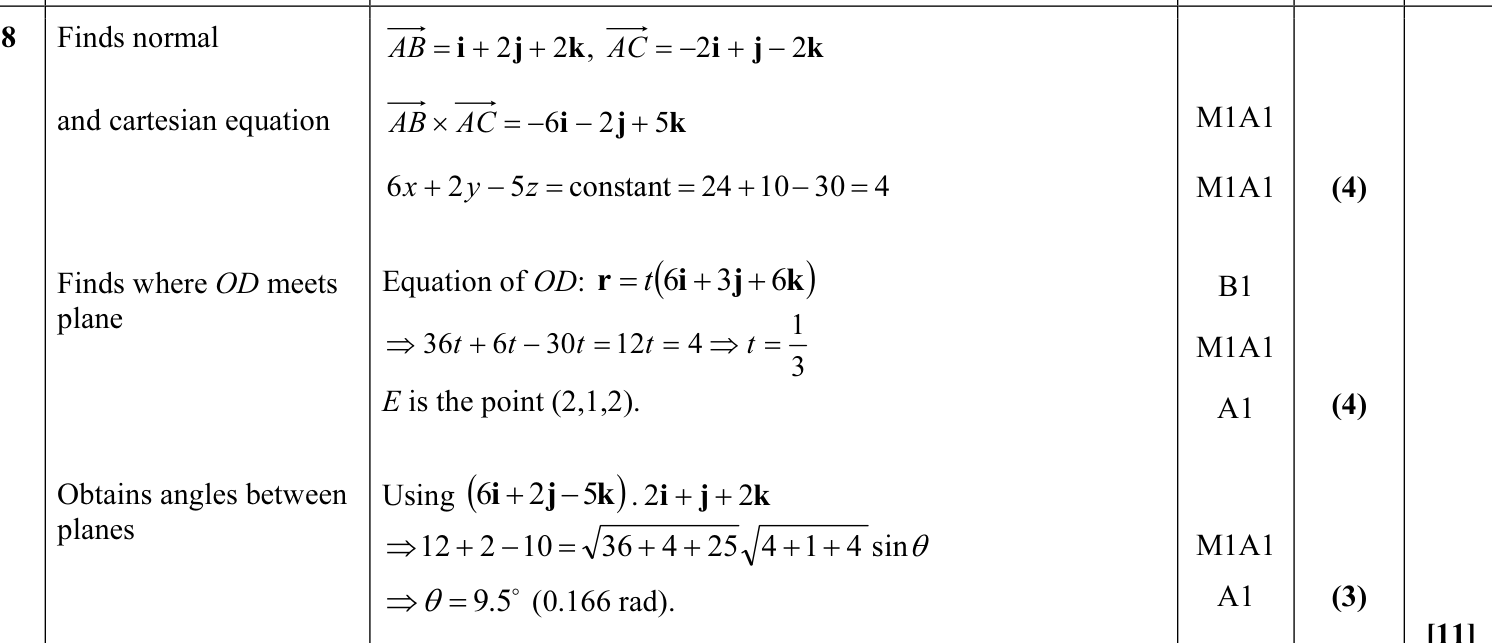
The points \(A, B, C\) have position vectors
\(4 \mathbf{i}+5 \mathbf{j}+6 \mathbf{k}, \quad 5 \mathbf{i}+7 \mathbf{j}+8 \mathbf{k}, \quad 2 \mathbf{i}+6 \mathbf{j}+4 \mathbf{k},\)
respectively, relative to the origin \(O\). Find a cartesian equation of the plane \(A B C\).
The point \(D\) has position vector \(6 \mathbf{i}+3 \mathbf{j}+6 \mathbf{k}\). Find the coordinates of \(E\), the point of intersection of the line \(O D\) with the plane \(A B C\).
Find the acute angle between the line \(E D\) and the plane \(A B C\).
9231 P1 - Nov 2008 - Q11 - 12 marks
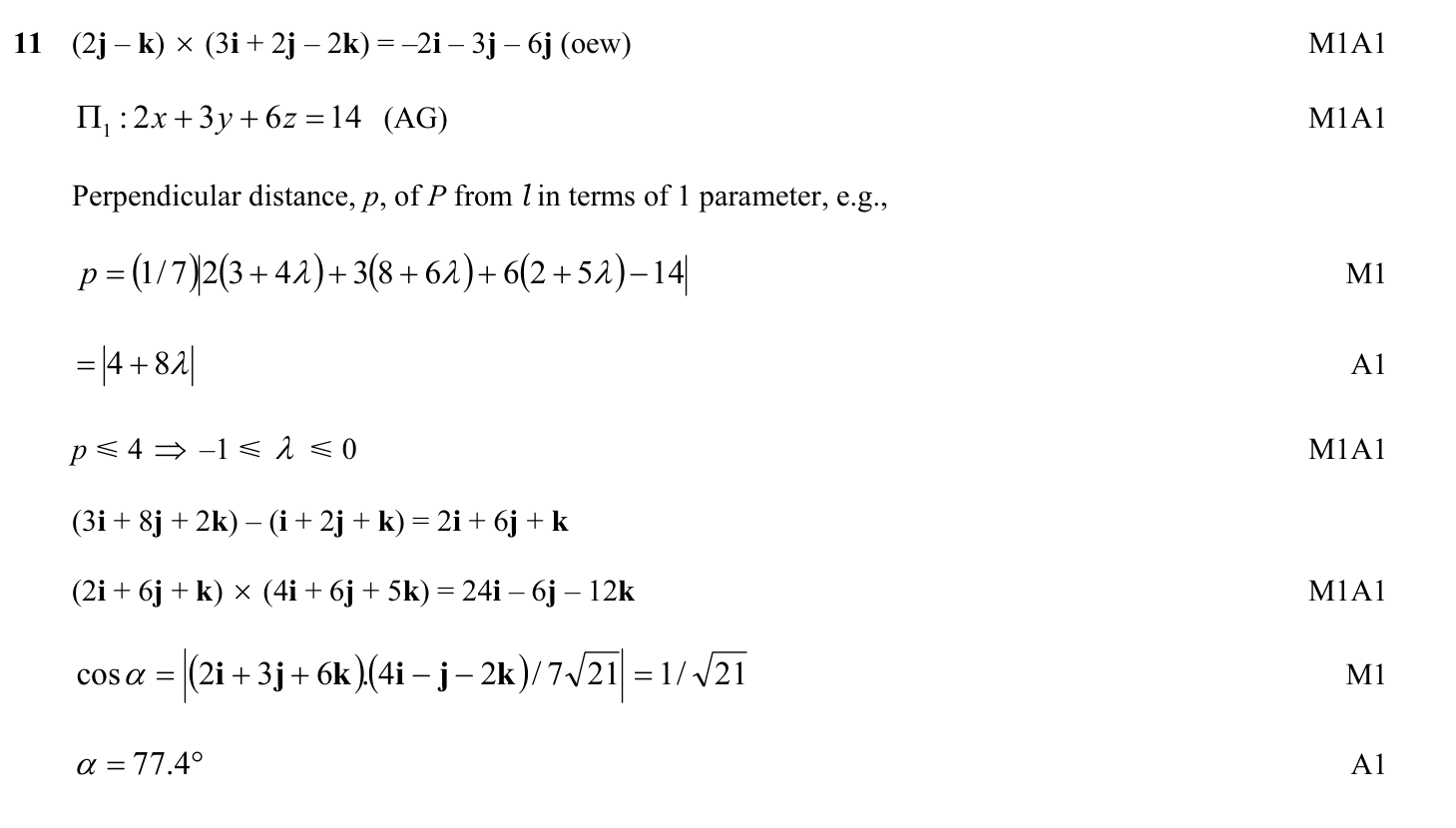
The plane \(\Pi_{1}\) has equation
\(\mathbf{r}=\mathbf{i}+2 \mathbf{j}+\mathbf{k}+\theta(2 \mathbf{j}-\mathbf{k})+\phi(3 \mathbf{i}+2 \mathbf{j}-2 \mathbf{k}) .\)
Find a vector normal to \(\Pi_{1}\) and hence show that the equation of \(\Pi_{1}\) can be written as \(2 x+3 y+6 z=14\).
The line \(l\) has equation
\(\mathbf{r}=3 \mathbf{i}+8 \mathbf{j}+2 \mathbf{k}+t(4 \mathbf{i}+6 \mathbf{j}+5 \mathbf{k})\)
The point on \(l\) where \(t=\lambda\) is denoted by \(P\). Find the set of values of \(\lambda\) for which the perpendicular distance of \(P\) from \(\Pi_{1}\) is not greater than 4 .
The plane \(\Pi_{2}\) contains \(l\) and the point with position vector \(\mathbf{i}+2 \mathbf{j}+\mathbf{k}\). Find the acute angle between \(\Pi_{1}\) and \(\Pi_{2}\).
9231 P12 - Jun 2014 - Q11 - 11 marks
The line \(l_{1}\) passes through the points \(A(2,3,-5)\) and \(B(8,7,-13)\). The line \(l_{2}\) passes through the points \(C(-2,1,8)\) and \(D(3,-1,4)\). Find the shortest distance between the lines \(l_{1}\) and \(l_{2}\).
The plane \(\Pi_{1}\) passes through the points \(A, B\) and \(D\). The plane \(\Pi_{2}\) passes though the points \(A, C\) and \(D\). Find the acute angle between \(\Pi_{1}\) and \(\Pi_{2}\), giving your answer in degrees.