Past Exam Questions
← Back9231 P11 - Jun 2025 - Q05 - 13 marks
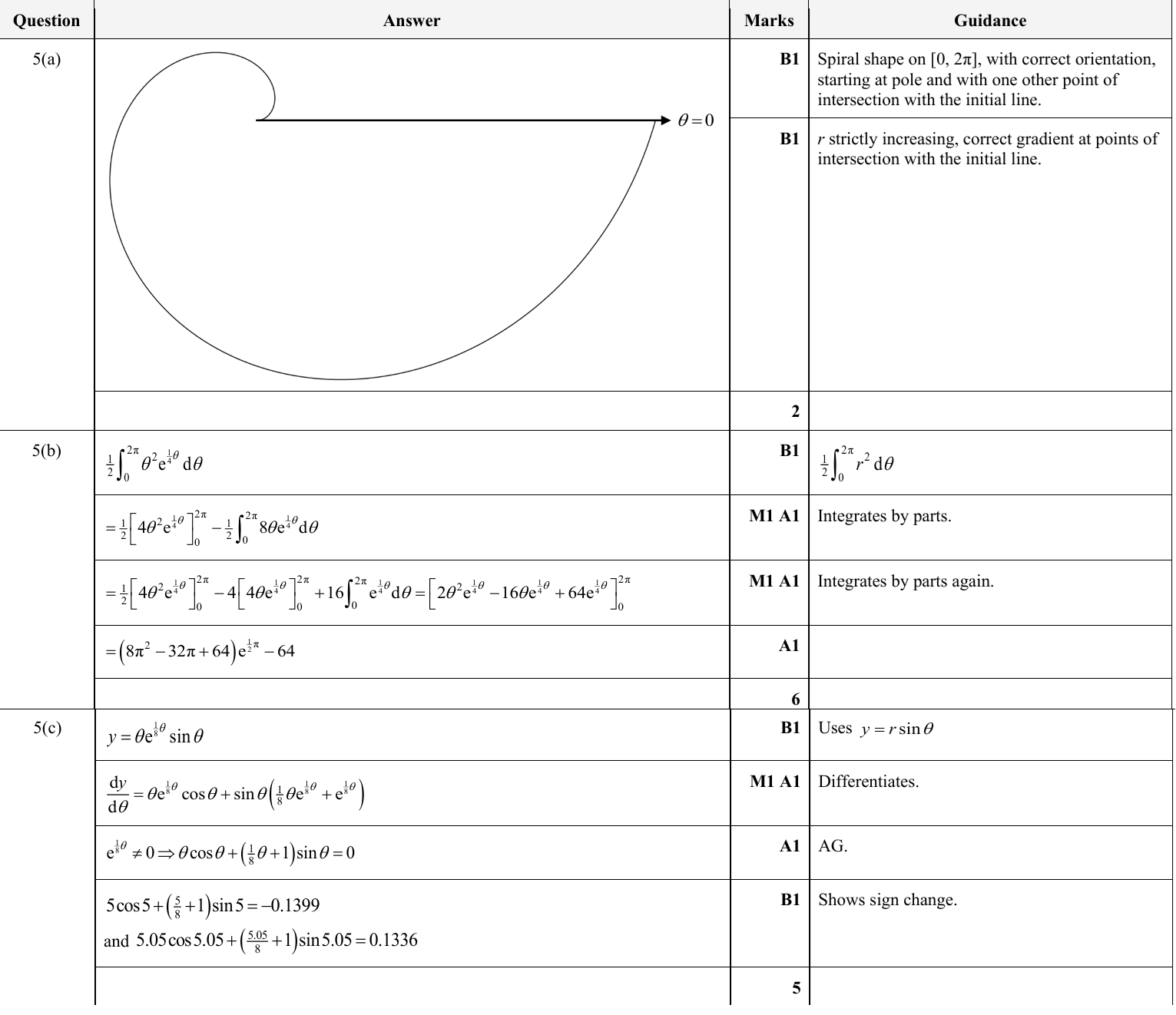
The curve C has polar equation \(r = \theta e^{\frac{1}{8} \theta}\), for \(0 \leq \theta \leq 2\pi\).
- Sketch C.
- Find the area of the region bounded by C and the initial line, giving your answer in the form \((p\pi^2 + q\pi + r)e^{\frac{1}{2}\pi} + s\), where \(p, q, r\) and \(s\) are integers to be determined.
- Show that, at the point of C furthest from the initial line, \(\theta \cos \theta + \left( \frac{1}{8} \theta + 1 \right) \sin \theta = 0\) and verify that this equation has a root between 5 and 5.05.
9231 P13 - Jun 2025 - Q07 - 16 marks
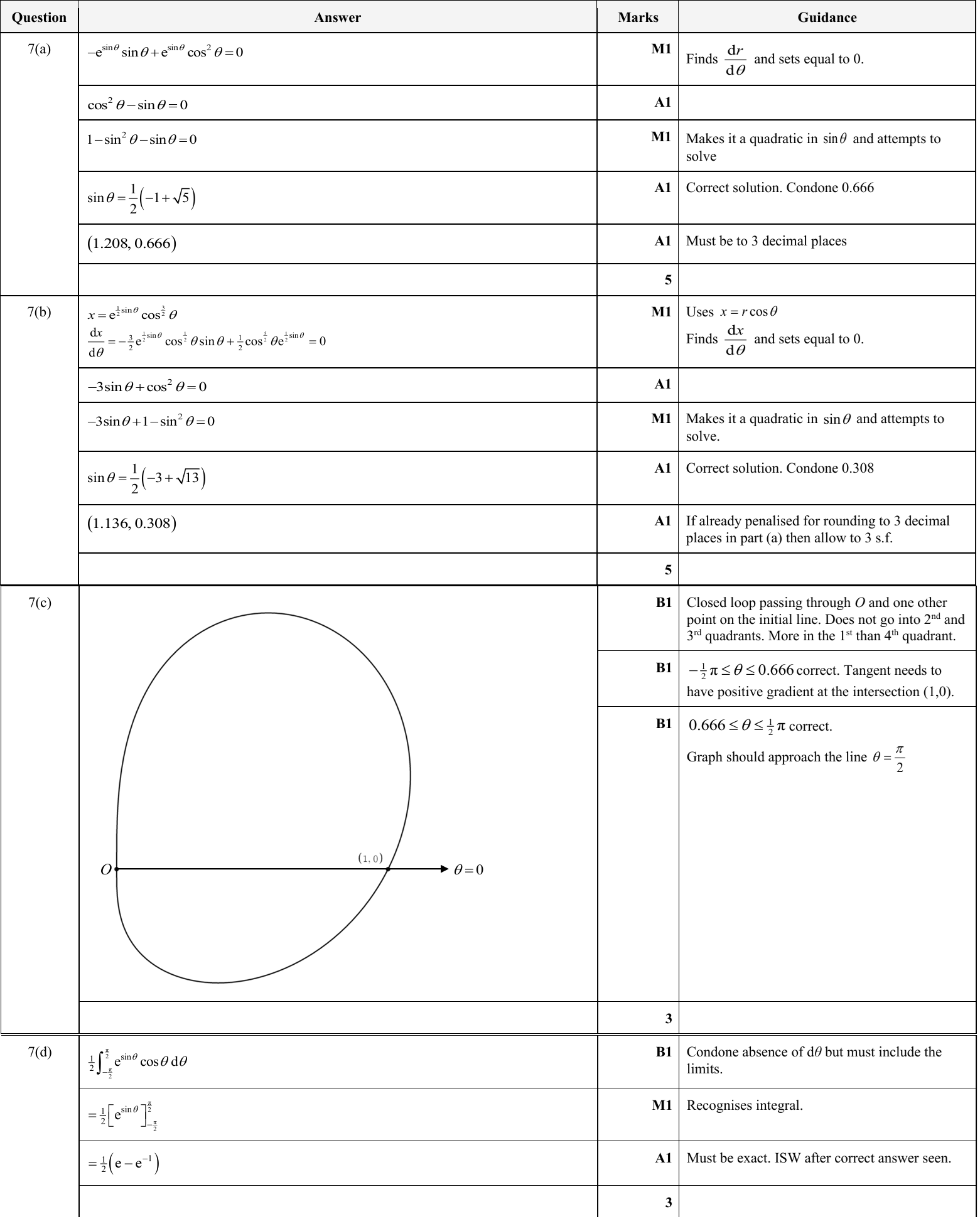
The curve C has polar equation \(r^2 = e^{\sin \theta} \cos \theta\), for \(-\frac{1}{2}\pi \leq \theta \leq \frac{1}{2}\pi\).
- Find the polar coordinates of the point on C that is furthest from the pole, giving your answers correct to 3 decimal places.
- Find the polar coordinates of the point on C that is furthest from the half-line \(\theta = \frac{1}{2}\pi\), giving your answers correct to 3 decimal places.
- Sketch C.
- Find the area of the region bounded by C, giving your answer in exact form.
9231 P14 - Jun 2025 - Q06 - 13 marks
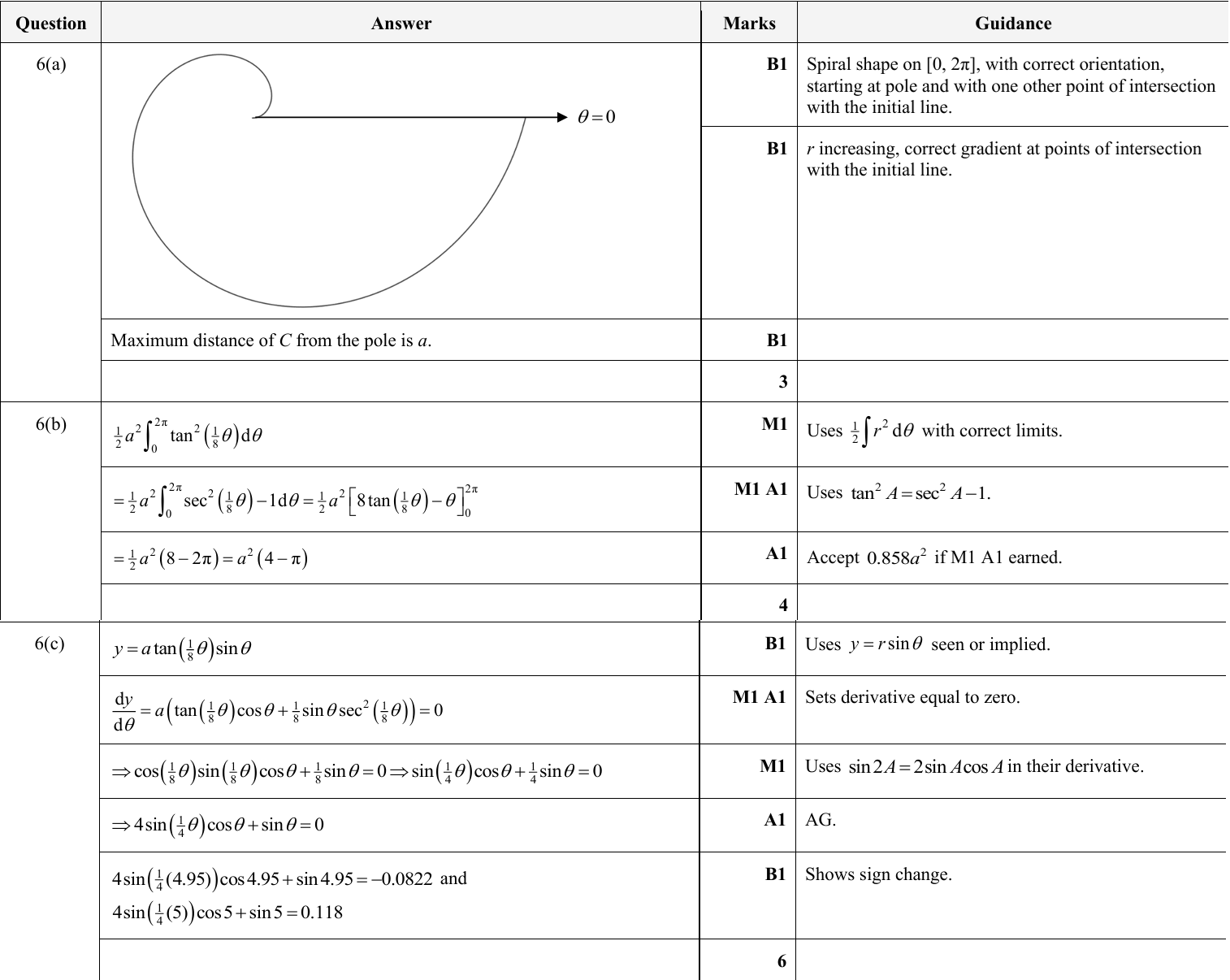
The curve C has polar equation \(r = a \tan\left(\frac{1}{8}\theta\right)\), where \(a\) is a positive constant and \(0 \leq \theta \leq 2\pi\).
(a) Sketch C and state, in terms of \(a\), the greatest distance of a point on C from the pole.
(b) Find, in terms of \(a\), the area of the region bounded by C and the initial line.
(c) Show that, at the point on C furthest from the initial line,
\(4 \sin\left(\frac{1}{4}\theta\right)\cos\theta + \sin\theta = 0\)
and verify that this equation has a root between 4.95 and 5.
9231 P11 - Nov 2024 - Q05 - 13 marks
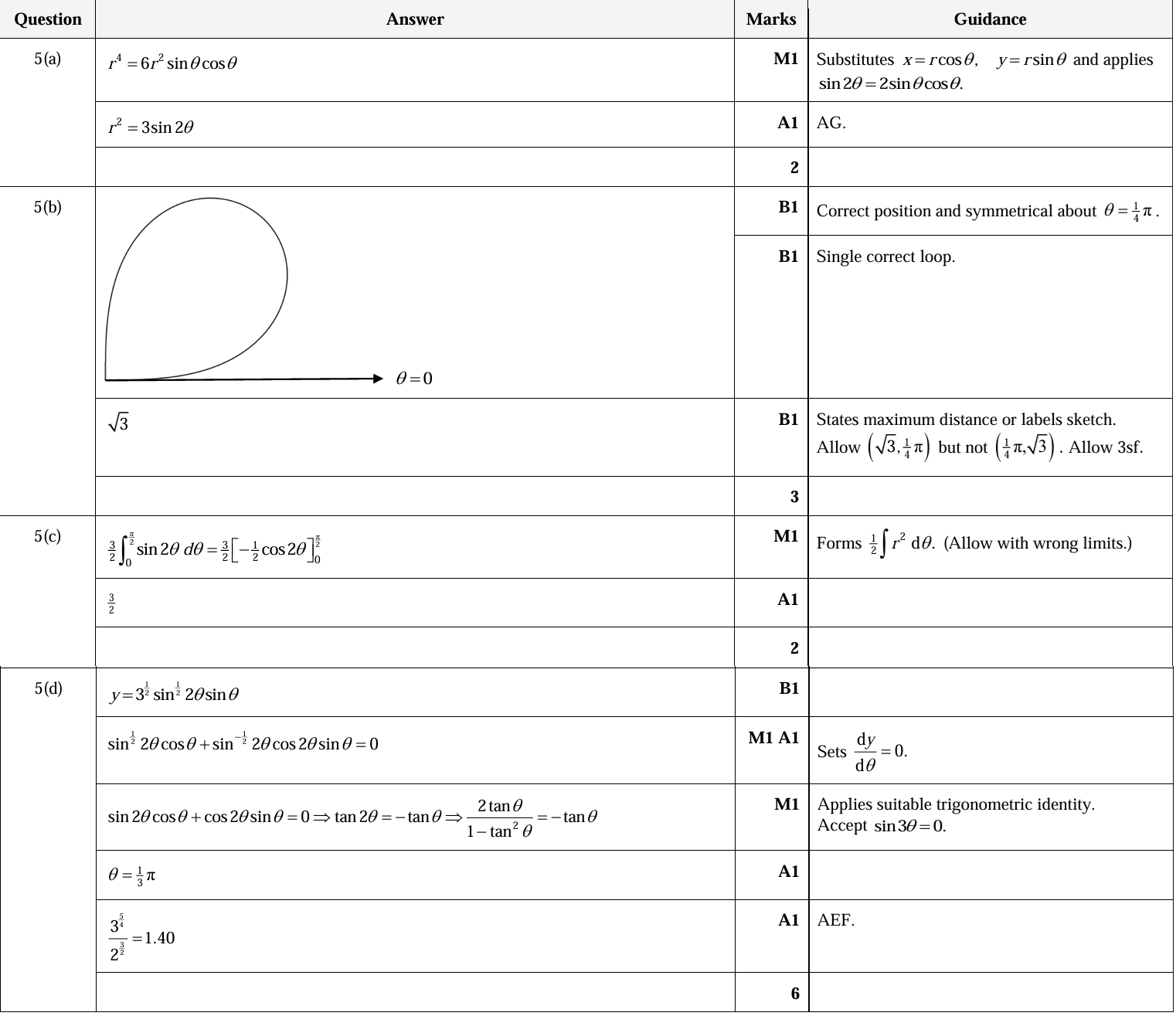
(a) Show that the curve with Cartesian equation \((x^2 + y^2)^2 = 6xy\) has polar equation \(r^2 = 3 \sin 2\theta\).
The curve \(C\) has polar equation \(r^2 = 3 \sin 2\theta\), for \(0 \leq \theta \leq \frac{1}{2}\pi\).
(b) Sketch \(C\) and state the maximum distance of a point on \(C\) from the pole.
(c) Find the area of the region enclosed by \(C\).
(d) Find the maximum distance of a point on \(C\) from the initial line.
9231 P12 - Nov 2024 - Q07 - 16 marks
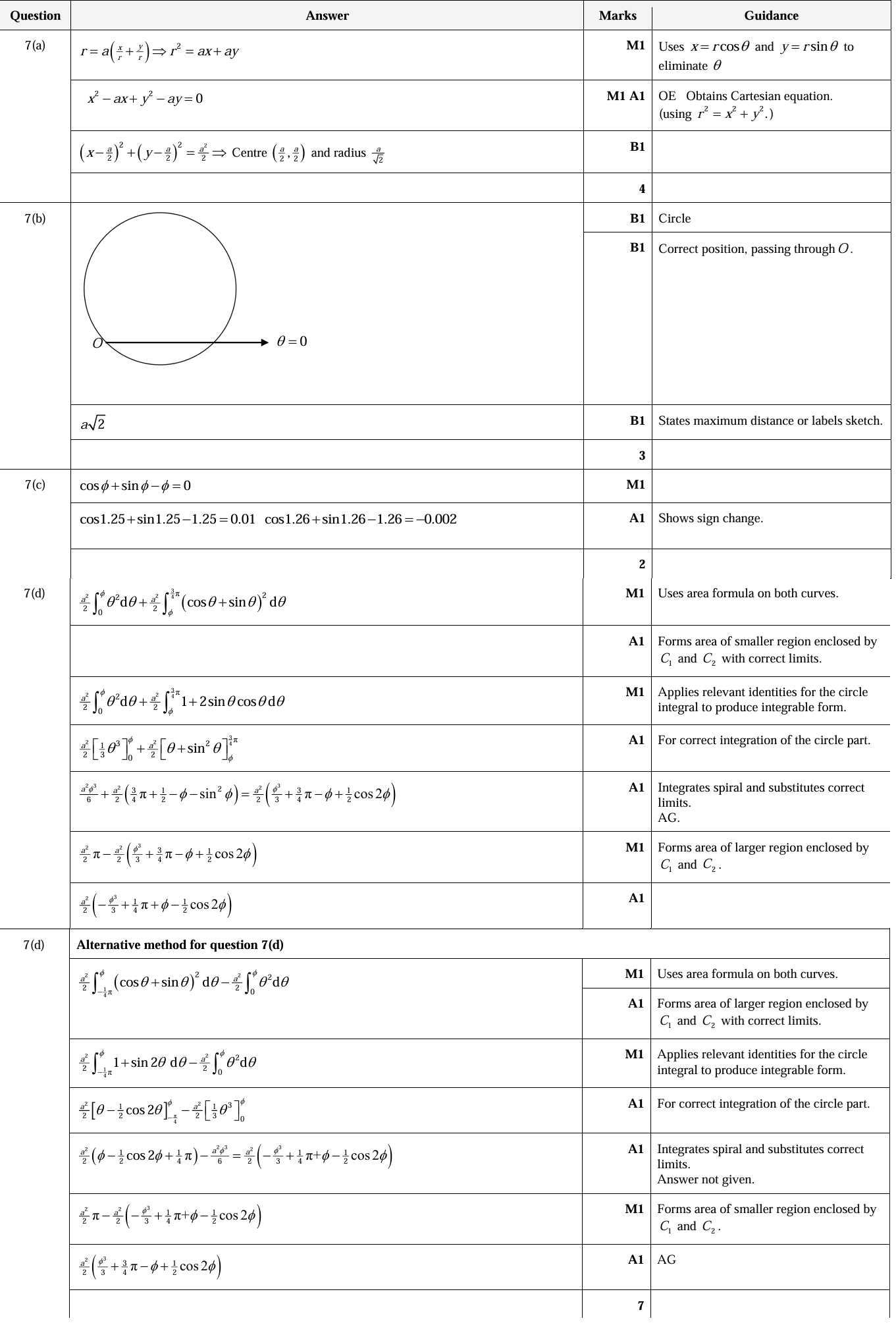
The curve \(C_1\) has polar equation \(r = a(\cos \theta + \sin \theta)\) for \(-\frac{1}{4}\pi \leq \theta \leq \frac{3}{4}\pi\), where \(a\) is a positive constant.
- Find a Cartesian equation for \(C_1\) and show that it represents a circle, stating its radius and the Cartesian coordinates of its centre.
- Sketch \(C_1\) and state the greatest distance of a point on \(C_1\) from the pole.
The curve \(C_2\) with polar equation \(r = a\theta\) intersects \(C_1\) at the pole and the point with polar coordinates \((a\phi, \phi)\).
- Verify that \(1.25 < \phi < 1.26\).
- Show that the area of the smaller region enclosed by \(C_1\) and \(C_2\) is equal to
\(\frac{1}{2}a^2 \left( \frac{3}{4}\pi + \frac{1}{3}\phi^3 - \phi + \frac{1}{2}\cos 2\phi \right)\)
and deduce, in terms of \(a\) and \(\phi\), the area of the larger region enclosed by \(C_1\) and \(C_2\).
9231 P13 - Nov 2024 - Q05 - 13 marks
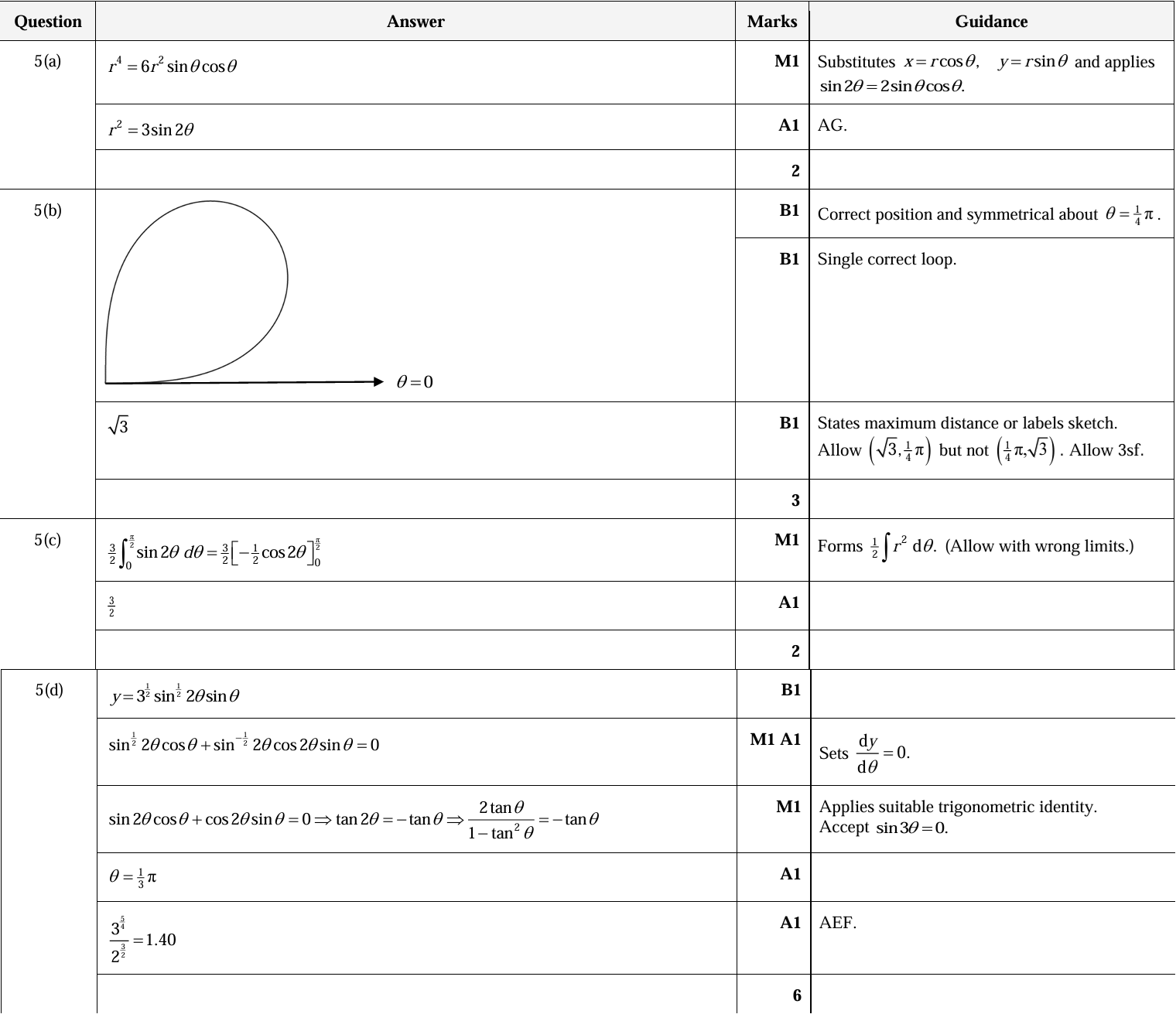
(a) Show that the curve with Cartesian equation \((x^2 + y^2)^2 = 6xy\) has polar equation \(r^2 = 3 \sin 2\theta\).
The curve \(C\) has polar equation \(r^2 = 3 \sin 2\theta\), for \(0 \leq \theta \leq \frac{1}{2}\pi\).
(b) Sketch \(C\) and state the maximum distance of a point on \(C\) from the pole.
(c) Find the area of the region enclosed by \(C\).
(d) Find the maximum distance of a point on \(C\) from the initial line.
9231 P11 - Jun 2024 - Q07 - 15 marks
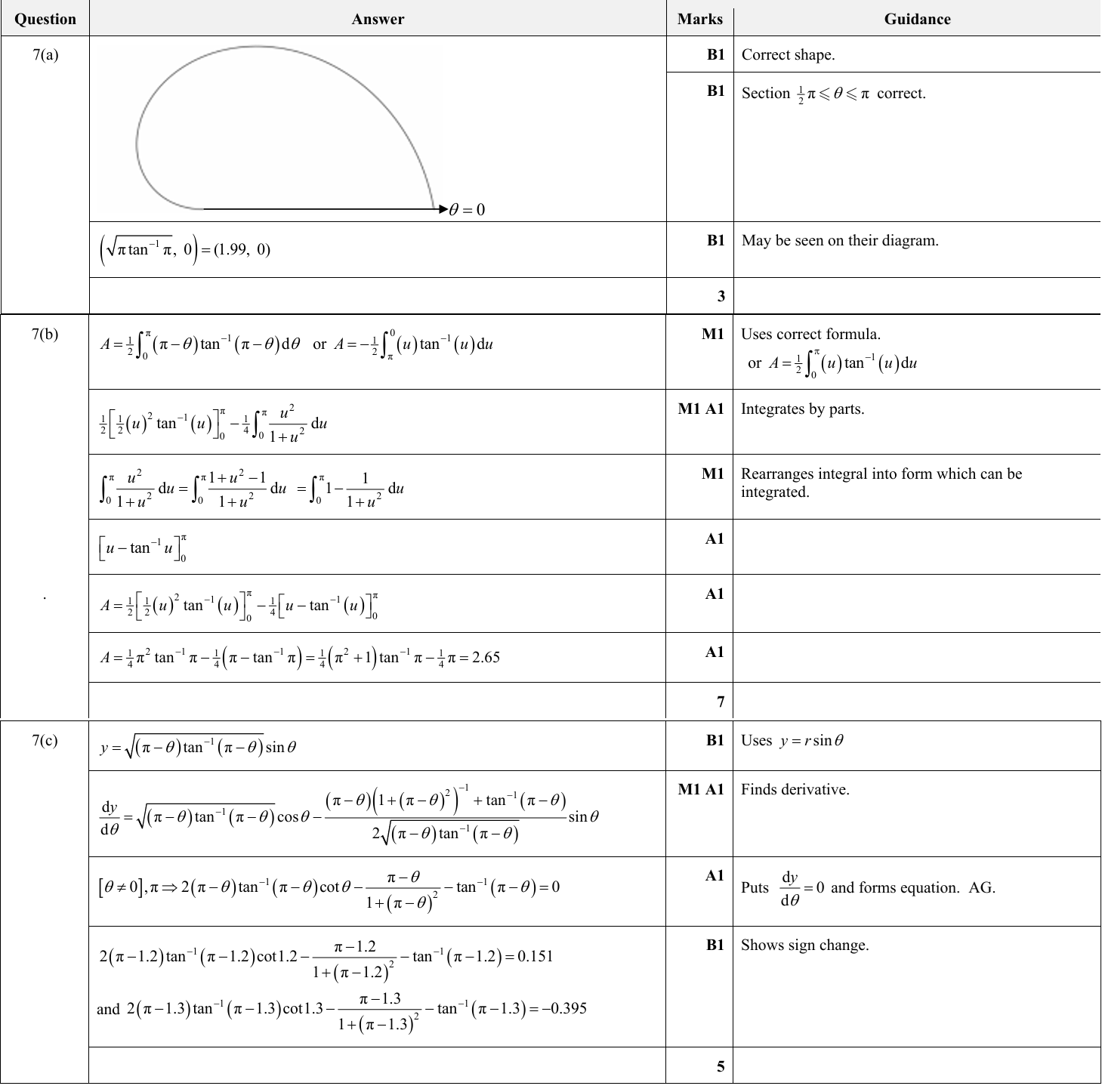
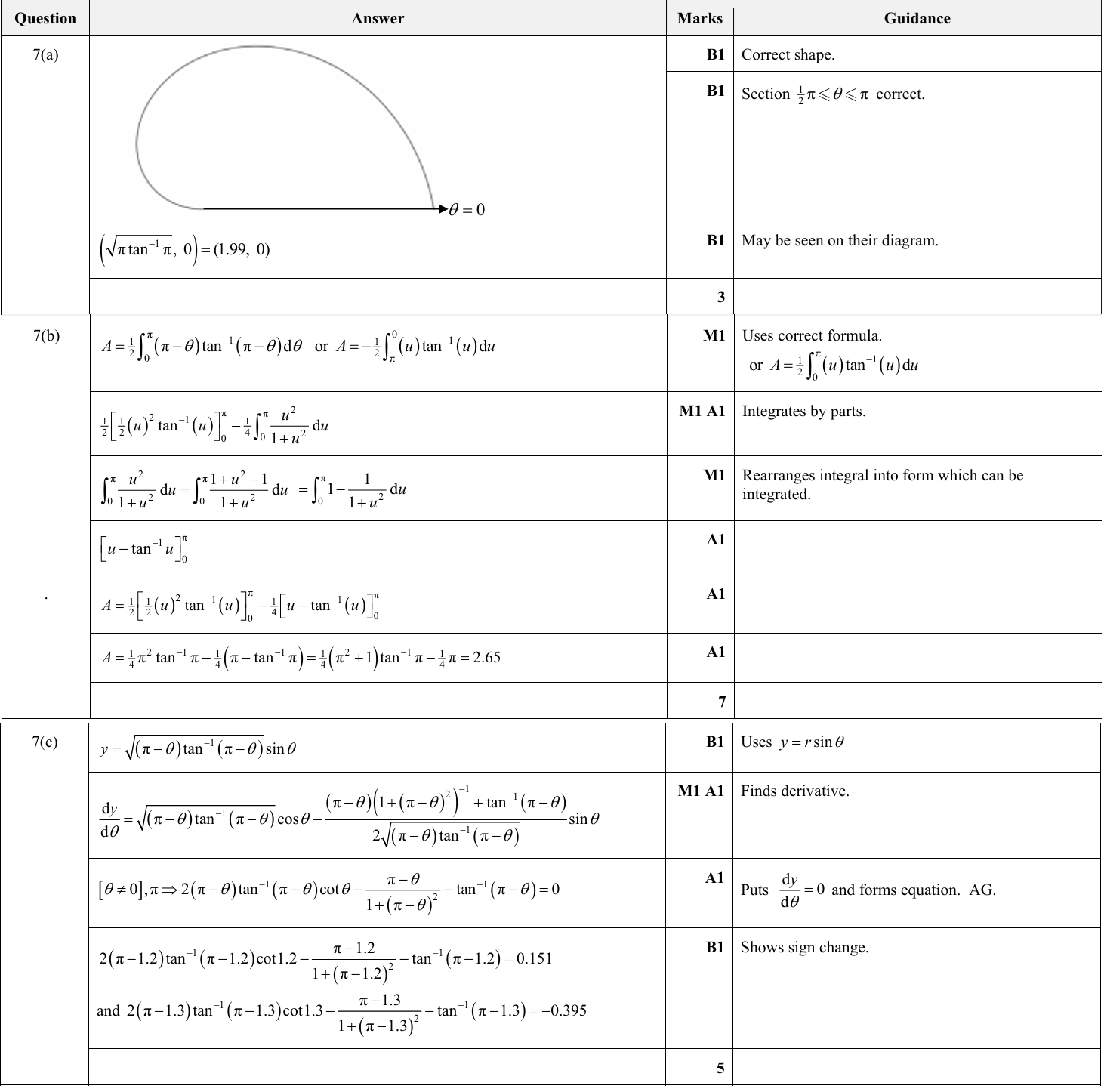
The curve C has polar equation \(r^2 = (\pi - \theta) \arctan(\pi - \theta)\), for \(0 \leq \theta \leq \pi\).
(a) Sketch C and state the polar coordinates of the point of C furthest from the pole. [3]
(b) Using the substitution \(u = \pi - \theta\), or otherwise, find the area of the region enclosed by C and the initial line. [7]
(c) Show that, at the point of C furthest from the initial line,
\(2(\pi - \theta) \arctan(\pi - \theta) \cot \theta - \frac{\pi - \theta}{1 + (\pi - \theta)^2} - \arctan(\pi - \theta) = 0\)
and verify that this equation has a root for \(\theta\) between 1.2 and 1.3. [5]
9231 P12 - Jun 2024 - Q07 - 15 marks
The curve C has polar equation \(r^2 = (\pi - \theta) \arctan(\pi - \theta)\), for \(0 \leq \theta \leq \pi\).
(a) Sketch C and state the polar coordinates of the point of C furthest from the pole. [3]
(b) Using the substitution \(u = \pi - \theta\), or otherwise, find the area of the region enclosed by C and the initial line. [7]
(c) Show that, at the point of C furthest from the initial line,
\(2(\pi - \theta) \arctan(\pi - \theta) \cot \theta - \frac{\pi - \theta}{1 + (\pi - \theta)^2} - \arctan(\pi - \theta) = 0\)
and verify that this equation has a root for \(\theta\) between 1.2 and 1.3. [5]
9231 P13 - Jun 2024 - Q07 - 16 marks
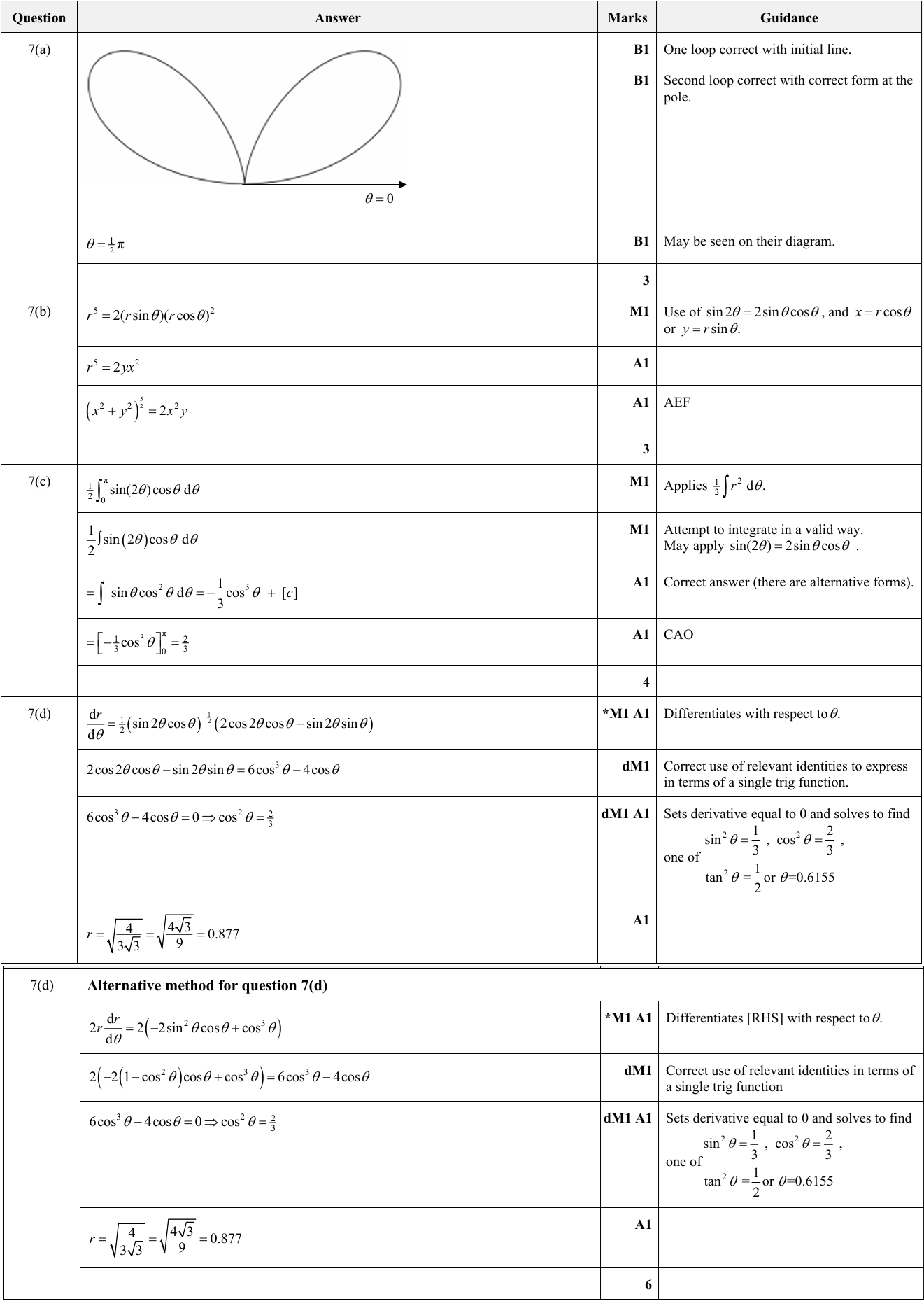
The curve C has polar equation \(r^2 = \sin 2\theta \cos \theta\), for \(0 \leq \theta \leq \pi\).
- Sketch C and state the equation of the line of symmetry.
- Find a Cartesian equation for C.
- Find the total area enclosed by C.
- Find the greatest distance of a point on C from the pole.
9231 P11 - Nov 2023 - Q06 - 15 marks
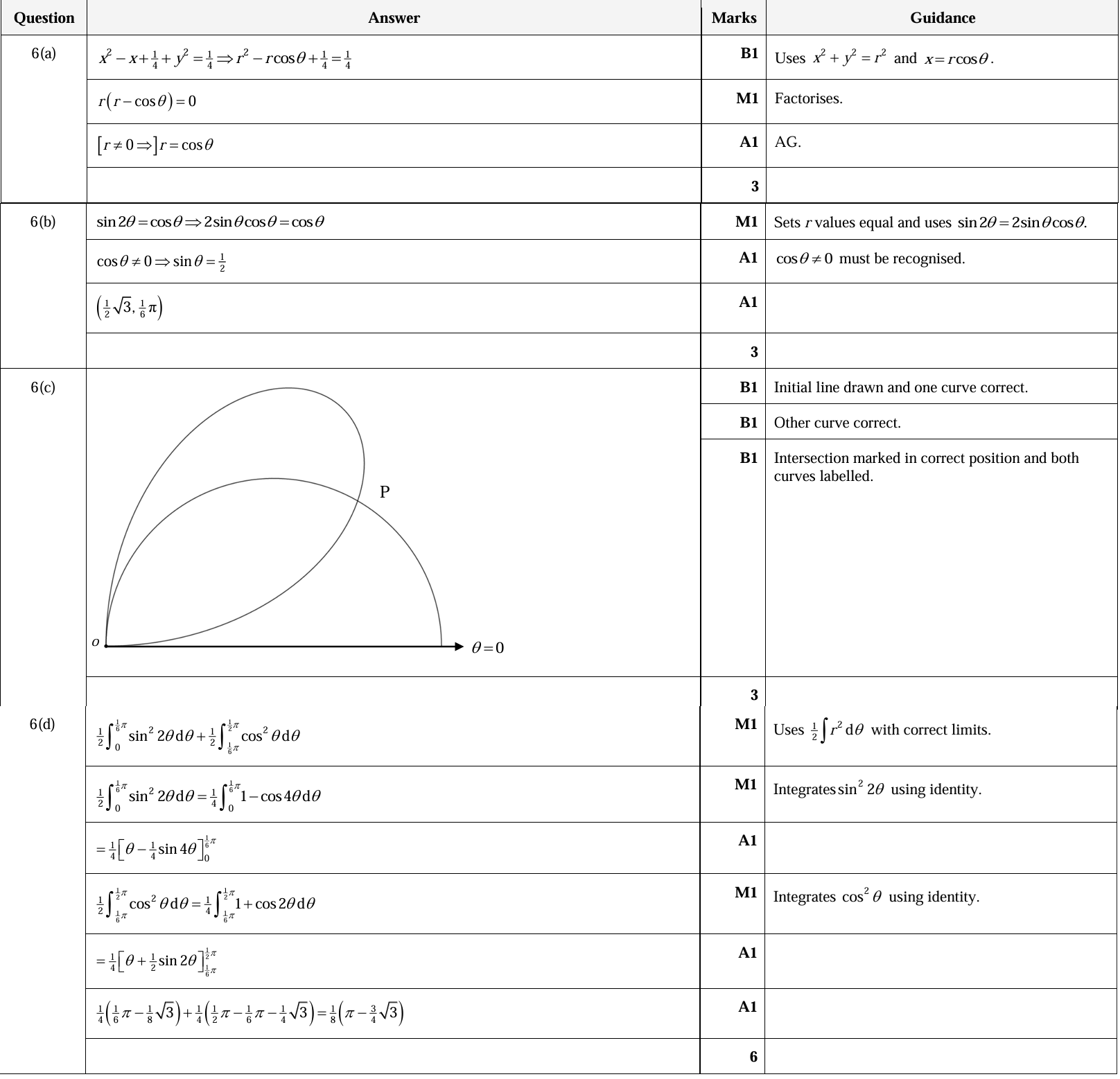
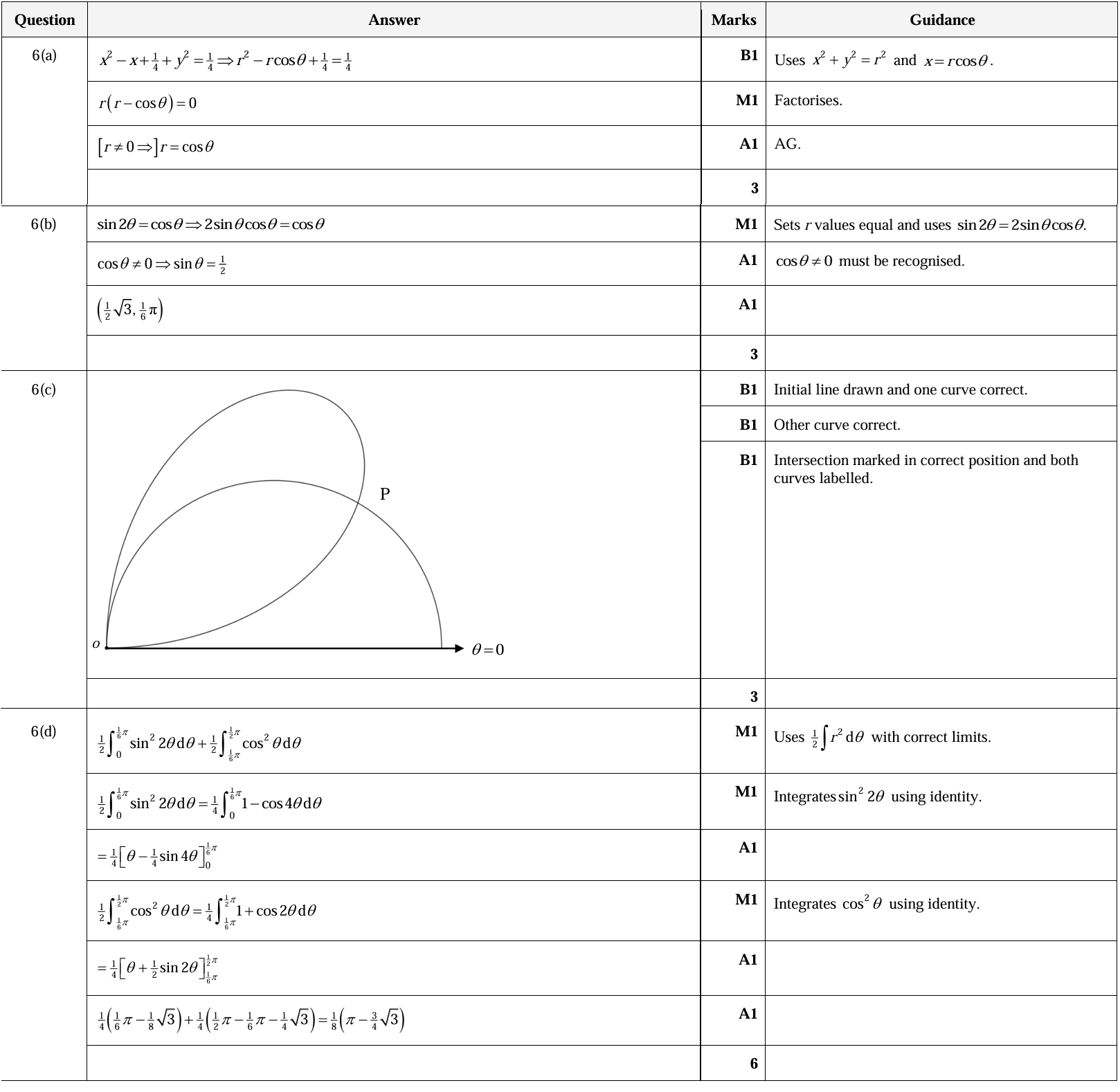
(a) Show that the curve with Cartesian equation \(\left( x - \frac{1}{2} \right)^2 + y^2 = \frac{1}{4}\) has polar equation \(r = \cos \theta\).
The curves \(C_1\) and \(C_2\) have polar equations \(r = \cos \theta\) and \(r = \sin 2\theta\) respectively, where \(0 \leq \theta \leq \frac{1}{2} \pi\). The curves \(C_1\) and \(C_2\) intersect at the pole and at another point \(P\).
(b) Find the polar coordinates of \(P\).
(c) In a single diagram sketch \(C_1\) and \(C_2\), clearly identifying each curve, and mark the point \(P\).
(d) The region \(R\) is enclosed by \(C_1\) and \(C_2\) and includes the line \(OP\). Find, in exact form, the area of \(R\).
9231 P12 - Nov 2023 - Q06 - 13 marks
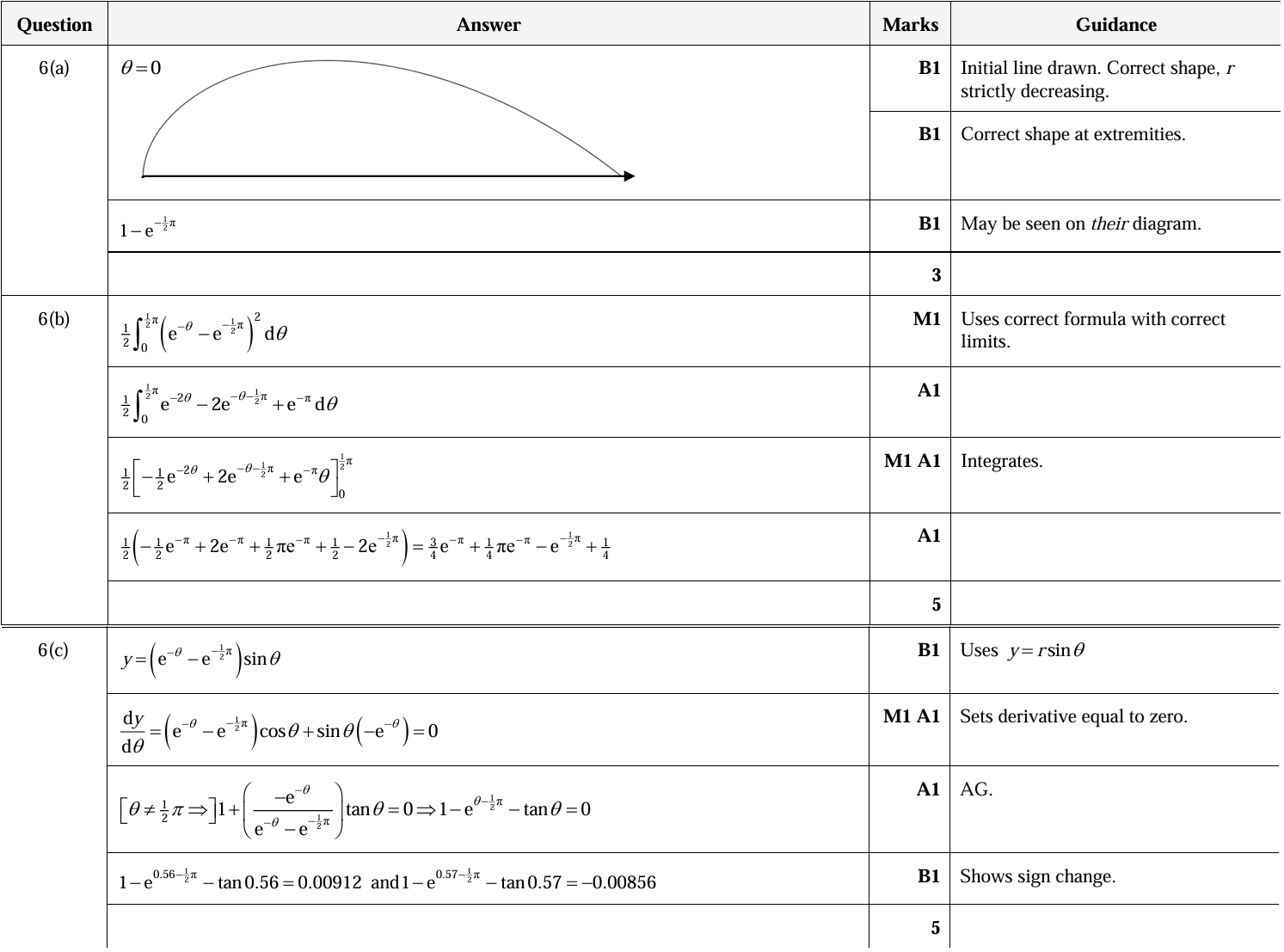
The curve C has polar equation \(r = e^{-\theta} - e^{-\frac{1}{2}\pi}\), where \(0 \leq \theta \leq \frac{1}{2}\pi\).
- Sketch C and state, in exact form, the greatest distance of a point on C from the pole.
- Find the exact value of the area of the region bounded by C and the initial line.
- Show that, at the point on C furthest from the initial line, \(1 - e^{\theta - \frac{1}{2}\pi} - \tan \theta = 0\) and verify that this equation has a root between 0.56 and 0.57.
9231 P13 - Nov 2023 - Q06 - 15 marks
(a) Show that the curve with Cartesian equation \(\left( x - \frac{1}{2} \right)^2 + y^2 = \frac{1}{4}\) has polar equation \(r = \cos \theta\).
The curves \(C_1\) and \(C_2\) have polar equations \(r = \cos \theta\) and \(r = \sin 2\theta\) respectively, where \(0 \leq \theta \leq \frac{1}{2} \pi\). The curves \(C_1\) and \(C_2\) intersect at the pole and at another point \(P\).
(b) Find the polar coordinates of \(P\).
(c) In a single diagram sketch \(C_1\) and \(C_2\), clearly identifying each curve, and mark the point \(P\).
(d) The region \(R\) is enclosed by \(C_1\) and \(C_2\) and includes the line \(OP\). Find, in exact form, the area of \(R\).
9231 P11 - Jun 2023 - Q05 - 12 marks
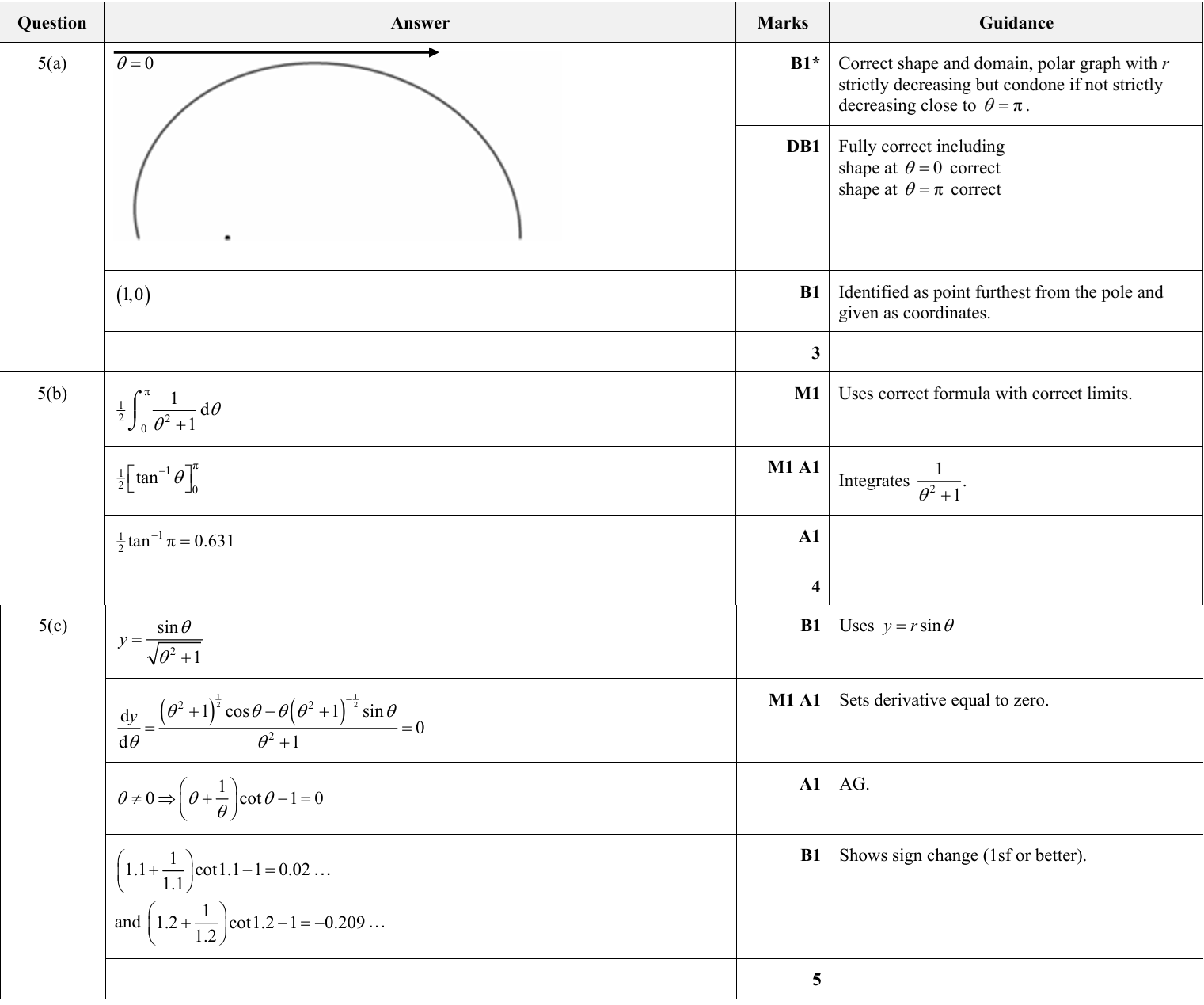
The curve \(C\) has polar equation \(r^2 = \frac{1}{\theta^2 + 1}\), for \(0 \leq \theta \leq \pi\).
- Sketch \(C\) and state the polar coordinates of the point of \(C\) furthest from the pole.
- Find the area of the region enclosed by \(C\), the initial line, and the half-line \(\theta = \pi\).
- Show that, at the point of \(C\) furthest from the initial line, \(\left( \theta + \frac{1}{\theta} \right) \cot \theta - 1 = 0\) and verify that this equation has a root between 1.1 and 1.2.
9231 P12 - Jun 2023 - Q05 - 12 marks
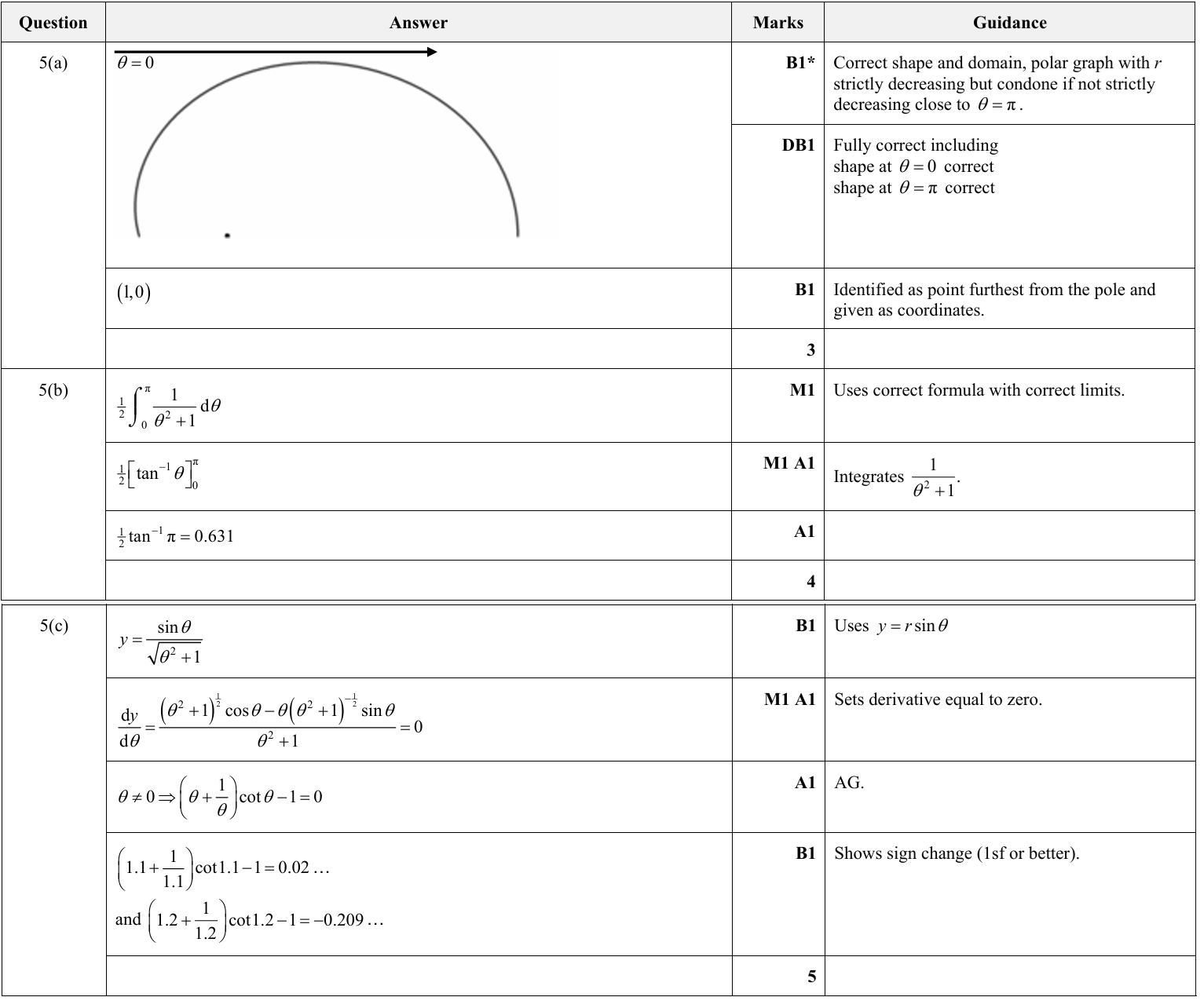
The curve C has polar equation \(r^2 = \frac{1}{\theta^2 + 1}\), for \(0 \leq \theta \leq \pi\).
- Sketch C and state the polar coordinates of the point of C furthest from the pole.
- Find the area of the region enclosed by C, the initial line, and the half-line \(\theta = \pi\).
- Show that, at the point of C furthest from the initial line, \(\left( \theta + \frac{1}{\theta} \right) \cot \theta - 1 = 0\) and verify that this equation has a root between 1.1 and 1.2.
9231 P13 - Jun 2023 - Q05 - 10 marks
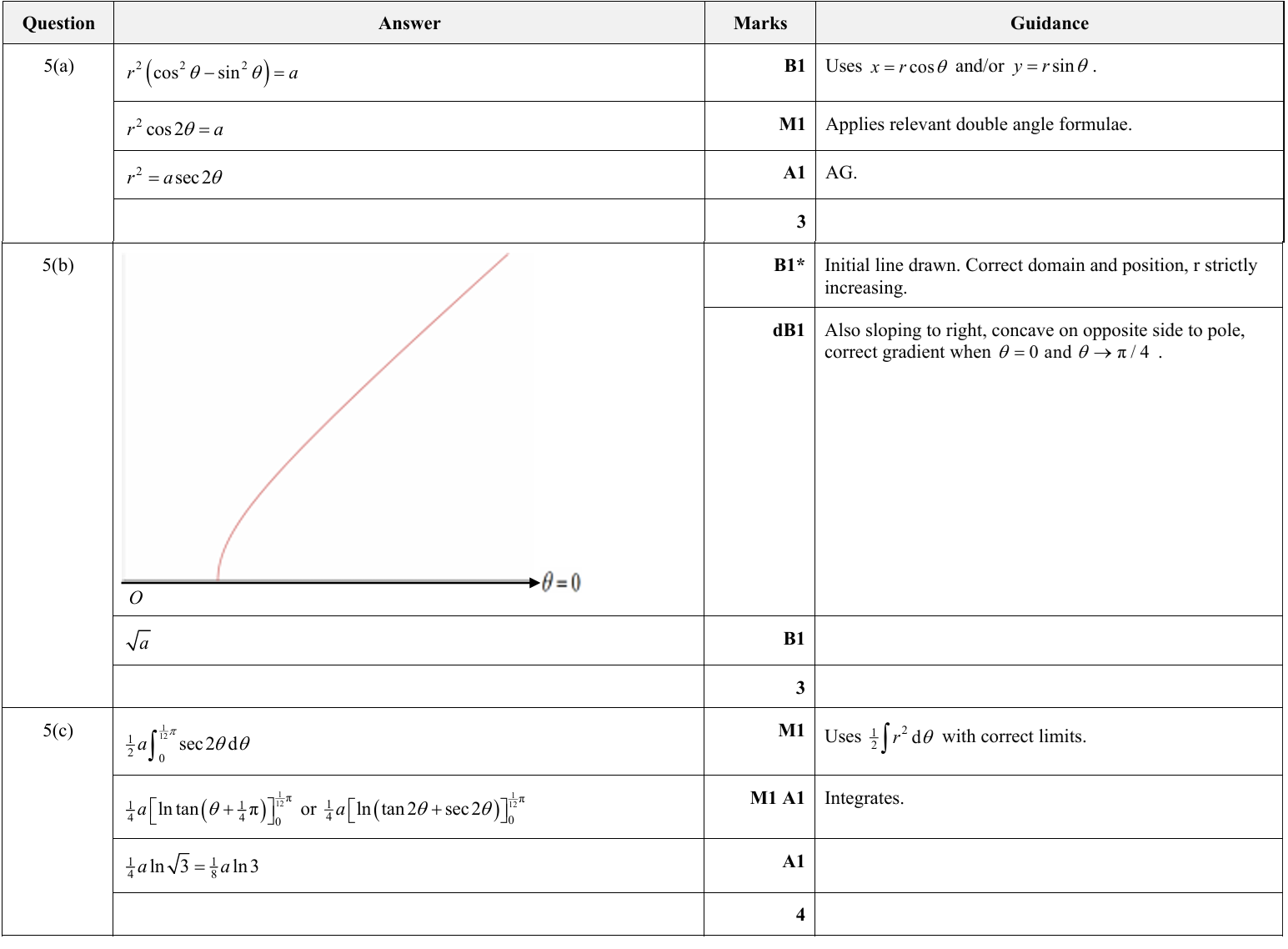
(a) Show that the curve with Cartesian equation \(x^2 - y^2 = a\), where \(a\) is a positive constant, has polar equation \(r^2 = a \sec 2\theta\).
The curve \(C\) has polar equation \(r^2 = a \sec 2\theta\), where \(a\) is a positive constant, for \(0 \leq \theta < \frac{1}{4}\pi\).
(b) Sketch \(C\) and state the minimum distance of \(C\) from the pole.
9231 P12 - Jun 2022 - Q06 - 13 marks
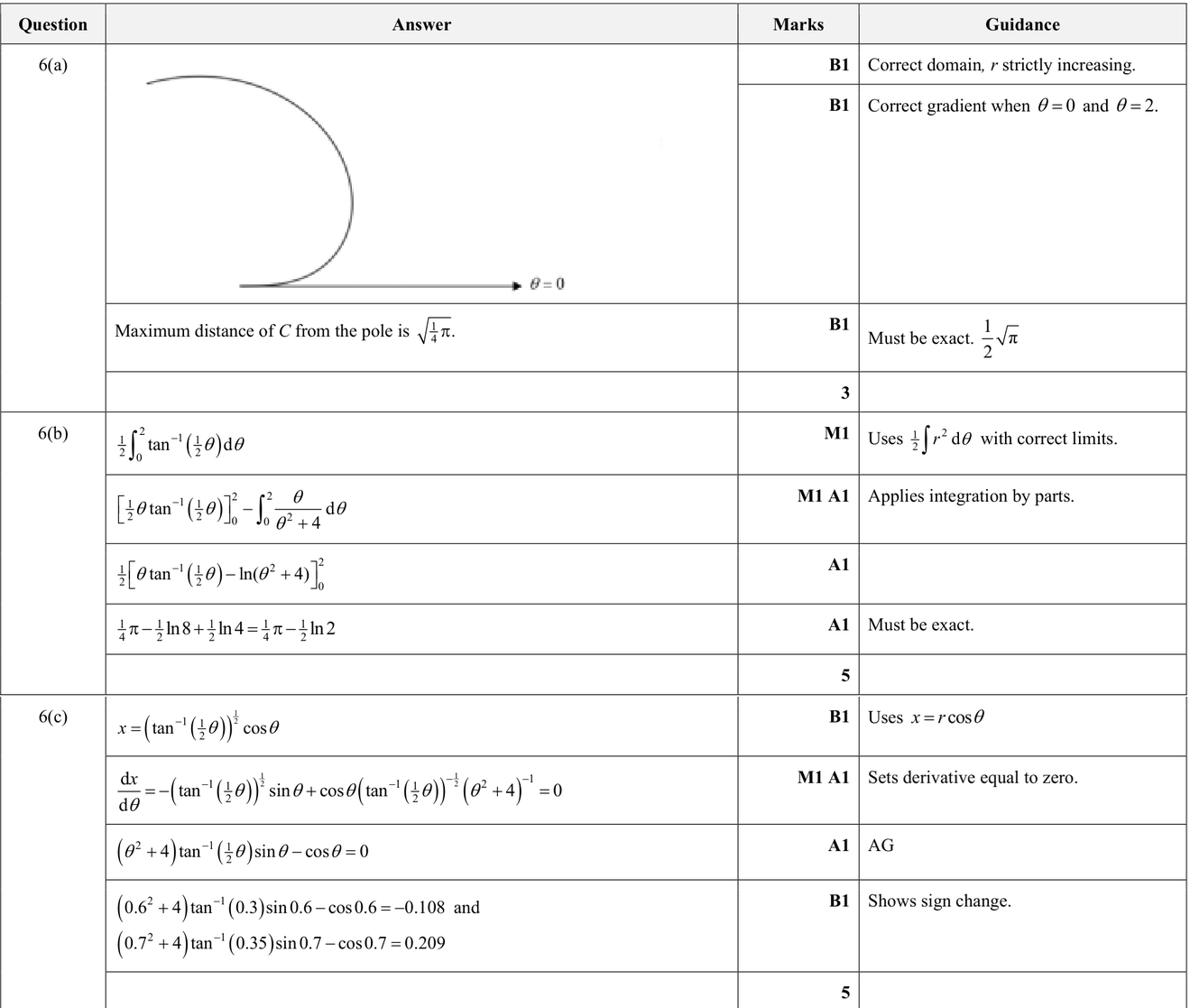
The curve C has polar equation \(r^2 = \arctan\left(\frac{1}{2}\theta\right)\), where \(0 \leq \theta \leq 2\).
(a) Sketch C and state, in exact form, the greatest distance of a point on C from the pole.
(b) Find the exact value of the area of the region bounded by C and the half-line \(\theta = 2\).
Now consider the part of C where \(0 \leq \theta \leq \frac{1}{2}\pi\).
(c) Show that, at the point furthest from the half-line \(\theta = \frac{1}{2}\pi\),
\((\theta^2 + 4)\arctan\left(\frac{1}{2}\theta\right)\sin\theta - \cos\theta = 0\)
and verify that this equation has a root between 0.6 and 0.7.
9231 P13 - Jun 2022 - Q06 - 13 marks
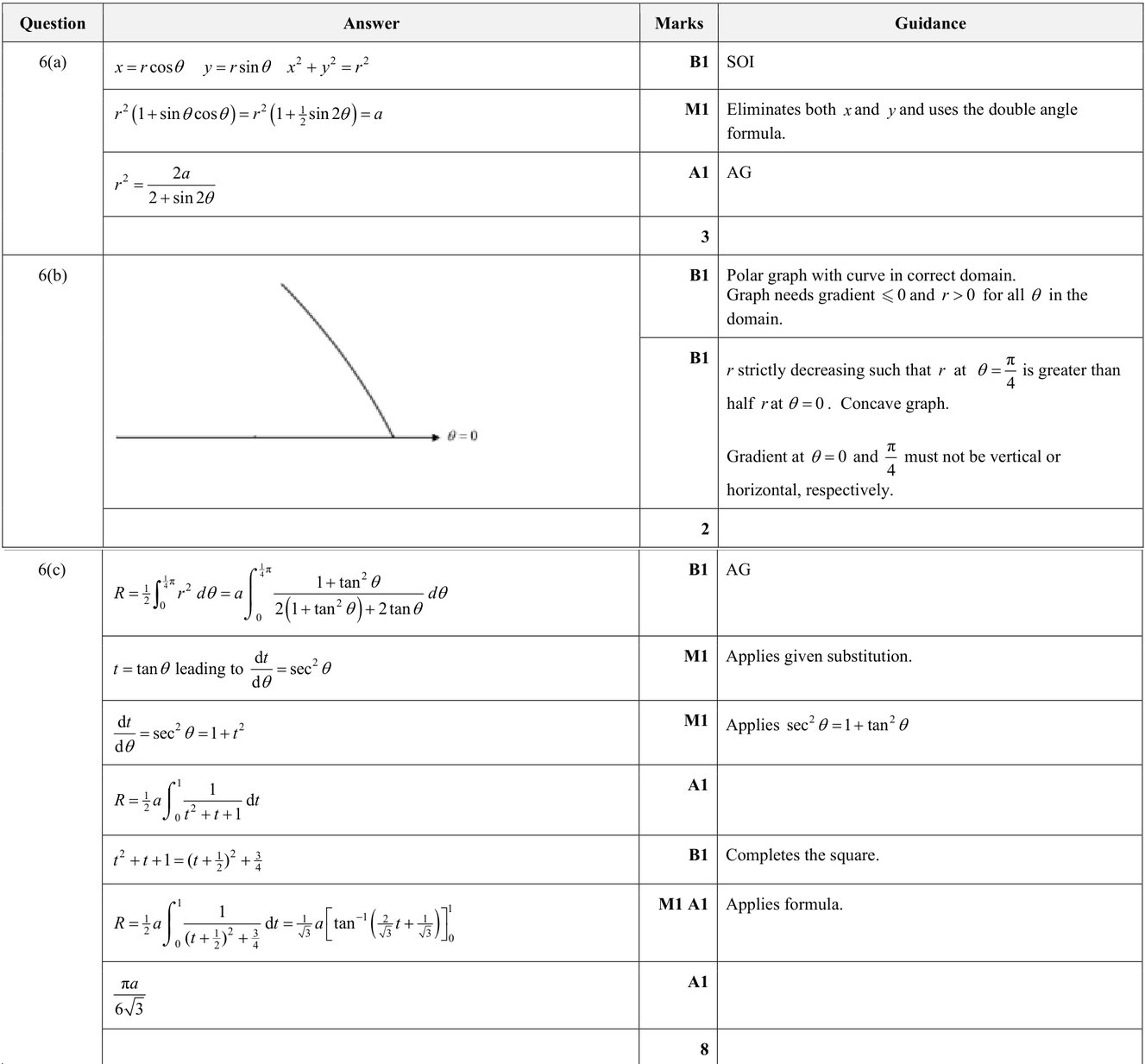
The curve C has Cartesian equation \(x^2 + xy + y^2 = a\), where \(a\) is a positive constant.
(a) Show that the polar equation of C is \(r^2 = \frac{2a}{2 + \sin 2\theta}\).
(b) Sketch the part of C for \(0 \leq \theta \leq \frac{1}{4}\pi\).
The region R is enclosed by this part of C, the initial line and the half-line \(\theta = \frac{1}{4}\pi\).
(c) It is given that \(\sin 2\theta\) may be expressed as \(\frac{2 \tan \theta}{1 + \tan^2 \theta}\). Use this result to show that the area of R is
\(\frac{1}{2} a \int_{0}^{\frac{1}{4}\pi} \frac{1 + \tan^2 \theta}{1 + \tan \theta + \tan^2 \theta} \, d\theta\)
and use the substitution \(t = \tan \theta\) to find the exact value of this area.
9231 P11 - Nov 2022 - Q06 - 14 marks
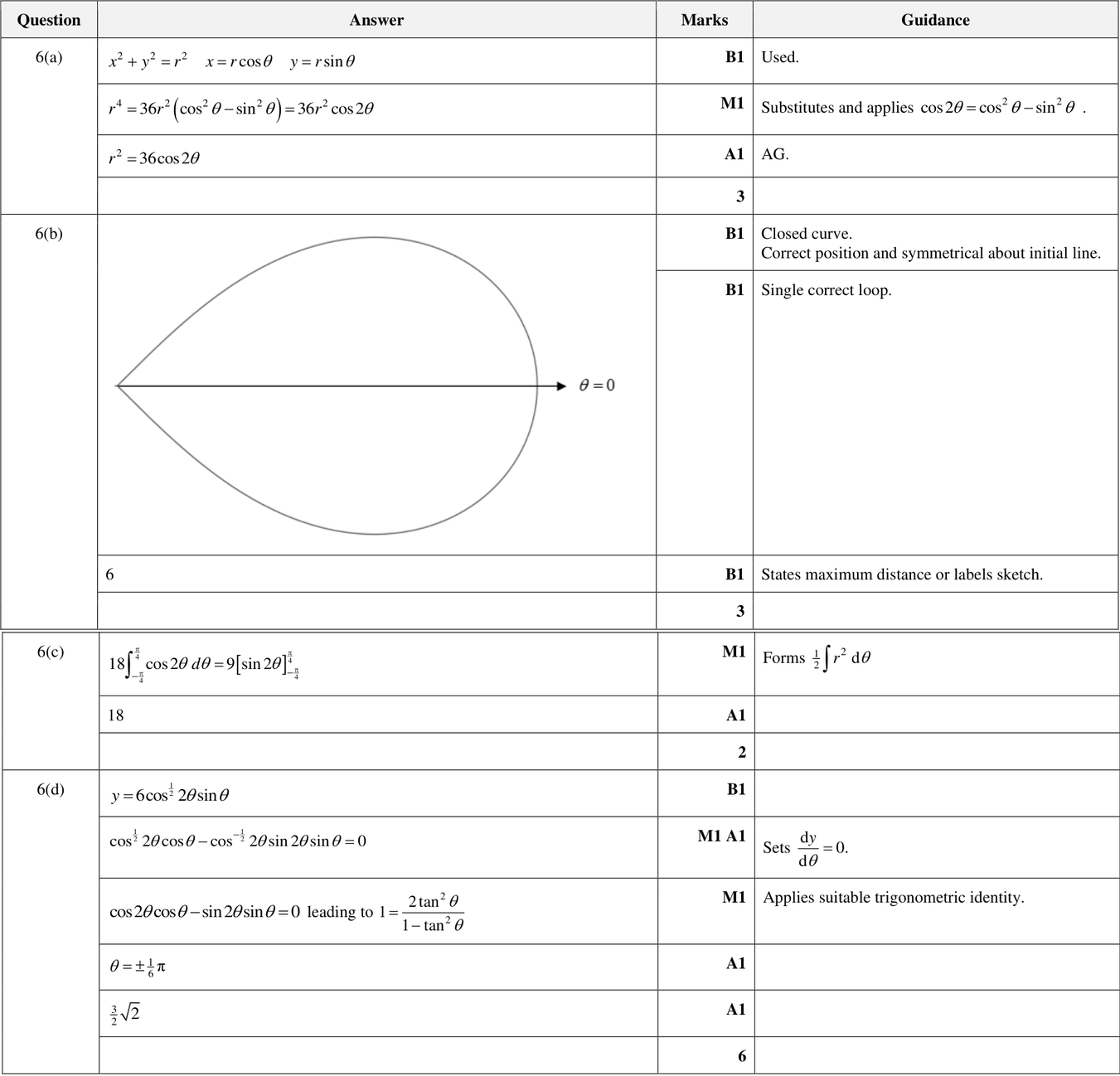
(a) Show that the curve with Cartesian equation \((x^2 + y^2)^2 = 36(x^2 - y^2)\) has polar equation \(r^2 = 36 \cos 2\theta\).
The curve \(C\) has polar equation \(r^2 = 36 \cos 2\theta\), for \(-\frac{1}{4}\pi \leq \theta \leq \frac{1}{4}\pi\).
(b) Sketch \(C\) and state the maximum distance of a point on \(C\) from the pole.
(c) Find the area of the region enclosed by \(C\).
(d) Find the maximum distance of a point on \(C\) from the initial line, giving the answer in exact form.
9231 P12 - Nov 2022 - Q05 - 12 marks
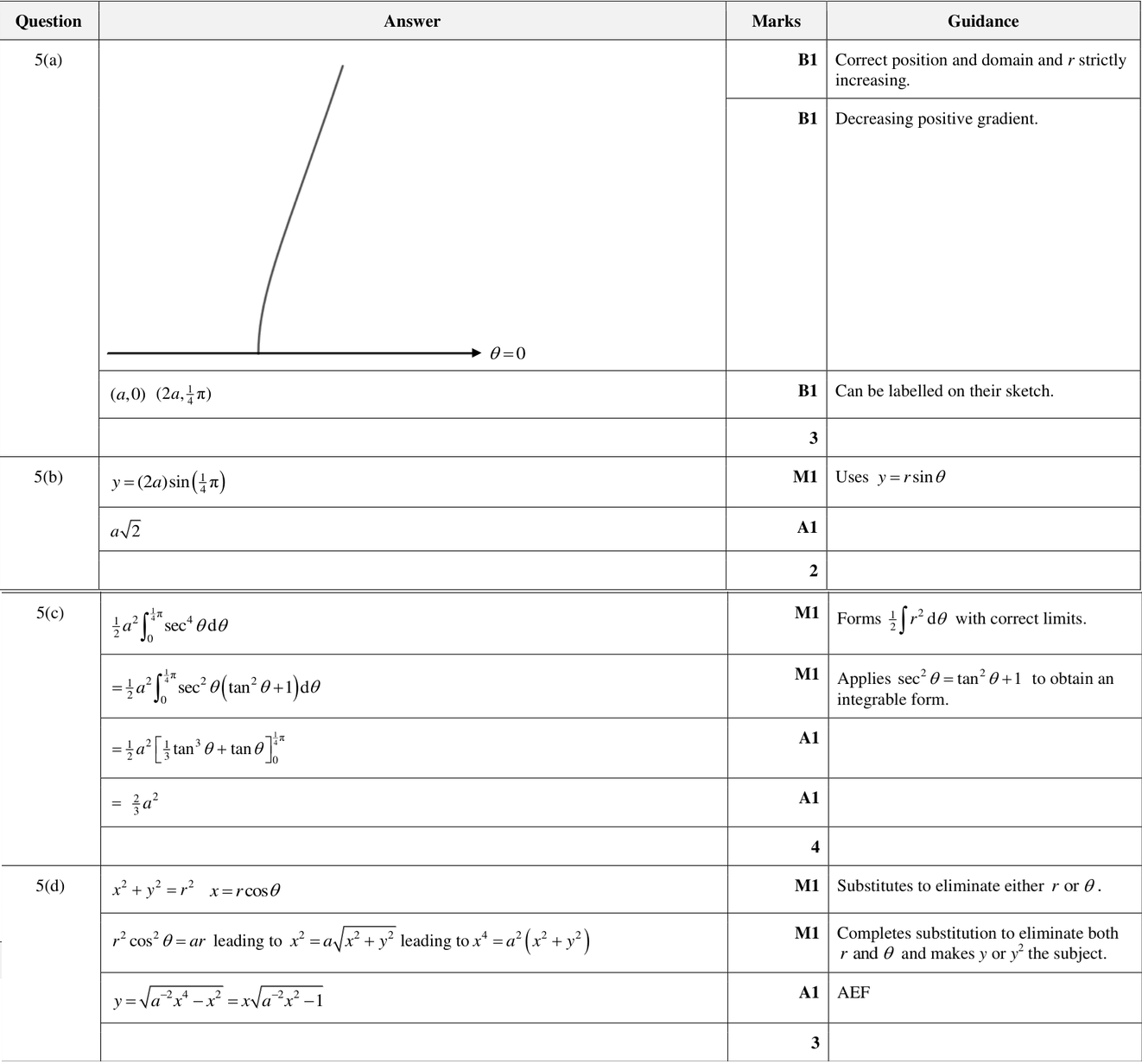
The curve C has polar equation \(r = a \sec^2 \theta\), where \(a\) is a positive constant and \(0 \leq \theta \leq \frac{1}{4} \pi\).
- Sketch C, stating the polar coordinates of the point of intersection of C with the initial line and also with the half-line \(\theta = \frac{1}{4} \pi\).
- Find the maximum distance of a point of C from the initial line.
- Find the area of the region enclosed by C, the initial line and the half-line \(\theta = \frac{1}{4} \pi\).
- Find, in the form \(y = f(x)\), the Cartesian equation of C.
9231 P12 - Jun 2021 - Q05 - 10 marks
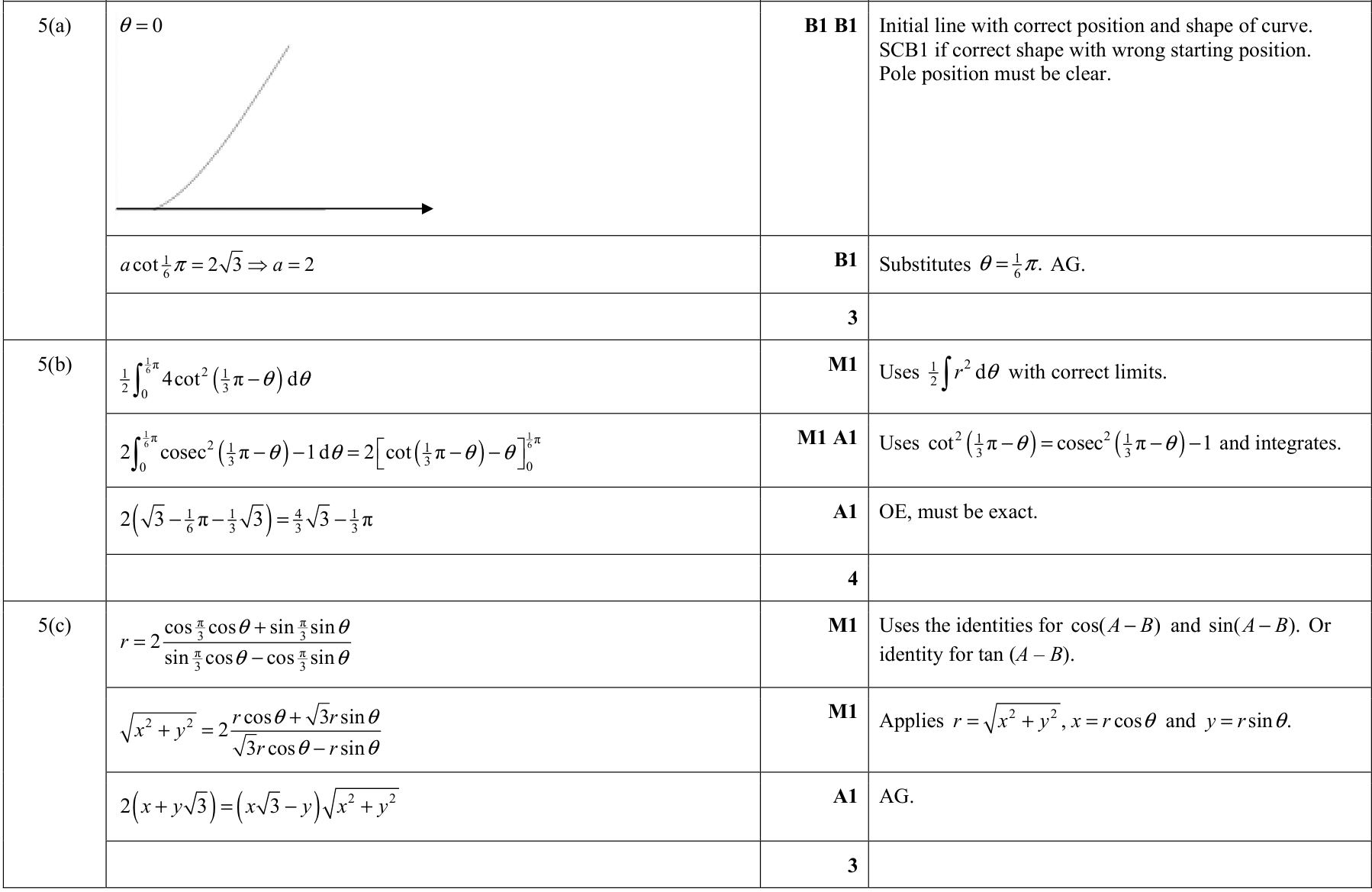
The curve C has polar equation \(r = a \cot\left(\frac{1}{3}\pi - \theta\right)\), where \(a\) is a positive constant and \(0 \leq \theta \leq \frac{1}{6}\pi\).
It is given that the greatest distance of a point on C from the pole is \(2\sqrt{3}\).
- Sketch C and show that \(a = 2\). [3]
- Find the exact value of the area of the region bounded by C, the initial line and the half-line \(\theta = \frac{1}{6}\pi\). [4]
- Show that C has Cartesian equation \(2(x + y\sqrt{3}) = (x\sqrt{3} - y)\sqrt{x^2 + y^2}\). [3]