0606 P13 - Nov 2019 - Q8 - 8 marks
8351
(a) Given that \(\log_a x=p\) and \(\log_a y=q\), find, in terms of \(p\) and \(q\),
(i) \(\log_a axy^2\),
(ii) \(\log_a\left(\frac{x^3}{ay}\right)\),
(iii) \(\log_x a+\log_y a\).
(b) Using the substitution \(m=3^x\), or otherwise, solve
\(3^x-3^{1+2x}+4=0.\)
Solution
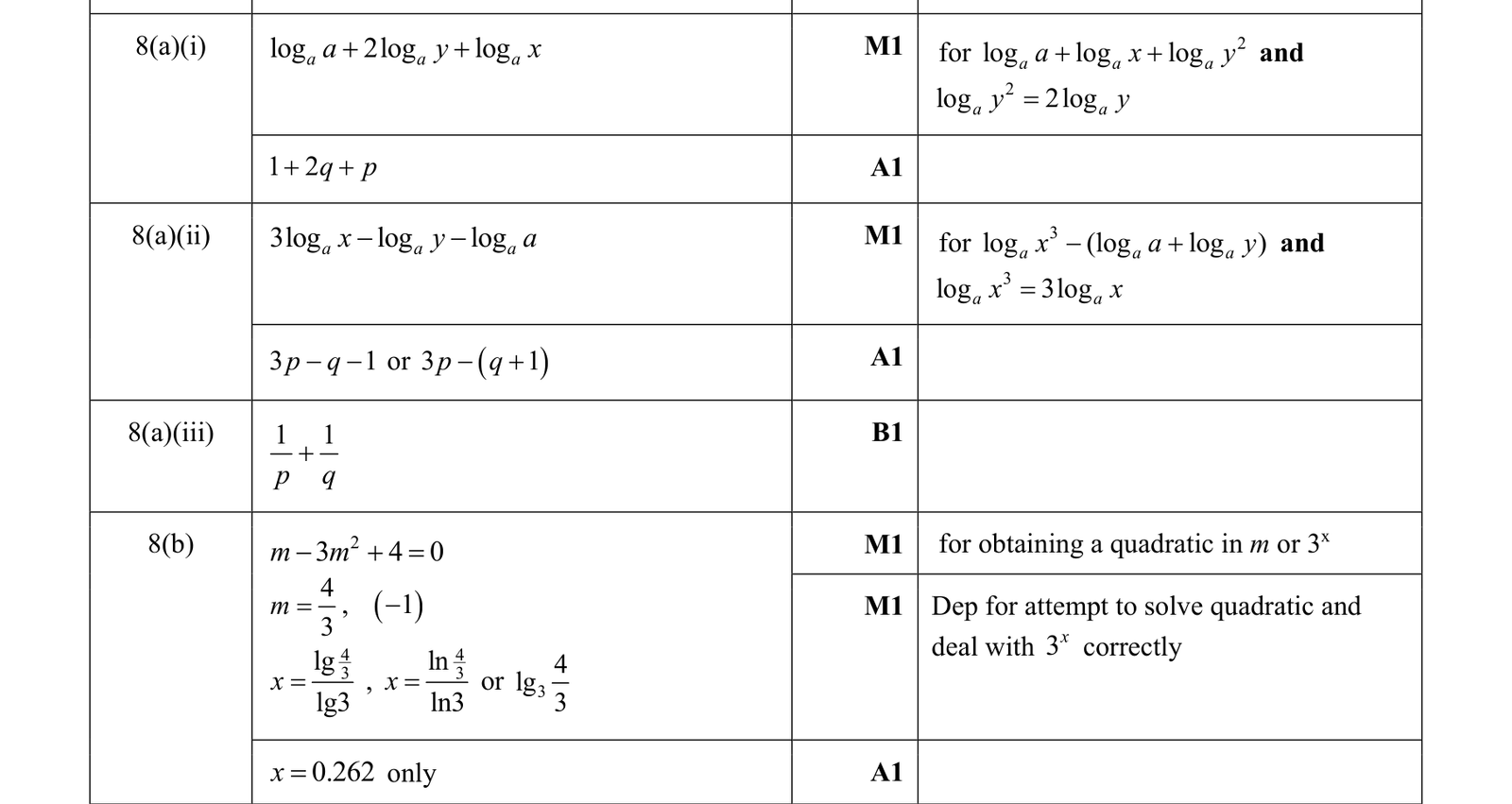
Answer: (a)(i) \(1+p+2q\), (ii) \(3p-q-1\), (iii) \(\frac1p+\frac1q\). (b) \(x=\log_3\frac43\approx0.262\).
(a)(i)
\(\log_a(axy^2)=\log_a a+\log_a x+\log_a y^2.\)
So
\(\log_a(axy^2)=1+p+2q.\)
(a)(ii)
\(\log_a\left(\frac{x^3}{ay}\right)=\log_a x^3-\log_a a-\log_a y.\)
Therefore
\(\log_a\left(\frac{x^3}{ay}\right)=3p-1-q.\)
(a)(iii) By the reciprocal law,
\(\log_x a=\frac1{\log_a x}=\frac1p,\qquad \log_y a=\frac1{\log_a y}=\frac1q.\)
Hence
\(\log_x a+\log_y a=\frac1p+\frac1q.\)
(b) Let
\(m=3^x.\)
Then
\(3^{1+2x}=3(3^x)^2=3m^2.\)
The equation becomes
\(m-3m^2+4=0.\)
So
\(3m^2-m-4=0.\)
Factorise:
\((3m-4)(m+1)=0.\)
Since \(m=3^x\gt 0\), we take
\(m=\frac43.\)
Therefore
\(3^x=\frac43,\)
so
\(\boxed{x=\log_3\frac43\approx0.262}.\)