Past Exam Questions
← Back9709 P11 - Jun 2011 - Q5 - 6 marks
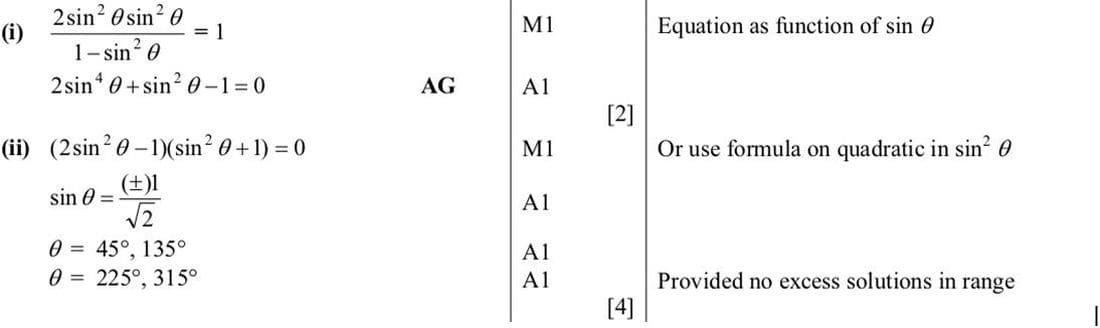
(i) Show that the equation \(2 \tan^2 \theta \sin^2 \theta = 1\) can be written in the form \(2 \sin^4 \theta + \sin^2 \theta - 1 = 0\).
(ii) Hence solve the equation \(2 \tan^2 \theta \sin^2 \theta = 1\) for \(0^\circ \leq \theta \leq 360^\circ\).
9709 P13 - Nov 2010 - Q3 - 4 marks
Solve the equation \(15 \sin^2 x = 13 + \cos x\) for \(0^\circ \leq x \leq 180^\circ\).

9709 P13 - Jun 2010 - Q4 - 5 marks
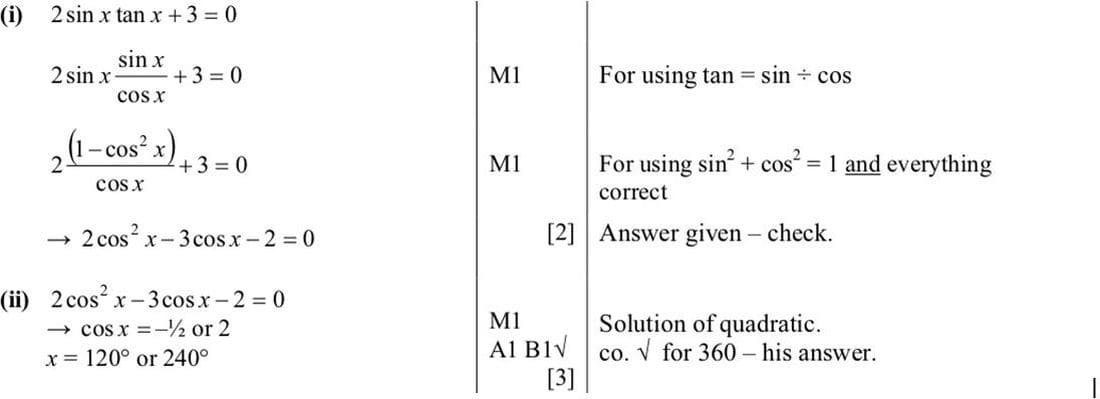
(i) Show that the equation \(2 \sin x \tan x + 3 = 0\) can be expressed as \(2 \cos^2 x - 3 \cos x - 2 = 0\).
(ii) Solve the equation \(2 \sin x \tan x + 3 = 0\) for \(0^\circ \leq x \leq 360^\circ\).
9709 P1 - Jun 2008 - Q2 - 5 marks
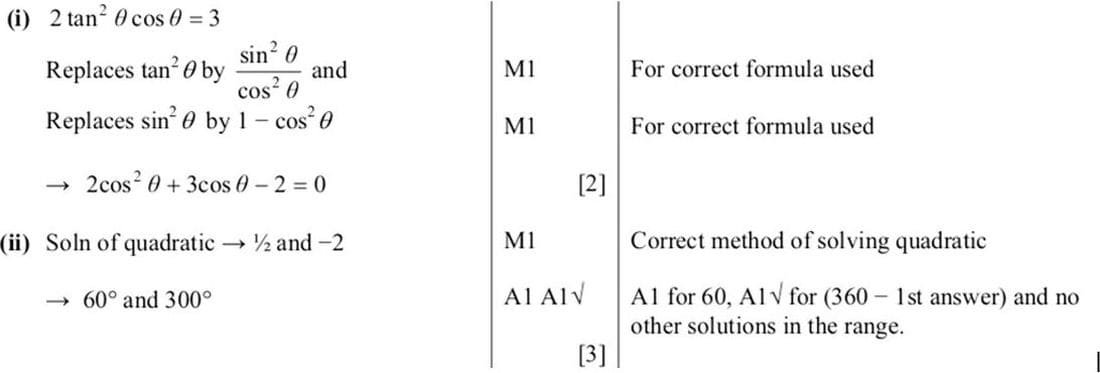
(i) Show that the equation \(2 \tan^2 \theta \cos \theta = 3\) can be written in the form \(2 \cos^2 \theta + 3 \cos \theta - 2 = 0\).
(ii) Hence solve the equation \(2 \tan^2 \theta \cos \theta = 3\), for \(0^\circ \leq \theta \leq 360^\circ\).
9709 P1 - Nov 2007 - Q5 - 6 marks
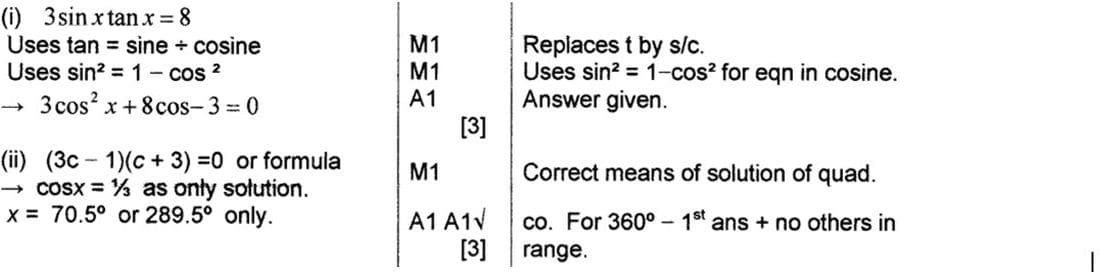
(i) Show that the equation \(3 \sin x \tan x = 8\) can be written as \(3 \cos^2 x + 8 \cos x - 3 = 0\).
(ii) Hence solve the equation \(3 \sin x \tan x = 8\) for \(0^\circ \leq x \leq 360^\circ\).
9709 P1 - Nov 2005 - Q1 - 4 marks
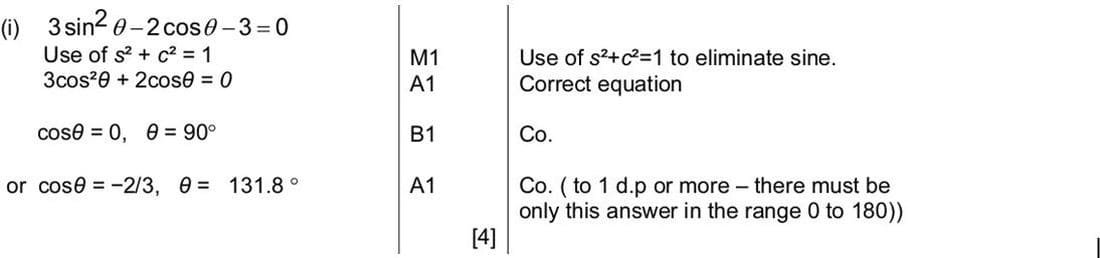
Solve the equation \(3 \sin^2 \theta - 2 \cos \theta - 3 = 0\), for \(0^\circ \leq \theta \leq 180^\circ\).
9709 P1 - Jun 2004 - Q3 - 5 marks
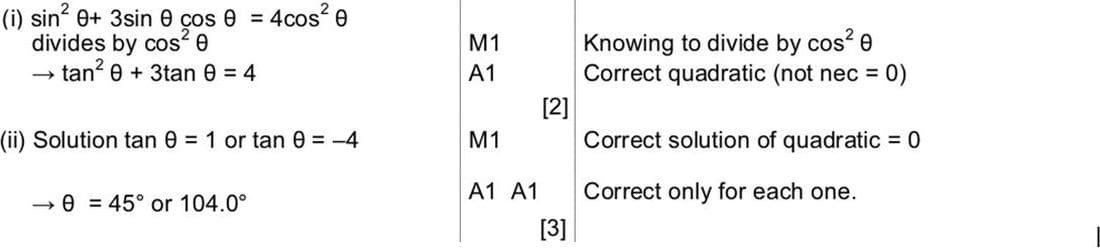
(i) Show that the equation \(\sin^2 \theta + 3 \sin \theta \cos \theta = 4 \cos^2 \theta\) can be written as a quadratic equation in \(\tan \theta\).
(ii) Hence, or otherwise, solve the equation in part (i) for \(0^\circ \leq \theta \leq 180^\circ\).
9709 P1 - Nov 2003 - Q2 - 5 marks
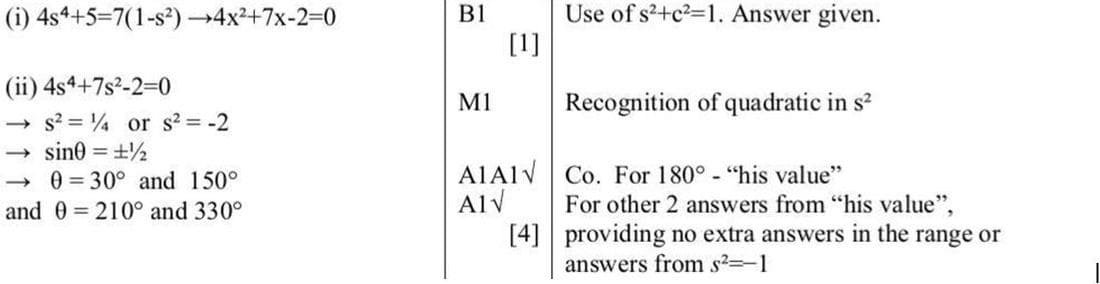
(i) Show that the equation \(4 \sin^4 \theta + 5 = 7 \cos^2 \theta\) may be written in the form \(4x^2 + 7x - 2 = 0\), where \(x = \sin^2 \theta\).
(ii) Hence solve the equation \(4 \sin^4 \theta + 5 = 7 \cos^2 \theta\), for \(0^\circ \leq \theta \leq 360^\circ\).
9709 P12 - Jun 2023 - Q7 - 11 marks
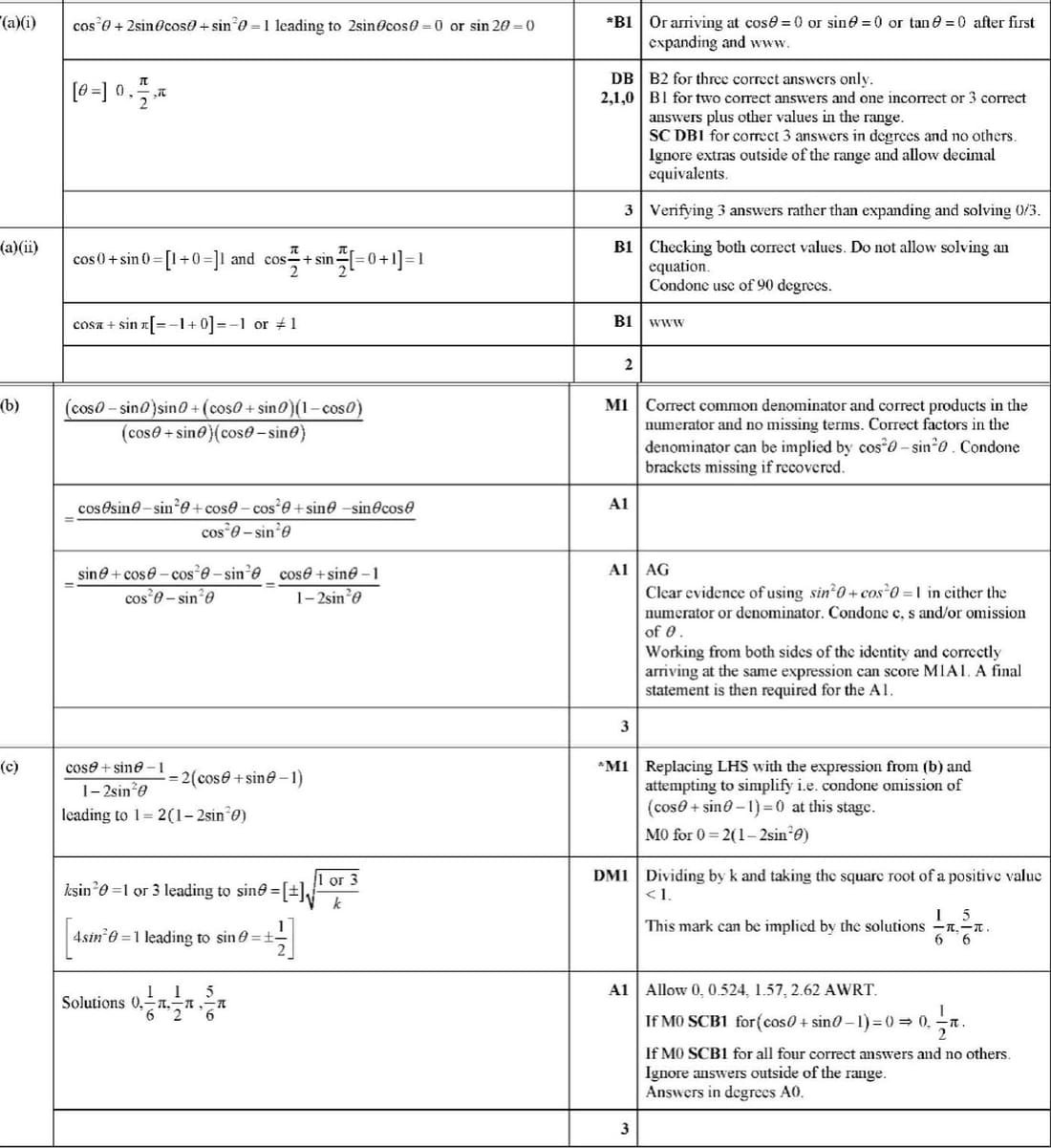
(a) (i) By first expanding \((\cos \theta + \sin \theta)^2\), find the three solutions of the equation \((\cos \theta + \sin \theta)^2 = 1\) for \(0 \leq \theta \leq \pi\).
(ii) Hence verify that the only solutions of the equation \(\cos \theta + \sin \theta = 1\) for \(0 \leq \theta \leq \pi\) are \(0\) and \(\frac{1}{2}\pi\).
(b) Prove the identity \(\frac{\sin \theta}{\cos \theta + \sin \theta} + \frac{1 - \cos \theta}{\cos \theta - \sin \theta} \equiv \frac{\cos \theta + \sin \theta - 1}{1 - 2 \sin^2 \theta}\).
(c) Using the results of (a)(ii) and (b), solve the equation \(\frac{\sin \theta}{\cos \theta + \sin \theta} + \frac{1 - \cos \theta}{\cos \theta - \sin \theta} = 2(\cos \theta + \sin \theta - 1)\) for \(0 \leq \theta \leq \pi\).
9709 P1 - Nov 2002 - Q5 - 6 marks
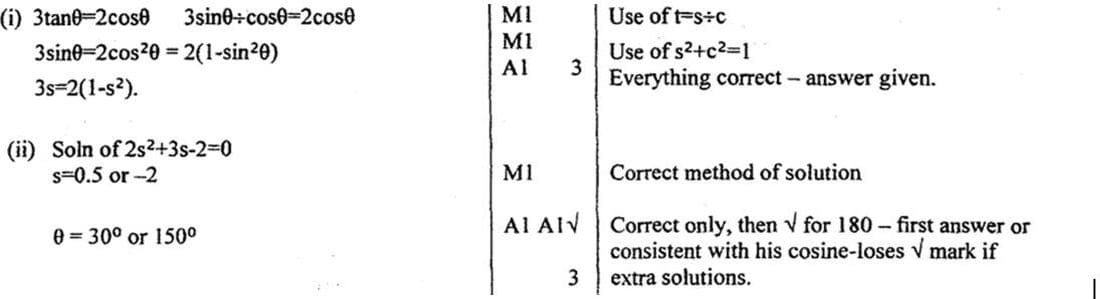
(i) Show that the equation \(3 \tan \theta = 2 \cos \theta\) can be expressed as \(2 \sin^2 \theta + 3 \sin \theta - 2 = 0\).
(ii) Hence solve the equation \(3 \tan \theta = 2 \cos \theta\), for \(0^\circ \leq \theta \leq 360^\circ\).
9709 P1 - Jun 2002 - Q2 - 5 marks
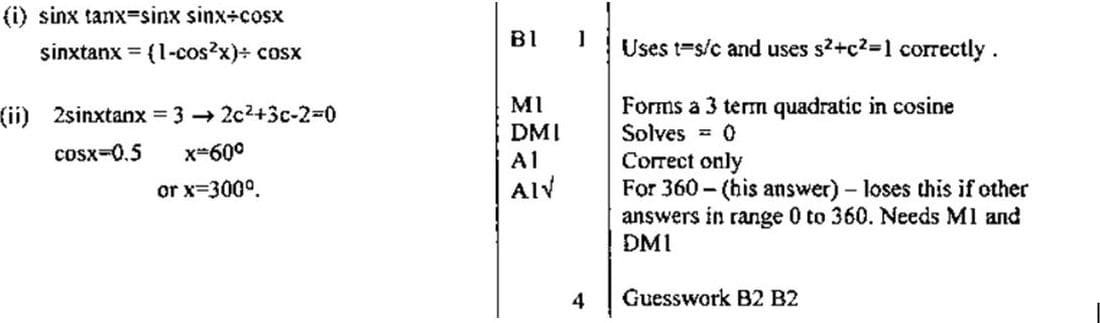
(i) Show that \(\sin x \tan x\) may be written as \(\frac{1 - \cos^2 x}{\cos x}\).
(ii) Hence solve the equation \(2 \sin x \tan x = 3\), for \(0^\circ \leq x \leq 360^\circ\).
9709 P12 - Mar 2023 - Q7A - 5 marks
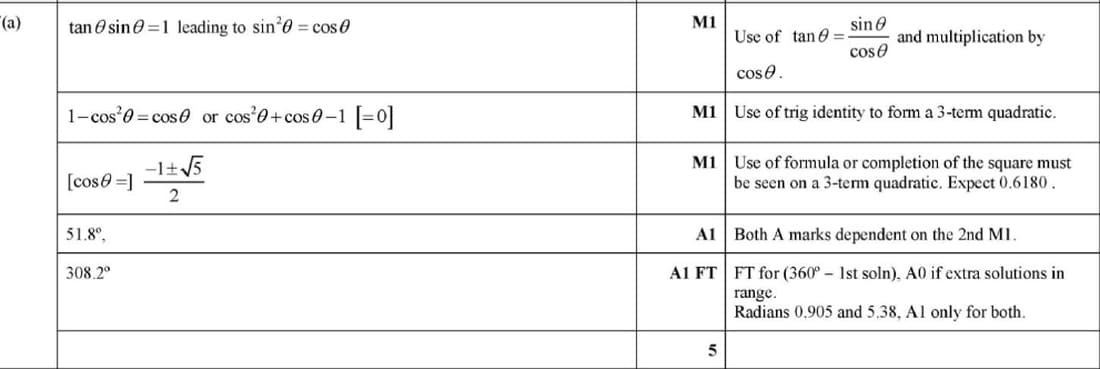
By first obtaining a quadratic equation in \(\cos \theta\), solve the equation
\(\tan \theta \sin \theta = 1\)
for \(0^\circ < \theta < 360^\circ\).
9709 P13 - Nov 2022 - Q1 - 3 marks
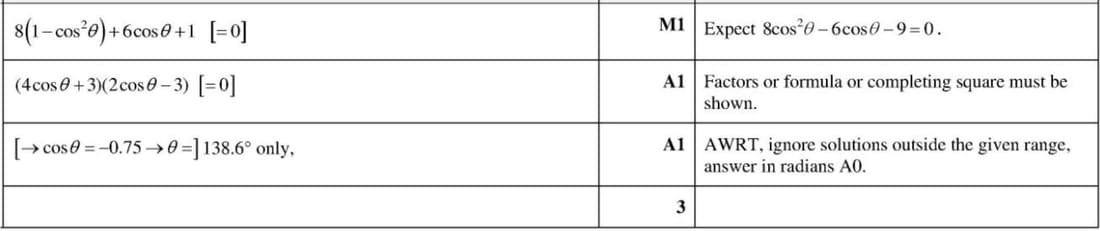
Solve the equation \(8 \sin^2 \theta + 6 \cos \theta + 1 = 0\) for \(0^\circ < \theta < 180^\circ\).
9709 P12 - Nov 2022 - Q7 - 7 marks
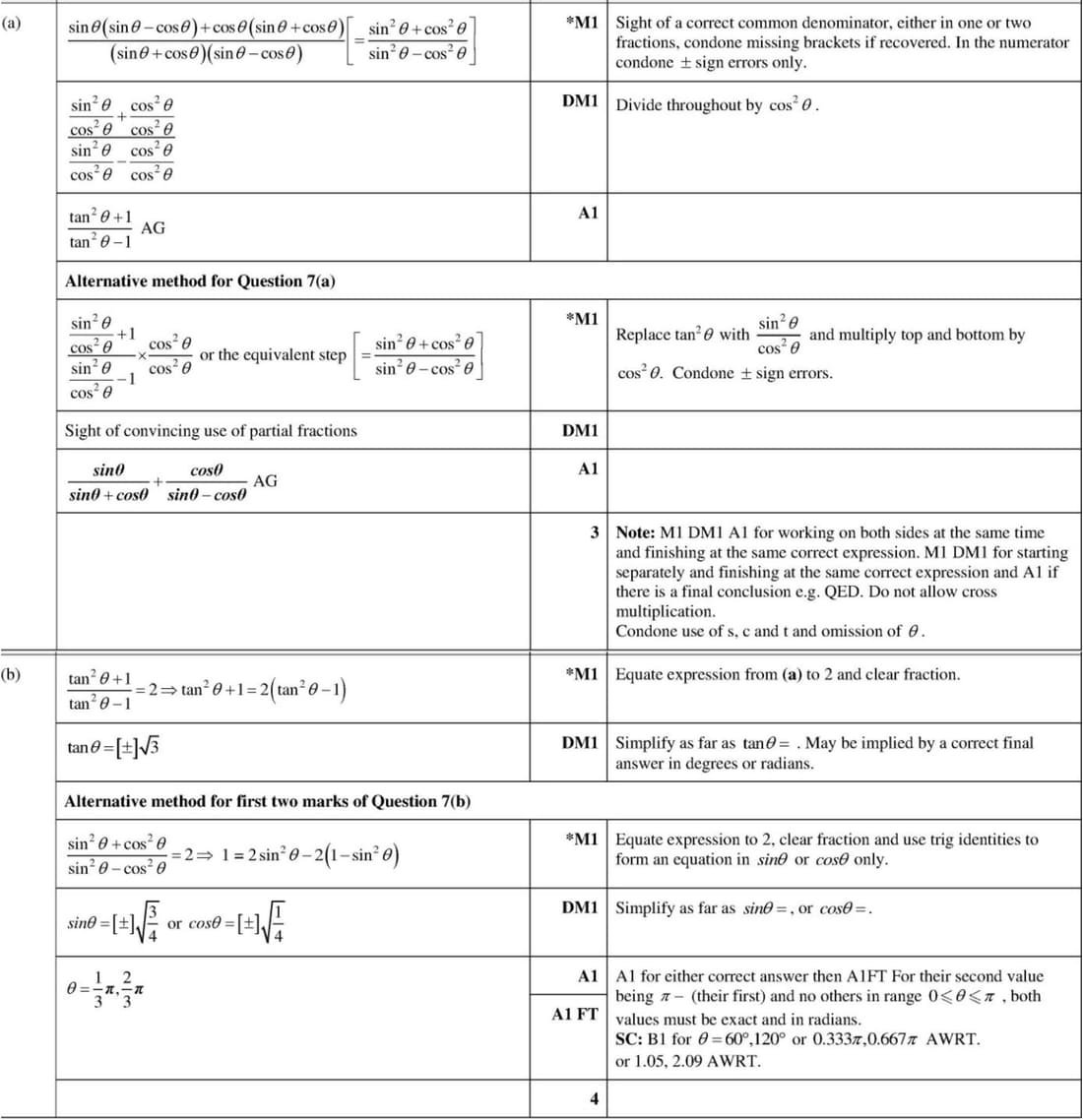
(a) Prove the identity \(\frac{\sin \theta}{\sin \theta + \cos \theta} + \frac{\cos \theta}{\sin \theta - \cos \theta} \equiv \frac{\tan^2 \theta + 1}{\tan^2 \theta - 1}\).
(b) Hence find the exact solutions of the equation \(\frac{\sin \theta}{\sin \theta + \cos \theta} + \frac{\cos \theta}{\sin \theta - \cos \theta} = 2\) for \(0 \leq \theta \leq \pi\).
9709 P12 - Nov 2022 - Q3B - 3 marks
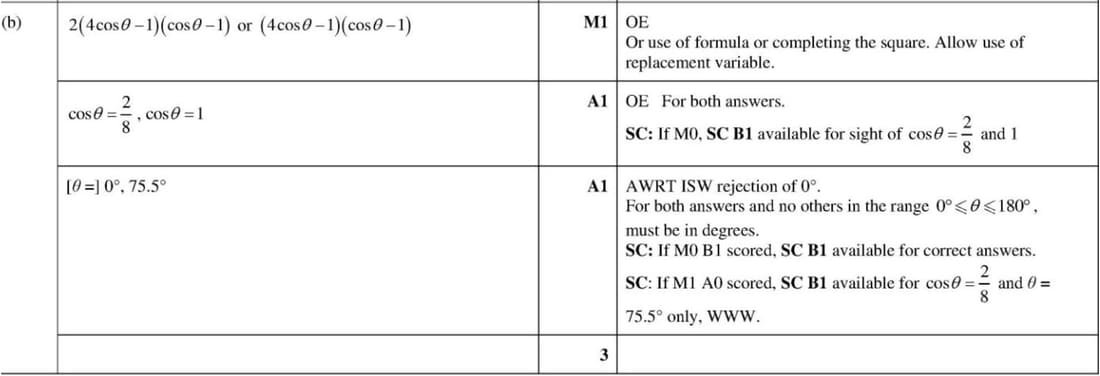
Solve the equation \(8 \cos^2 \theta - 10 \cos \theta + 2 = 0\) for \(0^\circ \leq \theta \leq 180^\circ\).
9709 P12 - Nov 2023 - Q2
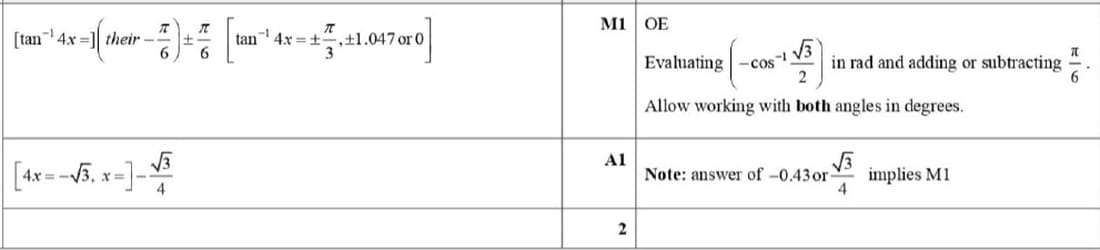
Find the exact solution of the equation
\(\frac{1}{6}\pi + \arctan(4x) = -\cos^{-1}\left(\frac{1}{2}\sqrt{3}\right)\).
9709 P13 - Jun 2018 - Q7
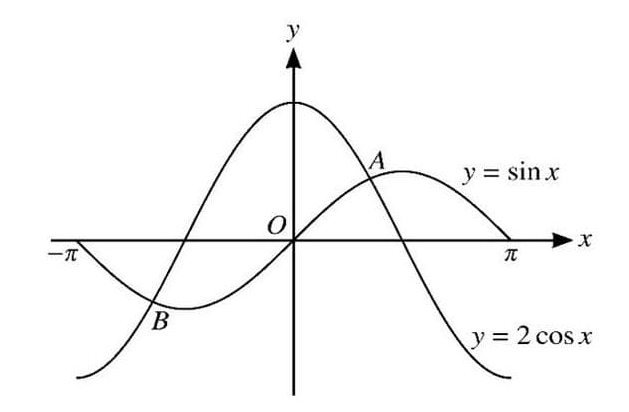
The diagram shows the graphs of \(y = \sin x\) and \(y = 2 \cos x\) for \(-\pi \leq x \leq \pi\). The graphs intersect at the points \(A\) and \(B\).
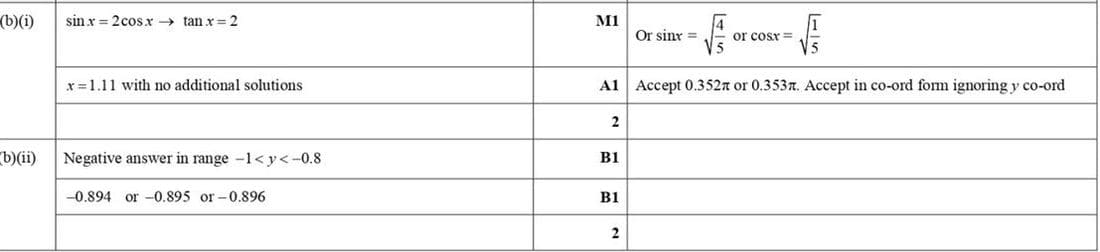
(i) Find the \(x\)-coordinate of \(A\).
(ii) Find the \(y\)-coordinate of \(B\).
9709 P12 - Jun 2018 - Q4
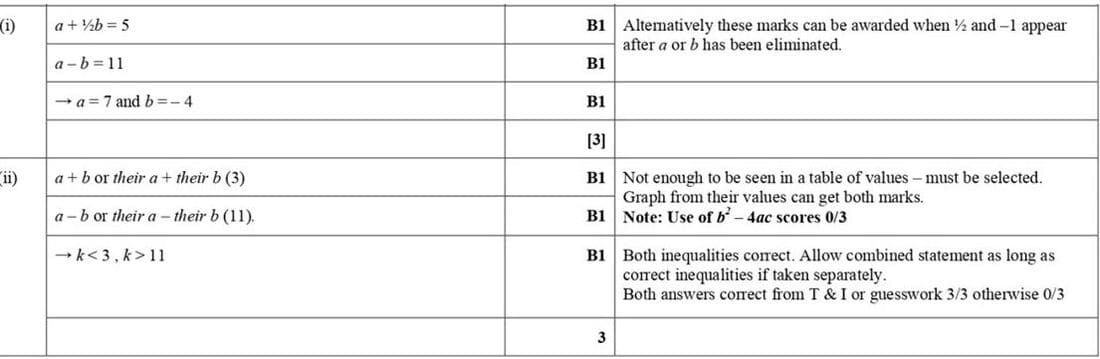
The function \(f\) is such that \(f(x) = a + b \cos x\) for \(0 \leq x \leq 2\pi\). It is given that \(f\left(\frac{1}{3}\pi\right) = 5\) and \(f(\pi) = 11\).
(i) Find the values of the constants \(a\) and \(b\).
(ii) Find the set of values of \(k\) for which the equation \(f(x) = k\) has no solution.
Question #569
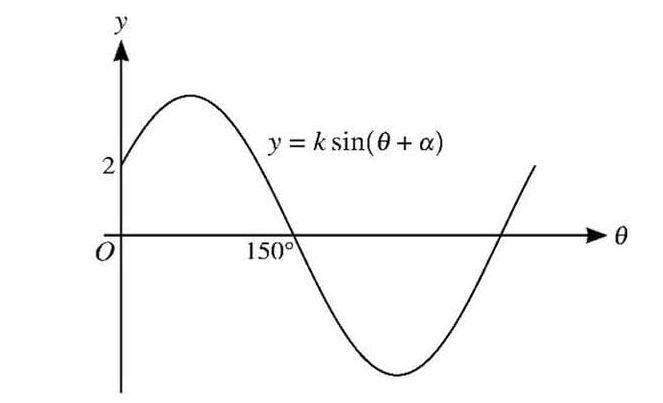
The diagram shows part of the graph of \(y = k \sin(\theta + \alpha)\), where \(k\) and \(\alpha\) are constants and \(0^\circ < \alpha < 180^\circ\). The graph has a maximum point at \(y = 2\) and \(\theta = 0^\circ\), and it crosses the \(\theta\)-axis at \(\theta = 150^\circ\). Find the value of \(\alpha\) and the value of \(k\).

9709 P12 - Mar 2018 - Q4
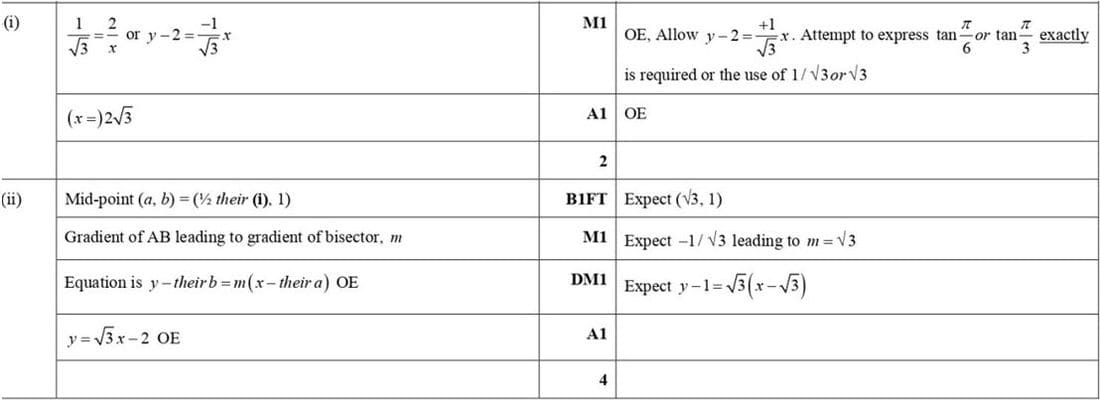
A straight line cuts the positive x-axis at A and the positive y-axis at B (0, 2). Angle BAO = \(\frac{1}{6} \pi\) radians, where O is the origin.
(i) Find the exact value of the x-coordinate of A.
(ii) Find the equation of the perpendicular bisector of AB, giving your answer in the form \(y = mx + c\), where \(m\) is given exactly and \(c\) is an integer.