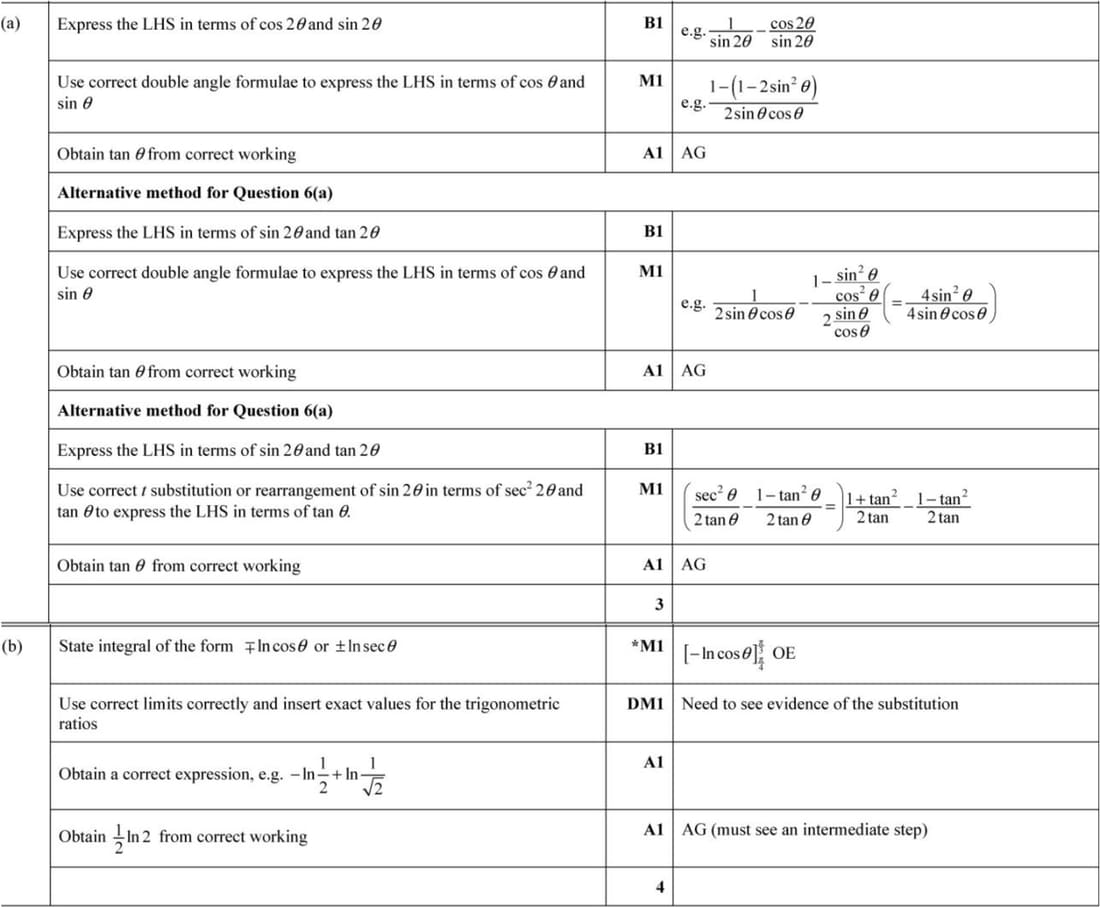
(a) Express \(\csc 2\theta\) and \(\cot 2\theta\) in terms of \(\sin 2\theta\) and \(\cos 2\theta\):
\(\csc 2\theta = \frac{1}{\sin 2\theta}\)
\(\cot 2\theta = \frac{\cos 2\theta}{\sin 2\theta}\)
Thus, \(\csc 2\theta - \cot 2\theta = \frac{1 - \cos 2\theta}{\sin 2\theta}\).
Using the double angle identity \(\cos 2\theta = 1 - 2\sin^2 \theta\), we have:
\(\csc 2\theta - \cot 2\theta = \frac{1 - (1 - 2\sin^2 \theta)}{2\sin \theta \cos \theta} = \frac{2\sin^2 \theta}{2\sin \theta \cos \theta} = \frac{\sin \theta}{\cos \theta} = \tan \theta\).
(b) The integral becomes:
\(\int_{\frac{1}{4}\pi}^{\frac{3}{4}\pi} (\csc 2\theta - \cot 2\theta) \, d\theta = \int_{\frac{1}{4}\pi}^{\frac{3}{4}\pi} \tan \theta \, d\theta\).
The integral of \(\tan \theta\) is \(-\ln |\cos \theta|\).
Evaluate from \(\frac{1}{4}\pi\) to \(\frac{3}{4}\pi\):
\(-\ln |\cos \frac{3}{4}\pi| + \ln |\cos \frac{1}{4}\pi|\).
\(\cos \frac{3}{4}\pi = -\frac{1}{\sqrt{2}}\) and \(\cos \frac{1}{4}\pi = \frac{1}{\sqrt{2}}\).
Thus, \(-\ln \left(\frac{1}{\sqrt{2}}\right) + \ln \left(\frac{1}{\sqrt{2}}\right) = \ln 2\).
Therefore, the result is \(\frac{1}{2} \ln 2\).