9709 P12 - Jun 2021 - Q3 - 4 marks
The equation of a curve is \(y=(x-3)\sqrt{x+1}+3\). The following points lie on the curve. Non-exact values are rounded to 4 decimal places.
| Point | Coordinates |
|---|---|
| A | \((2,k)\) |
| B | \((2.9,2.8025)\) |
| C | \((2.99,2.9800)\) |
| D | \((2.999,2.9980)\) |
| E | \((3,3)\) |
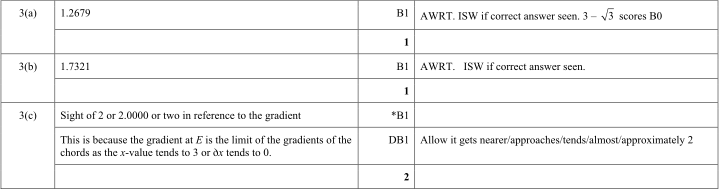
(a) Find k, giving your answer correct to 4 decimal places. [1]
(b) Find the gradient of AE, giving your answer correct to 4 decimal places. [1]
The gradients of BE, CE and DE, rounded to 4 decimal places, are 1.9748, 1.9975 and 1.9997 respectively.
(c) State, giving a reason for your answer, what the values of the four gradients suggest about the gradient of the curve at E. [2]
9709 P13 - Nov 2021 - Q3 - 5 marks
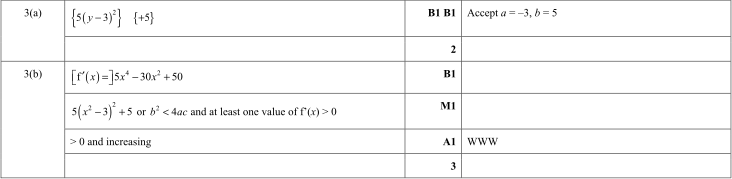
(a) Express \(5y^2-30y+50\) in the form \(5(y+a)^2+b\), where a and b are constants. [2]
The function f is defined by \(f(x)=x^5-10x^3+50x\) for \(x\in\mathbb R\).
(b) Determine whether f is an increasing function, a decreasing function or neither. [3]
9709 P13 - Jun 2021 - Q2 - 4 marks
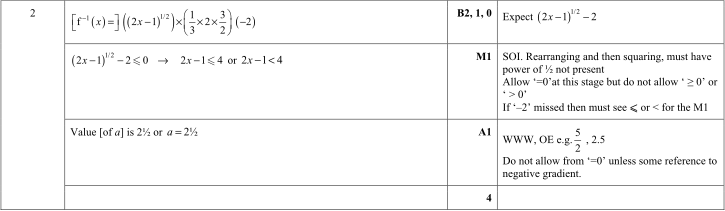
The function f is defined by \[f(x)=\frac13(2x-1)^{3/2}-2x\quad\text{for }1/2<x<a.\] It is given that f is a decreasing function.
Find the maximum possible value of the constant a. [4]
9709 P13 - Jun 2011 - Q4
Differentiate \(\frac{2x^3 + 5}{x}\) with respect to \(x\).

9709 P1 - Jun 2003 - Q3
Differentiate \(4x + \frac{6}{x^2}\) with respect to \(x\).

9709 P13 - Nov 2025 - Q3 - 3 marks
A curve is \(y=f(x)=\frac12x^{2/3}(x-2)^2\). Points on it are \[A(8,72),\quad B(8.001,k),\quad C(8.01,72.300388),\quad D(8.1,75.038882).\] Non-exact ordinates are given to 6 decimal places.
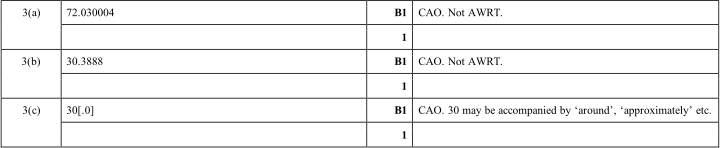
(a) Find \(k\), to 6 decimal places. [1]
The chord gradients below are given to 4 decimal places.
| Chord | AB | AC | AD |
|---|---|---|---|
| Gradient | 30.0039 | 30.0388 |
(b) Find the gradient of \(AD\), to 4 decimal places. [1]
(c) State what the table suggests about \(f^{\prime}(8)\). [1]
9709 P12 - Nov 2024 - Q3 - 5 marks
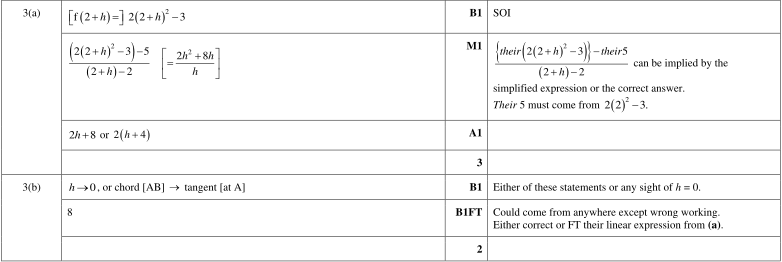
On \(y=2x^2-3\), A and B have x-coordinates 2 and 2+h.
(a) Find and simplify the gradient of chord AB in terms of h. [3]
(b) Explain how to deduce the gradient at A and state it. [2]
9709 P11 - Jun 2024 - Q4 - 3 marks
The curve is \(y=f(x)=(2x-1)\sqrt{3x-2}-2\). Its points are listed below; the y-coordinates are rounded to 5 decimal places.
| Point | x | y |
|---|---|---|
| A | 2 | 4 |
| B | 2.0001 | k |
| C | 2.001 | 4.00625 |
| D | 2.01 | 4.06261 |
| E | 2.1 | 4.63566 |
| F | 3 | 11.22876 |
(a) Find k to 5 decimal places. [1]
The gradients of AB, AC, AD and AF are 6.2501, 6.2511, 6.2608 and 7.2288 respectively.
(b) Calculate the gradient of AE to 4 decimal places. [1]
(c) Estimate f′(2). [1]

A polynomial with a repeated stationary factor · Maths4U Original · 8 marks
Info
For real x, let \(f(x)=3x^4-8x^3+6x^2-5\).
- Find f′(x) and express it as a product of factors. [3]
- Find f″(x). [2]
- Find every point on the curve where the tangent is horizontal. [3]
A radical and a reciprocal · Maths4U Original · 8 marks
Info
For x>0, let \(\displaystyle g(x)= \sqrt{3x+ 1}+ \frac{2}{x}\).
- Find g′(x). [3]
- Find g″(x). [3]
- Find g′(1) and interpret its sign for the curve near \(\displaystyle x=1\). [2]