Exam-Style Problems
⬅ Back to SubchapterProblem 181
The diagram shows points A, B and C lying on a circle with centre O and radius r. Angle AOB is 2.8 radians. The shaded region is bounded by two arcs. The upper arc is part of the circle with centre O and radius r. The lower arc is part of a circle with centre C and radius R.
(a) State the size of angle ACO in radians.
(b) Find R in terms of r.
(c) Find the area of the shaded region in terms of r.

Problem 182
The diagram shows a sector OAB of a circle with centre O. The length of the arc AB is 8 cm. It is given that the perimeter of the sector is 20 cm.
(a) Find the perimeter of the shaded segment.
(b) Find the area of the shaded segment.

Problem 183
In the diagram, AC is an arc of a circle, centre O and radius 6 cm. The line BC is perpendicular to OC and OAB is a straight line. Angle AOC = \(\frac{1}{3} \pi\) radians. Find the area of the shaded region, giving your answer in terms of \(\pi\) and \(\sqrt{3}\).

Problem 184
In the diagram, OCD is an isosceles triangle with OC = OD = 10 ext{ cm} and angle COD = 0.8 radians. The points A and B, on OC and OD respectively, are joined by an arc of a circle with centre O and radius 6 ext{ cm}. Find
- the area of the shaded region,
- the perimeter of the shaded region.

Problem 185
The diagram shows the sector OPQ of a circle with centre O and radius r cm. The angle POQ is \(\theta\) radians and the perimeter of the sector is 20 cm.
(i) Show that \(\theta = \frac{20}{r} - 2\).
(ii) Hence express the area of the sector in terms of r.
(iii) In the case where \(r = 8\), find the length of the chord PQ.

Problem 186
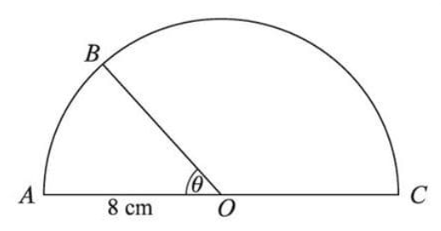
The diagram shows a semicircle ABC with centre O and radius 8 cm. Angle AOB = \(\theta\) radians.
(i) In the case where \(\theta = 1\), calculate the area of the sector BOC.
(ii) Find the value of \(\theta\) for which the perimeter of sector AOB is one half of the perimeter of sector BOC.
(iii) In the case where \(\theta = \frac{1}{3}\pi\), show that the exact length of the perimeter of triangle ABC is \((24 + 8\sqrt{3})\) cm.
Problem 187
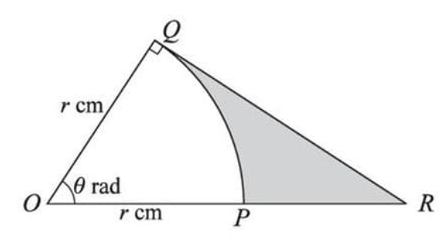
In the diagram, OPQ is a sector of a circle, centre O and radius r cm. Angle QOP = θ radians. The tangent to the circle at Q meets OP extended at R.
(i) Show that the area, A cm², of the shaded region is given by A = \frac{1}{2}r^2(\tan \theta - \theta).
(ii) In the case where θ = 0.8 and r = 15, evaluate the length of the perimeter of the shaded region.
June 2002 p1 q7
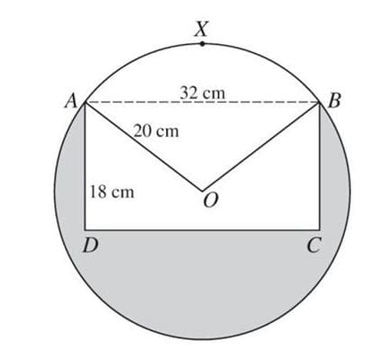
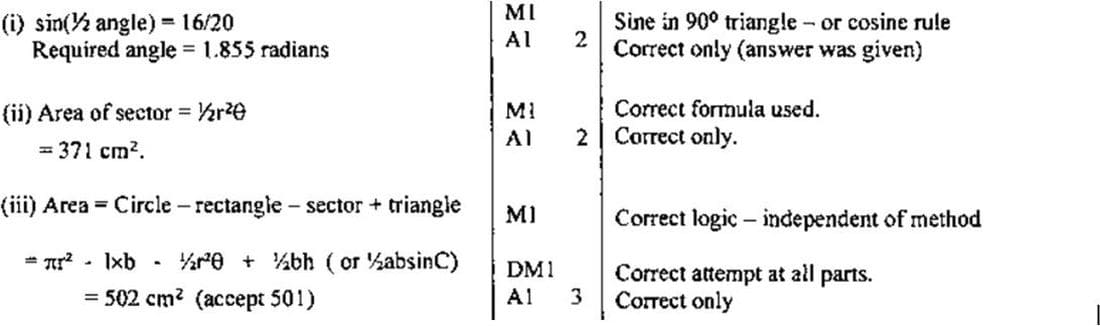
The diagram shows the circular cross-section of a uniform cylindrical log with centre O and radius 20 cm. The points A, X, and B lie on the circumference of the cross-section and AB = 32 cm.
- Show that angle AOB = 1.855 radians, correct to 3 decimal places.
- Find the area of the sector AXBO.
The section AXBCD, where ABCD is a rectangle with AD = 18 cm, is removed.
- Find the area of the new cross-section (shown shaded in the diagram).
June 2022 p13 q9
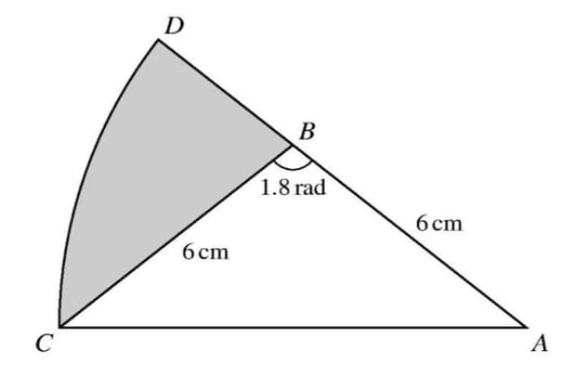
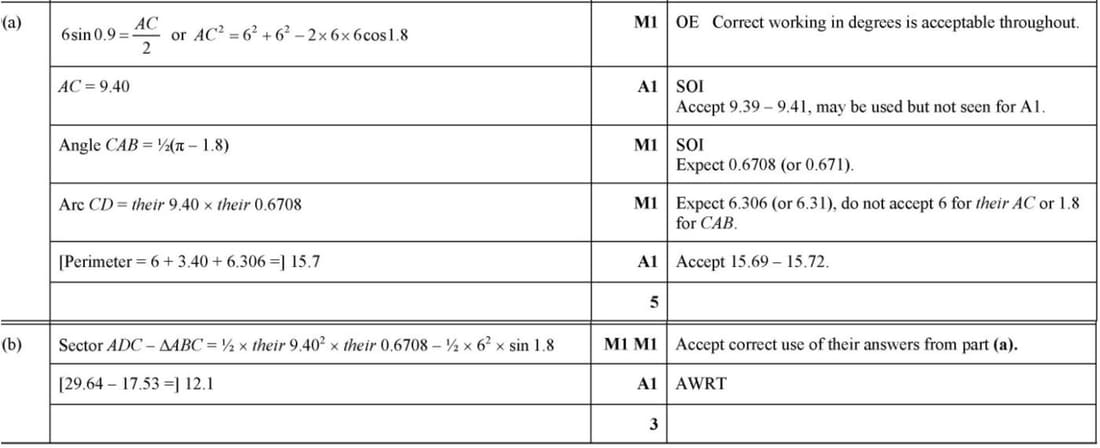
The diagram shows triangle ABC with AB = BC = 6 cm and angle ABC = 1.8 radians. The arc CD is part of a circle with centre A and ABD is a straight line.
(a) Find the perimeter of the shaded region.
(b) Find the area of the shaded region.
June 2022 p12 q7
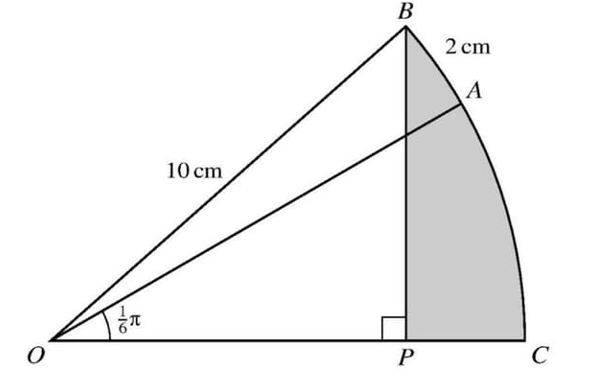
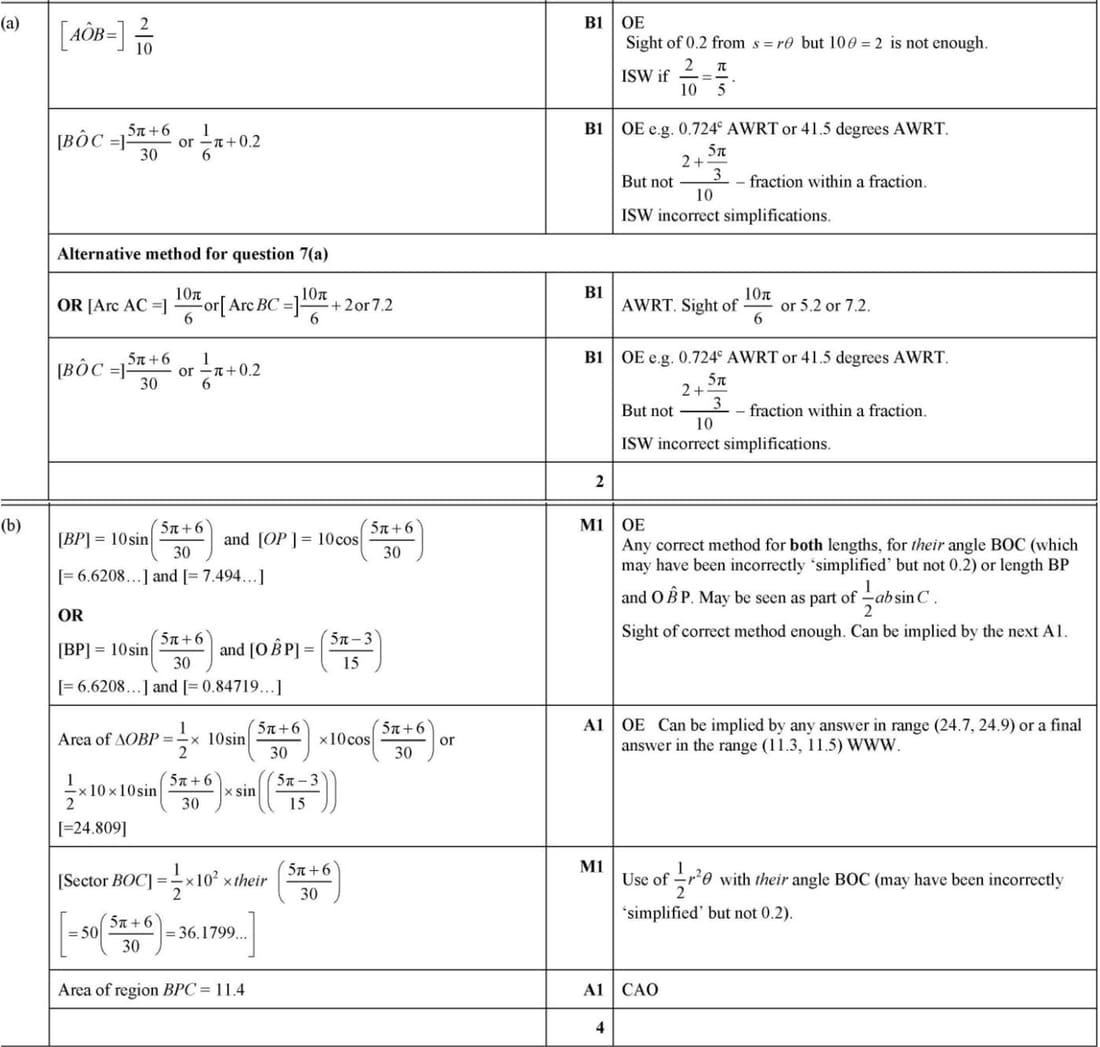
The diagram shows a sector OBAC of a circle with centre O and radius 10 cm. The point P lies on OC and BP is perpendicular to OC. Angle AOC = \(\frac{1}{6} \pi\) and the length of the arc AB is 2 cm.
(a) Find the angle BOC.
(b) Hence find the area of the shaded region BPC giving your answer correct to 3 significant figures.
June 2022 p11 q5
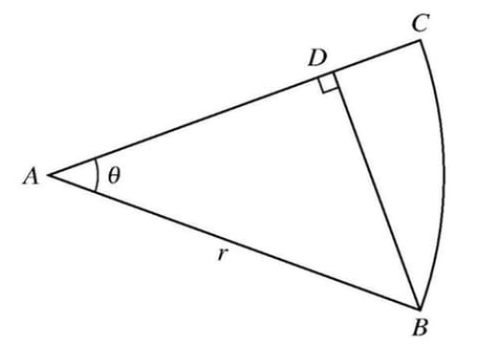
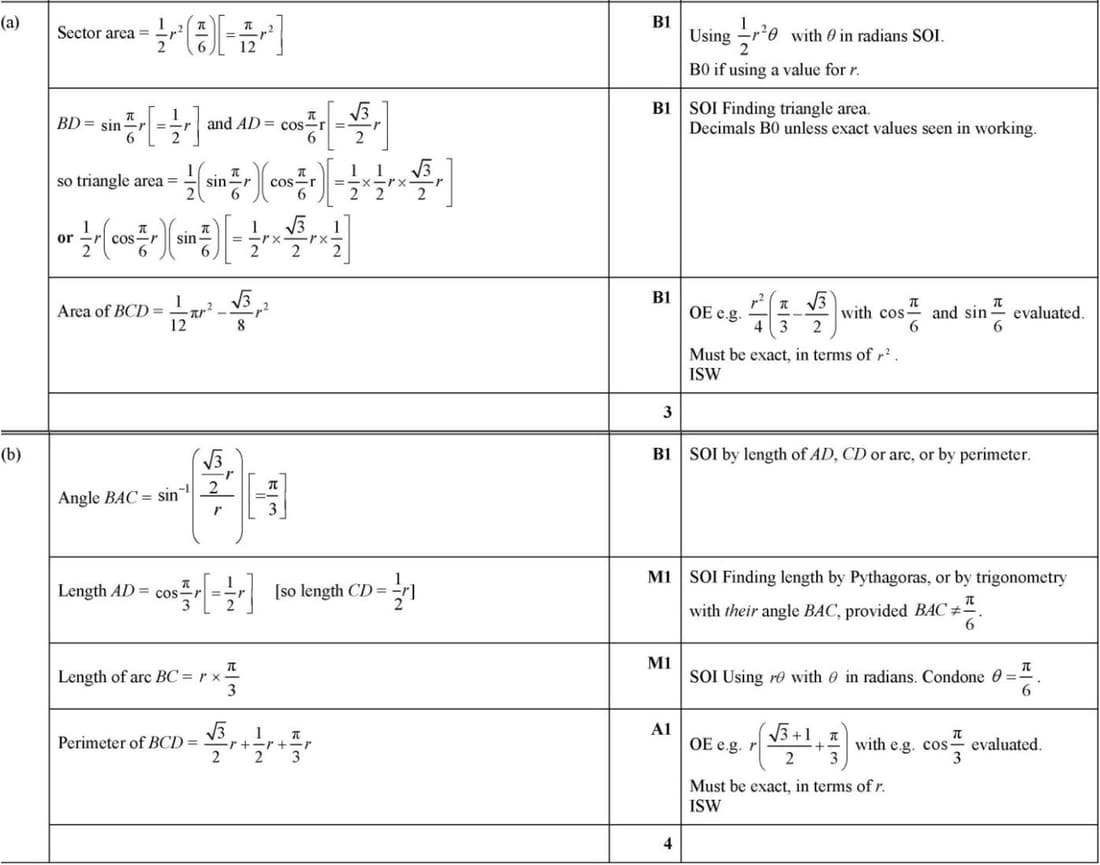
The diagram shows a sector ABC of a circle with centre A and radius r. The line BD is perpendicular to AC. Angle CAB is \(\theta\) radians.
(a) Given that \(\theta = \frac{\pi}{6}\), find the exact area of BCD in terms of r.
(b) Given instead that the length of \(BD = \frac{\sqrt{3}}{2}r\), find the exact perimeter of BCD in terms of r.
March 2022 p12 q10
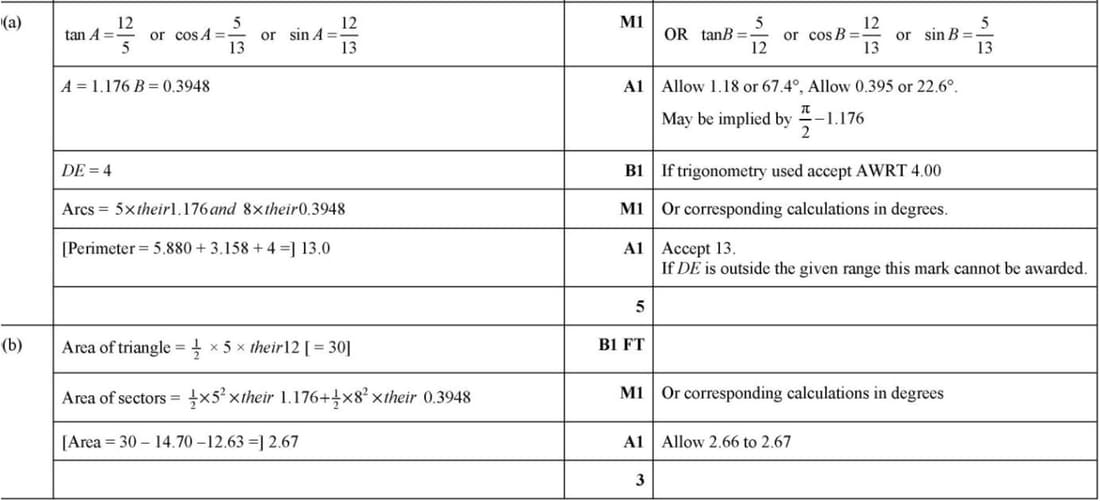
The diagram shows a circle with centre A of radius 5 cm and a circle with centre B of radius 8 cm. The circles touch at the point C so that ACB is a straight line. The tangent at the point D on the smaller circle intersects the larger circle at E and passes through B.
(a) Find the perimeter of the shaded region.
(b) Find the area of the shaded region.

Nov 2021 p13 q5
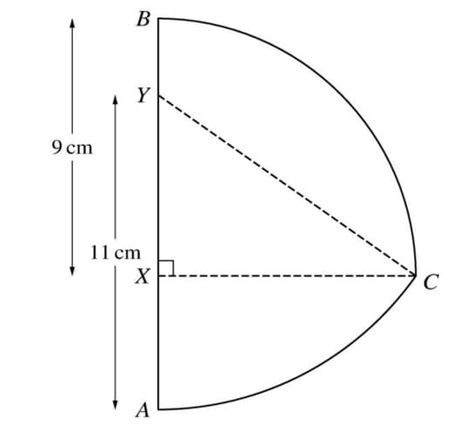
In the diagram, X and Y are points on the line AB such that BX = 9 ext{ cm} and AY = 11 ext{ cm}. Arc BC is part of a circle with centre X and radius 9 ext{ cm}, where CX is perpendicular to AB. Arc AC is part of a circle with centre Y and radius 11 ext{ cm}.
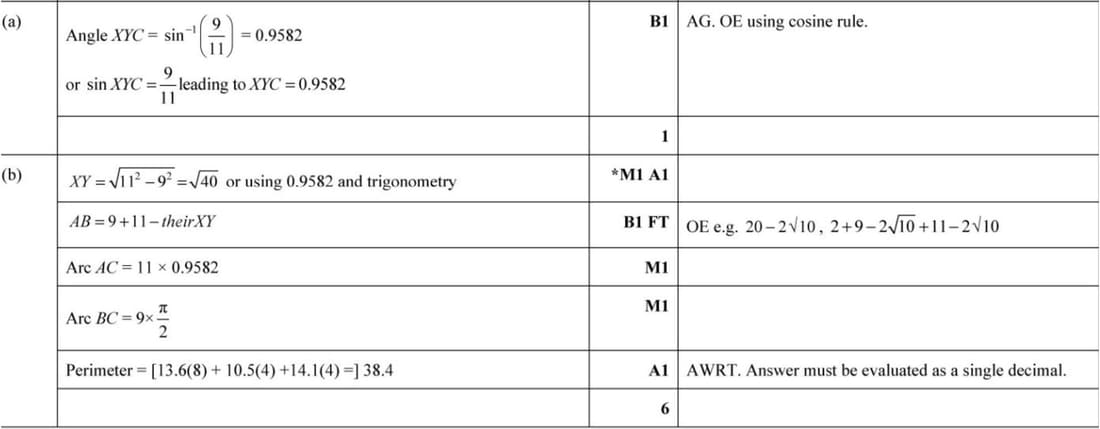
(a) Show that angle XYC = 0.9582 radians, correct to 4 significant figures.
(b) Find the perimeter of ABC.
Nov 2021 p12 q7
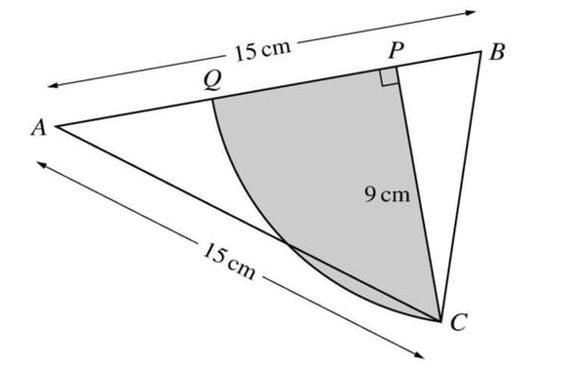
In the diagram the lengths of \(AB\) and \(AC\) are both 15 cm. The point \(P\) is the foot of the perpendicular from \(C\) to \(AB\). The length \(CP = 9\) cm. An arc of a circle with centre \(B\) passes through \(C\) and meets \(AB\) at \(Q\).
(a) Show that angle \(ABC = 1.25\) radians, correct to 3 significant figures.
(b) Calculate the area of the shaded region which is bounded by the arc \(CQ\) and the lines \(CP\) and \(PQ\).

Nov 2021 p11 q6
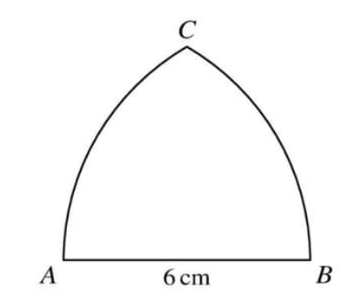
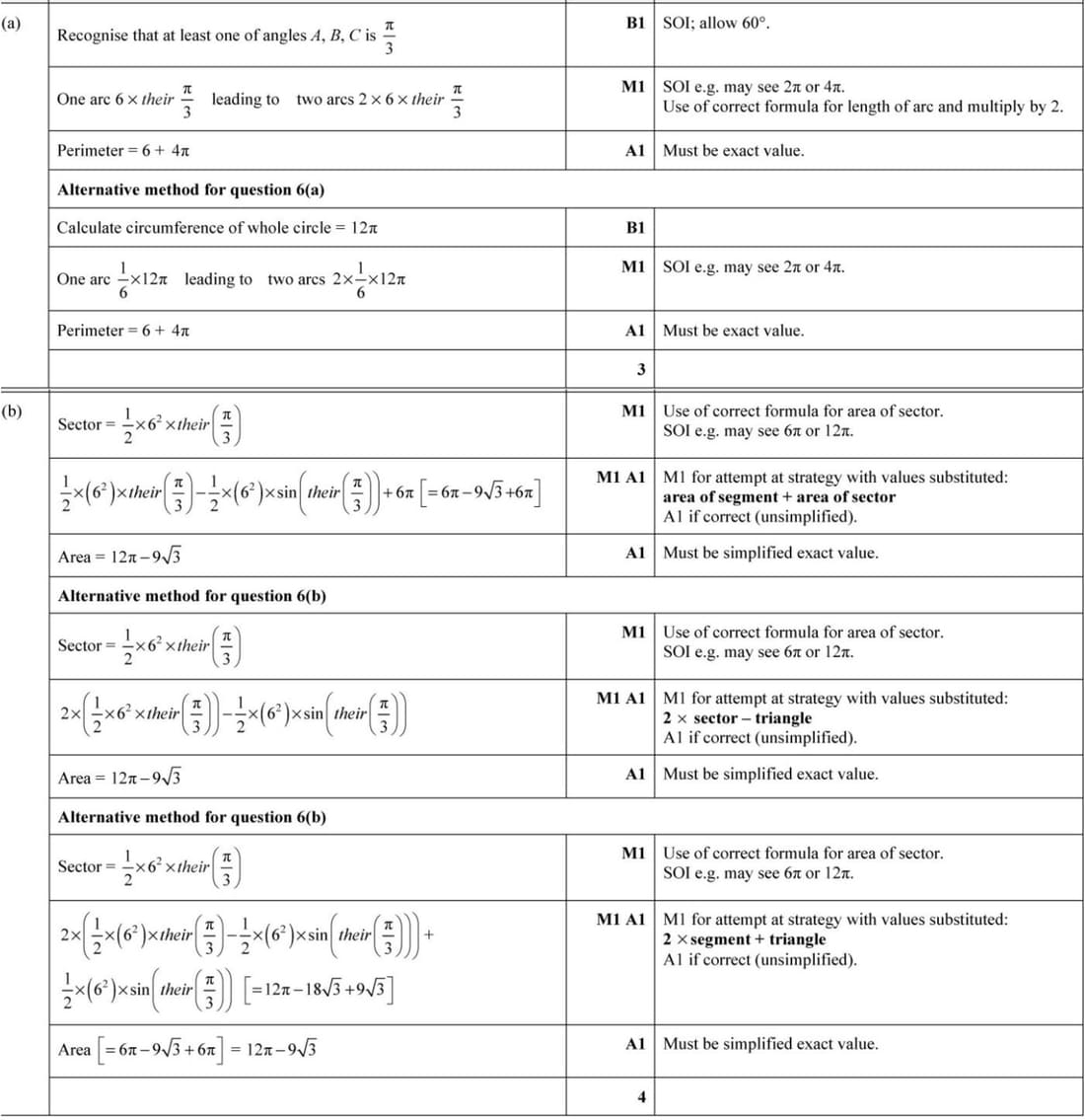
The diagram shows a metal plate ABC in which the sides are the straight line AB and the arcs AC and BC. The line AB has length 6 cm. The arc AC is part of a circle with centre B and radius 6 cm, and the arc BC is part of a circle with centre A and radius 6 cm.
(a) Find the perimeter of the plate, giving your answer in terms of \(\pi\).
(b) Find the area of the plate, giving your answer in terms of \(\pi\) and \(\sqrt{3}\).
June 2021 p13 q5
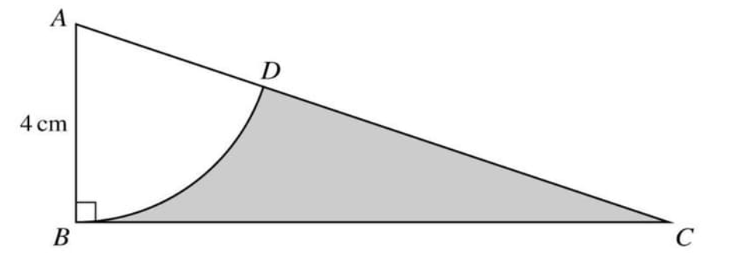
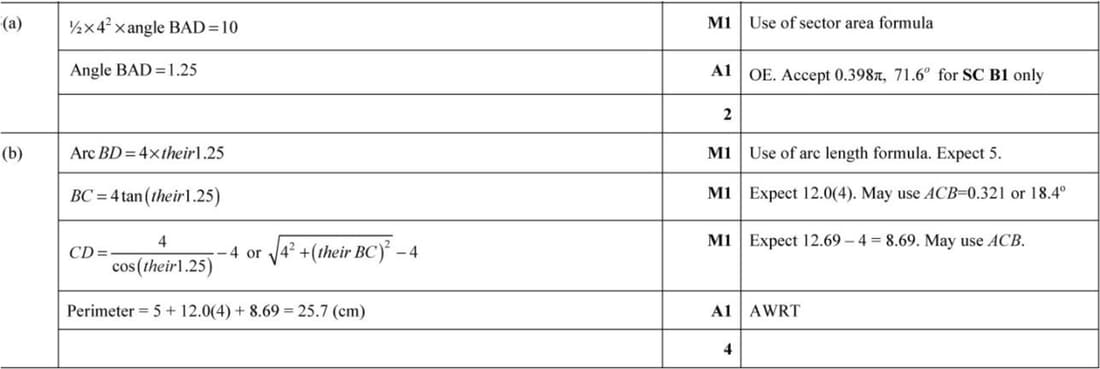
The diagram shows a triangle ABC, in which angle \(ABC = 90^\circ\) and \(AB = 4\text{ cm}\). The sector \(ABD\) is part of a circle with centre \(A\). The area of the sector is \(10\text{ cm}^2\).
(a) Find angle \(BAD\) in radians.
(b) Find the perimeter of the shaded region.
Problem 197
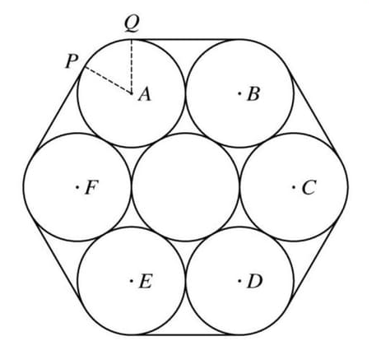
The diagram shows a cross-section of seven cylindrical pipes, each of radius 20 cm, held together by a thin rope which is wrapped tightly around the pipes. The centres of the six outer pipes are A, B, C, D, E and F. Points P and Q are situated where straight sections of the rope meet the pipe with centre A.
(a) Show that angle PAQ = \(\frac{1}{3} \pi\) radians.
(b) Find the length of the rope.
(c) Find the area of the hexagon ABCDEF, giving your answer in terms of \(\sqrt{3}\).
(d) Find the area of the complete region enclosed by the rope.
Problem 198
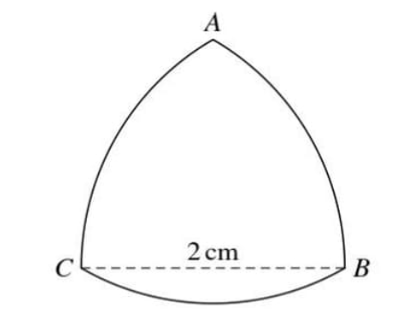
The diagram shows the shape of a coin. The three arcs AB, BC, and CA are parts of circles with centres C, A, and B respectively. ABC is an equilateral triangle with sides of length 2 cm.
(a) Find the perimeter of the coin.
(b) Find the area of the face ABC of the coin, giving the answer in terms of \(\pi\) and \(\sqrt{3}\).
Problem 199
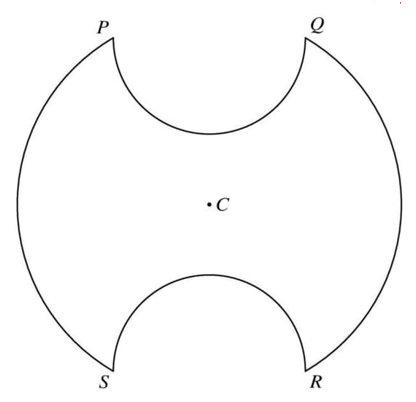
The diagram shows a symmetrical metal plate. The plate is made by removing two identical pieces from a circular disc with centre C. The boundary of the plate consists of two arcs PS and QR of the original circle and two semicircles with PQ and RS as diameters. The radius of the circle with centre C is 4 cm, and PQ = RS = 4 cm also.
(a) Show that angle PCS = \(\frac{2}{3} \pi\) radians.
(b) Find the exact perimeter of the plate.
(c) Show that the area of the plate is \(\left( \frac{20}{3} \pi + 8\sqrt{3} \right) \text{ cm}^2\).
Problem 200
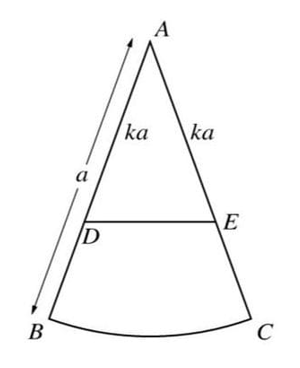
The diagram shows a sector ABC which is part of a circle of radius a. The points D and E lie on AB and AC respectively and are such that AD = AE = ka, where k < 1. The line DE divides the sector into two regions which are equal in area.
(a) For the case where angle BAC = \frac{1}{6}\pi radians, find k correct to 4 significant figures.
(b) For the general case in which angle BAC = \theta radians, where 0 < \theta < \frac{1}{2}\pi, it is given that \frac{\theta}{\sin \theta} > 1. Find the set of possible values of k.
Nov 2020 p13 q9
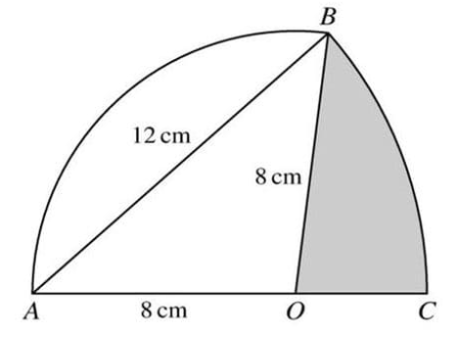
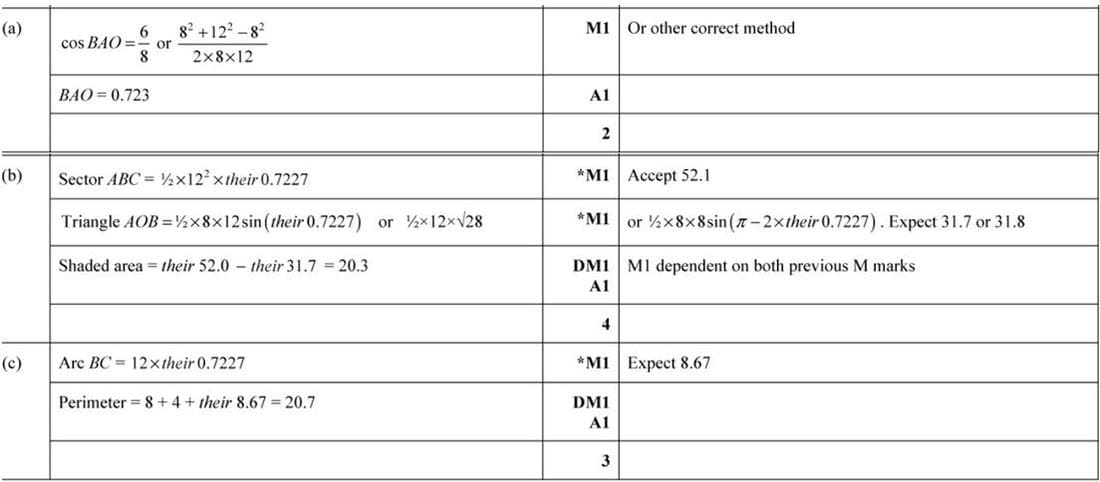
In the diagram, arc AB is part of a circle with centre O and radius 8 cm. Arc BC is part of a circle with centre A and radius 12 cm, where AOC is a straight line.
(a) Find angle BAO in radians.
(b) Find the area of the shaded region.
(c) Find the perimeter of the shaded region.
Problem 202
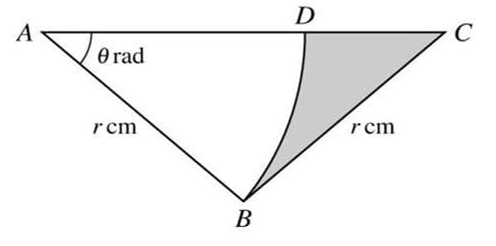
In the diagram, ABC is an isosceles triangle with AB = BC = r cm and angle BAC = θ radians. The point D lies on AC and ABD is a sector of a circle with centre A.
(a) Express the area of the shaded region in terms of r and θ.
(b) In the case where r = 10 and θ = 0.6, find the perimeter of the shaded region.
Problem 203
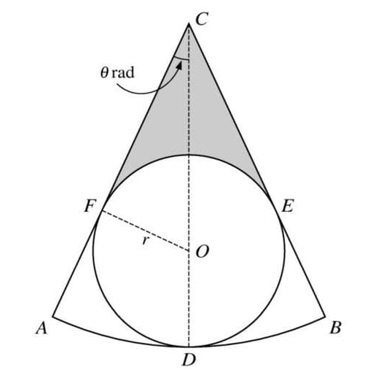
The diagram shows a sector CAB which is part of a circle with centre C. A circle with centre O and radius r lies within the sector and touches it at D, E and F, where COD is a straight line and angle ACD is \(\theta \\) radians.
(a) Find CD in terms of r and \(\sin \theta \\).
It is now given that \(r = 4 \\) and \(\theta = \frac{1}{6} \pi \\).
(b) Find the perimeter of sector CAB in terms of \(\pi \\).
(c) Find the area of the shaded region in terms of \(\pi \\) and \(\sqrt{3} \\).
Problem 204
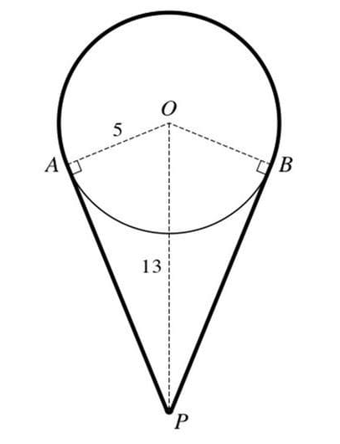
The diagram shows a cord going around a pulley and a pin. The pulley is modelled as a circle with centre O and radius 5 cm. The thickness of the cord and the size of the pin P can be neglected. The pin is situated 13 cm vertically below O. Points A and B are on the circumference of the circle such that AP and BP are tangents to the circle. The cord passes over the major arc AB of the circle and under the pin such that the cord is taut.
Calculate the length of the cord.
Problem 205
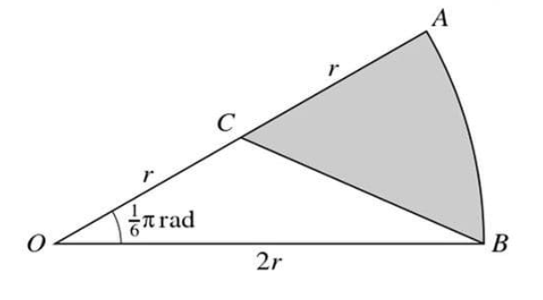
In the diagram, \(OAB\) is a sector of a circle with centre \(O\) and radius \(2r\), and angle \(AOB = \frac{1}{6} \pi\) radians. The point \(C\) is the midpoint of \(OA\).
(a) Show that the exact length of \(BC\) is \(r\sqrt{5} - 2\sqrt{3}\).
(b) Find the exact perimeter of the shaded region.
(c) Find the exact area of the shaded region.
Problem 206
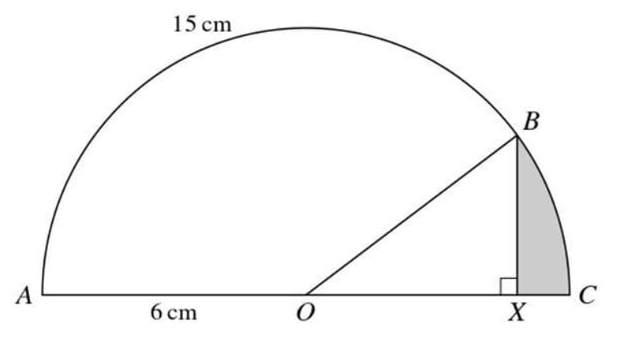
In the diagram, ABC is a semicircle with diameter AC, centre O and radius 6 cm. The length of the arc AB is 15 cm. The point X lies on AC and BX is perpendicular to AX.
Find the perimeter of the shaded region BXC.
Problem 207
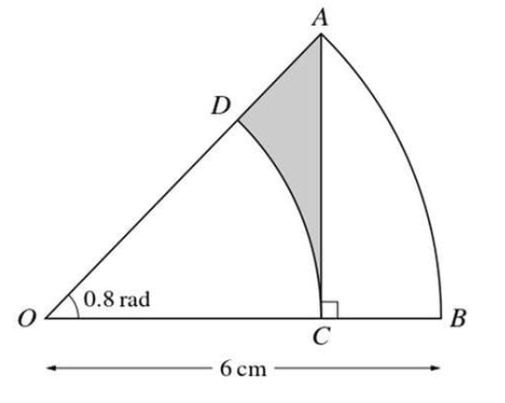
The diagram shows a sector AOB which is part of a circle with centre O and radius 6 cm and with angle AOB = 0.8 radians. The point C on OB is such that AC is perpendicular to OB. The arc CD is part of a circle with centre O, where D lies on OA.
Find the area of the shaded region.
Problem 208
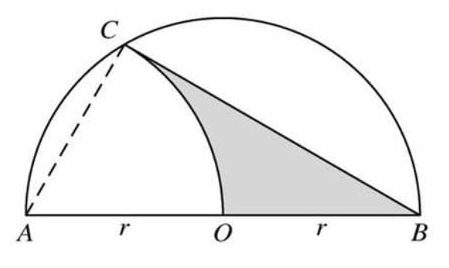
The diagram shows a semicircle ACB with centre O and radius r. Arc OC is part of a circle with centre A.
(i) Express angle CAO in radians in terms of \(\\pi\).
(ii) Find the area of the shaded region in terms of r, \(\\pi\) and \(\\sqrt{3}\), simplifying your answer.
Problem 209
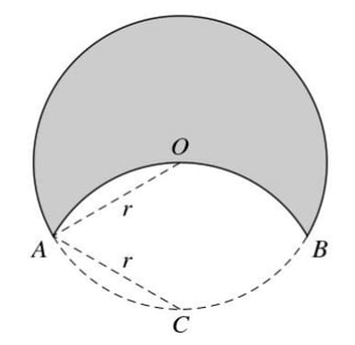
The diagram shows a motif formed by the major arc \(AB\) of a circle with radius \(r\) and centre \(O\), and the minor arc \(AOB\) of a circle, also with radius \(r\) but with centre \(C\). The point \(C\) lies on the circle with centre \(O\).
(a) Given that angle \(ACB = k\pi\) radians, state the value of the fraction \(k\).
(b) State the perimeter of the shaded motif in terms of \(\pi\) and \(r\).
(c) Find the area of the shaded motif, giving your answer in terms of \(\pi\), \(r\) and \(\sqrt{3}\).
Problem 210
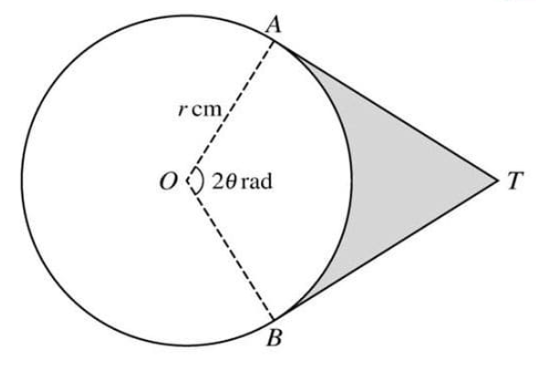
The diagram shows a circle with centre O and radius r cm. Points A and B lie on the circle and angle AOB = 2\theta radians. The tangents to the circle at A and B meet at T.
(i) Express the perimeter of the shaded region in terms of r and \theta.
(ii) In the case where r = 5 and \theta = 1.2, find the area of the shaded region.
Problem 211
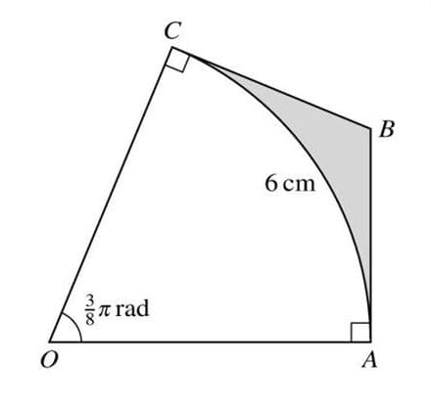
The diagram shows a sector OAC of a circle with centre O. Tangents AB and CB to the circle meet at B. The arc AC is of length 6 cm and angle AOC = \(\frac{3}{8} \pi\) radians.
(i) Find the length of OA correct to 4 significant figures.
(ii) Find the perimeter of the shaded region.
(iii) Find the area of the shaded region.
Problem 212
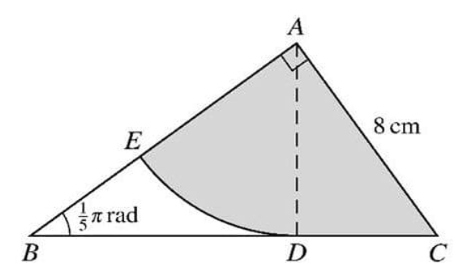
The diagram shows triangle ABC which is right-angled at A. Angle ABC = \frac{1}{5}\pi radians and AC = 8 cm. The points D and E lie on BC and BA respectively. The sector ADE is part of a circle with centre A and is such that BDC is the tangent to the arc DE at D.
(i) Find the length of AD.
(ii) Find the area of the shaded region.
Problem 213
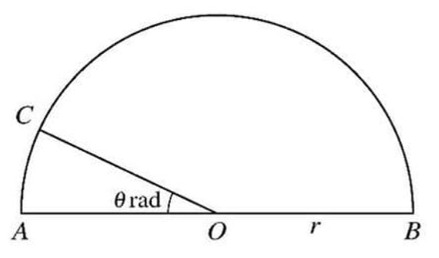
The diagram shows a semicircle with diameter \(AB\), centre \(O\) and radius \(r\). The point \(C\) lies on the circumference and angle \(AOC = \theta\) radians. The perimeter of sector \(BOC\) is twice the perimeter of sector \(AOC\). Find the value of \(\theta\) correct to 2 significant figures.
Problem 214
A sector of a circle of radius r cm has an area of A cm2. Express the perimeter of the sector in terms of r and A.
Problem 215
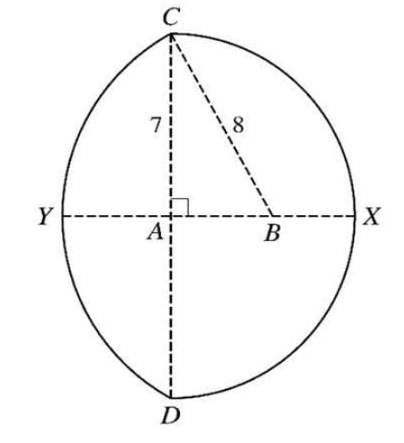
In the diagram, CXD is a semicircle of radius 7 cm with centre A and diameter CD. The straight line YABX is perpendicular to CD, and the arc CYD is part of a circle with centre B and radius 8 cm. Find the total area of the region enclosed by the two arcs.
Problem 216
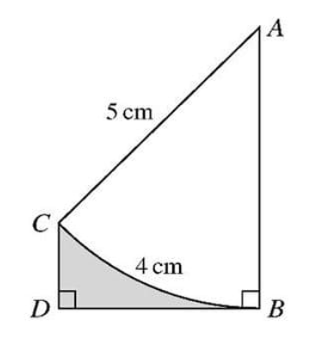
The diagram shows an arc BC of a circle with centre A and radius 5 cm. The length of the arc BC is 4 cm. The point D is such that the line BD is perpendicular to BA and DC is parallel to BA.
(i) Find angle BAC in radians.
(ii) Find the area of the shaded region BDC.
Problem 217
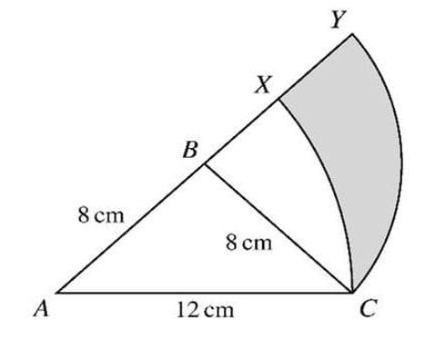
The diagram shows an isosceles triangle ACB in which AB = BC = 8 ext{ cm} and AC = 12 ext{ cm}. The arc XC is part of a circle with centre A and radius 12 ext{ cm}, and the arc YC is part of a circle with centre B and radius 8 ext{ cm}. The points A, B, X and Y lie on a straight line.
(i) Show that angle CBY = 1.445 radians, correct to 4 significant figures.
(ii) Find the perimeter of the shaded region.
Problem 218
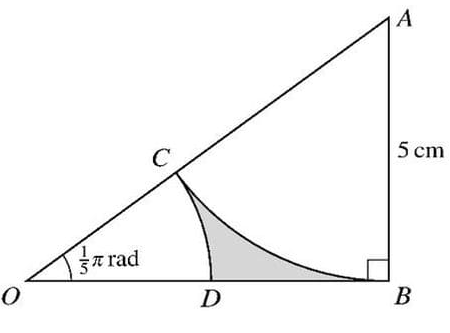
The diagram shows a triangle OAB in which angle ABO is a right angle, angle AOB = \frac{1}{5}\pi radians and AB = 5 \text{ cm}. The arc BC is part of a circle with centre A and meets OA at C. The arc CD is part of a circle with centre O and meets OB at D. Find the area of the shaded region.
Problem 219
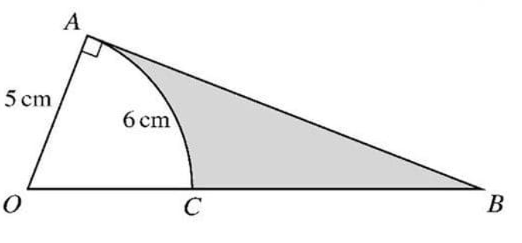
The diagram shows a triangle OAB in which angle OAB = 90° and OA = 5 cm. The arc AC is part of a circle with centre O. The arc has length 6 cm and it meets OB at C. Find the area of the shaded region.
Problem 220
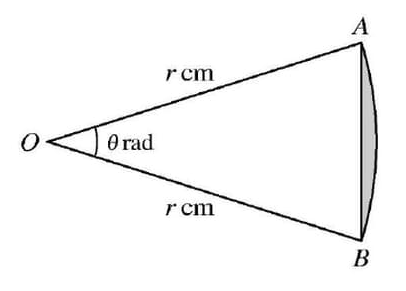
The diagram shows a sector OAB of a circle with centre O and radius r cm. Angle AOB = θ radians. It is given that the length of the arc AB is 9.6 cm and that the area of the sector OAB is 76.8 cm².
(a) Find the area of the shaded region.
(b) Find the perimeter of the shaded region.
Problem 221
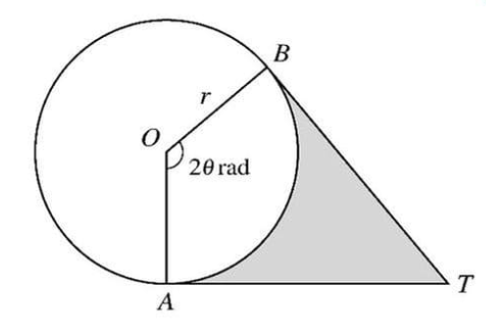
The diagram shows points A and B on a circle with centre O and radius r. The tangents to the circle at A and B meet at T. The shaded region is bounded by the minor arc AB and the lines AT and BT. Angle AOB is 2θ radians.
(i) In the case where the area of the sector AOB is the same as the area of the shaded region, show that tan θ = 2θ.
(ii) In the case where r = 8 cm and the length of the minor arc AB is 19.2 cm, find the area of the shaded region.
Problem 222
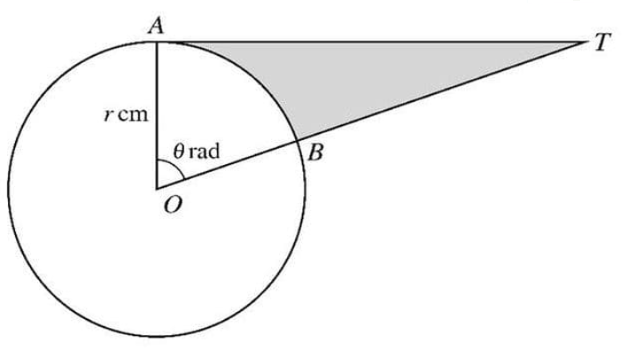
The diagram shows a circle with centre O and radius r cm. The points A and B lie on the circle and AT is a tangent to the circle. Angle AOB = \theta radians and OBT is a straight line.
(i) Express the area of the shaded region in terms of r and \theta.
(ii) In the case where r = 3 and \theta = 1.2, find the perimeter of the shaded region.
Problem 223
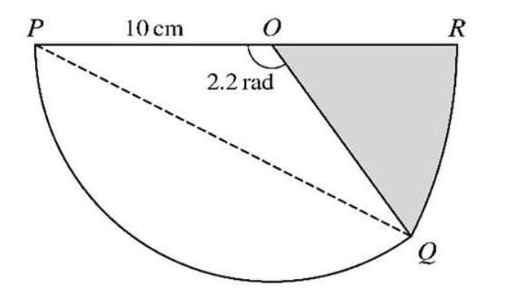
The diagram shows a sector POQ of a circle of radius 10 cm and centre O. Angle POQ is 2.2 radians. QR is an arc of a circle with centre P and POR is a straight line.
(i) Show that the length of PQ is 17.8 cm, correct to 3 significant figures.
(ii) Find the perimeter of the shaded region.
Problem 224
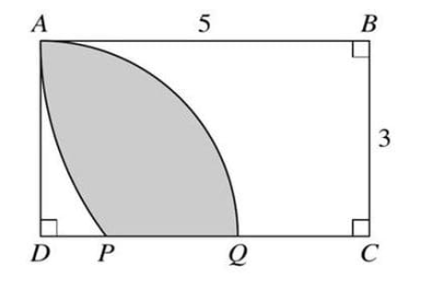
The diagram shows a rectangle ABCD in which AB = 5 units and BC = 3 units. Point P lies on DC and AP is an arc of a circle with centre B. Point Q lies on DC and AQ is an arc of a circle with centre D.
(i) Show that angle ABP = 0.6435 radians, correct to 4 decimal places.
(ii) Calculate the areas of the sectors BAP and DAQ.
(iii) Calculate the area of the shaded region.
Problem 225
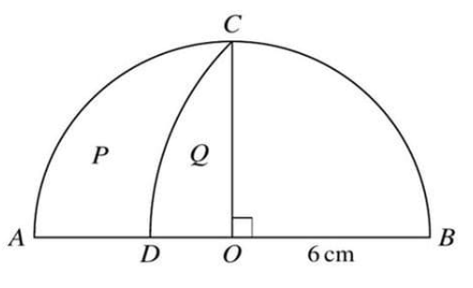
The diagram shows a semicircle with centre O and radius 6 cm. The radius OC is perpendicular to the diameter AB. The point D lies on AB, and DC is an arc of a circle with centre B.
(i) Calculate the length of the arc DC.
(ii) Find the value of \(\frac{\text{area of region } P}{\text{area of region } Q}\), giving your answer correct to 3 significant figures.
Problem 226
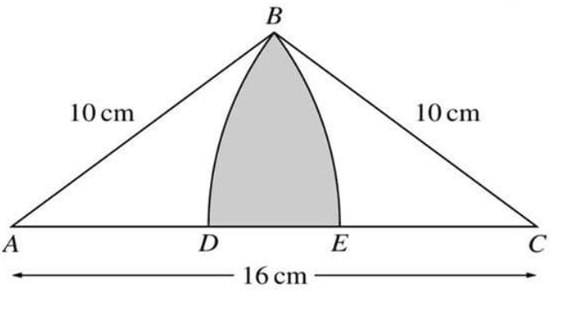
The diagram shows an isosceles triangle ABC in which AC = 16 ext{ cm} and AB = BC = 10 ext{ cm}. The circular arcs BE and BD have centres at A and C respectively, where D and E lie on AC.
(i) Show that angle BAC = 0.6435 radians, correct to 4 decimal places.
(ii) Find the area of the shaded region.
Problem 227
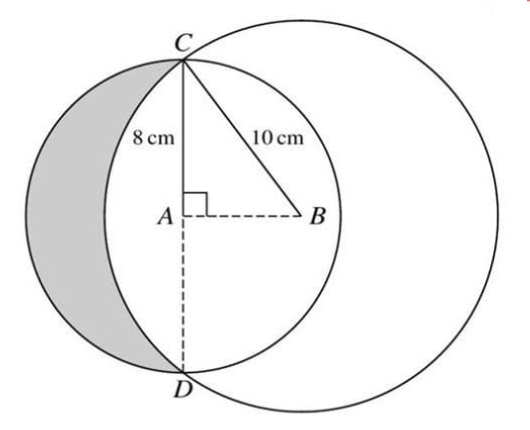
The diagram shows two circles with centres A and B having radii 8 cm and 10 cm respectively. The two circles intersect at C and D where CAD is a straight line and AB is perpendicular to CD.
(i) Find angle ABC in radians.
(ii) Find the area of the shaded region.
Problem 228
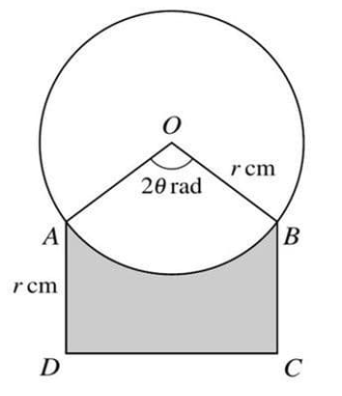
The diagram shows a circle with radius r cm and centre O. Points A and B lie on the circle and ABCD is a rectangle. Angle AOB = 2θ radians and AD = r cm.
(i) Express the perimeter of the shaded region in terms of r and θ.
(ii) In the case where r = 5 and θ = \(\frac{1}{6} \pi\), find the area of the shaded region.
Problem 229
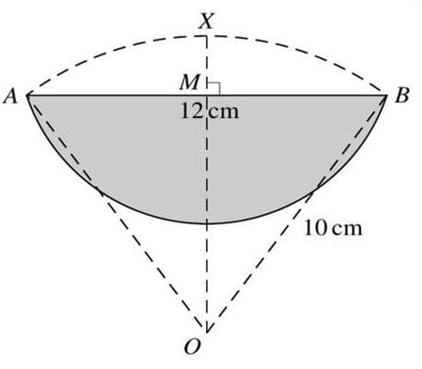
In the diagram, \(OAXB\) is a sector of a circle with centre \(O\) and radius 10 cm. The length of the chord \(AB\) is 12 cm. The line \(OX\) passes through \(M\), the mid-point of \(AB\), and \(OX\) is perpendicular to \(AB\). The shaded region is bounded by the chord \(AB\) and by the arc of a circle with centre \(X\) and radius \(XA\).
(i) Show that angle \(AXB\) is 2.498 radians, correct to 3 decimal places.
(ii) Find the perimeter of the shaded region.
(iii) Find the area of the shaded region.
Problem 230
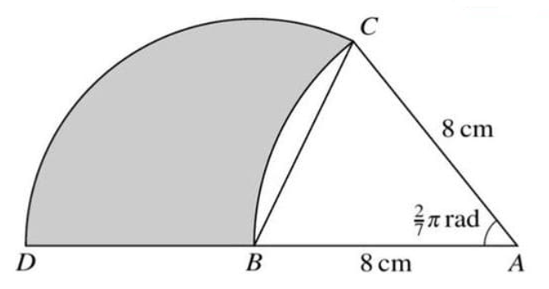
In the diagram, \(AB = AC = 8 \text{ cm}\) and angle \(CAB = \frac{2}{7} \pi\) radians. The circular arc \(BC\) has centre \(A\), the circular arc \(CD\) has centre \(B\) and \(ABD\) is a straight line.
(i) Show that angle \(CBD = \frac{9}{14} \pi\) radians.
(ii) Find the perimeter of the shaded region.
Problem 231
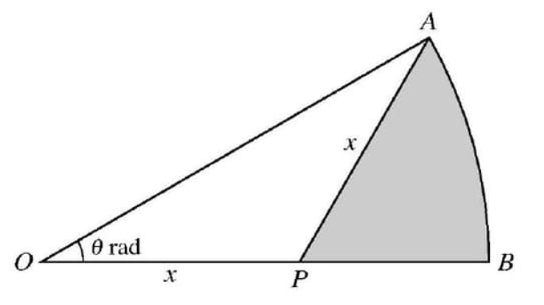
The diagram shows a sector OAB of a circle with centre O. Angle AOB = \(\theta\) radians and \(OP = AP = x\).
(a) Show that the arc length AB is \(2x\theta \cos \theta\).
(b) Find the area of the shaded region APB in terms of \(x\) and \(\theta\).
Problem 232
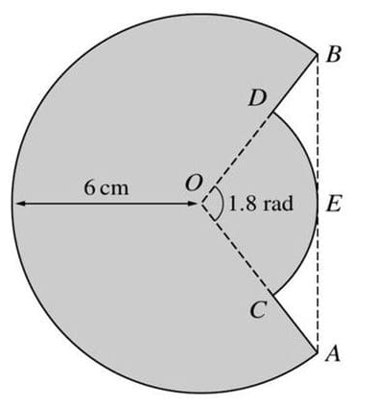
The diagram shows a major arc \(AB\) of a circle with centre \(O\) and radius 6 cm. Points \(C\) and \(D\) on \(OA\) and \(OB\) respectively are such that the line \(AB\) is a tangent at \(E\) to the arc \(CED\) of a smaller circle also with centre \(O\). Angle \(COD = 1.8\) radians.
(i) Show that the radius of the arc \(CED\) is 3.73 cm, correct to 3 significant figures.
(ii) Find the area of the shaded region.
Problem 233
The diagram shows a metal plate ABCD made from two parts. The part BCD is a semicircle. The part DAB is a segment of a circle with centre O and radius 10 cm. Angle BOD is 1.2 radians.
(i) Show that the radius of the semicircle is 5.646 cm, correct to 3 decimal places.
(ii) Find the perimeter of the metal plate.
(iii) Find the area of the metal plate.

Problem 234
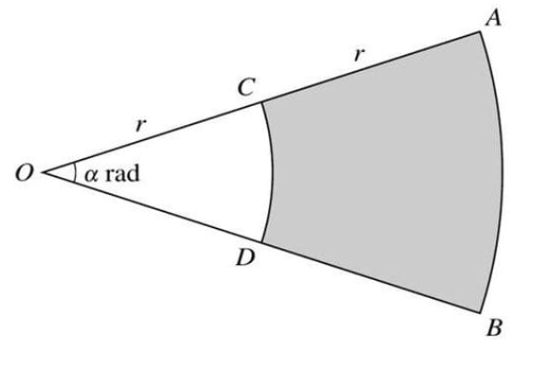
In the diagram, OCA and ODB are radii of a circle with centre O and radius 2r cm. Angle AOB = α radians. CD and AB are arcs of circles with centre O and radii r cm and 2r cm respectively. The perimeter of the shaded region ABDC is 4.4r cm.
(i) Find the value of α.
(ii) It is given that the area of the shaded region is 30 cm². Find the value of r.
Problem 235
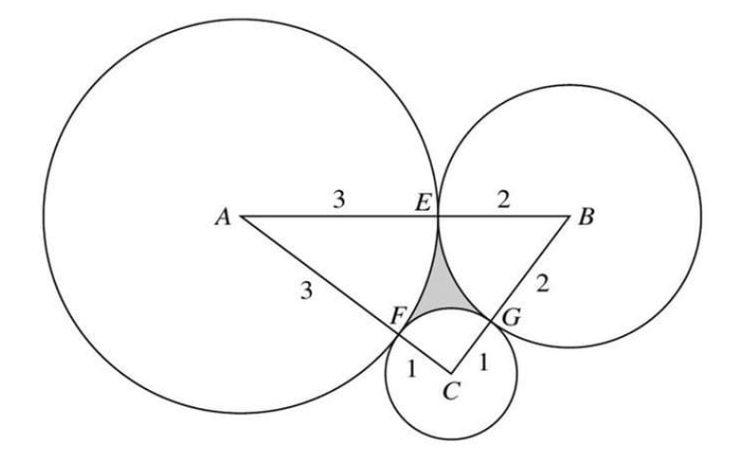
The diagram shows triangle ABC where AB = 5 cm, AC = 4 cm and BC = 3 cm. Three circles with centres at A, B and C have radii 3 cm, 2 cm and 1 cm respectively. The circles touch each other at points E, F and G, lying on AB, AC and BC respectively. Find the area of the shaded region EFG.
Problem 236
The diagram shows a circle with radius r cm and centre O. The line PT is the tangent to the circle at P and angle POT = α radians. The line OT meets the circle at Q.
(i) Express the perimeter of the shaded region PQT in terms of r and α.
(ii) In the case where α = \(\frac{1}{3} \pi\) and r = 10, find the area of the shaded region correct to 2 significant figures.

Problem 237
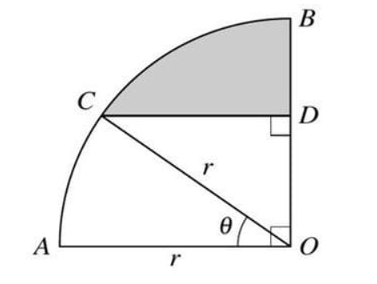
In the diagram, AOB is a quarter circle with centre O and radius r. The point C lies on the arc AB and the point D lies on OB. The line CD is parallel to AO and angle AOC = θ radians.
(i) Express the perimeter of the shaded region in terms of r, θ and π.
(ii) For the case where r = 5 cm and θ = 0.6, find the area of the shaded region.
Problem 238
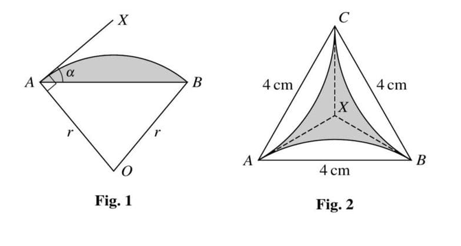
(a) In Fig. 1, \(OAB\) is a sector of a circle with centre \(O\) and radius \(r\). \(AX\) is the tangent at \(A\) to the arc \(AB\) and angle \(BAX = \alpha\).
(i) Show that angle \(AOB = 2\alpha\).
(ii) Find the area of the shaded segment in terms of \(r\) and \(\alpha\).
(b) In Fig. 2, \(ABC\) is an equilateral triangle of side 4 cm. The lines \(AX, BX\) and \(CX\) are tangents to the equal circular arcs \(AB, BC\) and \(CA\). Use the results in part (a) to find the area of the shaded region, giving your answer in terms of \(\pi\) and \(\sqrt{3}\).
Problem 239
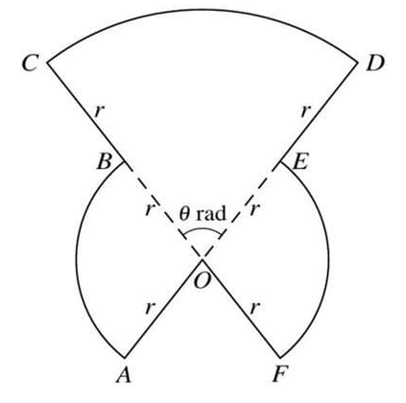
The diagram shows a metal plate OABCDEF consisting of 3 sectors, each with centre O. The radius of sector COD is 2r and angle COD is θ radians. The radius of each of the sectors BOA and FOE is r, and AOED and CBOF are straight lines.
(i) Show that the area of the metal plate is r^2(π + θ).
(ii) Show that the perimeter of the metal plate is independent of θ.
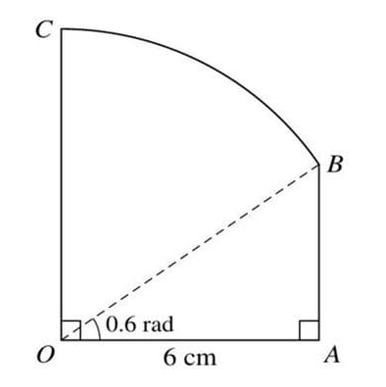
Problem 240
The diagram shows a metal plate OABC, consisting of a right-angled triangle OAB and a sector OBC of a circle with centre O. Angle AOB = 0.6 radians, OA = 6 cm and OA is perpendicular to OC.
(i) Show that the length of OB is 7.270 cm, correct to 3 decimal places.
(ii) Find the perimeter of the metal plate.
(iii) Find the area of the metal plate.
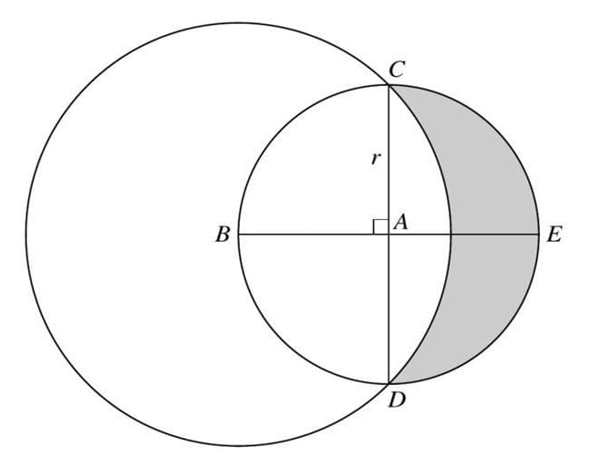
Problem 241
The diagram shows a circle with centre A and radius r. Diameters CAD and BAE are perpendicular to each other. A larger circle has centre B and passes through C and D.
(i) Show that the radius of the larger circle is r√2.
(ii) Find the area of the shaded region in terms of r.
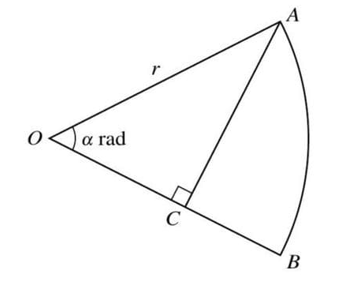
Problem 243
In the diagram, OAB is a sector of a circle with centre O and radius r. The point C on OB is such that angle ACO is a right angle. Angle AOB is α radians and is such that AC divides the sector into two regions of equal area.
(i) Show that \(\sin \alpha \cos \alpha = \frac{1}{2} \alpha\).
It is given that the solution of the equation in part (i) is \(\alpha = 0.9477\), correct to 4 decimal places.
(ii) Find the ratio perimeter of region OAC : perimeter of region ACB, giving your answer in the form k : 1, where k is given correct to 1 decimal place.
(iii) Find angle AOB in degrees.
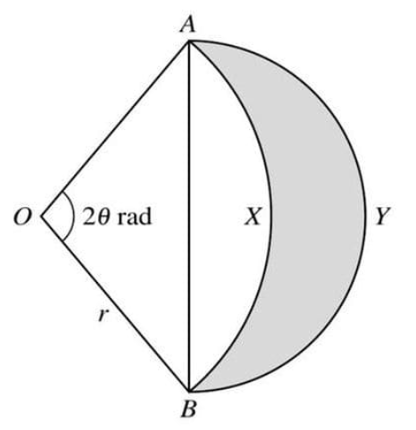
Problem 244
In the diagram, AYB is a semicircle with AB as diameter and OAXB is a sector of a circle with centre O and radius r. Angle AOB = 2θ radians. Find an expression, in terms of r and θ, for the area of the shaded region.
Problem 245
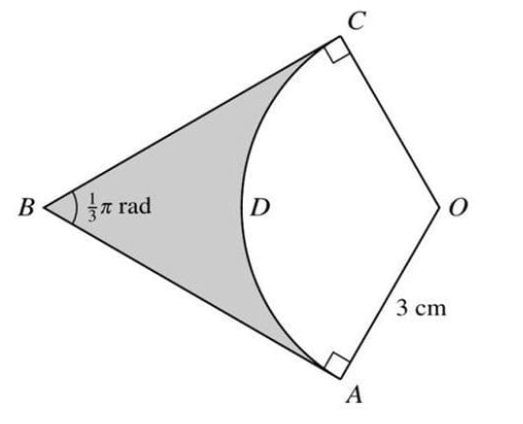
In the diagram, OADC is a sector of a circle with centre O and radius 3 cm. AB and CB are tangents to the circle and angle ABC = \(\frac{1}{3} \pi\) radians. Find, giving your answer in terms of \(\sqrt{3}\) and \(\pi\),
(i) the perimeter of the shaded region,
(ii) the area of the shaded region.
Problem 246
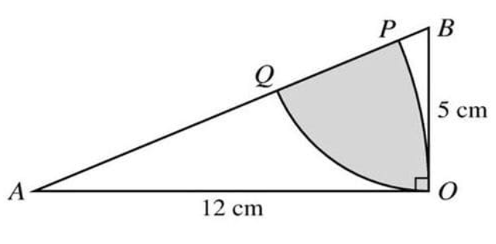
The diagram shows a triangle AOB in which OA is 12 cm, OB is 5 cm and angle AOB is a right angle. Point P lies on AB and OP is an arc of a circle with centre A. Point Q lies on AB and OQ is an arc of a circle with centre B.
(i) Show that angle BAO is 0.3948 radians, correct to 4 decimal places.
(ii) Calculate the area of the shaded region.
Problem 247
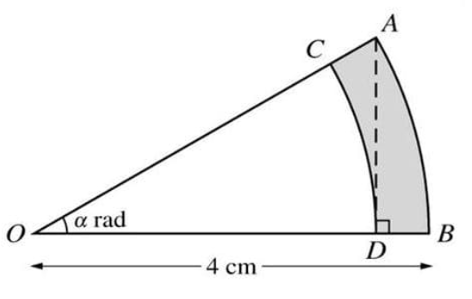
In the diagram, AB is an arc of a circle with centre O and radius 4 cm. Angle AOB is \(\alpha\) radians. The point D on OB is such that AD is perpendicular to OB. The arc DC, with centre O, meets OA at C.
(i) Find an expression in terms of \(\alpha\) for the perimeter of the shaded region ABDC.
(ii) For the case where \(\alpha = \frac{1}{6}\pi\), find the area of the shaded region ABDC, giving your answer in the form \(k\pi\), where \(k\) is a constant to be determined.
Problem 249
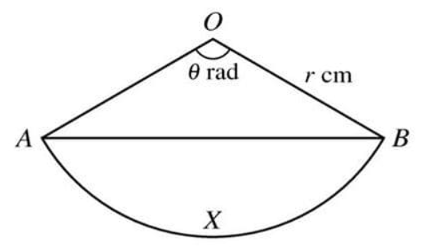
The diagram shows a sector of a circle with radius r cm and centre O. The chord AB divides the sector into a triangle AOB and a segment AXB. Angle AOB is θ radians.
(i) In the case where the areas of the triangle AOB and the segment AXB are equal, find the value of the constant p for which θ = p \, \sin \, θ.
(ii) In the case where r = 8 and θ = 2.4, find the perimeter of the segment AXB.
Problem 250
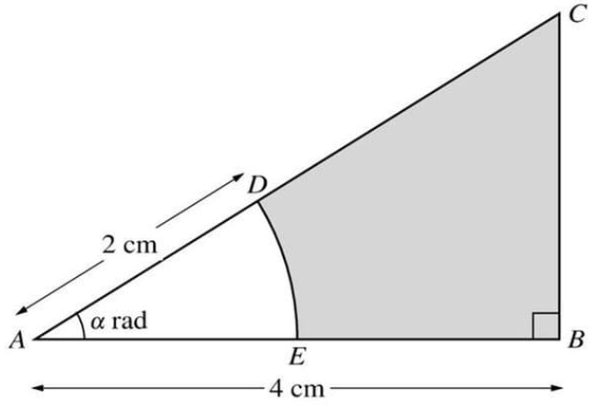
The diagram shows triangle ABC in which AB is perpendicular to BC. The length of AB is 4 cm and angle CAB is \(\alpha\) radians. The arc DE with centre A and radius 2 cm meets AC at D and AB at E. Find, in terms of \(\alpha\),
(i) the area of the shaded region,
Problem 252
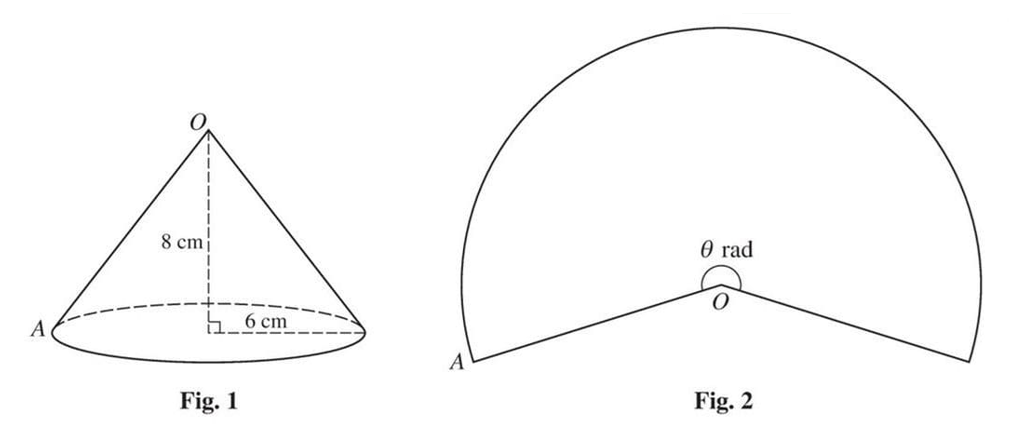
Fig. 1 shows a hollow cone with no base, made of paper. The radius of the cone is 6 cm and the height is 8 cm. The paper is cut from A to O and opened out to form the sector shown in Fig. 2. The circular bottom edge of the cone in Fig. 1 becomes the arc of the sector in Fig. 2. The angle of the sector is \(\theta\) radians. Calculate
(i) the value of \(\theta\),
(ii) the area of paper needed to make the cone.
Problem 253
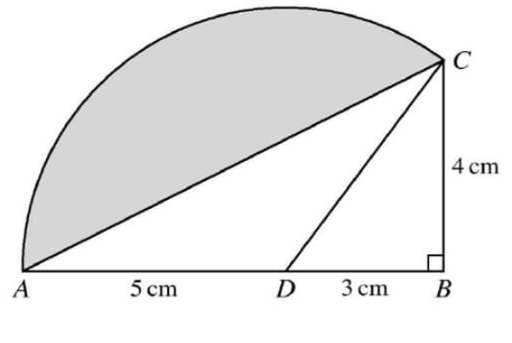
The diagram shows triangle ABC in which angle B is a right angle. The length of AB is 8 cm and the length of BC is 4 cm. The point D on AB is such that AD = 5 cm. The sector DAC is part of a circle with centre D.
(a) Find the perimeter of the shaded region.
(b) Find the area of the shaded region.
Problem 254
The diagram shows a metal plate made by fixing together two pieces, OABCD (shaded) and OAED (unshaded). The piece OABCD is a minor sector of a circle with centre O and radius 2r. The piece OAED is a major sector of a circle with centre O and radius r. Angle AOD is \(\alpha\) radians. Simplifying your answers where possible, find, in terms of \(\alpha\), \(\pi\) and \(r\),
(i) the perimeter of the metal plate,
(ii) the area of the metal plate.
It is now given that the shaded and unshaded pieces are equal in area.
(iii) Find \(\alpha\) in terms of \(\pi\).
Problem 255
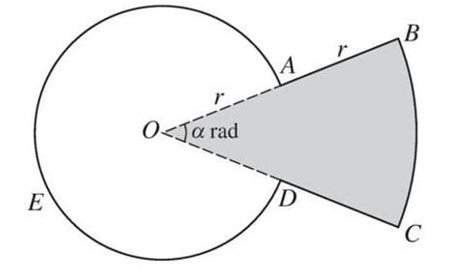
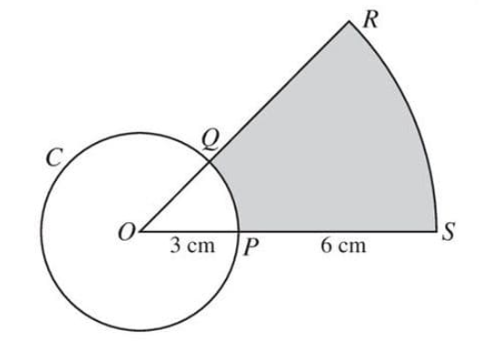
The diagram shows a circle C with centre O and radius 3 cm. The radii OP and OQ are extended to S and R respectively so that ORS is a sector of a circle with centre O. Given that PS = 6 cm and that the area of the shaded region is equal to the area of circle C,
- show that angle POQ = \frac{1}{4}\pi radians,
- find the perimeter of the shaded region.
Problem 256
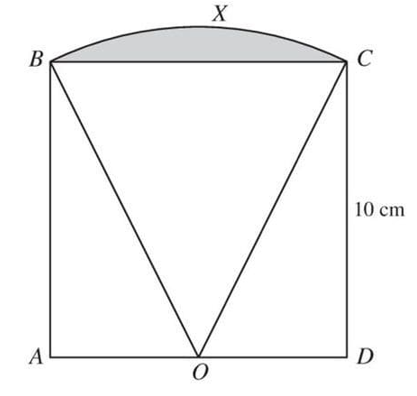
The diagram shows a square ABCD of side 10 cm. The mid-point of AD is O and BXC is an arc of a circle with centre O.
- Show that angle BOC is 0.9273 radians, correct to 4 decimal places.
- Find the perimeter of the shaded region.
- Find the area of the shaded region.
Problem 257
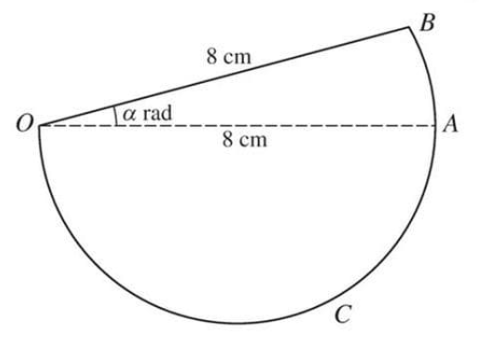
In the diagram, OAB is a sector of a circle with centre O and radius 8 cm. Angle BOA is \(\alpha\) radians. OAC is a semicircle with diameter OA. The area of the semicircle OAC is twice the area of the sector OAB.
(i) Find \(\alpha\) in terms of \(\pi\).
(ii) Find the perimeter of the complete figure in terms of \(\pi\).
Problem 258
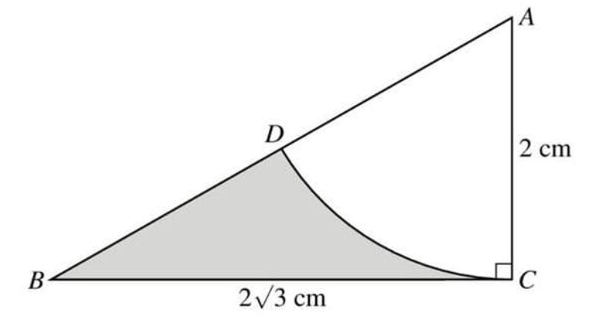
In the diagram, D lies on the side AB of triangle ABC and CD is an arc of a circle with centre A and radius 2 cm. The line BC is of length \(2\sqrt{3}\) cm and is perpendicular to AC. Find the area of the shaded region BDC, giving your answer in terms of \(\pi\) and \(\sqrt{3}\).
Problem 259
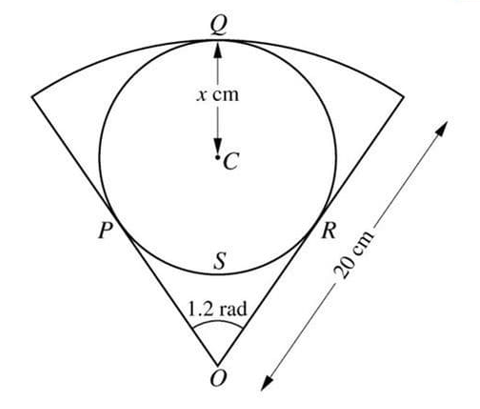
The diagram shows a sector of a circle with centre O and radius 20 cm. A circle with centre C and radius x cm lies within the sector and touches it at P, Q, and R. Angle POR = 1.2 radians.
(i) Show that x = 7.218, correct to 3 decimal places.
(ii) Find the total area of the three parts of the sector lying outside the circle with centre C.
(iii) Find the perimeter of the region OPSR bounded by the arc PSR and the lines OP and OR.
Problem 260
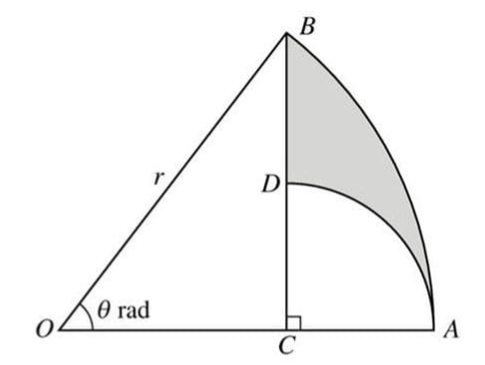
The diagram shows a sector OAB of a circle with centre O and radius r. Angle AOB is \(\theta\) radians. The point C on OA is such that BC is perpendicular to OA. The point D is on BC and the circular arc AD has centre C.
(i) Find AC in terms of r and \(\theta\).
(ii) Find the perimeter of the shaded region ABD when \(\theta = \frac{1}{3} \pi\) and r = 4, giving your answer as an exact value.
Problem 261
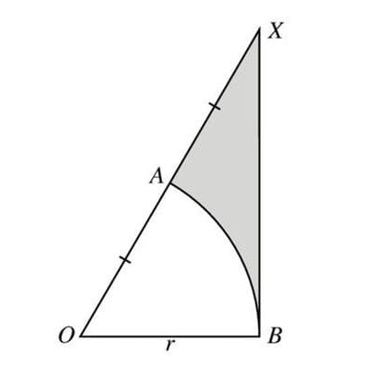
In the diagram, AB is an arc of a circle with centre O and radius r. The line XB is a tangent to the circle at B and A is the mid-point of OX.
(i) Show that angle AOB = \frac{1}{3}\pi radians.
Express each of the following in terms of r, \pi and \sqrt{3}:
(ii) the perimeter of the shaded region,
(iii) the area of the shaded region.
Problem 262
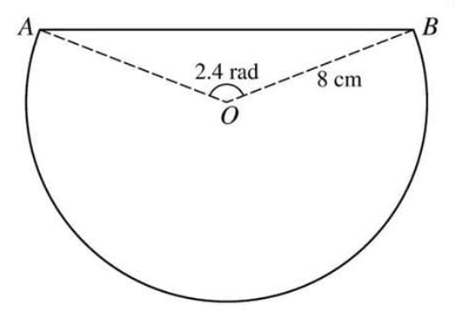
The diagram shows a metal plate made by removing a segment from a circle with centre O and radius 8 cm. The line AB is a chord of the circle and angle AOB = 2.4 radians. Find
- the length of AB,
- the perimeter of the plate,
- the area of the plate.
Problem 263
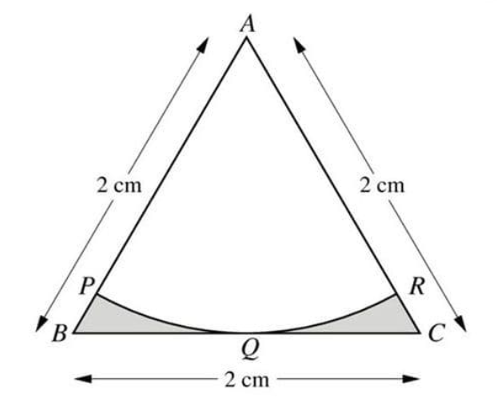
In the diagram, \(ABC\) is an equilateral triangle of side \(2 \text{ cm}\). The mid-point of \(BC\) is \(Q\). An arc of a circle with centre \(A\) touches \(BC\) at \(Q\), and meets \(AB\) at \(P\) and \(AC\) at \(R\). Find the total area of the shaded regions, giving your answer in terms of \(\pi\) and \(\sqrt{3}\).
Problem 264
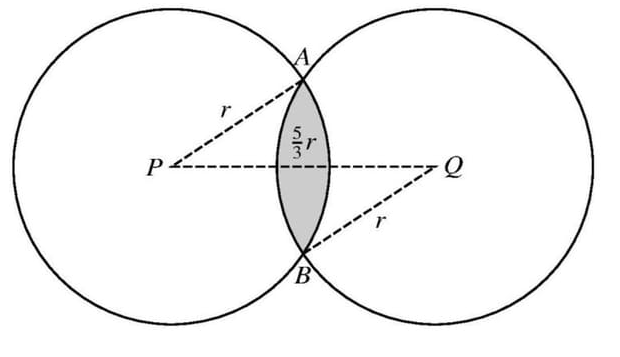
The diagram shows two identical circles intersecting at points A and B and with centres at P and Q. The radius of each circle is \(r\) and the distance \(PQ\) is \(\frac{5}{3}r\).
(a) Find the perimeter of the shaded region in terms of \(r\).
(b) Find the area of the shaded region in terms of \(r\).
Problem 265
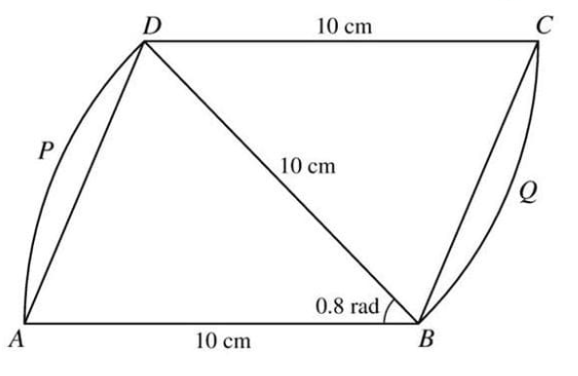
In the diagram, ABCD is a parallelogram with AB = BD = DC = 10 cm and angle ABD = 0.8 radians. APD and BQC are arcs of circles with centres B and D respectively.
- Find the area of the parallelogram ABCD.
- Find the area of the complete figure ABQCDP.
- Find the perimeter of the complete figure ABQCDP.
Problem 266
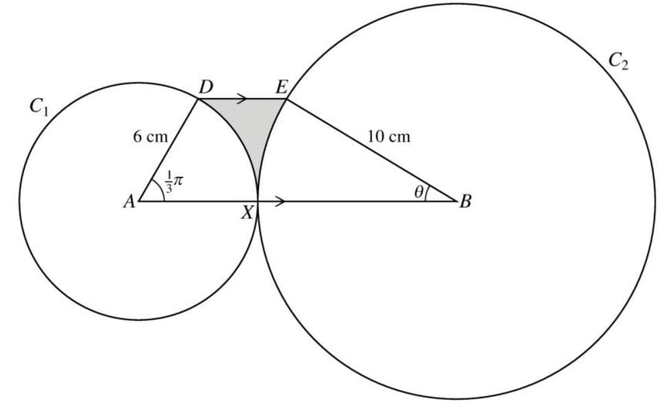
The diagram shows a circle \(C_1\) touching a circle \(C_2\) at a point \(X\). Circle \(C_1\) has centre \(A\) and radius 6 cm, and circle \(C_2\) has centre \(B\) and radius 10 cm. Points \(D\) and \(E\) lie on \(C_1\) and \(C_2\) respectively and \(DE\) is parallel to \(AB\). Angle \(DAX = \frac{1}{3}\pi\) radians and angle \(EBX = \theta\) radians.
(i) By considering the perpendicular distances of \(D\) and \(E\) from \(AB\), show that the exact value of \(\theta\) is \(\sin^{-1}\left(\frac{3\sqrt{3}}{10}\right)\).
(ii) Find the perimeter of the shaded region, correct to 4 significant figures.
Problem 267
The diagram represents a metal plate OABC, consisting of a sector OAB of a circle with centre O and radius r, together with a triangle OCB which is right-angled at C. Angle AOB = \(\theta\) radians and OC is perpendicular to OA.
(i) Find an expression in terms of r and \(\theta\) for the perimeter of the plate.
(ii) For the case where r = 10 and \(\theta = \frac{1}{5}\pi\), find the area of the plate.
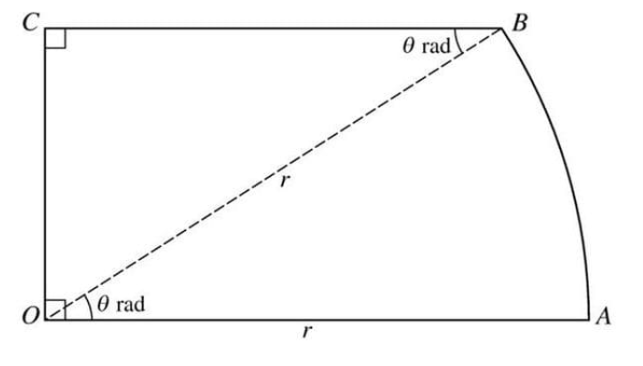
Problem 268
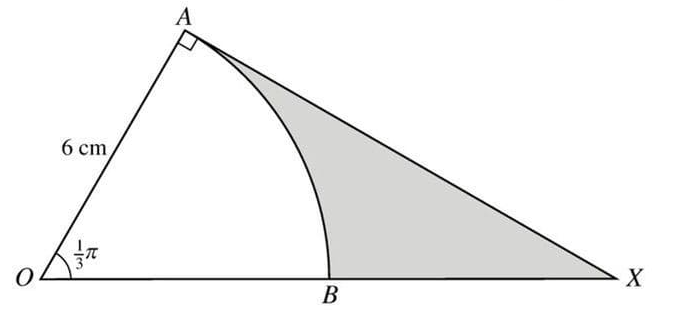
In the diagram, AB is an arc of a circle, centre O and radius 6 cm, and angle AOB = \(\frac{1}{3} \pi\) radians. The line AX is a tangent to the circle at A, and OBX is a straight line.
- Show that the exact length of AX is \(6 \sqrt{3}\) cm.
- Find, in terms of \(\pi\) and \(\sqrt{3}\),
- the area of the shaded region,
- the perimeter of the shaded region.
Problem 269
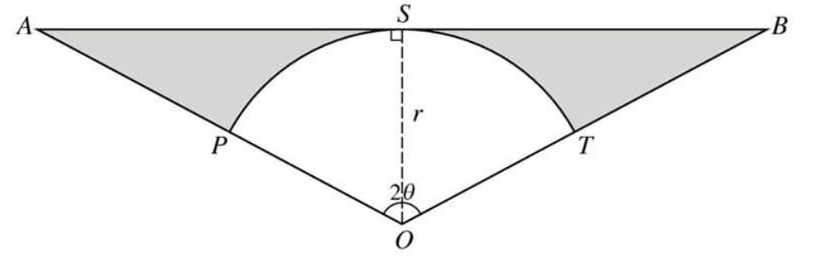
In the diagram, OAB is an isosceles triangle with OA = OB and angle AOB = 2\theta radians. Arc PST has centre O and radius r, and the line ASB is a tangent to the arc PST at S.
(i) Find the total area of the shaded regions in terms of r and \(\theta\).
(ii) In the case where \(\theta = \frac{1}{3}\pi\) and \(r = 6\), find the total perimeter of the shaded regions, leaving your answer in terms of \(\sqrt{3}\) and \(\pi\).
Problem 270
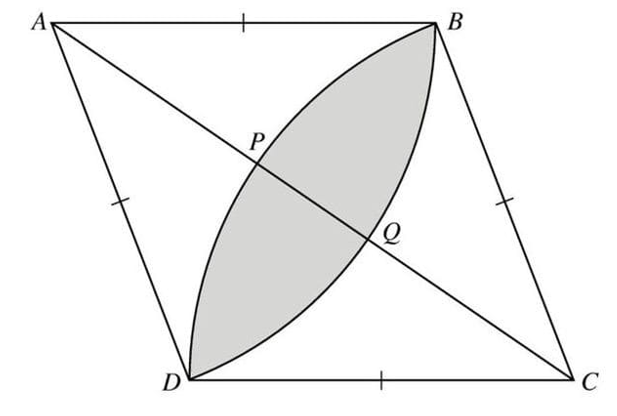
The diagram shows a rhombus ABCD. Points P and Q lie on the diagonal AC such that BPD is an arc of a circle with centre C and BQD is an arc of a circle with centre A. Each side of the rhombus has length 5 cm and angle BAD = 1.2 radians.
(i) Find the area of the shaded region BPDQ.
(ii) Find the length of PQ.
Problem 272
The diagram shows two circles, \(C_1\) and \(C_2\), touching at the point \(T\). Circle \(C_1\) has centre \(P\) and radius 8 cm; circle \(C_2\) has centre \(Q\) and radius 2 cm. Points \(R\) and \(S\) lie on \(C_1\) and \(C_2\) respectively, and \(RS\) is a tangent to both circles.
(i) Show that \(RS = 8\) cm.
(ii) Find angle \(RPQ\) in radians correct to 4 significant figures.
(iii) Find the area of the shaded region.
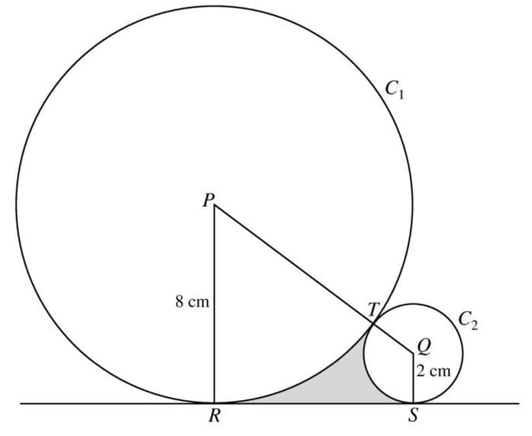
Problem 273
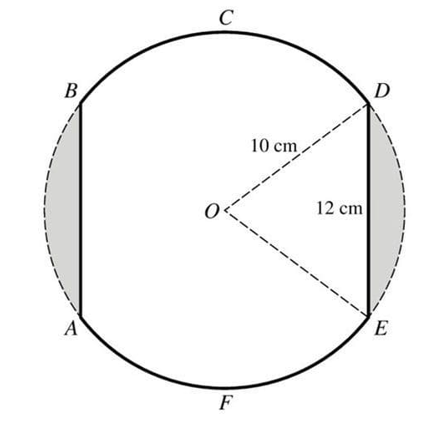
The diagram shows a metal plate ABCDEF which has been made by removing the two shaded regions from a circle of radius 10 cm and centre O. The parallel edges AB and ED are both of length 12 cm.
- Show that angle DOE is 1.287 radians, correct to 4 significant figures.
- Find the perimeter of the metal plate.
- Find the area of the metal plate.
Problem 274
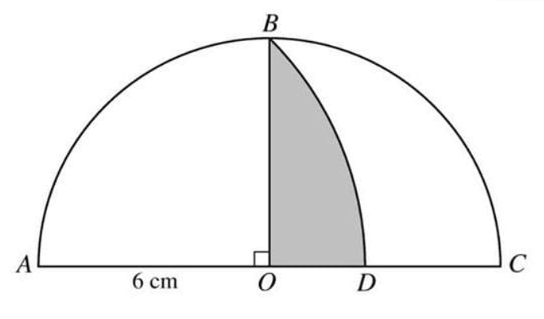
The diagram shows a semicircle ABC with centre O and radius 6 cm. The point B is such that angle BOA is 90° and BD is an arc of a circle with centre A. Find
- the length of the arc BD,
- the area of the shaded region.
Problem 275
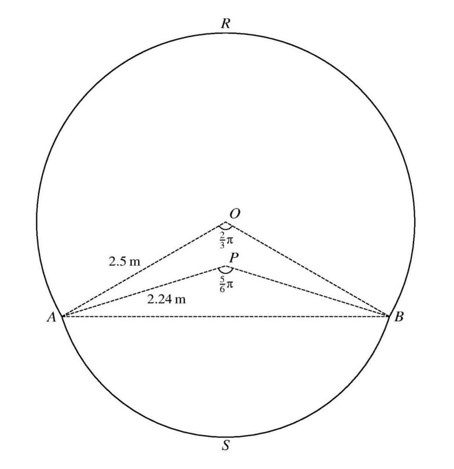
The diagram shows a cross-section RASB of the body of an aircraft. The cross-section consists of a sector OARB of a circle of radius 2.5 m, with centre O, a sector PASB of another circle of radius 2.24 m with centre P and a quadrilateral OAPB. Angle AOB = \(\frac{2\pi}{3}\) and angle APB = \(\frac{5\pi}{6}\).
(a) Find the perimeter of the cross-section RASB, giving your answer correct to 2 decimal places.
(b) Find the difference in area of the two triangles AOB and APB, giving your answer correct to 2 decimal places.
(c) Find the area of the cross-section RASB, giving your answer correct to 1 decimal place.
Problem 276
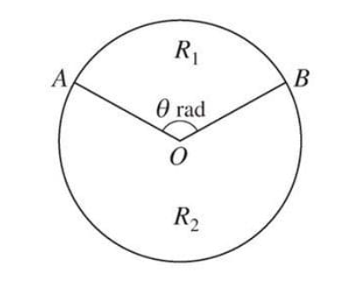
The diagram shows a circle with centre O. The circle is divided into two regions, R1 and R2, by the radii OA and OB, where angle AOB = \theta radians. The perimeter of the region R1 is equal to the length of the major arc AB.
(i) Show that \(\theta = \pi - 1\).
(ii) Given that the area of region R1 is 30 cm2, find the area of region R2, correct to 3 significant figures.
Problem 277
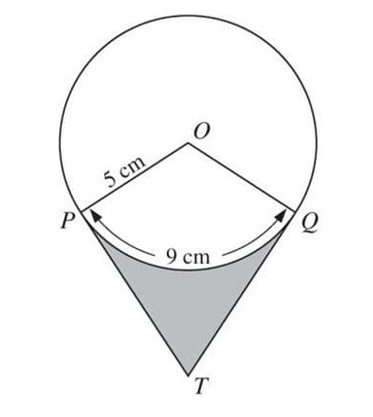
In the diagram, the circle has centre O and radius 5 cm. The points P and Q lie on the circle, and the arc length PQ is 9 cm. The tangents to the circle at P and Q meet at the point T. Calculate
(i) angle POQ in radians,
(ii) the length of PT,
(iii) the area of the shaded region.
Problem 278
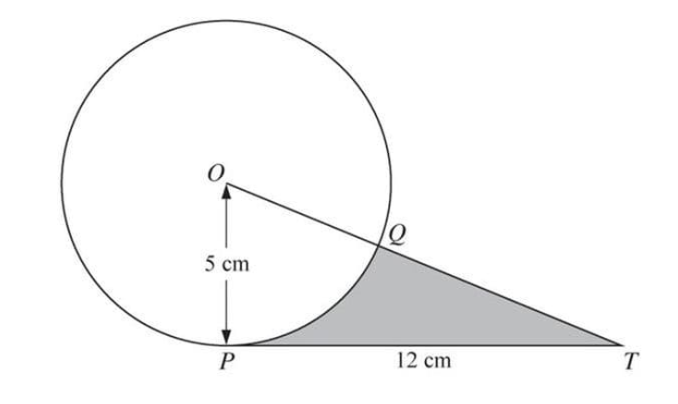
The diagram shows a circle with centre O and radius 5 cm. The point P lies on the circle, PT is a tangent to the circle and PT = 12 cm. The line OT cuts the circle at the point Q.
(i) Find the perimeter of the shaded region.
(ii) Find the area of the shaded region.
Problem 279
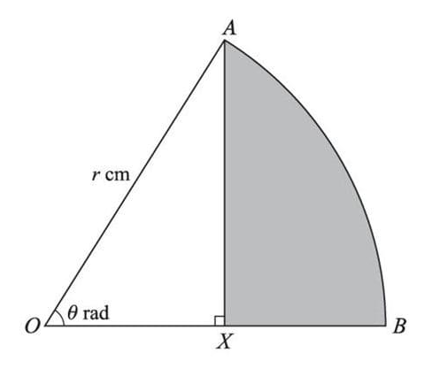
In the diagram, AB is an arc of a circle, centre O and radius r cm, and angle AOB = θ radians. The point X lies on OB and AX is perpendicular to OB.
(i) Show that the area, A cm², of the shaded region AXB is given by
\(A = \frac{1}{2}r^2(\theta - \sin \theta \cos \theta)\).
(ii) In the case where r = 12 and θ = \(\frac{1}{6}\pi\), find the perimeter of the shaded region AXB, leaving your answer in terms of \(\sqrt{3}\) and \(\pi\).
Problem 280
In the diagram, OAB is a sector of a circle with centre O and radius 12 cm. The lines AX and BX are tangents to the circle at A and B respectively. Angle AOB = \(\frac{1}{3} \pi\) radians.
(i) Find the exact length of AX, giving your answer in terms of \(\sqrt{3}\).
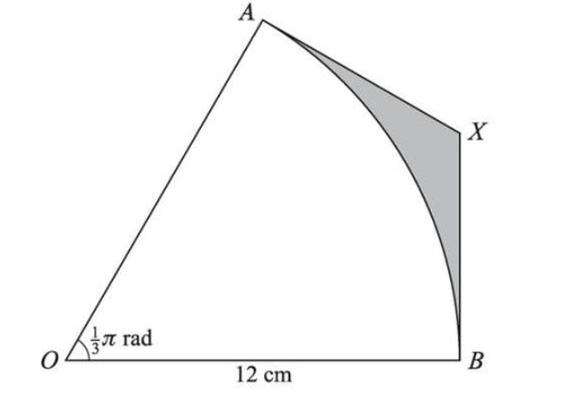
Problem 281
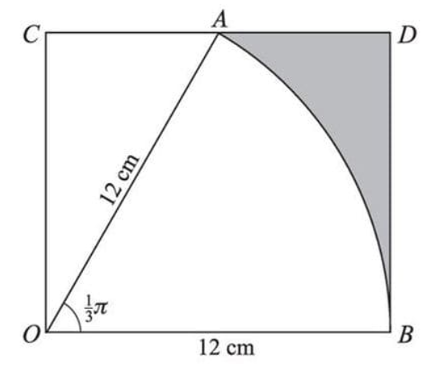
In the diagram, AOB is a sector of a circle with centre O and radius 12 cm. The point A lies on the side CD of the rectangle OCDB. Angle AOB = \(\frac{1}{3} \pi\) radians. Express the area of the shaded region in the form \(a(\sqrt{3}) - b\pi\), stating the values of the integers a and b.
Problem 282
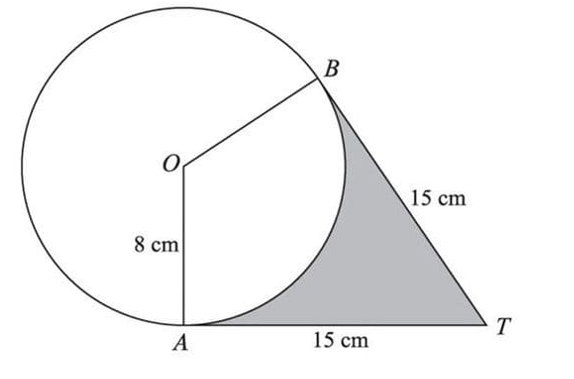
The diagram shows a circle with centre O and radius 8 cm. Points A and B lie on the circle. The tangents at A and B meet at the point T, and AT = BT = 15 cm.
(i) Show that angle AOB is 2.16 radians, correct to 3 significant figures.
(ii) Find the perimeter of the shaded region.
(iii) Find the area of the shaded region.
Problem 283
The equation of a curve is \(xy = 12\) and the equation of a line \(l\) is \(2x + y = k\), where \(k\) is a constant.
In the case where \(k = 10\), one of the points of intersection is \(P(2, 6)\). Find the angle, in degrees correct to 1 decimal place, between \(l\) and the tangent to the curve at \(P\).
Problem 285
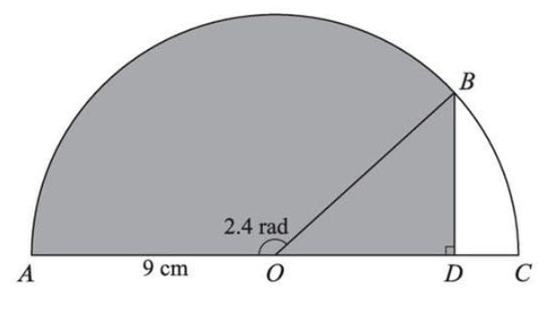
In the diagram, ABC is a semicircle, centre O and radius 9 cm. The line BD is perpendicular to the diameter AC and angle AOB = 2.4 radians.
- Show that BD = 6.08 cm, correct to 3 significant figures.
- Find the perimeter of the shaded region.
- Find the area of the shaded region.