Exam-Style Problems
⬅ Back to SubchapterNov 2023 p53 q3
2582
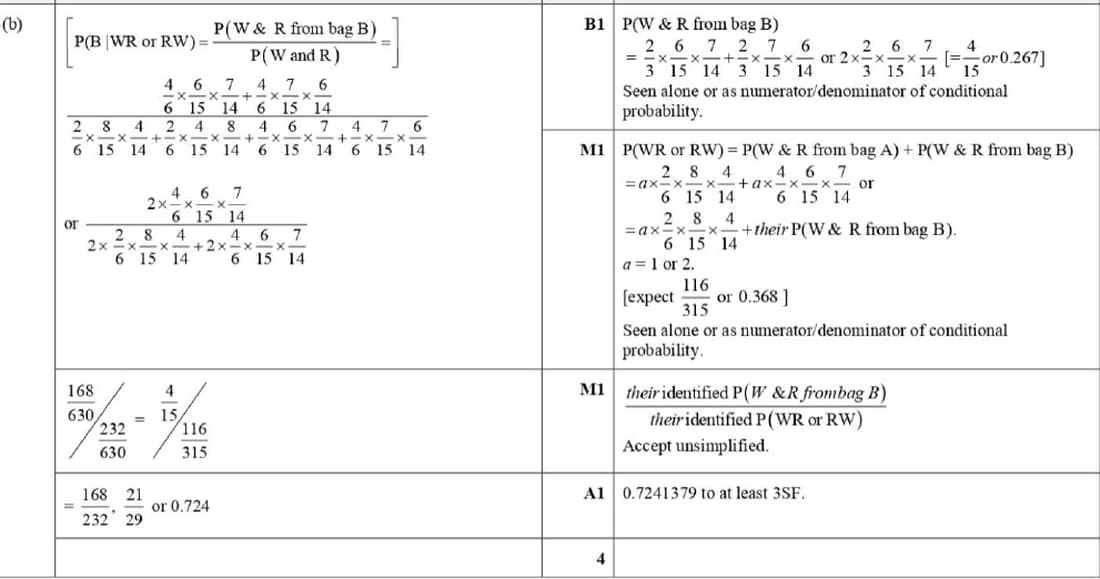
Tim has two bags of marbles, A and B.
Bag A contains 8 white, 4 red and 3 yellow marbles.
Bag B contains 6 white, 7 red and 2 yellow marbles.
Tim also has an ordinary fair 6-sided dice. He rolls the dice. If he obtains a 1 or 2, he chooses two marbles at random from bag A, without replacement. If he obtains a 3, 4, 5 or 6, he chooses two marbles at random from bag B, without replacement.
Find the probability that the two marbles come from bag B given that one is white and one is red.
Nov 2021 p53 q7
2583
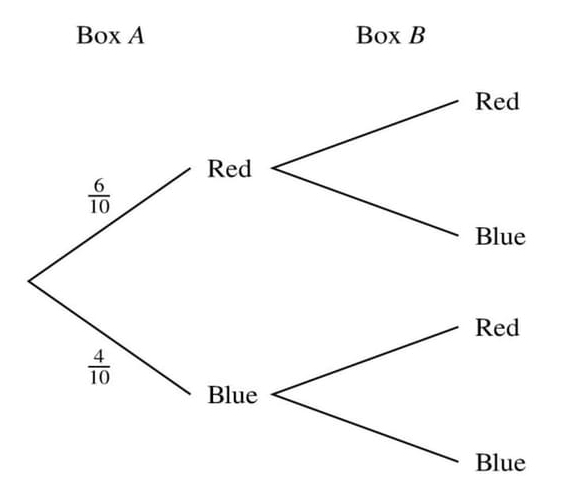
Box A contains 6 red balls and 4 blue balls. Box B contains x red balls and 9 blue balls. A ball is chosen at random from box A and placed in box B. A ball is then chosen at random from box B.
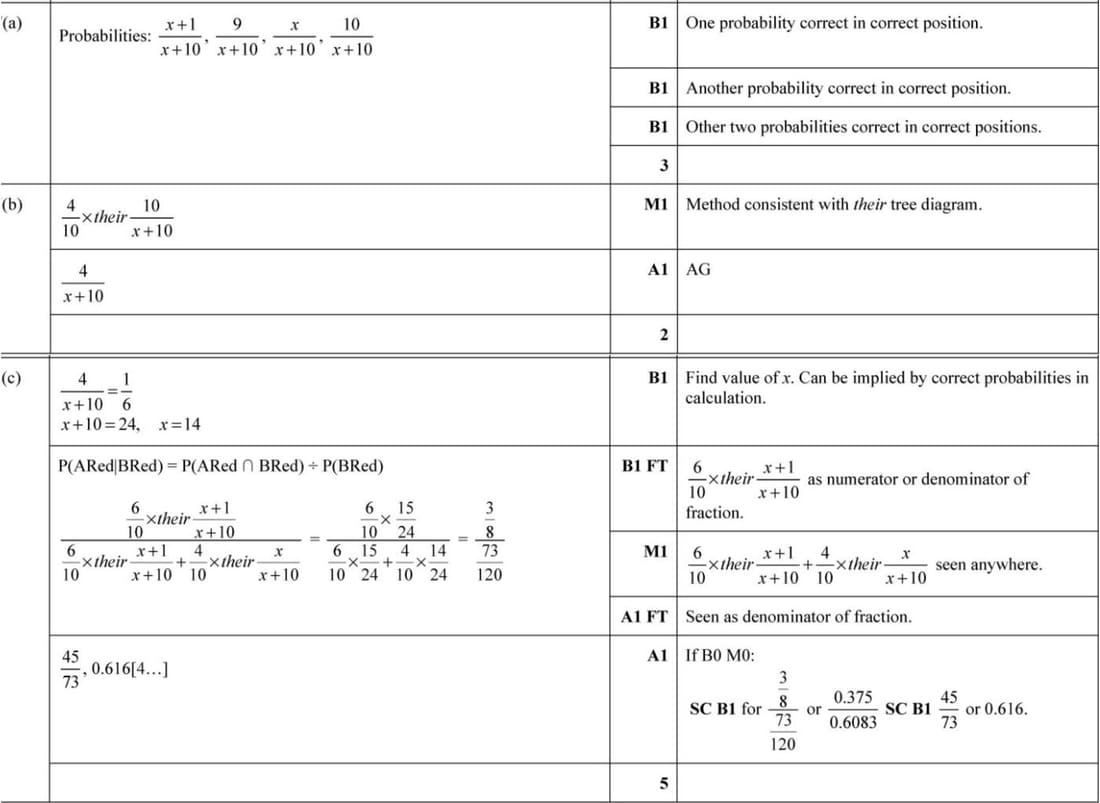
(a) Complete the tree diagram below, giving the remaining four probabilities in terms of x.
(b) Show that the probability that both balls chosen are blue is \(\frac{4}{x+10}\).
It is given that the probability that both balls chosen are blue is \(\frac{1}{6}\).
(c) Find the probability, correct to 3 significant figures, that the ball chosen from box A is red given that the ball chosen from box B is red.
Nov 2021 p52 q1
2584
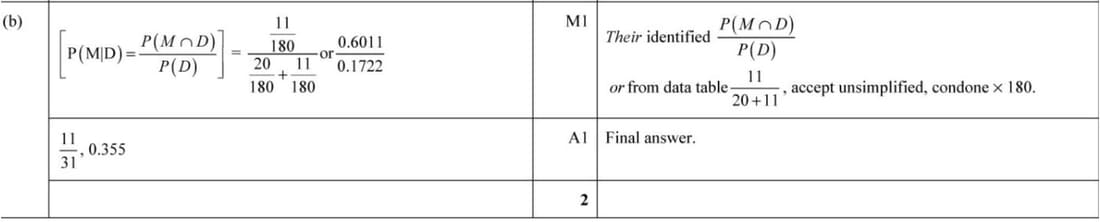
Each of the 180 students at a college plays exactly one of the piano, the guitar, and the drums. The numbers of male and female students who play the piano, the guitar, and the drums are given in the following table.
| Piano | Guitar | Drums | |
|---|---|---|---|
| Male | 25 | 44 | 11 |
| Female | 42 | 38 | 20 |
A student at the college is chosen at random.
Find the probability that the student is male given that the student plays the drums.
Nov 2021 p51 q3
2585
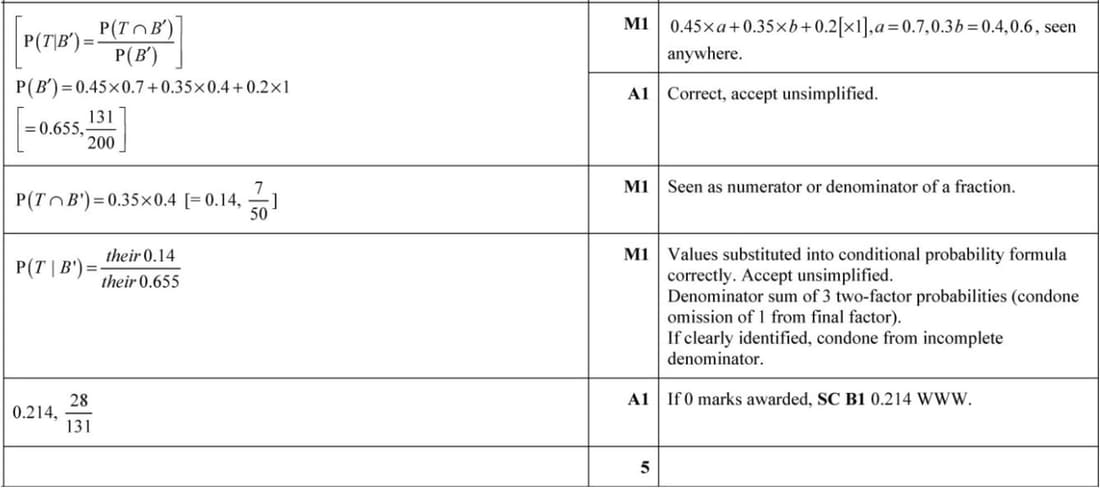
For her bedtime drink, Suki has either chocolate, tea or milk with probabilities 0.45, 0.35 and 0.2 respectively. When she has chocolate, the probability that she has a biscuit is 0.3. When she has tea, the probability that she has a biscuit is 0.6. When she has milk, she never has a biscuit.
Find the probability that Suki has tea given that she does not have a biscuit.
June 2021 p53 q7
2586
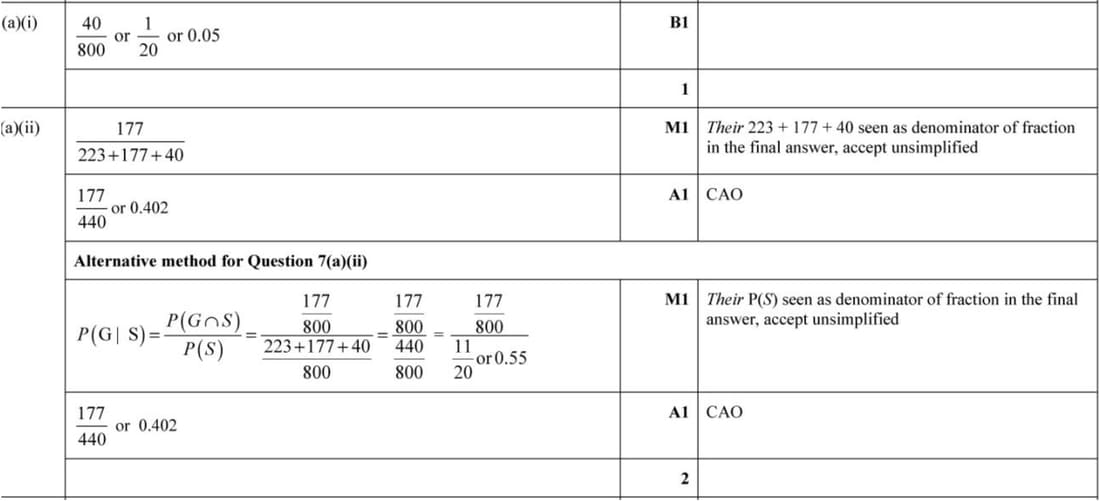
In the region of Arka, the total number of households in the three villages Reeta, Shan and Teber is 800. Each of the households was asked about the quality of their broadband service. Their responses are summarised in the following table.
| Village | Excellent | Good | Poor |
|---|---|---|---|
| Reeta | 75 | 118 | 32 |
| Shan | 223 | 177 | 40 |
| Teber | 12 | 60 | 63 |
(i) Find the probability that a randomly chosen household is in Shan and has poor broadband service.
(ii) Find the probability that a randomly chosen household has good broadband service given that the household is in Shan.
June 2021 p52 q3
2587
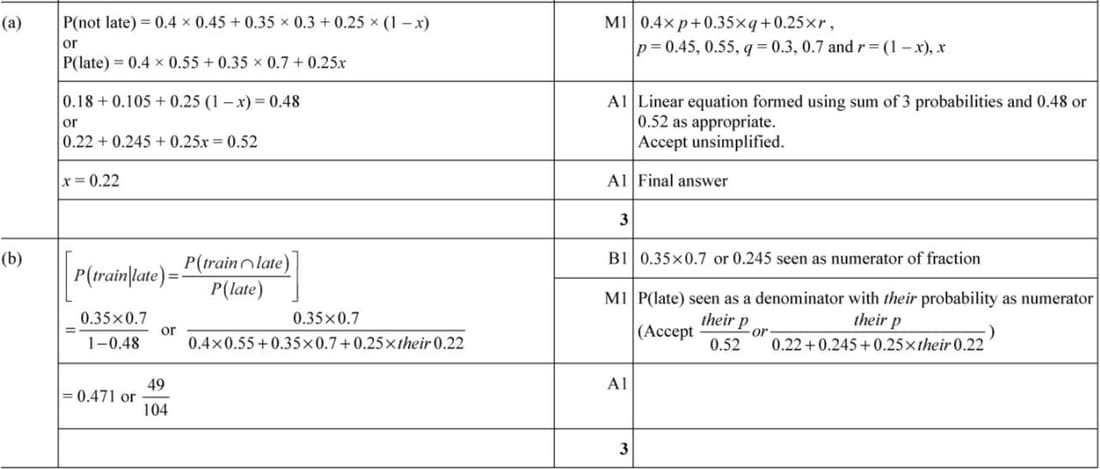
On each day that Alexa goes to work, the probabilities that she travels by bus, by train or by car are 0.4, 0.35 and 0.25 respectively. When she travels by bus, the probability that she arrives late is 0.55. When she travels by train, the probability that she arrives late is 0.7. When she travels by car, the probability that she arrives late is x.
On a randomly chosen day when Alexa goes to work, the probability that she does not arrive late is 0.48.
(a) Find the value of x.
(b) Find the probability that Alexa travels to work by train given that she arrives late.
June 2021 p51 q4
2588
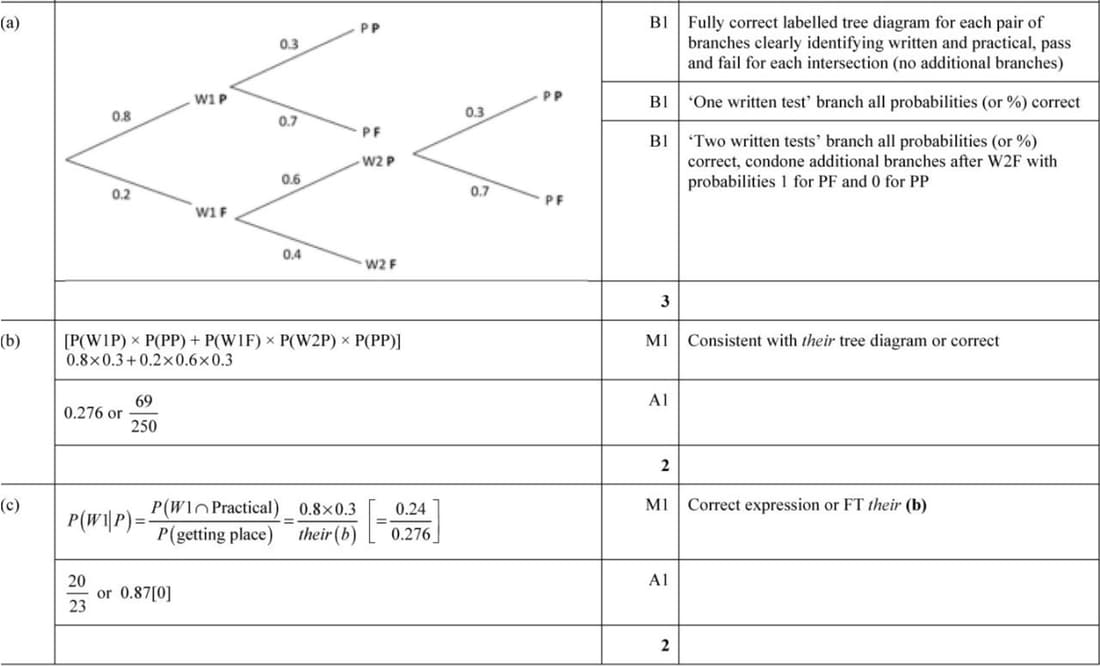
To gain a place at a science college, students first have to pass a written test and then a practical test.
Each student is allowed a maximum of two attempts at the written test. A student is only allowed a second attempt if they fail the first attempt. No student is allowed more than one attempt at the practical test. If a student fails both attempts at the written test, then they cannot attempt the practical test.
The probability that a student will pass the written test at the first attempt is 0.8. If a student fails the first attempt at the written test, the probability that they will pass at the second attempt is 0.6. The probability that a student will pass the practical test is always 0.3.
(a) Draw a tree diagram to represent this information, showing the probabilities on the branches.
(b) Find the probability that a randomly chosen student will succeed in gaining a place at the college.
(c) Find the probability that a randomly chosen student passes the written test at the first attempt given that the student succeeds in gaining a place at the college.
Feb/Mar 2021 p52 q2
2589
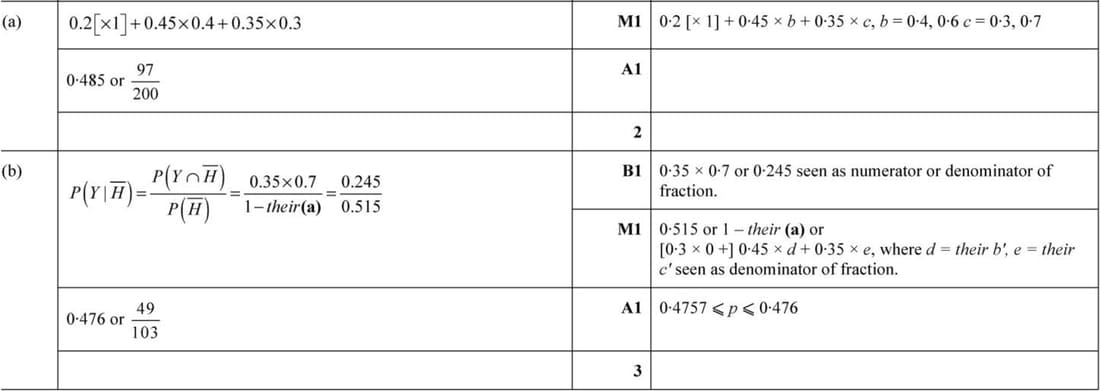
Georgie has a red scarf, a blue scarf and a yellow scarf. Each day she wears exactly one of these scarves. The probabilities for the three colours are 0.2, 0.45 and 0.35 respectively. When she wears a red scarf, she always wears a hat. When she wears a blue scarf, she wears a hat with probability 0.4. When she wears a yellow scarf, she wears a hat with probability 0.3.
(a) Find the probability that on a randomly chosen day Georgie wears a hat.
(b) Find the probability that on a randomly chosen day Georgie wears a yellow scarf given that she does not wear a hat.
Nov 2020 p52 q4
2590
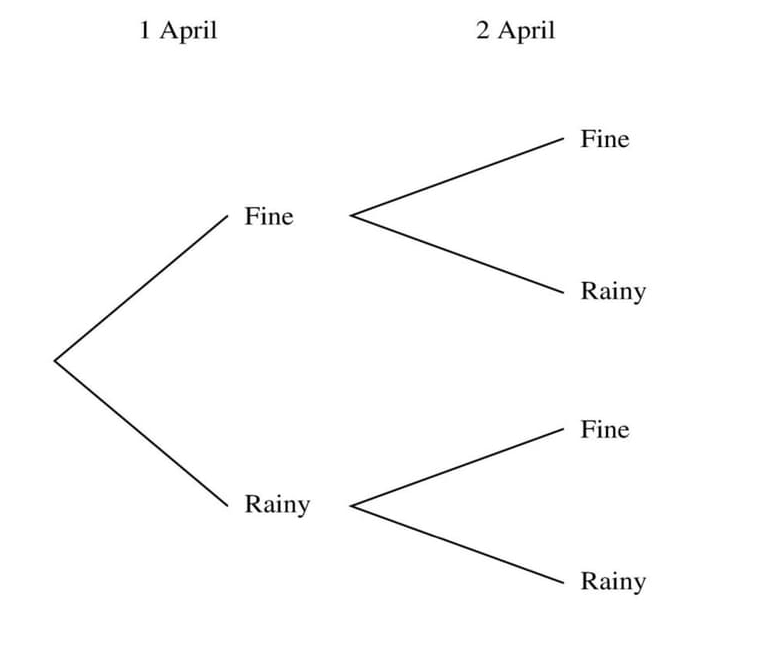
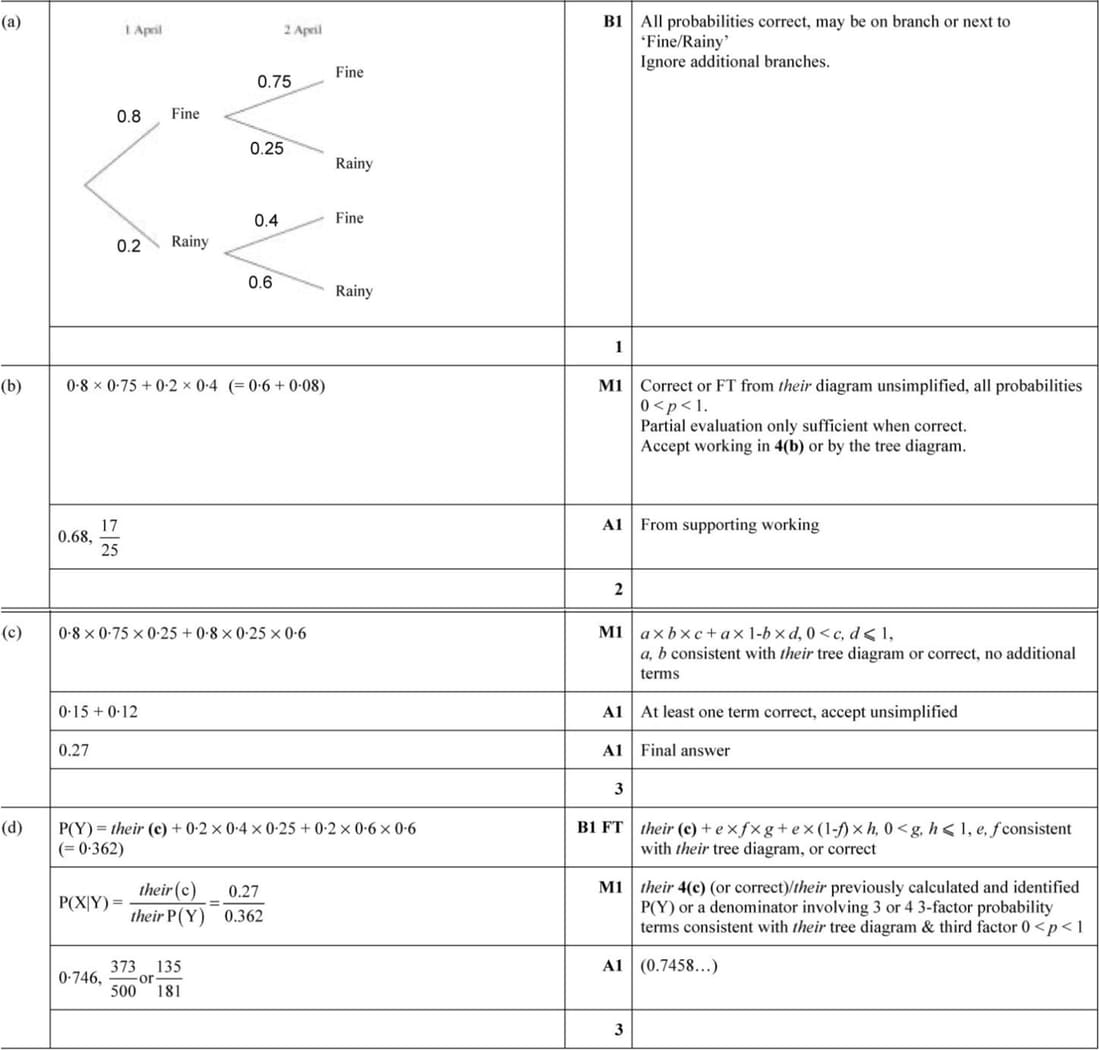
In a certain country, the weather each day is classified as fine or rainy. The probability that a fine day is followed by a fine day is 0.75 and the probability that a rainy day is followed by a fine day is 0.4. The probability that it is fine on 1 April is 0.8. The tree diagram below shows the possibilities for the weather on 1 April and 2 April.
(a) Complete the tree diagram to show the probabilities.
(b) Find the probability that 2 April is fine.
Let \(X\) be the event that 1 April is fine and \(Y\) be the event that 3 April is rainy.
(c) Find the value of \(P(X \cap Y)\).
(d) Find the probability that 1 April is fine given that 3 April is rainy.
June 2020 p53 q1
2591
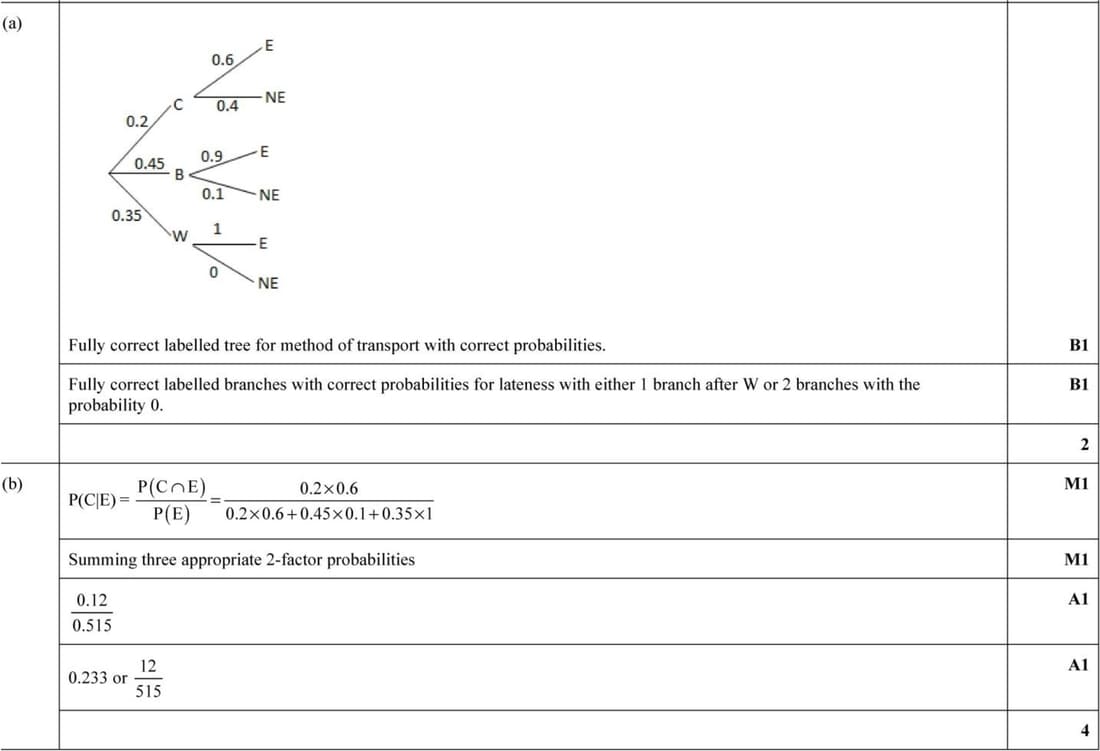
Juan goes to college each day by any one of car or bus or walking. The probability that he goes by car is 0.2, the probability that he goes by bus is 0.45 and the probability that he walks is 0.35. When Juan goes by car, the probability that he arrives early is 0.6. When he goes by bus, the probability that he arrives early is 0.1. When he walks he always arrives early.
(a) Draw a fully labelled tree diagram to represent this information.
(b) Find the probability that Juan goes to college by car given that he arrives early.
June 2020 p52 q2
2592
A total of 500 students were asked which one of four colleges they attended and whether they preferred soccer or hockey. The numbers of students in each category are shown in the following table.
| Soccer | Hockey | Total | |
|---|---|---|---|
| Amos | 54 | 32 | 86 |
| Benn | 84 | 72 | 156 |
| Canton | 22 | 56 | 78 |
| Devar | 120 | 60 | 180 |
| Total | 280 | 220 | 500 |
Find the probability that a randomly chosen student is at Devar college given that he prefers soccer.

Nov 2023 p52 q6
2593
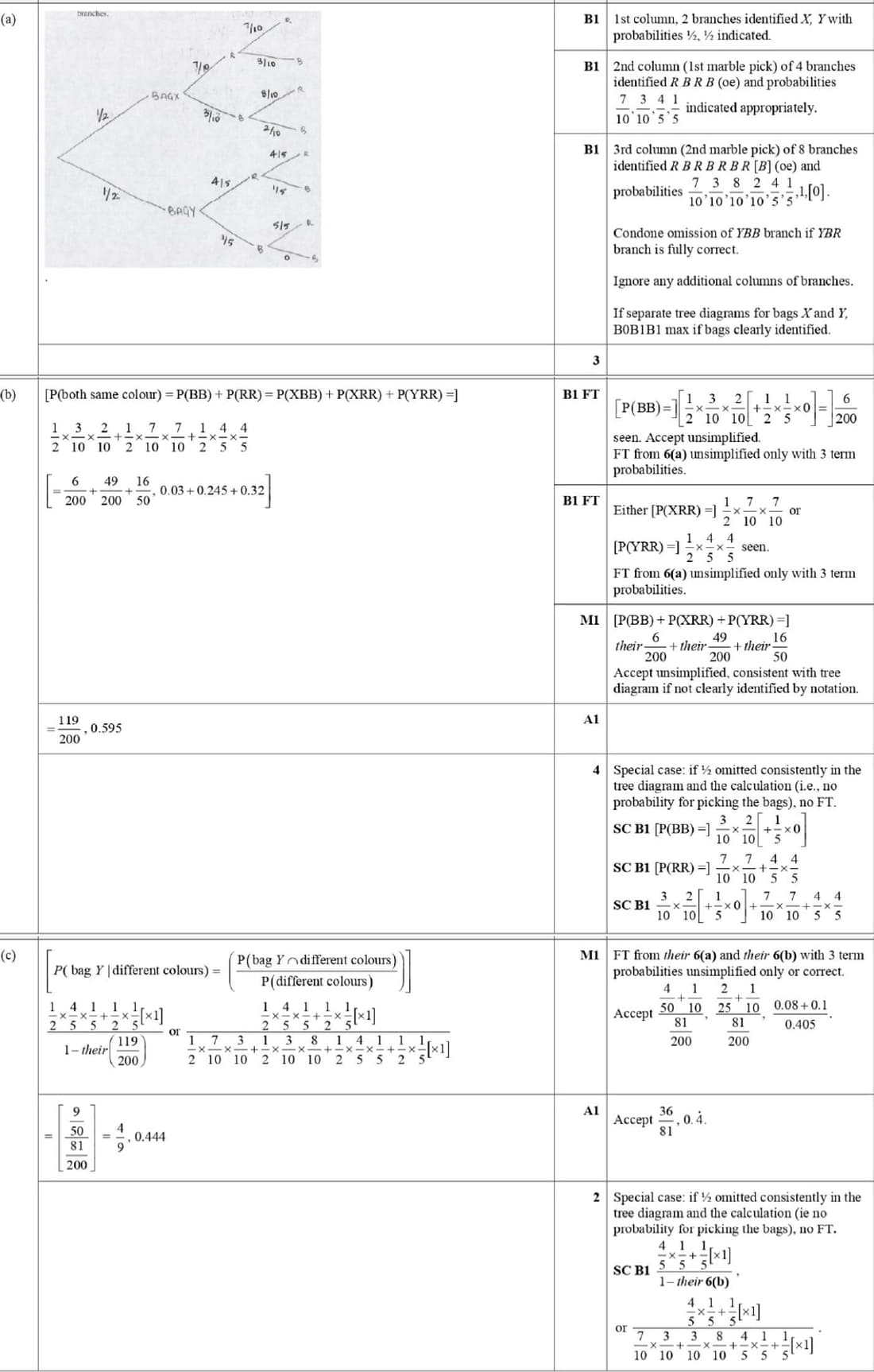
Freddie has two bags of marbles.
Bag X contains 7 red marbles and 3 blue marbles.
Bag Y contains 4 red marbles and 1 blue marble.
Freddie chooses one of the bags at random. A marble is removed at random from that bag and not replaced. A new red marble is now added to each bag. A second marble is then removed at random from the same bag that the first marble had been removed from.
(a) Draw a tree diagram to represent this information, showing the probability on each of the branches. [3]
(b) Find the probability that both of the marbles removed from the bag are the same colour. [4]
(c) Find the probability that bag Y is chosen given that the marbles removed are not both the same colour. [2]
June 2020 p51 q5
2594
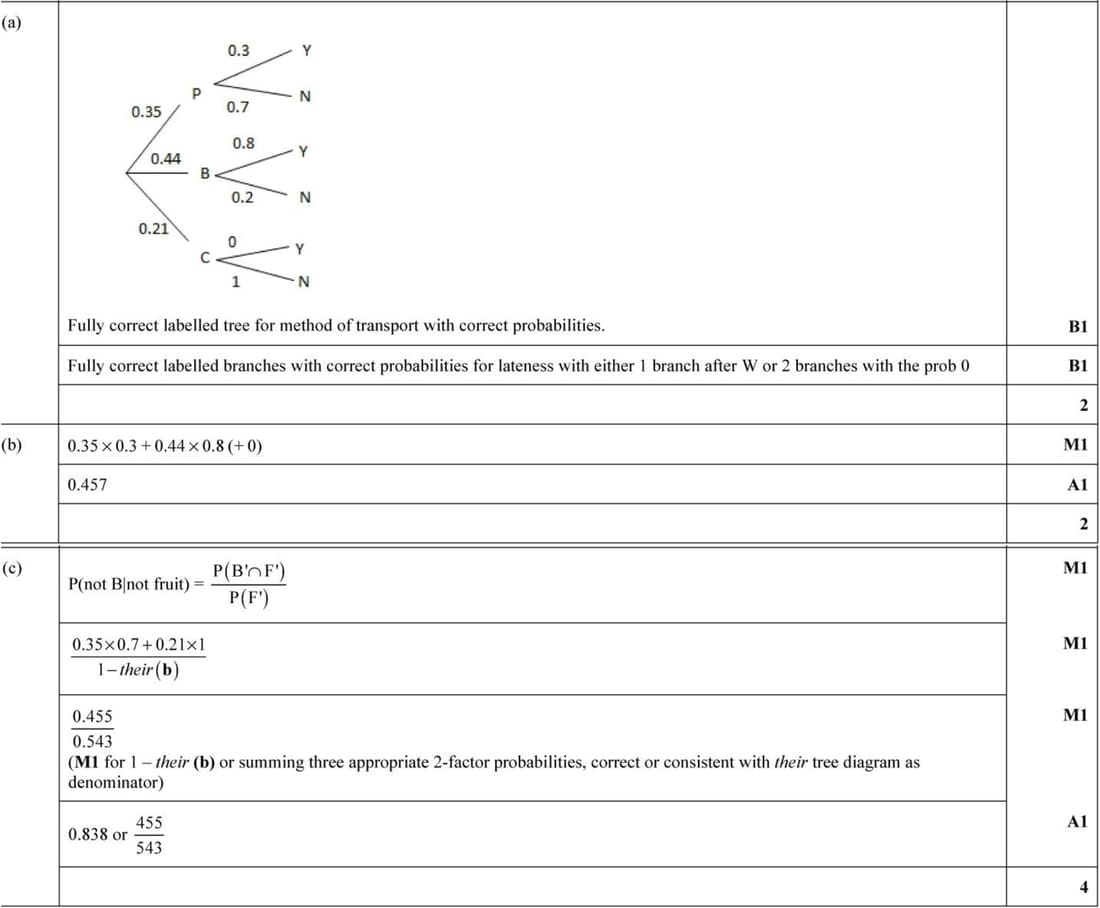
On Mondays, Rani cooks her evening meal. She has a pizza, a burger or a curry with probabilities 0.35, 0.44, 0.21 respectively. When she cooks a pizza, Rani has some fruit with probability 0.3. When she cooks a burger, she has some fruit with probability 0.8. When she cooks a curry, she never has any fruit.
(a) Draw a fully labelled tree diagram to represent this information.
(b) Find the probability that Rani has some fruit.
(c) Find the probability that Rani does not have a burger given that she does not have any fruit.
Feb/Mar 2020 p52 q6
2595
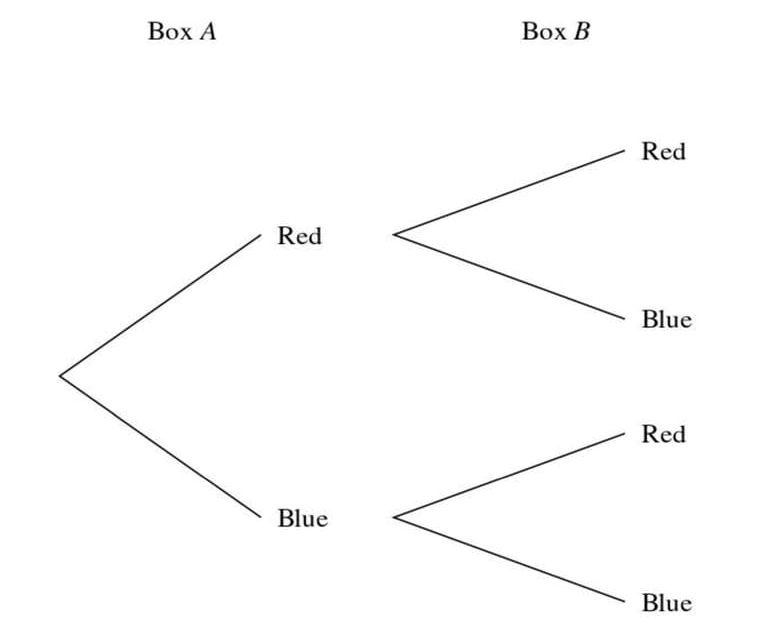
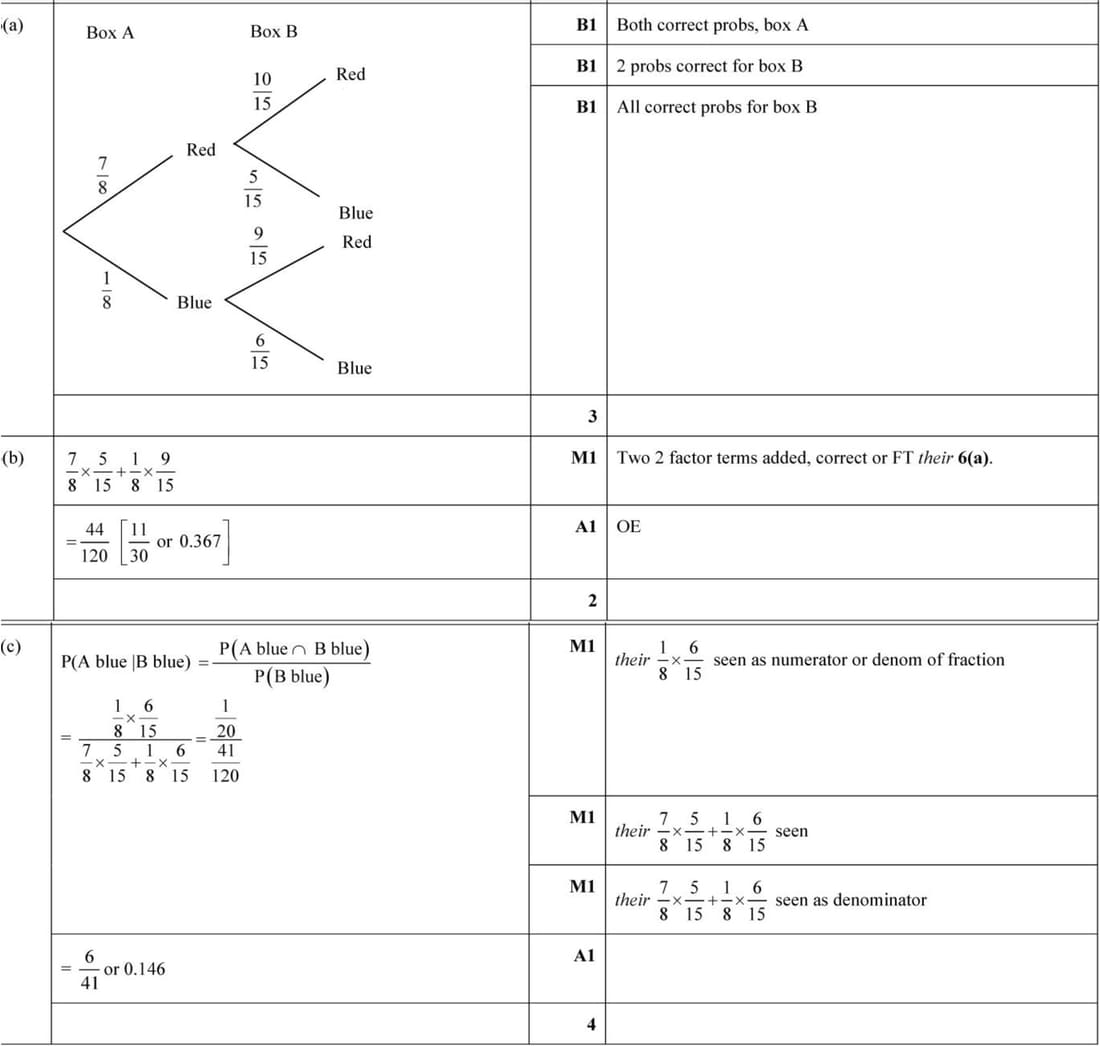
Box A contains 7 red balls and 1 blue ball. Box B contains 9 red balls and 5 blue balls. A ball is chosen at random from box A and placed in box B. A ball is then chosen at random from box B. The tree diagram below shows the possibilities for the colours of the balls chosen.
(a) Complete the tree diagram to show the probabilities.
(b) Find the probability that the two balls chosen are not the same colour.
(c) Find the probability that the ball chosen from box A is blue given that the ball chosen from box B is blue.
Nov 2019 p62 q2
2596
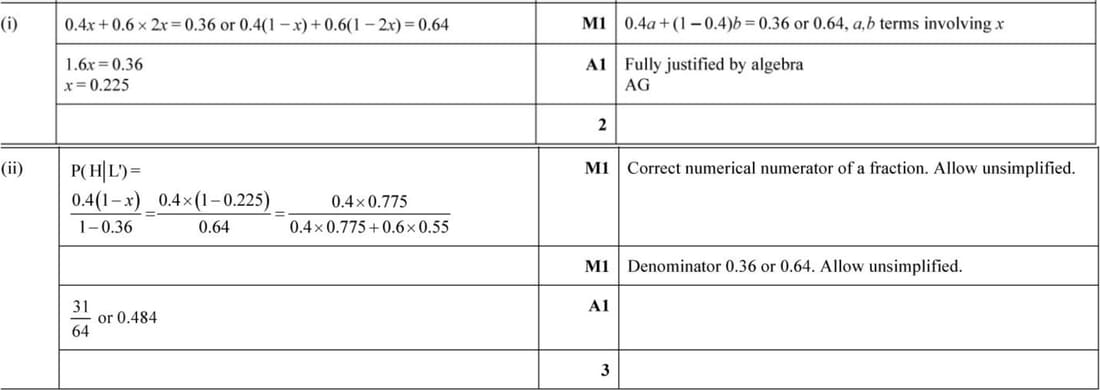
Benju cycles to work each morning and he has two possible routes. He chooses the hilly route with probability 0.4 and the busy route with probability 0.6. If he chooses the hilly route, the probability that he will be late for work is \(x\) and if he chooses the busy route the probability that he will be late for work is \(2x\). The probability that Benju is late for work on any day is 0.36.
(i) Show that \(x = 0.225\).
(ii) Given that Benju is not late for work, find the probability that he chooses the hilly route.
June 2019 p63 q2
2597
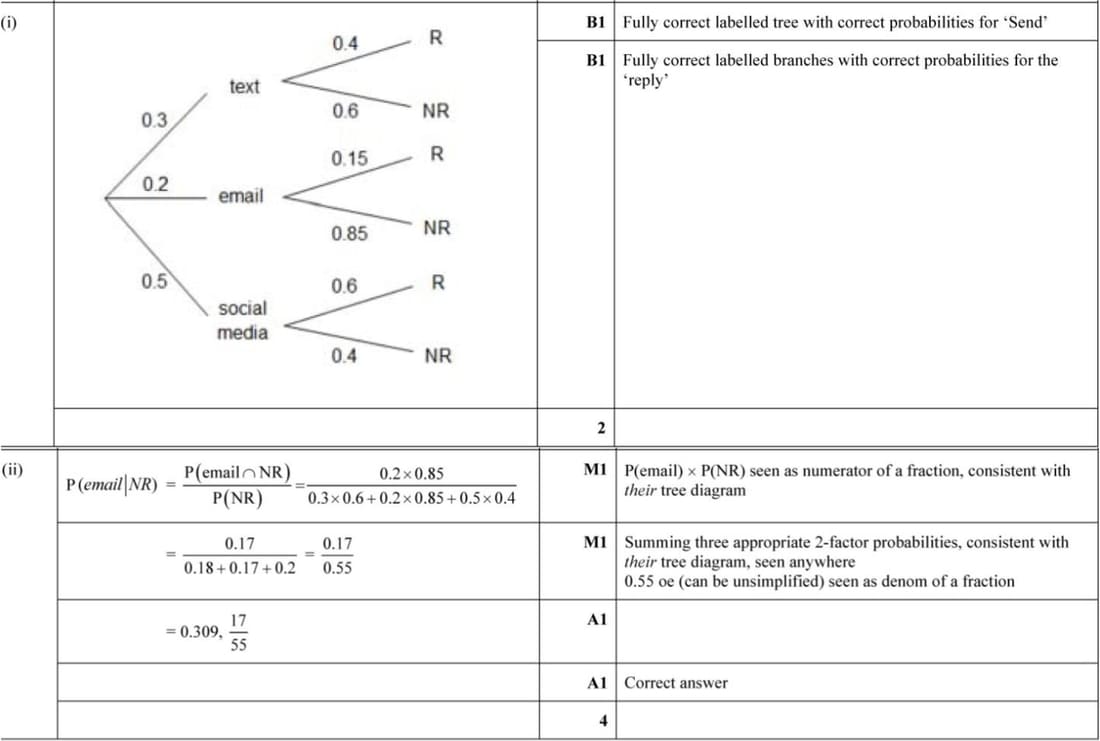
Megan sends messages to her friends in one of 3 different ways: text, email or social media. For each message, the probability that she uses text is 0.3 and the probability that she uses email is 0.2. She receives an immediate reply from a text message with probability 0.4, from an email with probability 0.15 and from social media with probability 0.6.
(i) Draw a fully labelled tree diagram to represent this information.
(ii) Given that Megan does not receive an immediate reply to a message, find the probability that the message was an email.
Feb/Mar 2019 p62 q1
2598
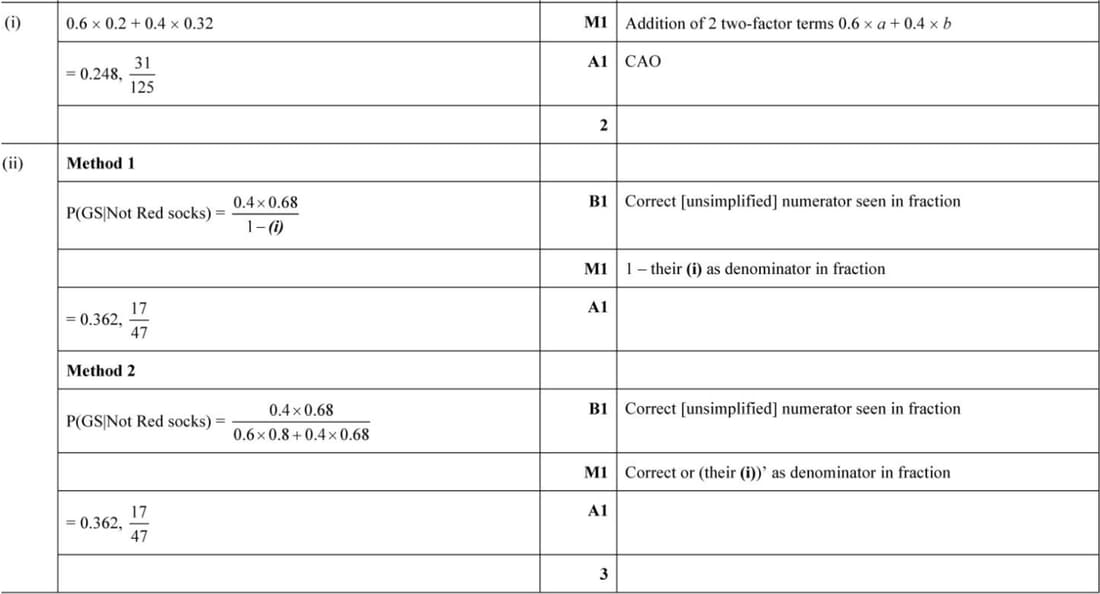
On each day that Tamar goes to work, he wears either a blue suit with probability 0.6 or a grey suit with probability 0.4. If he wears a blue suit then the probability that he wears red socks is 0.2. If he wears a grey suit then the probability that he wears red socks is 0.32.
(i) Find the probability that Tamar wears red socks on any particular day that he is at work.
(ii) Given that Tamar is not wearing red socks at work, find the probability that he is wearing a grey suit.
Nov 2018 p63 q3
2599
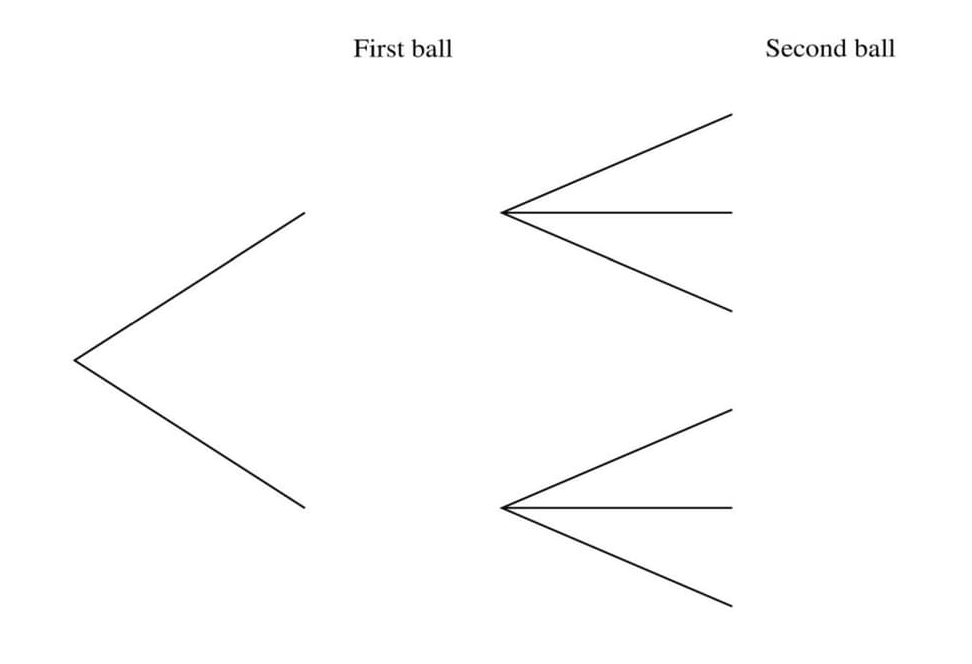
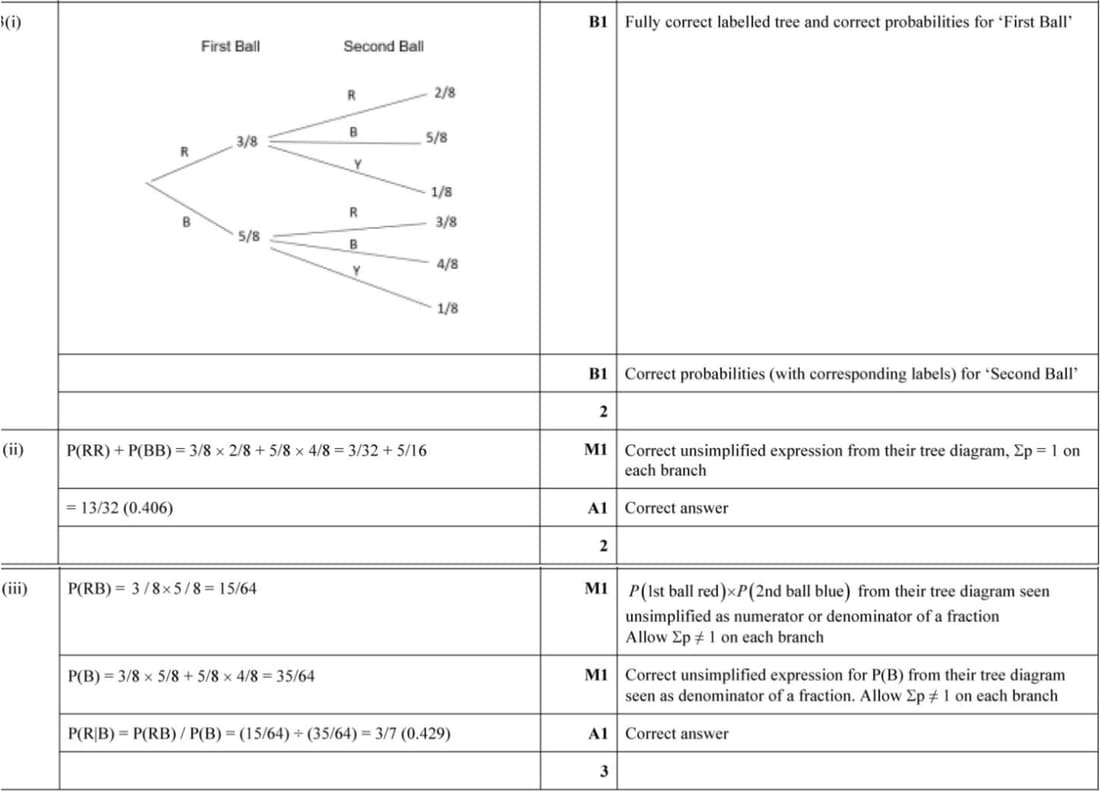
A box contains 3 red balls and 5 blue balls. One ball is taken at random from the box and not replaced. A yellow ball is then put into the box. A second ball is now taken at random from the box.
- Complete the tree diagram to show all the outcomes and the probability for each branch.
- Find the probability that the two balls taken are the same colour.
- Find the probability that the first ball taken is red, given that the second ball taken is blue.
Nov 2018 p61 q7
2600
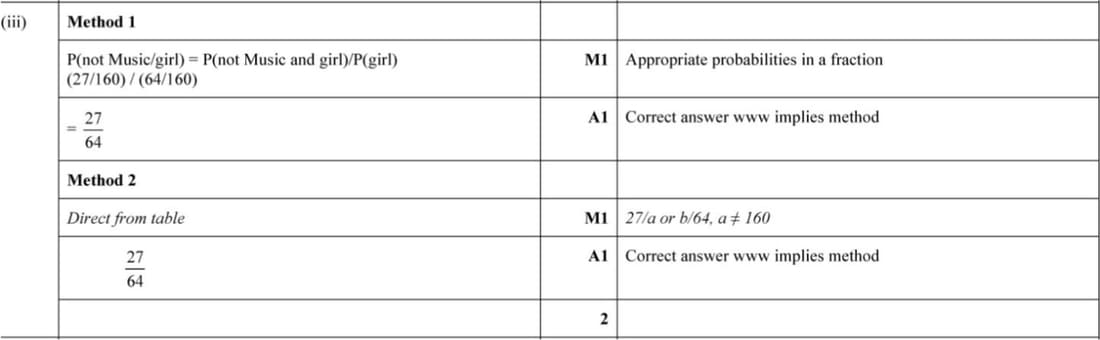
In a group of students, the numbers of boys and girls studying Art, Music and Drama are given in the following table. Each of these 160 students is studying exactly one of these subjects.
| Art | Music | Drama | |
|---|---|---|---|
| Boys | 24 | 40 | 32 |
| Girls | 15 | 12 | 37 |
Find the probability that a randomly chosen student is not studying Drama, given that the student is a girl.
June 2018 p63 q3
2601
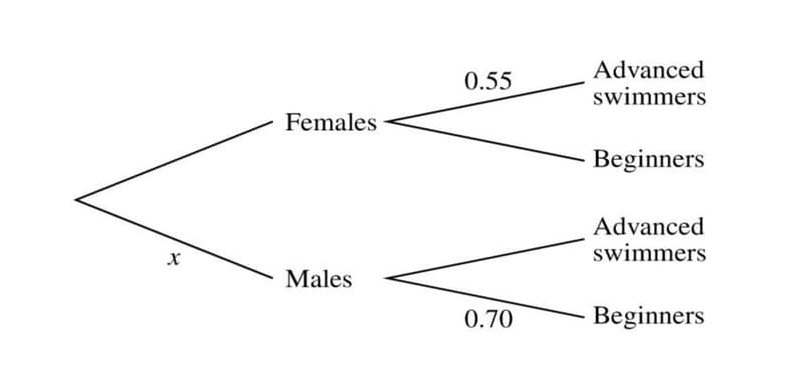
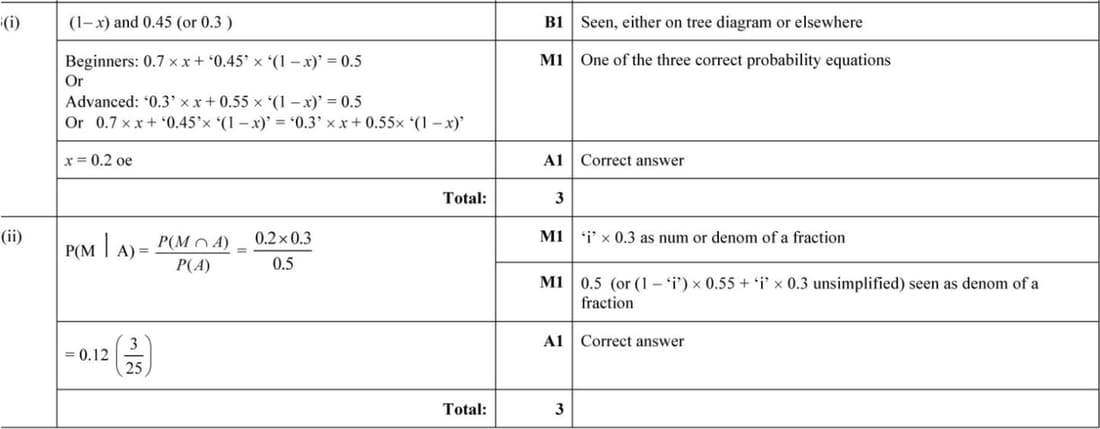
The members of a swimming club are classified either as ‘Advanced swimmers’ or ‘Beginners’. The proportion of members who are male is \(x\), and the proportion of males who are Beginners is 0.7. The proportion of females who are Advanced swimmers is 0.55. This information is shown in the tree diagram.
For a randomly chosen member, the probability of being an Advanced swimmer is the same as the probability of being a Beginner.
(i) Find \(x\).
(ii) Given that a randomly chosen member is an Advanced swimmer, find the probability that the member is male.
June 2018 p61 q6
2602
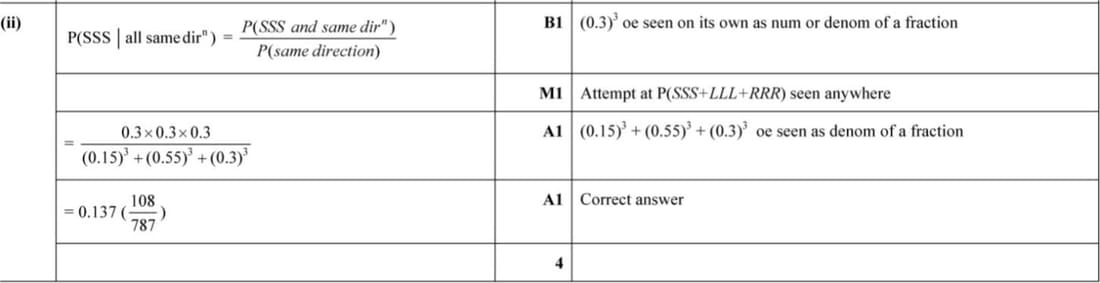
Vehicles approaching a certain road junction from town A can either turn left, turn right or go straight on. Over time it has been noted that of the vehicles approaching this particular junction from town A, 55% turn left, 15% turn right and 30% go straight on. The direction a vehicle takes at the junction is independent of the direction any other vehicle takes at the junction.
Three vehicles approach the junction from town A. Given that all three drivers choose the same direction at the junction, find the probability that they all go straight on.
Nov 2017 p63 q3
2603
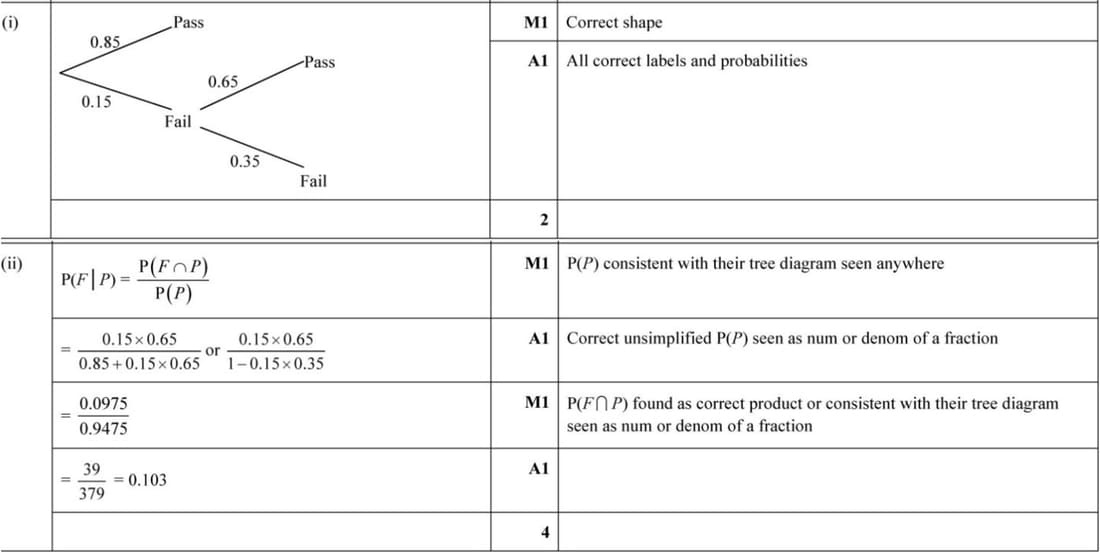
At the end of a revision course in mathematics, students have to pass a test to gain a certificate. The probability of any student passing the test at the first attempt is 0.85. Those students who fail are allowed to retake the test once, and the probability of any student passing the retake test is 0.65.
- Draw a fully labelled tree diagram to show all the outcomes.
- Given that a student gains the certificate, find the probability that this student fails the test on the first attempt.
June 2023 p53 q5
2604
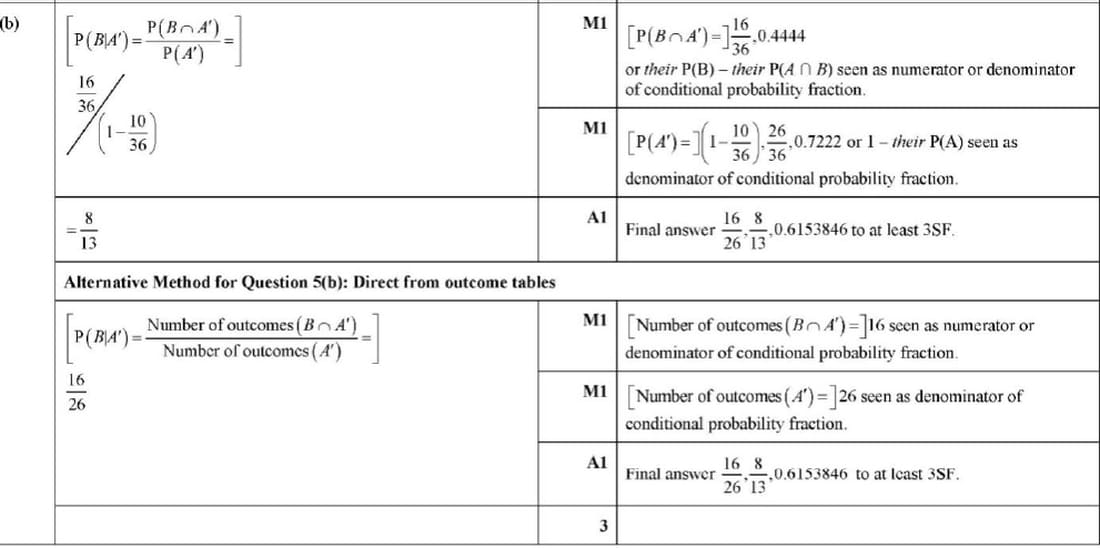
Jasmine throws two ordinary fair 6-sided dice at the same time and notes the numbers on the uppermost faces. The events A and B are defined as follows.
A: The sum of the two numbers is less than 6.
B: The difference between the two numbers is at most 2.
Find \(P(B \,|\, A')\).
Nov 2017 p61 q5
2605
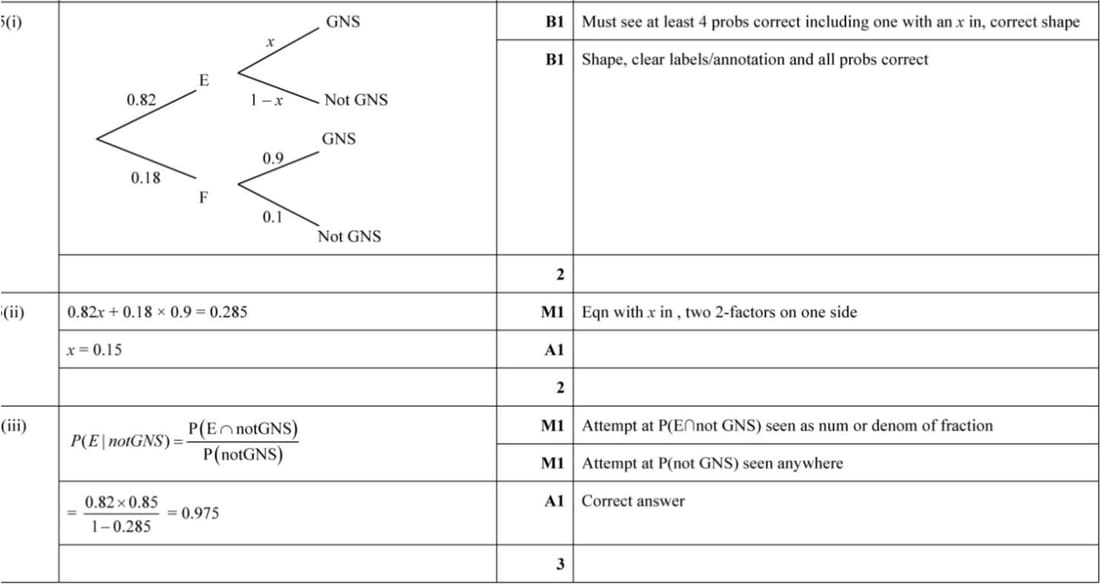
Over a period of time Julian finds that on long-distance flights he flies economy class on 82% of flights. On the rest of the flights he flies first class. When he flies economy class, the probability that he gets a good night's sleep is \(x\). When he flies first class, the probability that he gets a good night's sleep is 0.9.
(i) Draw a fully labelled tree diagram to illustrate this situation.
The probability that Julian gets a good night's sleep on a randomly chosen flight is 0.285.
(ii) Find the value of \(x\).
(iii) Given that on a particular flight Julian does not get a good night's sleep, find the probability that he is flying economy class.
June 2017 p63 q3
2606
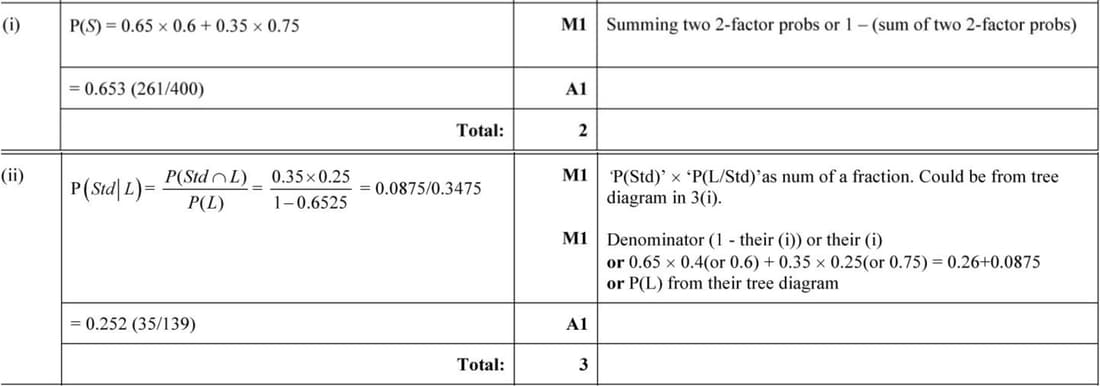
A shop sells two makes of coffee, Café Premium and Café Standard. Both coffees come in two sizes, large jars and small jars. Of the jars on sale, 65% are Café Premium and 35% are Café Standard. Of the Café Premium, 40% of the jars are large and of the Café Standard, 25% of the jars are large. A jar is chosen at random.
- Find the probability that the jar is small.
- Find the probability that the jar is Café Standard given that it is large.
June 2017 p62 q7
2607
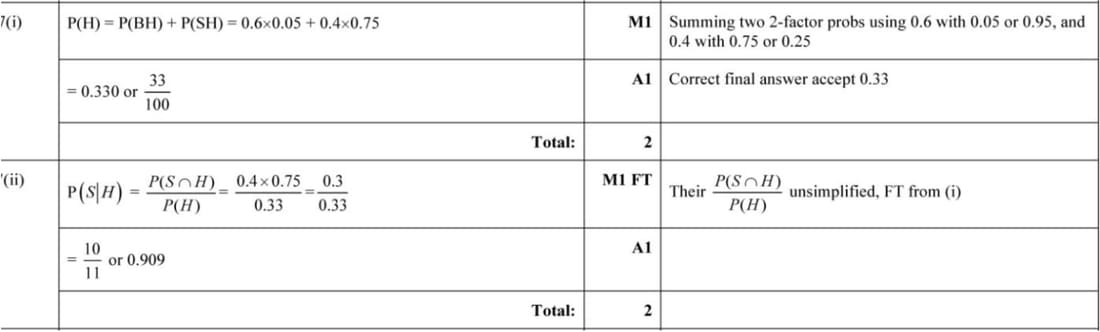
During the school holidays, each day Khalid either rides on his bicycle with probability 0.6, or on his skateboard with probability 0.4. Khalid does not ride on both on the same day. If he rides on his bicycle then the probability that he hurts himself is 0.05. If he rides on his skateboard the probability that he hurts himself is 0.75.
(i) Find the probability that Khalid hurts himself on any particular day.
(ii) Given that Khalid hurts himself on a particular day, find the probability that he is riding on his skateboard.
June 2017 p61 q3
2608
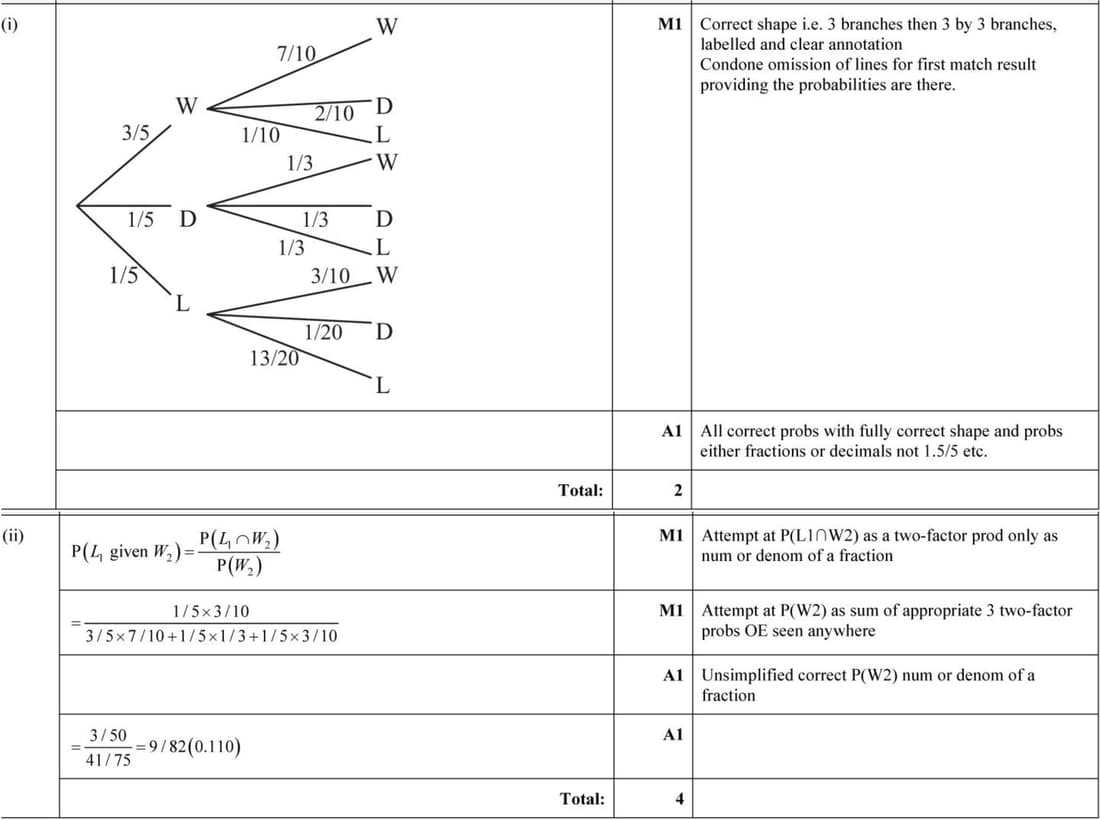
Redbury United soccer team play a match every week. Each match can be won, drawn or lost. At the beginning of the soccer season the probability that Redbury United win their first match is \(\frac{3}{5}\), with equal probabilities of losing or drawing. If they win the first match, the probability that they win the second match is \(\frac{7}{10}\) and the probability that they lose the second match is \(\frac{1}{10}\). If they draw the first match they are equally likely to win, draw or lose the second match. If they lose the first match, the probability that they win the second match is \(\frac{3}{10}\) and the probability that they draw the second match is \(\frac{1}{20}\).
- Draw a fully labelled tree diagram to represent the first two matches played by Redbury United in the soccer season.
- Given that Redbury United win the second match, find the probability that they lose the first match.
Nov 2016 p62 q1
2609
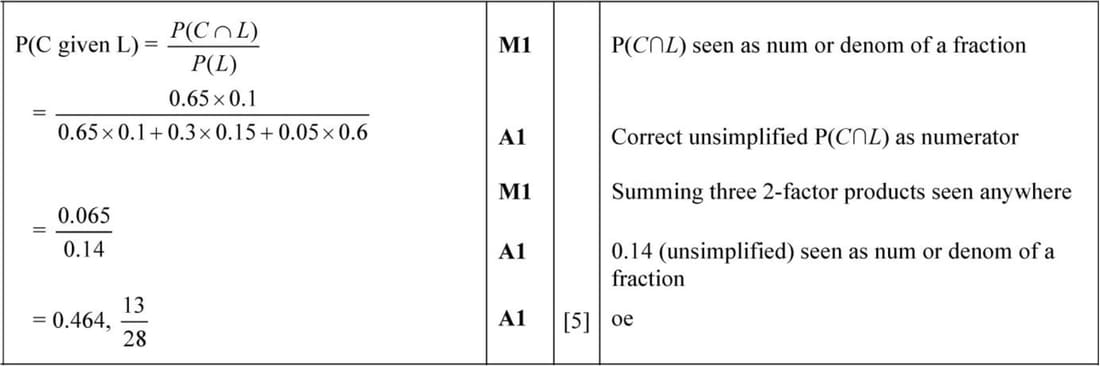
When Anya goes to school, the probability that she walks is 0.3 and the probability that she cycles is 0.65; if she does not walk or cycle she takes the bus. When Anya walks the probability that she is late is 0.15. When she cycles the probability that she is late is 0.1 and when she takes the bus the probability that she is late is 0.6. Given that Anya is late, find the probability that she cycles.
Nov 2016 p61 q6
2610
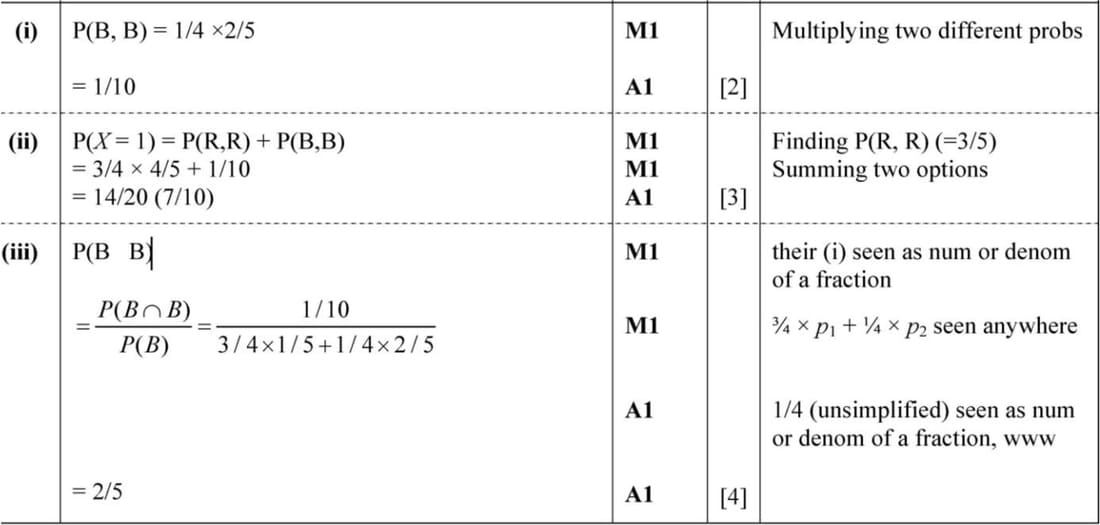
Deeti has 3 red pens and 1 blue pen in her left pocket and 3 red pens and 1 blue pen in her right pocket. 'Operation T' consists of Deeti taking one pen at random from her left pocket and placing it in her right pocket, then taking one pen at random from her right pocket and placing it in her left pocket.
(i) Find the probability that, when Deeti carries out operation T, she takes a blue pen from her left pocket and then a blue pen from her right pocket.
The random variable X is the number of blue pens in Deeti's left pocket after carrying out operation T.
\((ii) Find P(X = 1).\)
(iii) Given that the pen taken from Deeti's right pocket is blue, find the probability that the pen taken from Deeti's left pocket is blue.
June 2016 p62 q1
2611
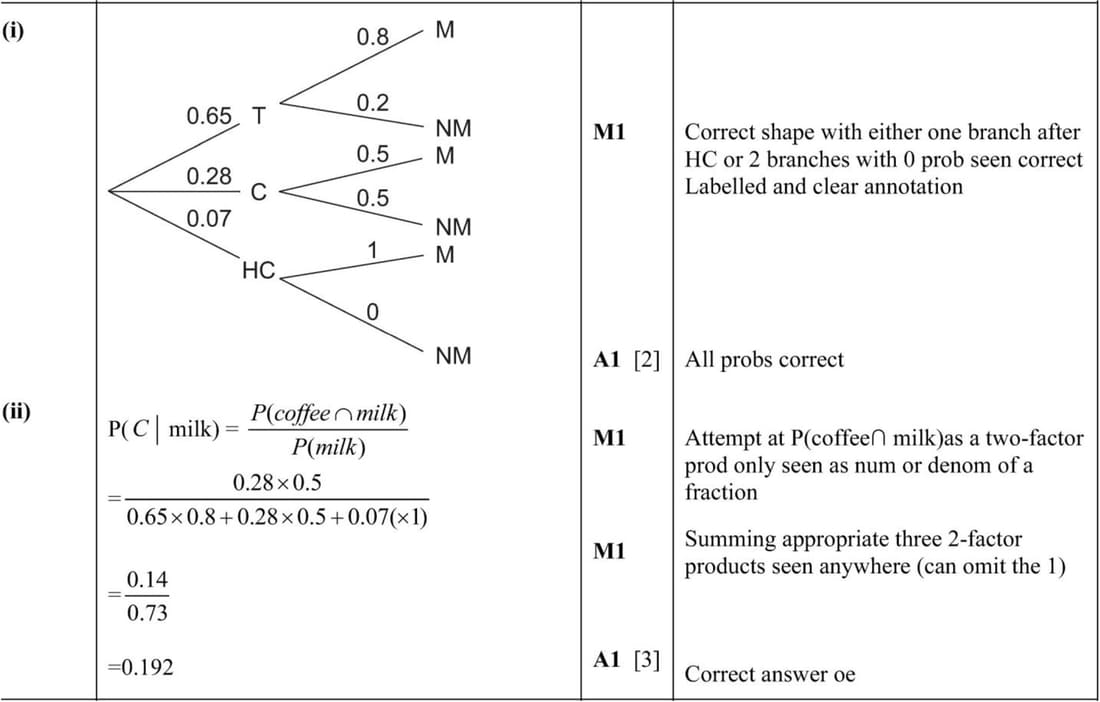
Ayman’s breakfast drink is tea, coffee or hot chocolate with probabilities 0.65, 0.28, 0.07 respectively. When he drinks tea, the probability that he has milk in it is 0.8. When he drinks coffee, the probability that he has milk in it is 0.5. When he drinks hot chocolate he always has milk in it.
(i) Draw a fully labelled tree diagram to represent this information.
(ii) Find the probability that Ayman’s breakfast drink is coffee, given that his drink has milk in it.
June 2016 p61 q3
2612
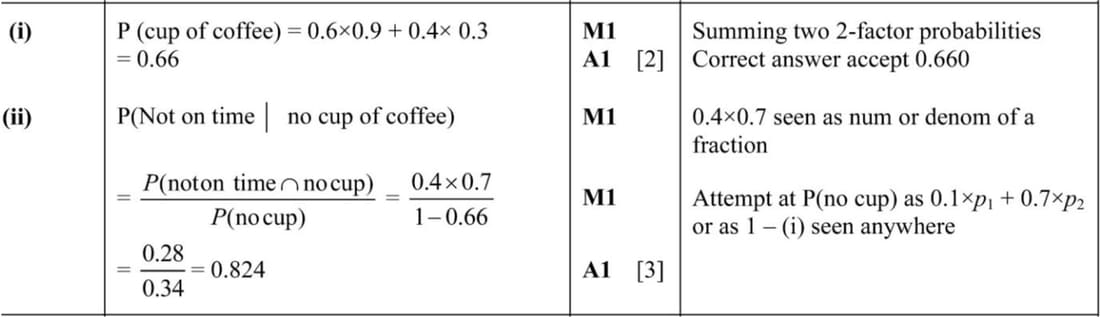
The probability that the school bus is on time on any particular day is 0.6. If the bus is on time the probability that Sam the driver gets a cup of coffee is 0.9. If the bus is not on time the probability that Sam gets a cup of coffee is 0.3.
(i) Find the probability that Sam gets a cup of coffee.
(ii) Given that Sam does not get a cup of coffee, find the probability that the bus is not on time.
Feb/Mar 2016 p62 q5
2613
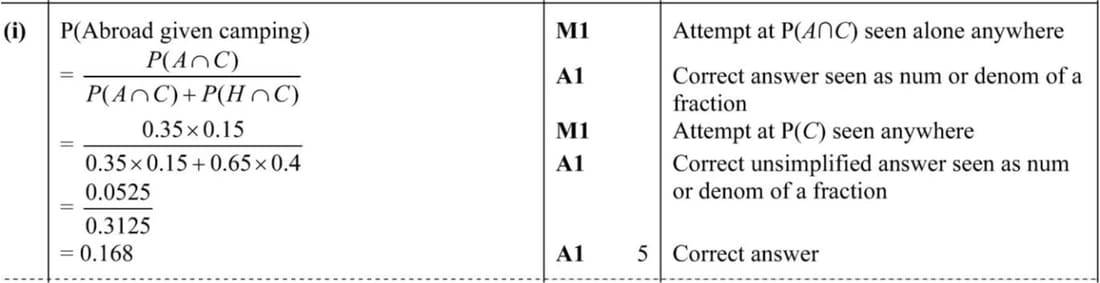
In a certain town, 35% of the people take a holiday abroad and 65% take a holiday in their own country. Of those going abroad 80% go to the seaside, 15% go camping and 5% take a city break. Of those taking a holiday in their own country, 20% go to the seaside and the rest are divided equally between camping and a city break.
A person is chosen at random. Given that the person chosen goes camping, find the probability that the person goes abroad.
June 2015 p63 q2
2614
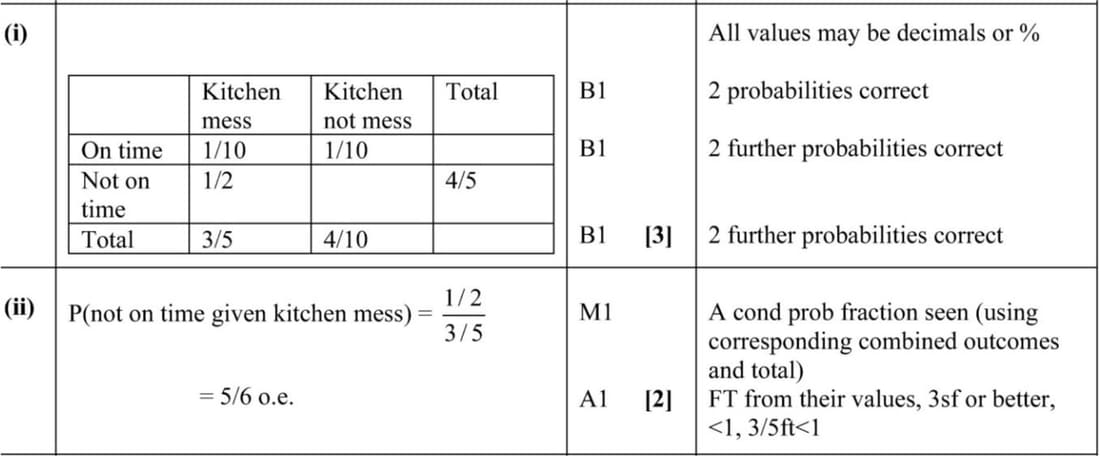
When Joanna cooks, the probability that the meal is served on time is \(\frac{1}{5}\). The probability that the kitchen is left in a mess is \(\frac{3}{5}\). The probability that the meal is not served on time and the kitchen is not left in a mess is \(\frac{3}{10}\). Some of this information is shown in the following table.
| Kitchen left in a mess | Kitchen not left in a mess | Total | |
|---|---|---|---|
| Meal served on time | \(\frac{1}{5}\) | ||
| Meal not served on time | \(\frac{3}{10}\) | ||
| Total | 1 |
(i) Copy and complete the table.
(ii) Given that the kitchen is left in a mess, find the probability that the meal is not served on time.
June 2023 p52 q4
2615
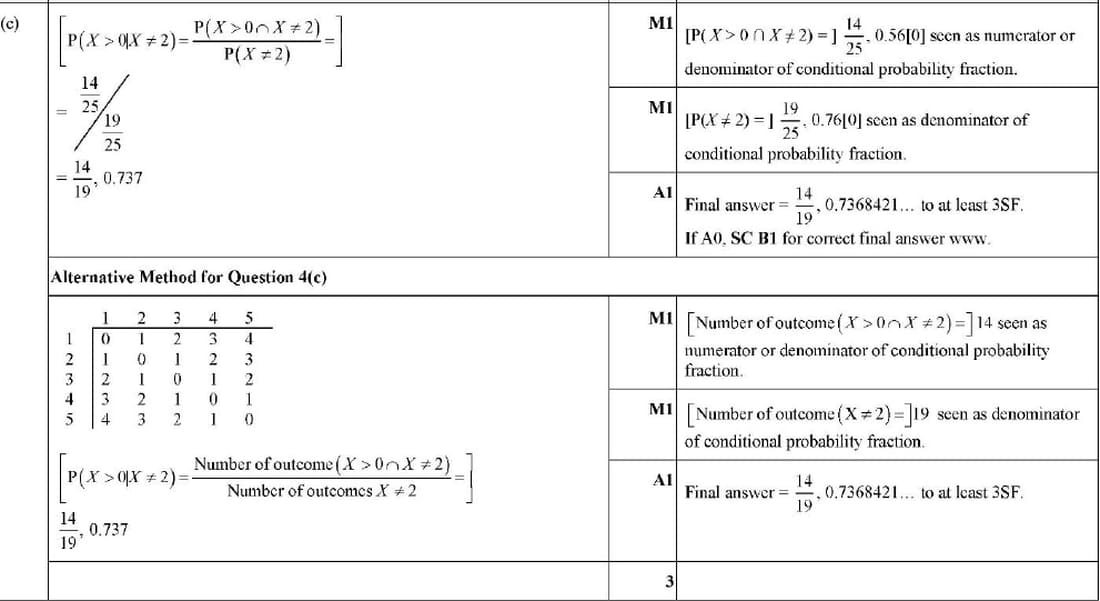
Two fair 5-sided spinners, each with sides labelled 1, 2, 3, 4, 5, are spun at the same time. If the numbers obtained are equal, the score is 0. Otherwise, the score is the higher number minus the lower number.
Find the probability that the score is greater than 0 given that the score is not equal to 2.
June 2015 p62 q4
2616
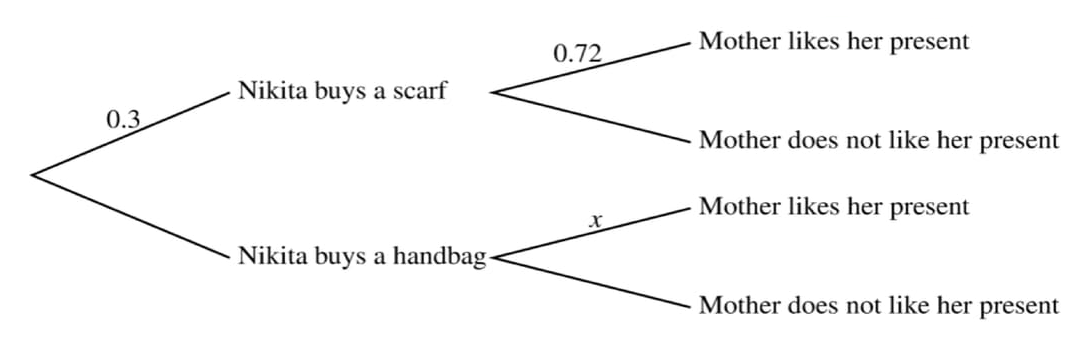
Nikita goes shopping to buy a birthday present for her mother. She buys either a scarf, with probability 0.3, or a handbag. The probability that her mother will like the choice of scarf is 0.72. The probability that her mother will like the choice of handbag is x. This information is shown on the tree diagram. The probability that Nikita’s mother likes the present that Nikita buys is 0.783.
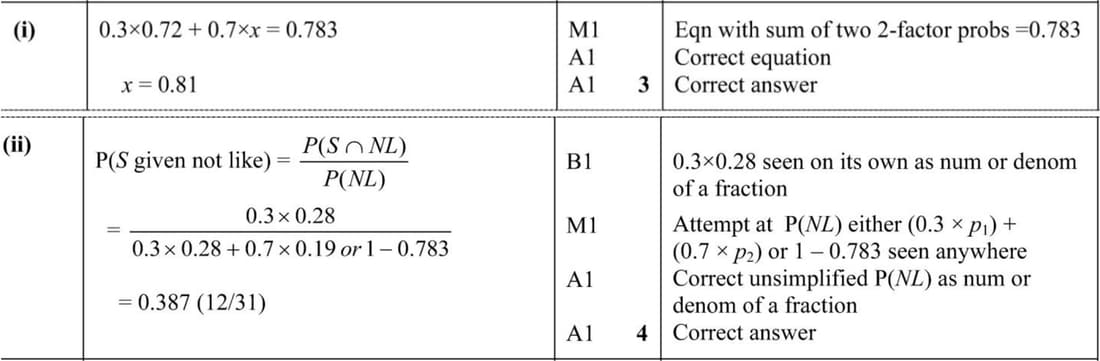
(i) Find x.
(ii) Given that Nikita’s mother does not like her present, find the probability that the present is a scarf.
June 2015 p61 q4
2617
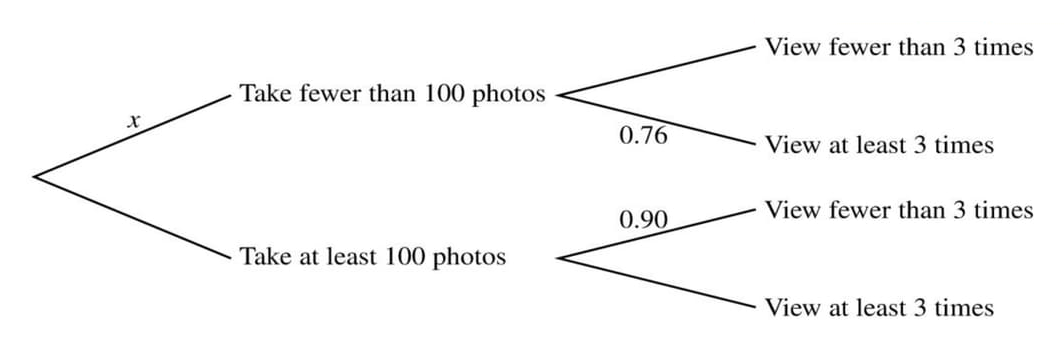
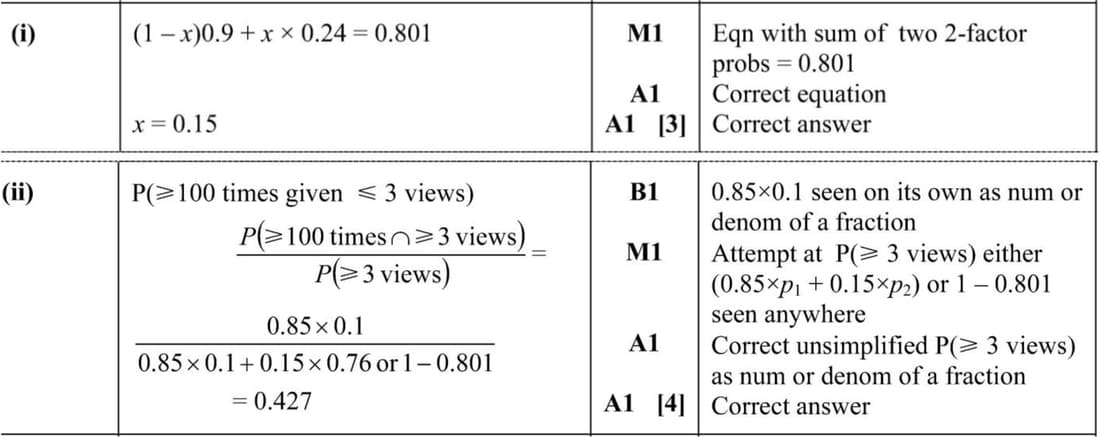
A survey is undertaken to investigate how many photos people take on a one-week holiday and also how many times they view past photos. For a randomly chosen person, the probability of taking fewer than 100 photos is \(x\). The probability that these people view past photos at least 3 times is 0.76. For those who take at least 100 photos, the probability that they view past photos fewer than 3 times is 0.90. This information is shown in the tree diagram. The probability that a randomly chosen person views past photos fewer than 3 times is 0.801.
(i) Find \(x\).
(ii) Given that a person views past photos at least 3 times, find the probability that this person takes at least 100 photos.
Nov 2015 p63 q2
2618
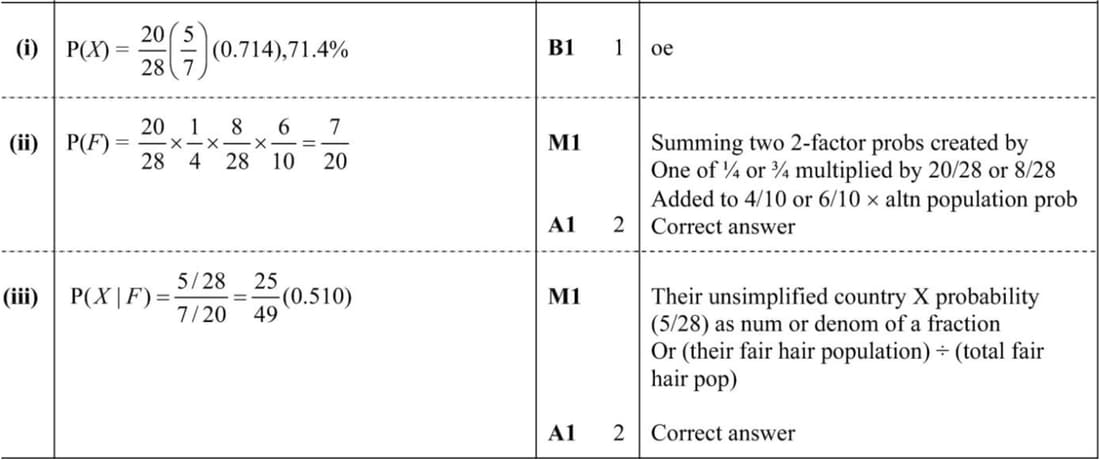
In country X, 25% of people have fair hair. In country Y, 60% of people have fair hair. There are 20 million people in country X and 8 million people in country Y. A person is chosen at random from these 28 million people.
- Find the probability that the person chosen is from country X.
- Find the probability that the person chosen has fair hair.
- Find the probability that the person chosen is from country X, given that the person has fair hair.
Nov 2014 p61 q3
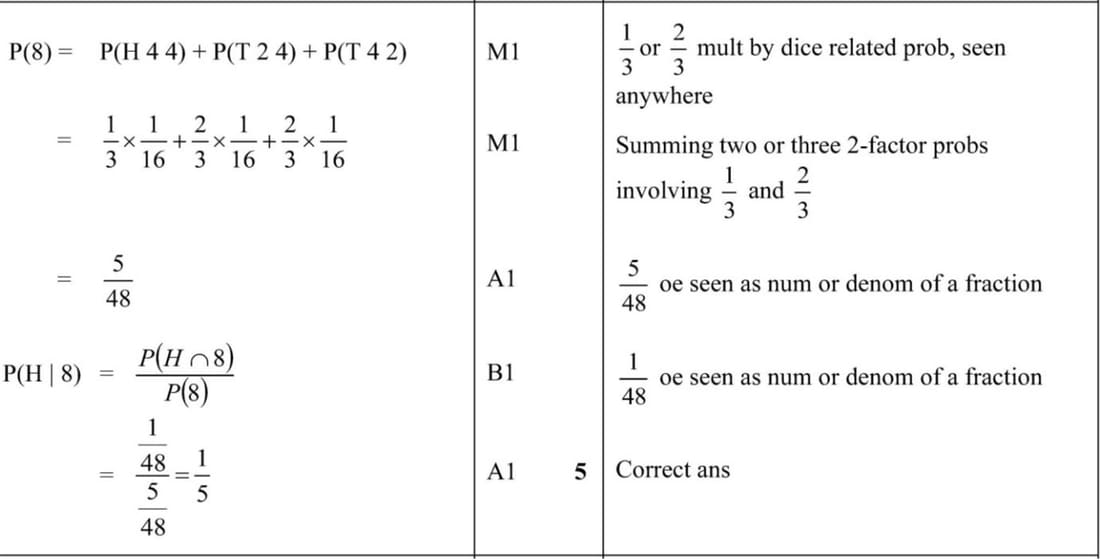
2619
Jodie tosses a biased coin and throws two fair tetrahedral dice. The probability that the coin shows a head is \(\frac{1}{3}\). Each of the dice has four faces, numbered 1, 2, 3, and 4. Jodie’s score is calculated from the numbers on the faces that the dice land on, as follows:
- if the coin shows a head, the two numbers from the dice are added together;
- if the coin shows a tail, the two numbers from the dice are multiplied together.
Find the probability that the coin shows a head given that Jodie’s score is 8.
June 2014 p63 q6
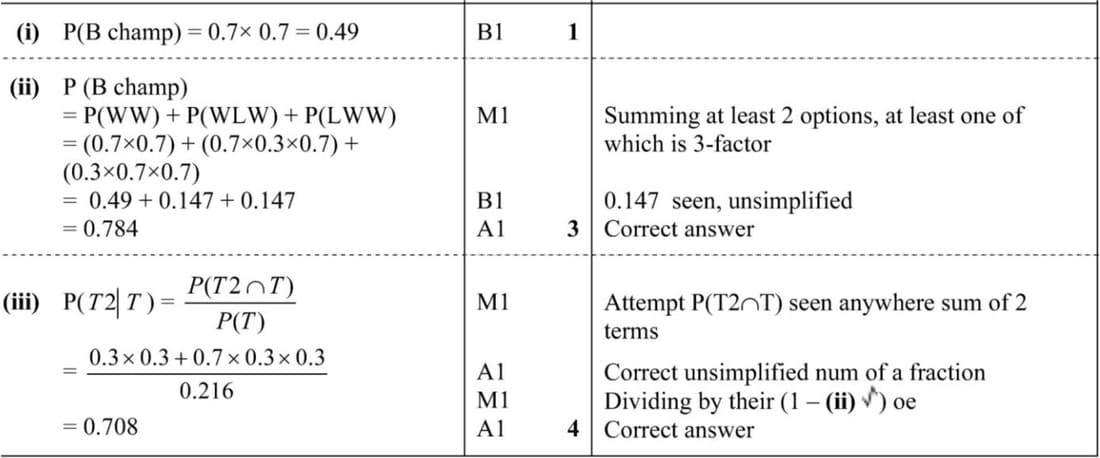
2620
Tom and Ben play a game repeatedly. The probability that Tom wins any game is 0.3. Each game is won by either Tom or Ben. Tom and Ben stop playing when one of them (to be called the champion) has won two games.
- Find the probability that Ben becomes the champion after playing exactly 2 games. [1]
- Find the probability that Ben becomes the champion. [3]
- Given that Tom becomes the champion, find the probability that he won the 2nd game. [4]
June 2014 p61 q5
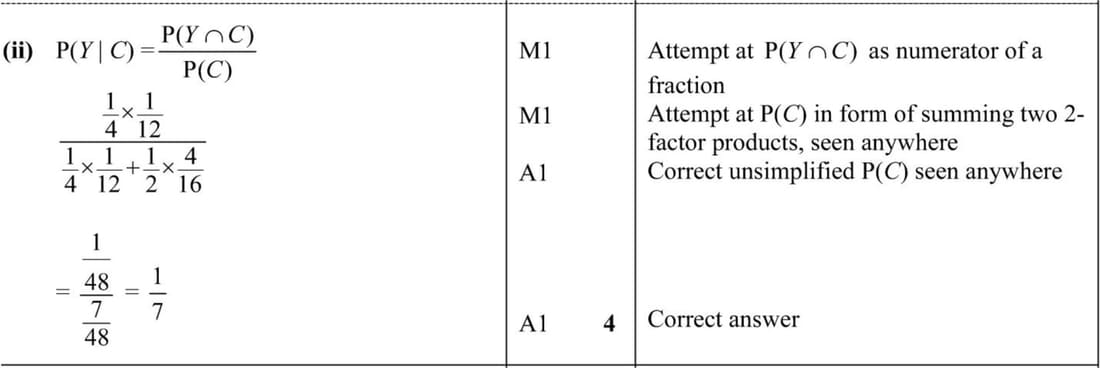
2621
Playground equipment consists of swings (S), roundabouts (R), climbing frames (C) and play-houses (P). The numbers of pieces of equipment in each of 3 playgrounds are as follows.
| Playground X | Playground Y | Playground Z | |
|---|---|---|---|
| 3S, 2R, 4P | 6S, 3R, 1C, 2P | 8S, 3R, 4C, 1P |
Each day Nur takes her child to one of the playgrounds. The probability that she chooses playground X is \(\frac{1}{4}\). The probability that she chooses playground Y is \(\frac{1}{4}\). The probability that she chooses playground Z is \(\frac{1}{2}\). When she arrives at the playground, she chooses one piece of equipment at random.
Given that Nur chooses a climbing frame, find the probability that she chose playground Y. [4]
Nov 2013 p63 q7
2622
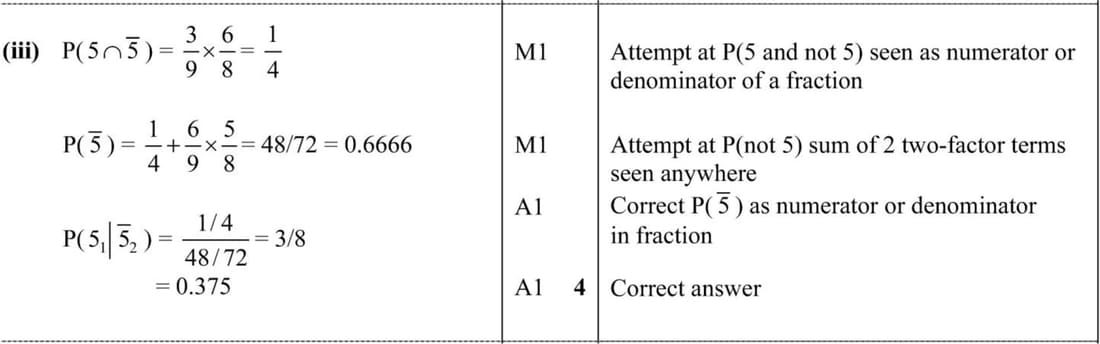
Dayo chooses two digits at random, without replacement, from the 9-digit number 113 333 555.
Find the probability that the first digit Dayo chose was a 5, given that the second digit he chose is not a 5.
Nov 2013 p62 q2
2623
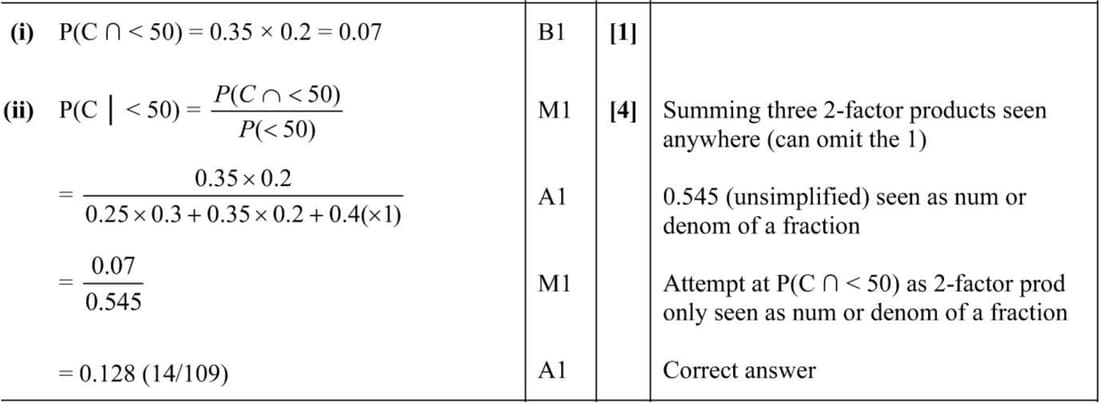
On Saturday afternoons Mohit goes shopping with probability 0.25, or goes to the cinema with probability 0.35 or stays at home. If he goes shopping the probability that he spends more than $50 is 0.7. If he goes to the cinema the probability that he spends more than $50 is 0.8. If he stays at home he spends $10 on a pizza.
(i) Find the probability that Mohit will go to the cinema and spend less than $50.
(ii) Given that he spends less than $50, find the probability that he went to the cinema.
Nov 2013 p61 q2
2624
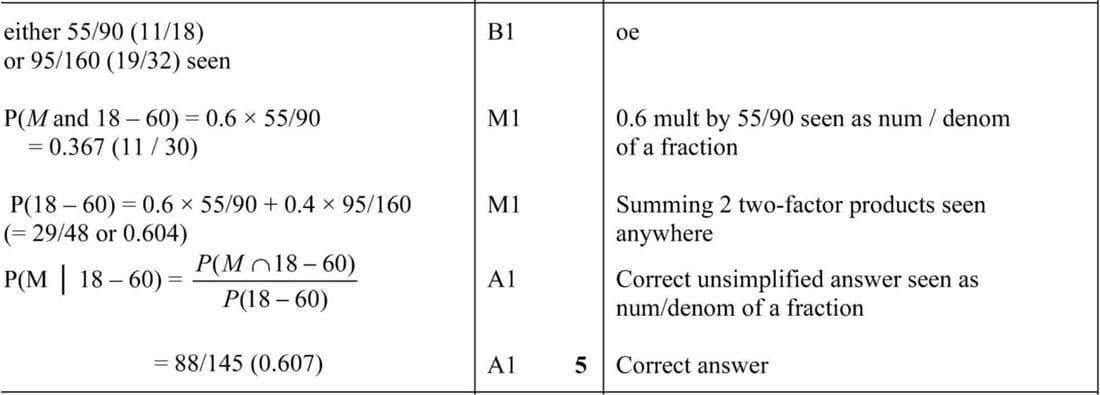
The people living in two towns, Mumbok and Bagville, are classified by age. The numbers in thousands living in each town are shown in the table below.
| Mumbok | Bagville | |
|---|---|---|
| Under 18 years | 15 | 35 |
| 18 to 60 years | 55 | 95 |
| Over 60 years | 20 | 30 |
One of the towns is chosen. The probability of choosing Mumbok is 0.6 and the probability of choosing Bagville is 0.4. Then a person is chosen at random from that town. Given that the person chosen is between 18 and 60 years old, find the probability that the town chosen was Mumbok.
June 2013 p63 q5
2625
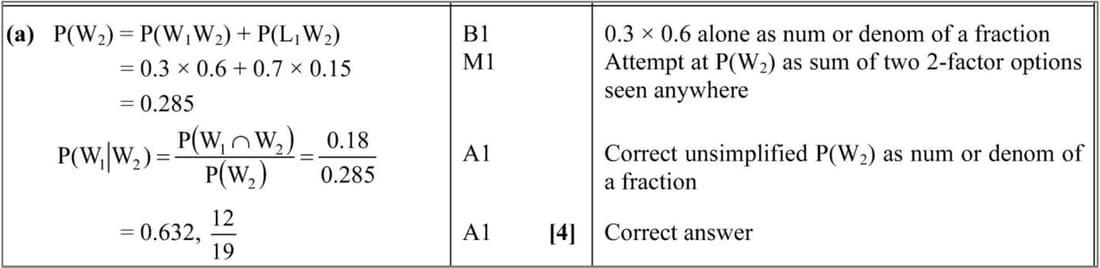
John plays two games of squash. The probability that he wins his first game is 0.3. If he wins his first game, the probability that he wins his second game is 0.6. If he loses his first game, the probability that he wins his second game is 0.15. Given that he wins his second game, find the probability that he won his first game.
Nov 2022 p53 q7
2626
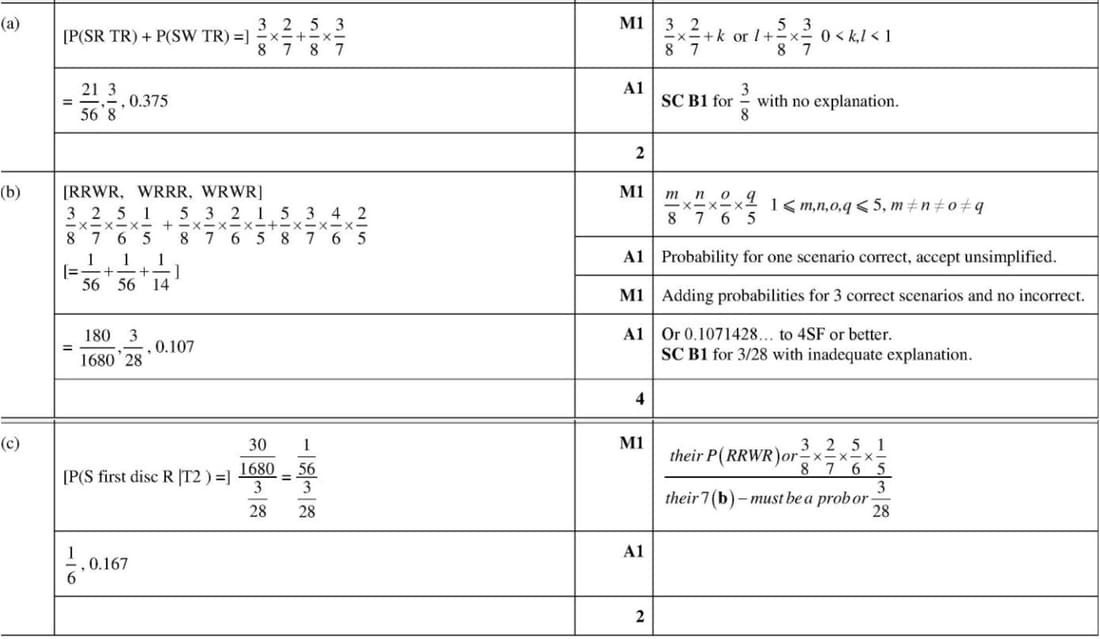
Sam and Tom are playing a game which involves a bag containing 5 white discs and 3 red discs. They take turns to remove one disc from the bag at random. Discs that are removed are not replaced into the bag. The game ends as soon as one player has removed two red discs from the bag. That player wins the game.
Sam removes the first disc.
(a) Find the probability that Tom removes a red disc on his first turn.
(b) Find the probability that Tom wins the game on his second turn.
(c) Find the probability that Sam removes a red disc on his first turn given that Tom wins the game on his second turn.
June 2013 p62 q7
2627
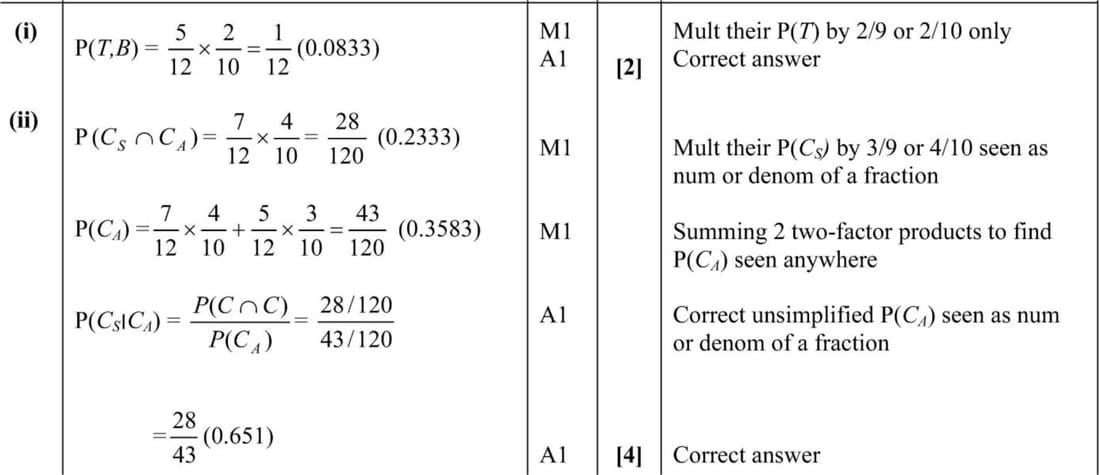
Susan has a bag of sweets containing 7 chocolates and 5 toffees. Ahmad has a bag of sweets containing 3 chocolates, 4 toffees and 2 boiled sweets. A sweet is taken at random from Susan’s bag and put in Ahmad’s bag. A sweet is then taken at random from Ahmad’s bag.
(i) Find the probability that the two sweets taken are a toffee from Susan’s bag and a boiled sweet from Ahmad’s bag.
(ii) Given that the sweet taken from Ahmad’s bag is a chocolate, find the probability that the sweet taken from Susan’s bag was also a chocolate.
June 2013 p61 q7
2628
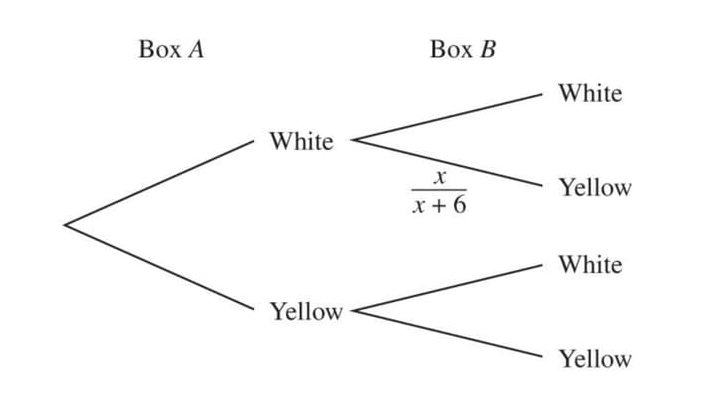
Box A contains 8 white balls and 2 yellow balls. Box B contains 5 white balls and x yellow balls. A ball is chosen at random from box A and placed in box B. A ball is then chosen at random from box B. The tree diagram below shows the possibilities for the colours of the balls chosen.
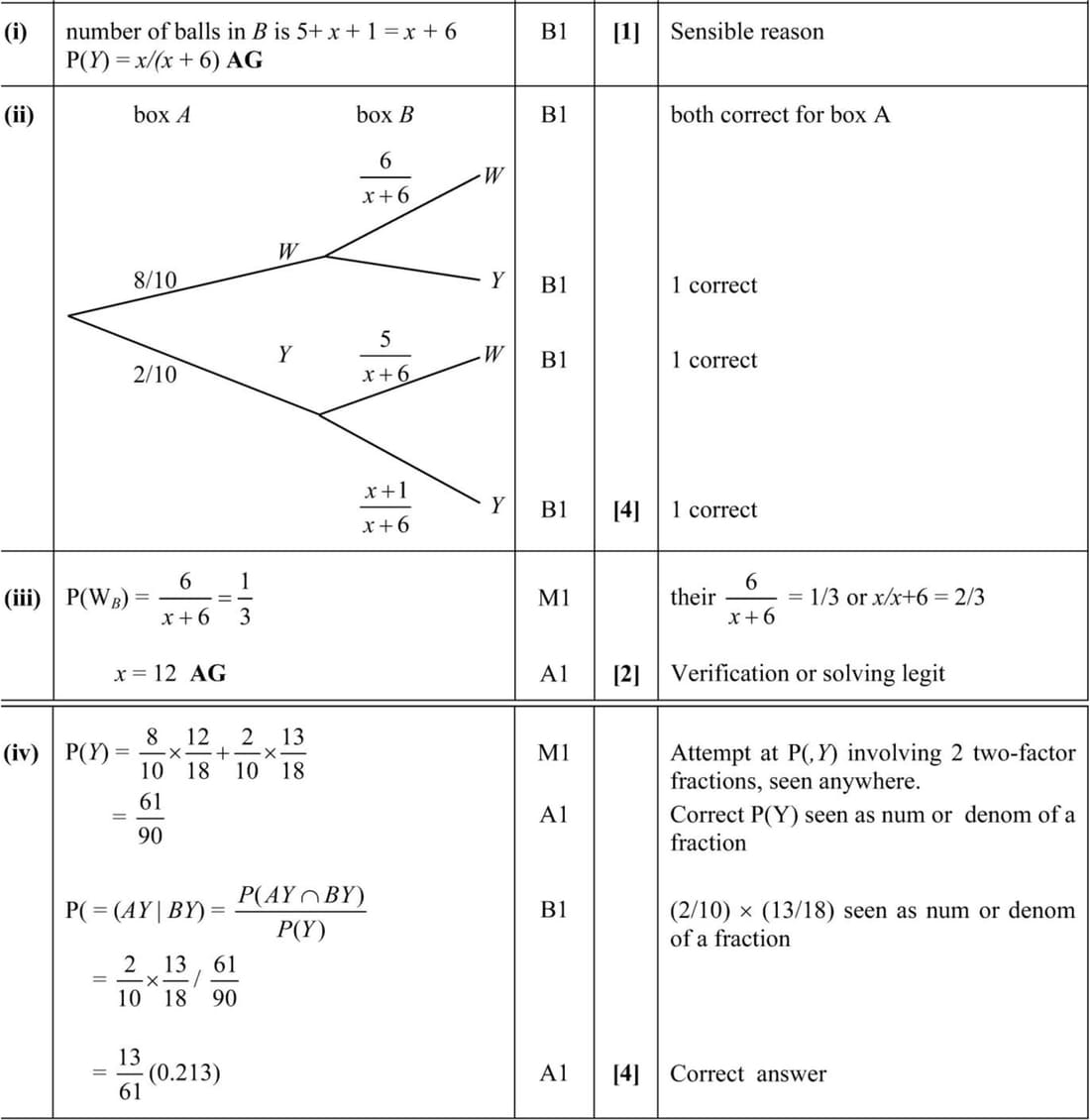
(i) Justify the probability \(\frac{x}{x+6}\) on the tree diagram.
(ii) Copy and complete the tree diagram.
(iii) If the ball chosen from box A is white then the probability that the ball chosen from box B is also white is \(\frac{1}{3}\). Show that the value of \(x\) is 12.
(iv) Given that the ball chosen from box B is yellow, find the conditional probability that the ball chosen from box A was yellow.
Nov 2012 p62 q1
2629
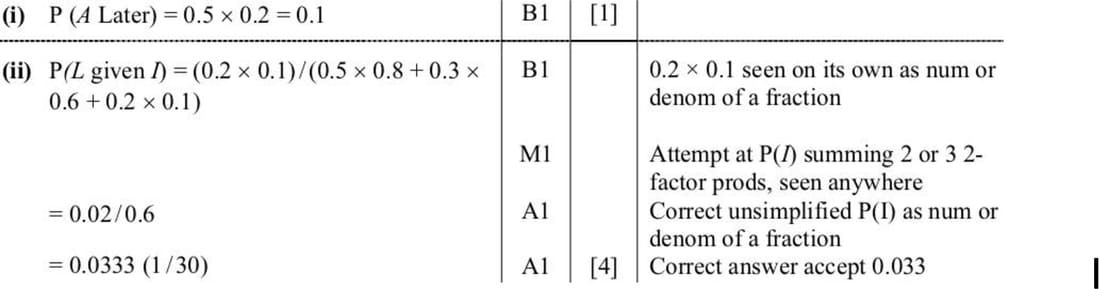
Fabio drinks coffee each morning. He chooses Americano, Cappuccino or Latte with probabilities 0.5, 0.3 and 0.2 respectively. If he chooses Americano he either drinks it immediately with probability 0.8, or leaves it to drink later. If he chooses Cappuccino he either drinks it immediately with probability 0.6, or leaves it to drink later. If he chooses Latte he either drinks it immediately with probability 0.1, or leaves it to drink later.
(i) Find the probability that Fabio chooses Americano and leaves it to drink later.
(ii) Fabio drinks his coffee immediately. Find the probability that he chose Latte.
Nov 2012 p61 q6
2630
Ana meets her friends once every day. For each day the probability that she is early is 0.05 and the probability that she is late is 0.75. Otherwise she is on time.
If she is early there is a probability of 0.7 that she will eat a banana. If she is late she does not eat a banana. If she is on time there is a probability of 0.4 that she will eat a banana. Given that for one particular meeting with friends she does not eat a banana, find the probability that she is on time.

June 2012 p61 q2
2631
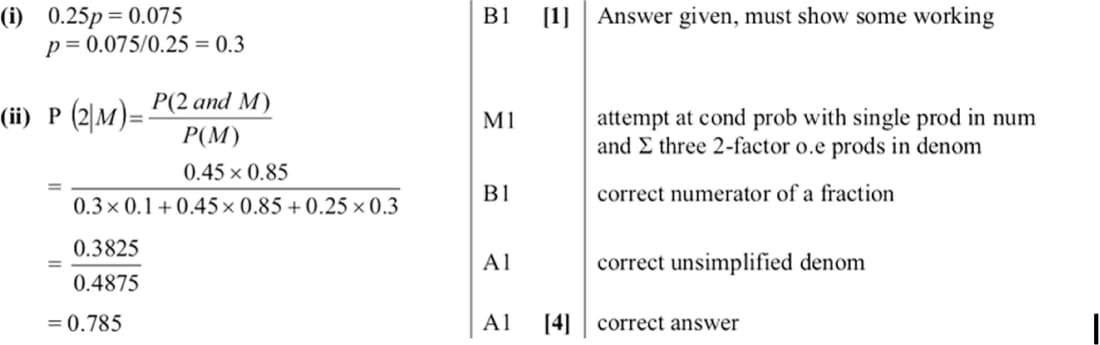
Maria has 3 pre-set stations on her radio. When she switches her radio on, there is a probability of 0.3 that it will be set to station 1, a probability of 0.45 that it will be set to station 2 and a probability of 0.25 that it will be set to station 3. On station 1 the probability that the presenter is male is 0.1, on station 2 the probability that the presenter is male is 0.85 and on station 3 the probability that the presenter is male is \(p\). When Maria switches on the radio, the probability that it is set to station 3 and the presenter is male is 0.075.
- Show that the value of \(p\) is 0.3.
- Given that Maria switches on and hears a male presenter, find the probability that the radio was set to station 2.
June 2011 p61 q2
2632
When Ted is looking for his pen, the probability that it is in his pencil case is 0.7. If his pen is in his pencil case he always finds it. If his pen is somewhere else, the probability that he finds it is 0.2. Given that Ted finds his pen when he is looking for it, find the probability that it was in his pencil case.

Nov 2010 p63 q3
2633
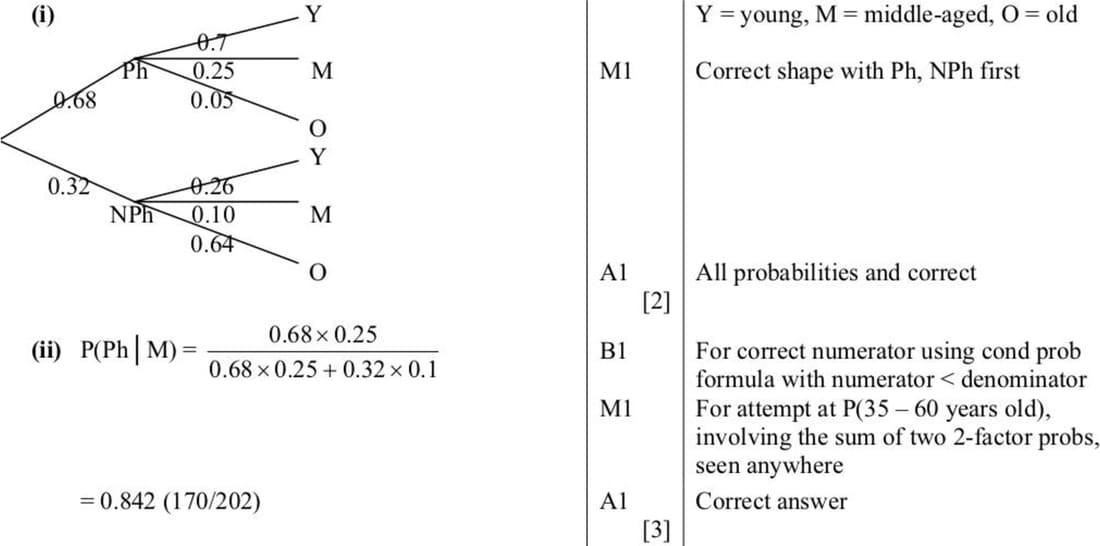
It was found that 68% of the passengers on a train used a cell phone during their train journey. Of those using a cell phone, 70% were under 30 years old, 25% were between 30 and 65 years old and the rest were over 65 years old. Of those not using a cell phone, 26% were under 30 years old and 64% were over 65 years old.
(i) Draw a tree diagram to represent this information, giving all probabilities as decimals.
(ii) Given that one of the passengers is 45 years old, find the probability of this passenger using a cell phone during the journey.
Nov 2010 p62 q3
2634
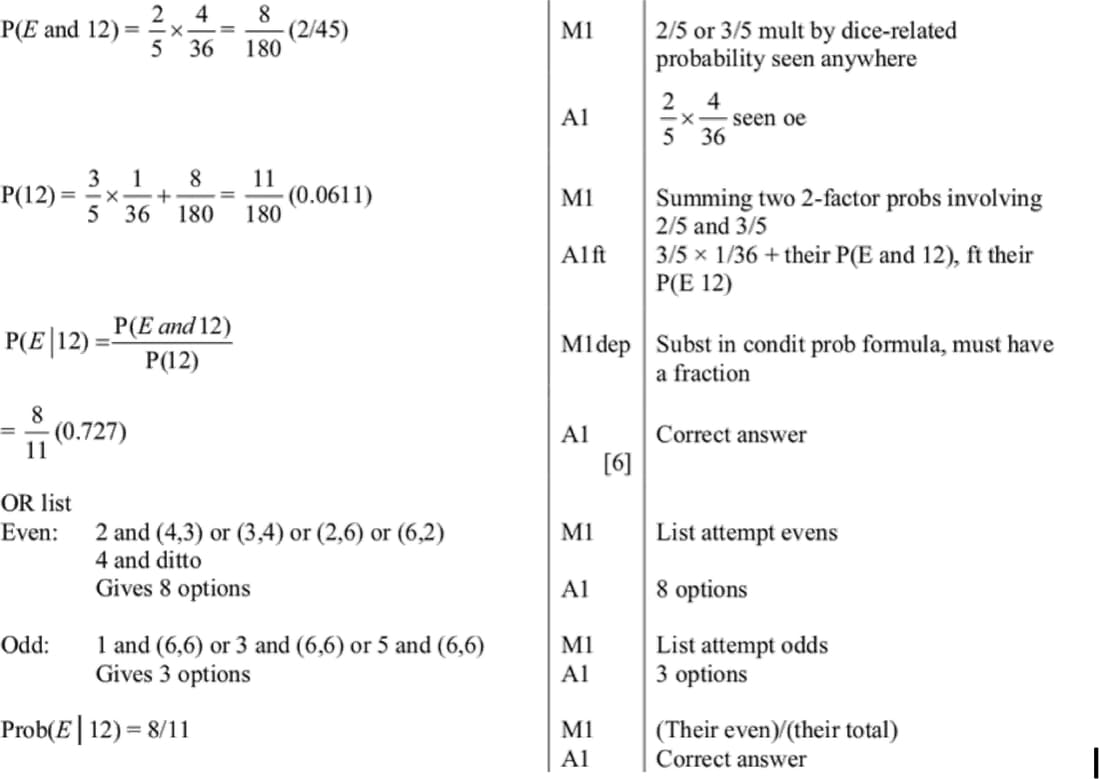
A fair five-sided spinner has sides numbered 1, 2, 3, 4, 5. Raj spins the spinner and throws two fair dice. He calculates his score as follows:
- If the spinner lands on an even-numbered side, Raj multiplies the two numbers showing on the dice to get his score.
- If the spinner lands on an odd-numbered side, Raj adds the numbers showing on the dice to get his score.
Given that Raj’s score is 12, find the probability that the spinner landed on an even-numbered side.
June 2010 p62 q6
2635
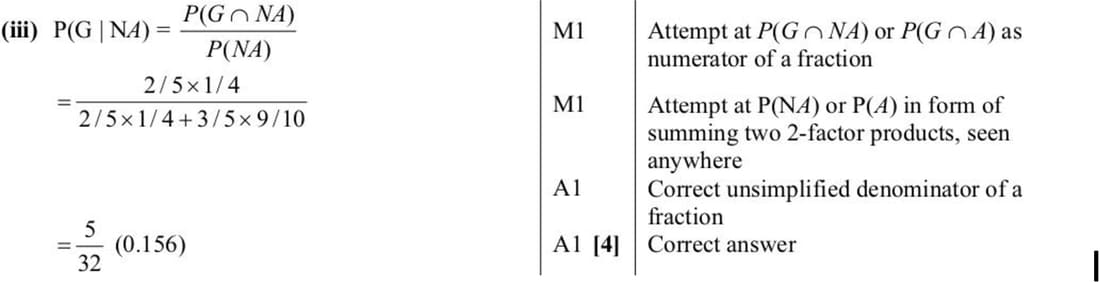
When the farmer’s dog is let loose, it chases either the ducks with probability \(\frac{3}{5}\) or the geese with probability \(\frac{2}{5}\). If the dog chases the ducks there is a probability of \(\frac{1}{10}\) that they will attack the dog. If the dog chases the geese there is a probability of \(\frac{3}{4}\) that they will attack the dog. Given that the dog is not attacked, find the probability that it was chasing the geese.
June 2010 p61 q7
2636
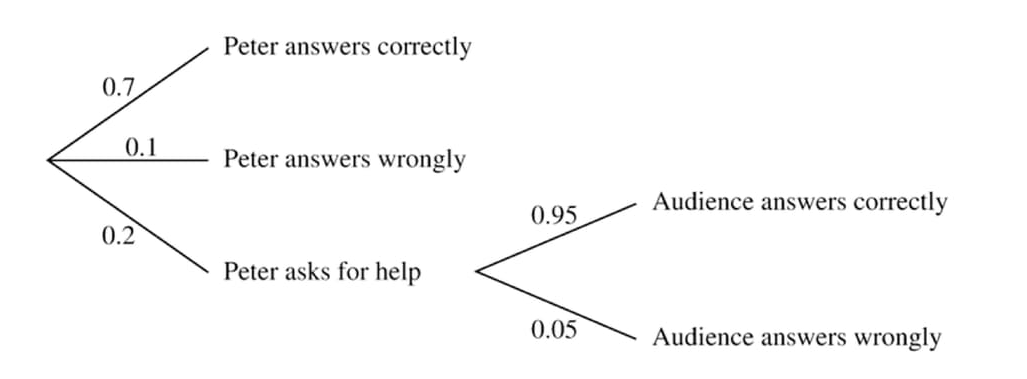
In a television quiz show Peter answers questions one after another, stopping as soon as a question is answered wrongly.
- The probability that Peter gives the correct answer himself to any question is 0.7.
- The probability that Peter gives a wrong answer himself to any question is 0.1.
- The probability that Peter decides to ask for help for any question is 0.2.
On the first occasion that Peter decides to ask for help he asks the audience. The probability that the audience gives the correct answer to any question is 0.95. This information is shown in the tree diagram below.
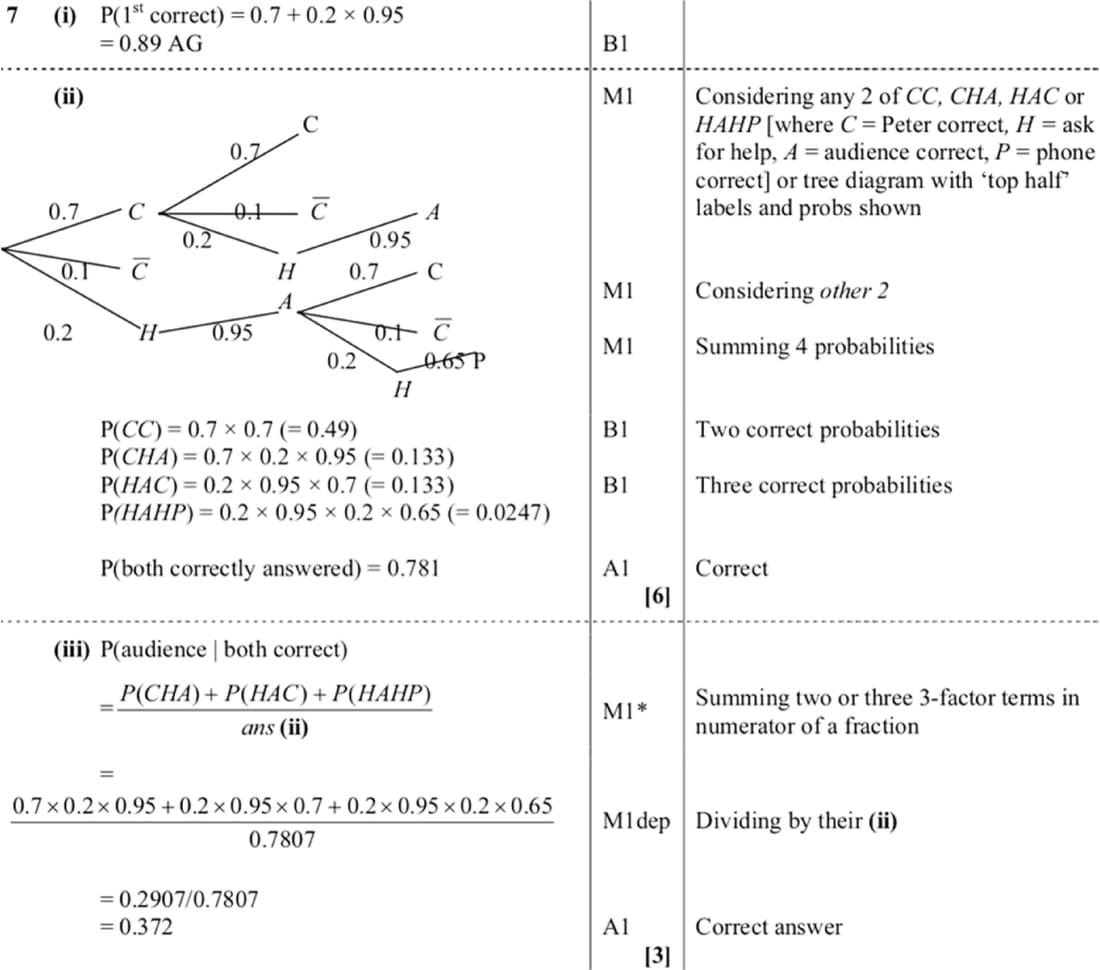
(i) Show that the probability that the first question is answered correctly is 0.89.
On the second occasion that Peter decides to ask for help he phones a friend. The probability that his friend gives the correct answer to any question is 0.65.
(ii) Find the probability that the first two questions are both answered correctly.
(iii) Given that the first two questions were both answered correctly, find the probability that Peter asked the audience.
Nov 2022 p52 q1
2637
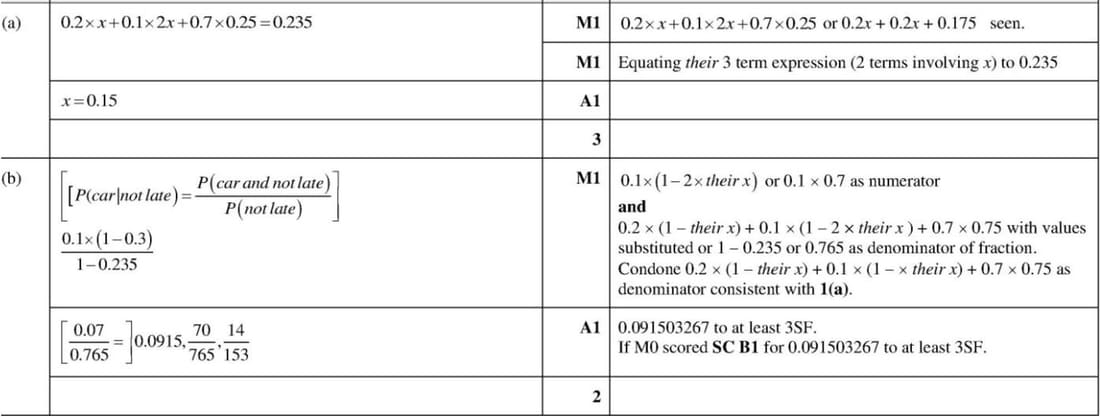
On any day, Kino travels to school by bus, by car or on foot with probabilities 0.2, 0.1 and 0.7 respectively. The probability that he is late when he travels by bus is \(x\). The probability that he is late when he travels by car is \(2x\) and the probability that he is late when he travels on foot is 0.25.
The probability that, on a randomly chosen day, Kino is late is 0.235.
(a) Find the value of \(x\).
(b) Find the probability that, on a randomly chosen day, Kino travels to school by car given that he is not late.
Nov 2009 p62 q3
2638
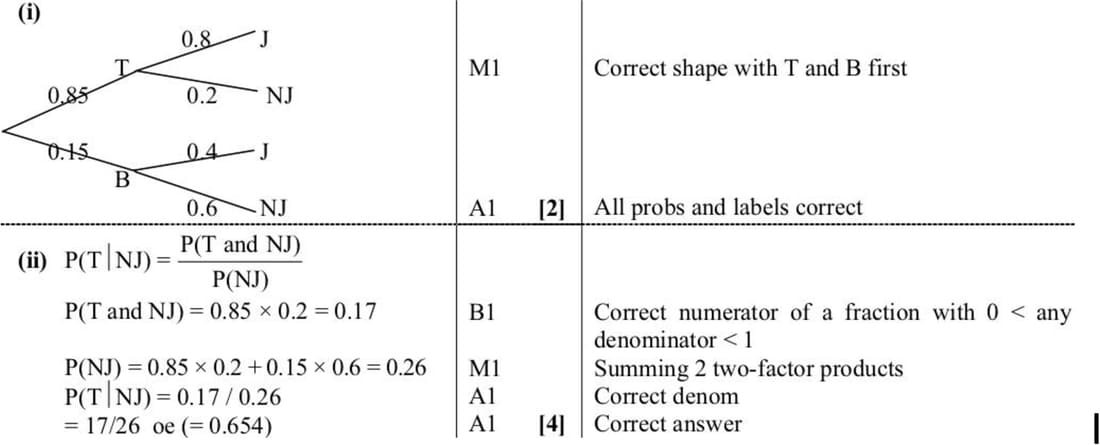
Maria chooses toast for her breakfast with probability 0.85. If she does not choose toast then she has a bread roll. If she chooses toast then the probability that she will have jam on it is 0.8. If she has a bread roll then the probability that she will have jam on it is 0.4.
(i) Draw a fully labelled tree diagram to show this information.
(ii) Given that Maria did not have jam for breakfast, find the probability that she had toast.
Nov 2009 p61 q6
2639
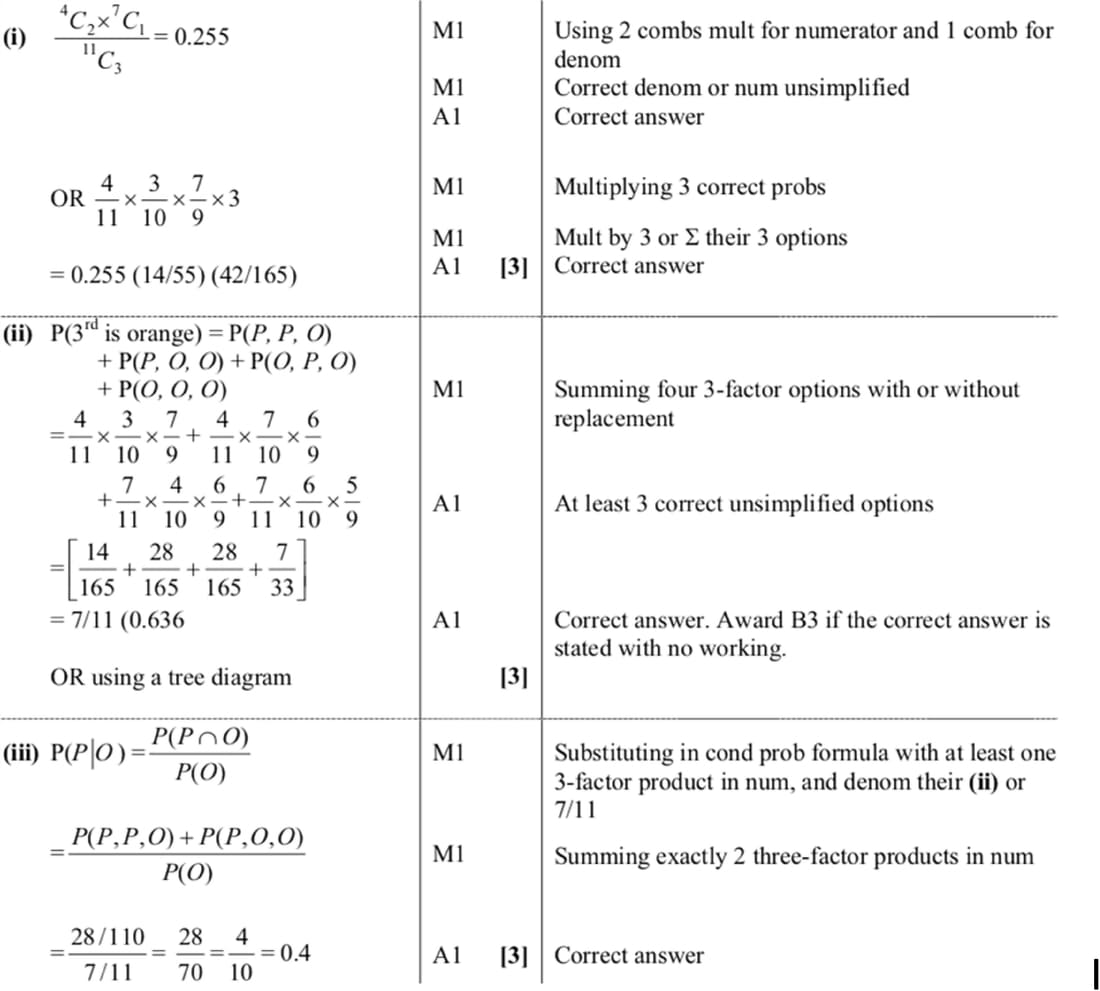
A box contains 4 pears and 7 oranges. Three fruits are taken out at random and eaten. Find the probability that
- 2 pears and 1 orange are eaten, in any order,
- the third fruit eaten is an orange,
- the first fruit eaten was a pear, given that the third fruit eaten is an orange.
June 2009 p6 q5
2640
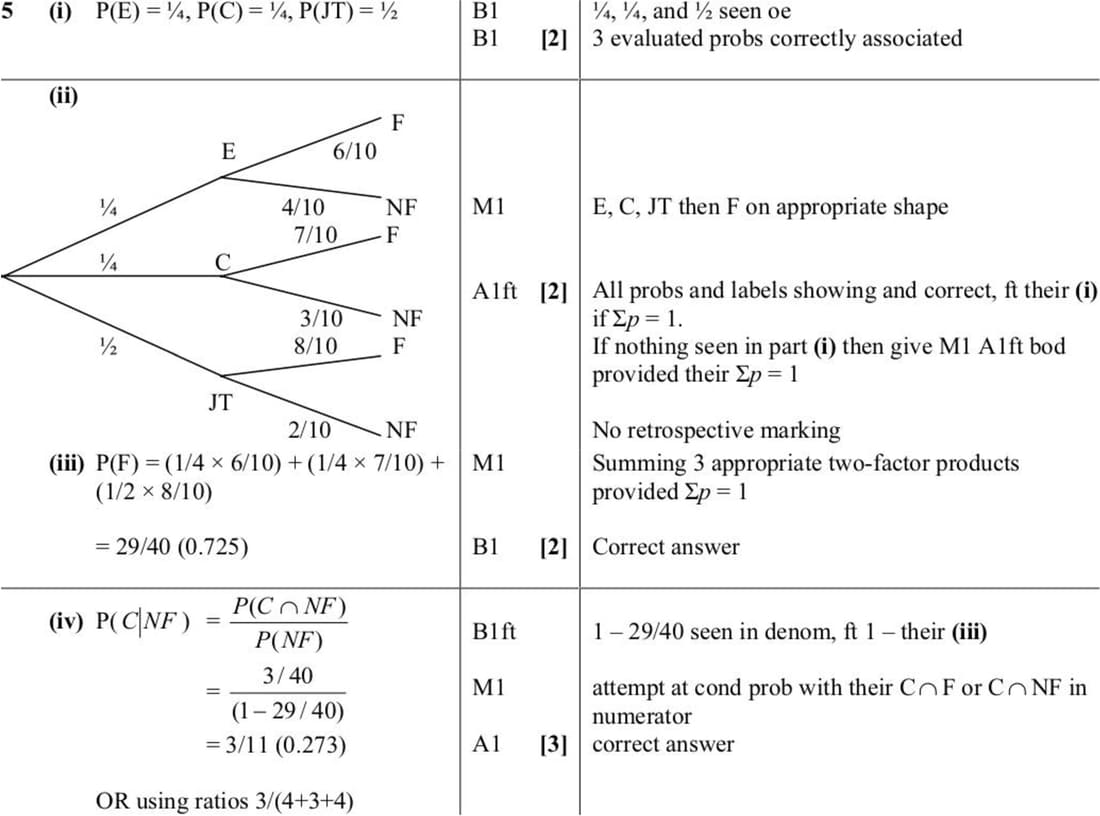
At a zoo, rides are offered on elephants, camels and jungle tractors. Ravi has money for only one ride. To decide which ride to choose, he tosses a fair coin twice. If he gets 2 heads he will go on the elephant ride, if he gets 2 tails he will go on the camel ride and if he gets 1 of each he will go on the jungle tractor ride.
(i) Find the probabilities that he goes on each of the three rides.
The probabilities that Ravi is frightened on each of the rides are as follows:
elephant ride \(\frac{6}{10}\), camel ride \(\frac{7}{10}\), jungle tractor ride \(\frac{8}{10}\).
(ii) Draw a fully labelled tree diagram showing the rides that Ravi could take and whether or not he is frightened.
Ravi goes on a ride.
(iii) Find the probability that he is frightened.
(iv) Given that Ravi is not frightened, find the probability that he went on the camel ride.
Nov 2008 p6 q6
2641
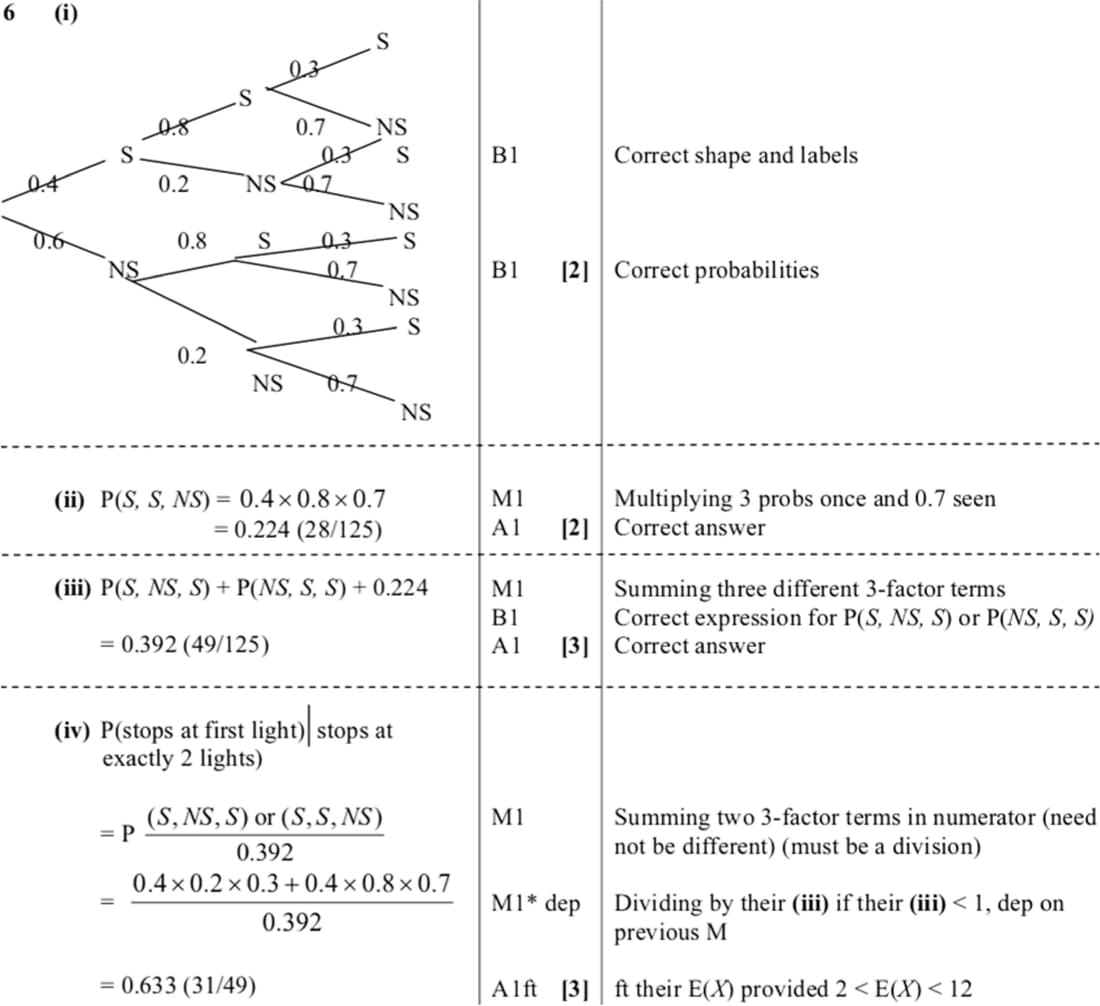
There are three sets of traffic lights on Karinne’s journey to work. The independent probabilities that Karinne has to stop at the first, second and third set of lights are 0.4, 0.8 and 0.3 respectively.
- Draw a tree diagram to show this information.
- Find the probability that Karinne has to stop at each of the first two sets of lights but does not have to stop at the third set.
- Find the probability that Karinne has to stop at exactly two of the three sets of lights.
- Find the probability that Karinne has to stop at the first set of lights, given that she has to stop at exactly two sets of lights.
June 2008 p6 q2
2642
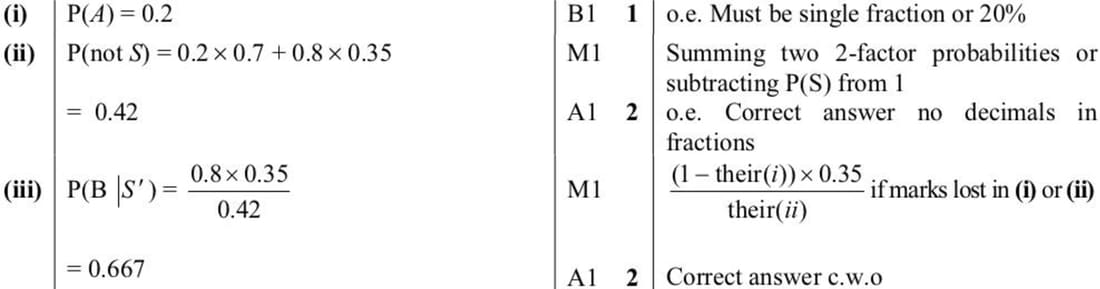
In country A, 30% of people who drink tea have sugar in it. In country B, 65% of people who drink tea have sugar in it. There are 3 million people in country A who drink tea and 12 million people in country B who drink tea. A person is chosen at random from these 15 million people.
- Find the probability that the person chosen is from country A.
- Find the probability that the person chosen does not have sugar in their tea.
- Given that the person chosen does not have sugar in their tea, find the probability that the person is from country B.
Nov 2007 p6 q7
2643
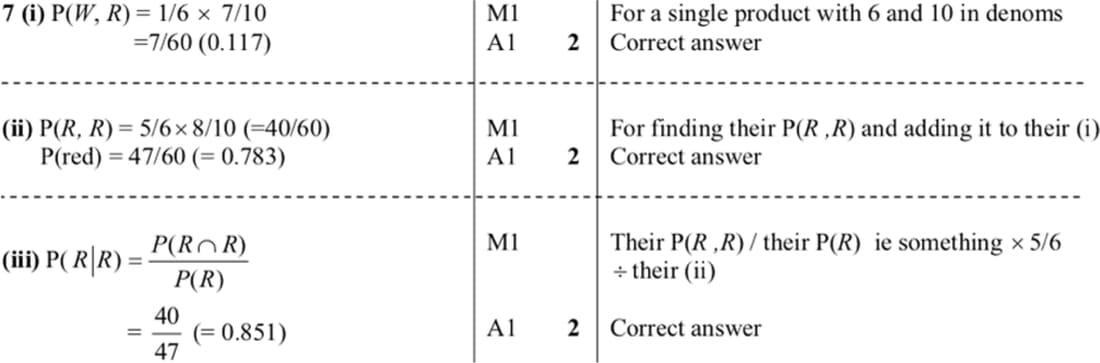
Box A contains 5 red paper clips and 1 white paper clip. Box B contains 7 red paper clips and 2 white paper clips. One paper clip is taken at random from box A and transferred to box B. One paper clip is then taken at random from box B.
- Find the probability of taking both a white paper clip from box A and a red paper clip from box B.
- Find the probability that the paper clip taken from box B is red.
- Find the probability that the paper clip taken from box A was red, given that the paper clip from box B is red.
June 2007 p6 q2
2644
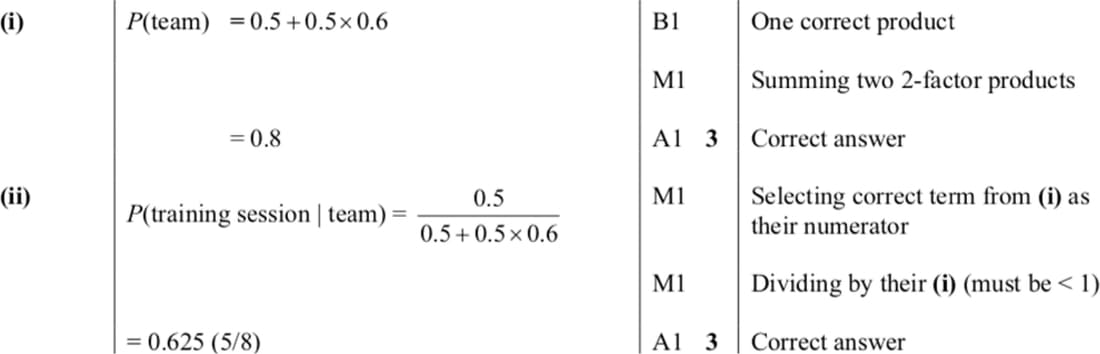
Jamie is equally likely to attend or not to attend a training session before a football match. If he attends, he is certain to be chosen for the team which plays in the match. If he does not attend, there is a probability of 0.6 that he is chosen for the team.
(i) Find the probability that Jamie is chosen for the team.
(ii) Find the conditional probability that Jamie attended the training session, given that he was chosen for the team.
Nov 2004 p6 q3
2645
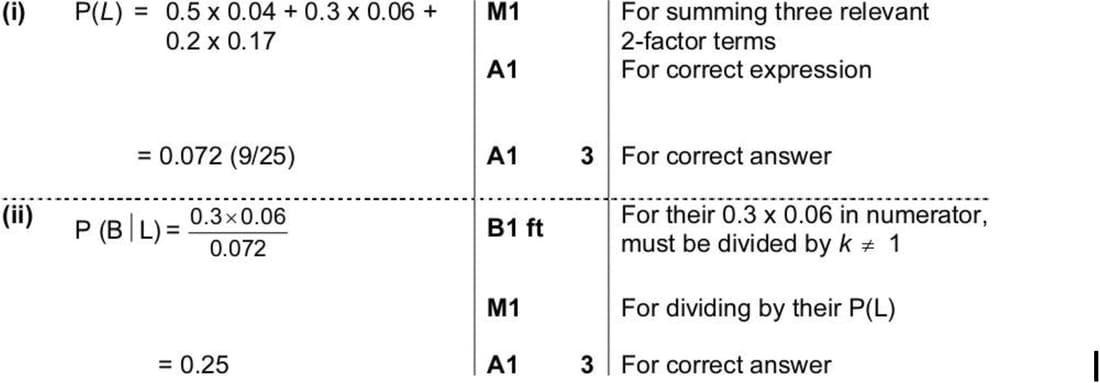
When Andrea needs a taxi, she rings one of three taxi companies, A, B or C. 50% of her calls are to taxi company A, 30% to B and 20% to C. A taxi from company A arrives late 4% of the time, a taxi from company B arrives late 6% of the time and a taxi from company C arrives late 17% of the time.
- Find the probability that, when Andrea rings for a taxi, it arrives late.
- Given that Andrea’s taxi arrives late, find the conditional probability that she rang company B.
June 2004 p6 q6
2646
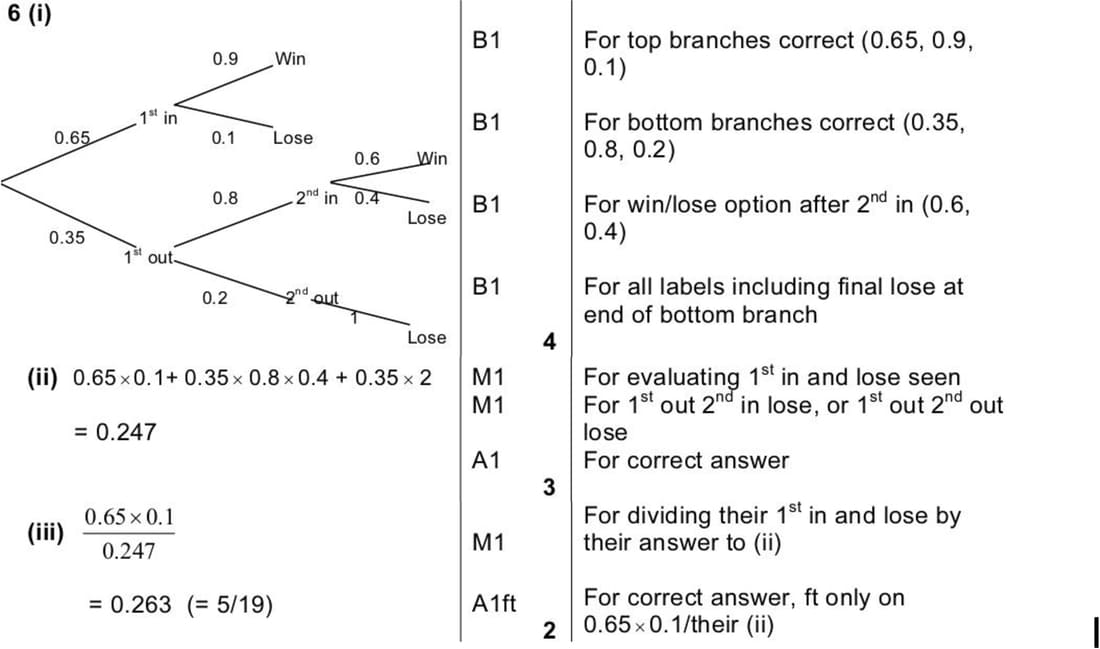
When Don plays tennis, 65% of his first serves go into the correct area of the court. If the first serve goes into the correct area, his chance of winning the point is 90%. If his first serve does not go into the correct area, Don is allowed a second serve, and of these, 80% go into the correct area. If the second serve goes into the correct area, his chance of winning the point is 60%. If neither serve goes into the correct area, Don loses the point.
- Draw a tree diagram to represent this information.
- Using your tree diagram, find the probability that Don loses the point.
- Find the conditional probability that Don’s first serve went into the correct area, given that he loses the point.
Nov 2003 p6 q5
2647
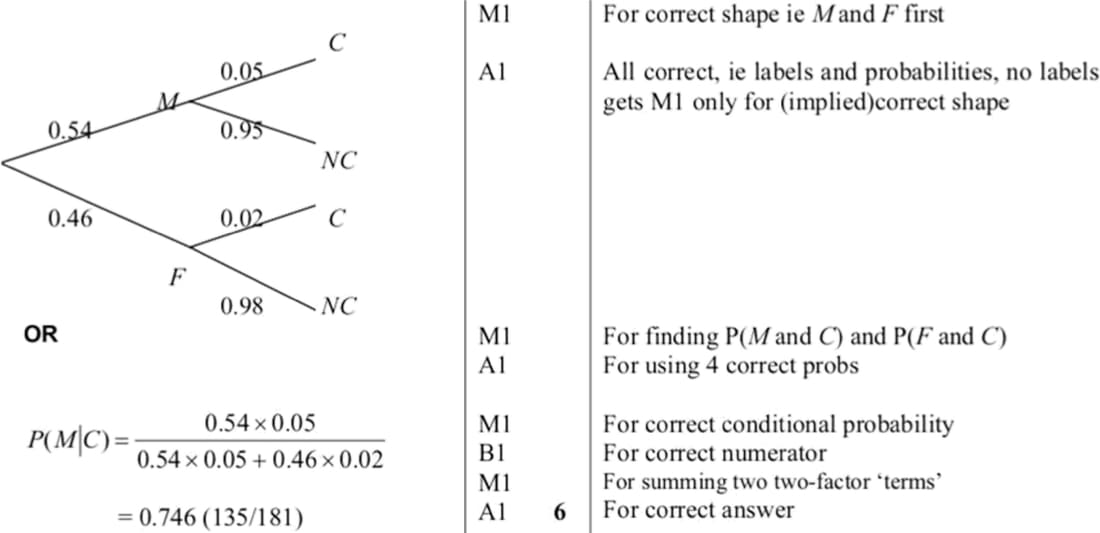
In a certain country 54% of the population is male. It is known that 5% of the males are colour-blind and 2% of the females are colour-blind. A person is chosen at random and found to be colour-blind. By drawing a tree diagram, or otherwise, find the probability that this person is male.
June 2022 p53 q6
2648
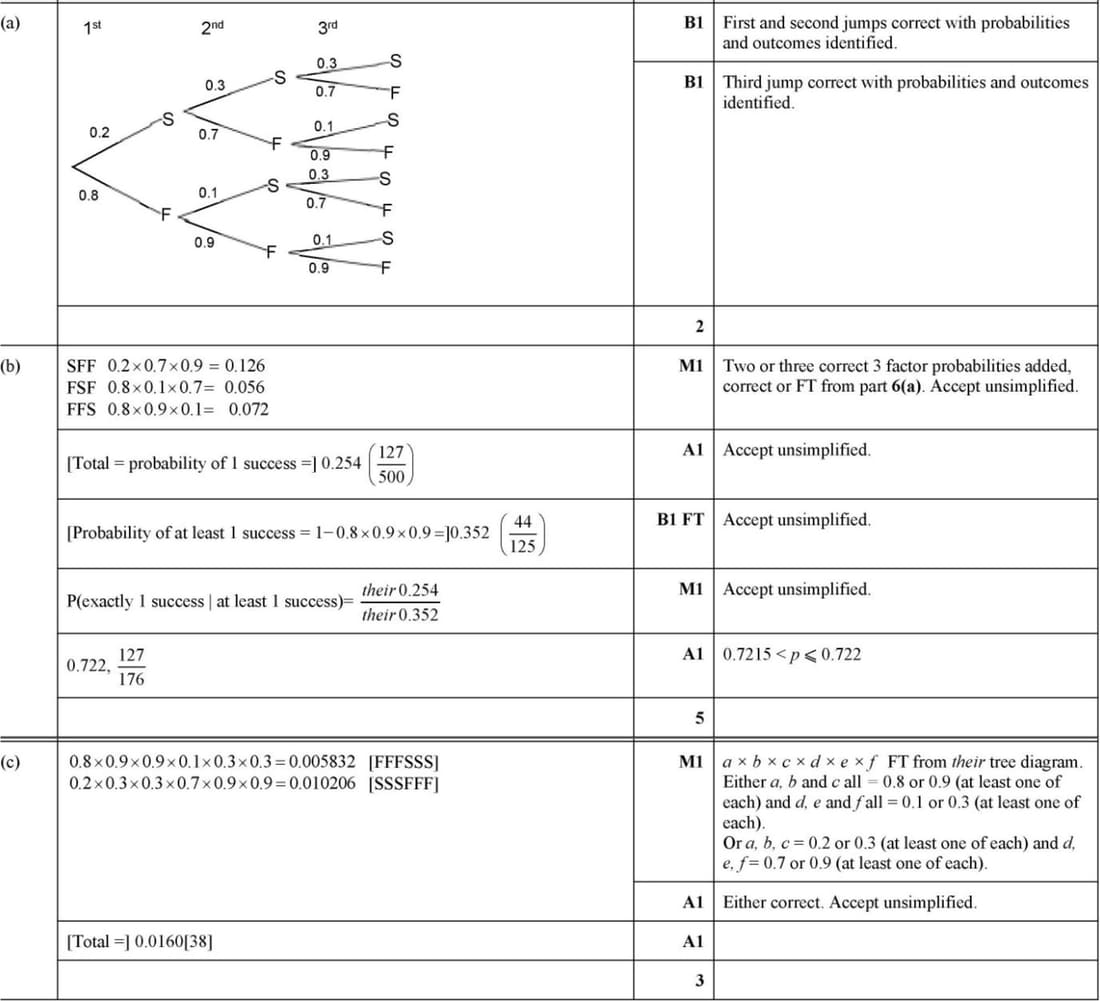
Sajid is practising for a long jump competition. He counts any jump that is longer than 6 m as a success. On any day, the probability that he has a success with his first jump is 0.2. For any subsequent jump, the probability of a success is 0.3 if the previous jump was a success and 0.1 otherwise. Sajid makes three jumps.
(a) Draw a tree diagram to illustrate this information, showing all the probabilities.
(b) Find the probability that Sajid has exactly one success given that he has at least one success.
On another day, Sajid makes six jumps.
(c) Find the probability that only his first three jumps are successes or only his last three jumps are successes.
June 2003 p6 q6
2649
The people living in 3 houses are classified as children (C), parents (P) or grandparents (G). The numbers living in each house are shown in the table below.
| House number 1 | House number 2 | House number 3 | |
|---|---|---|---|
| 4C, 1P, 2G | 2C, 2P, 3G | 1C, 1G |
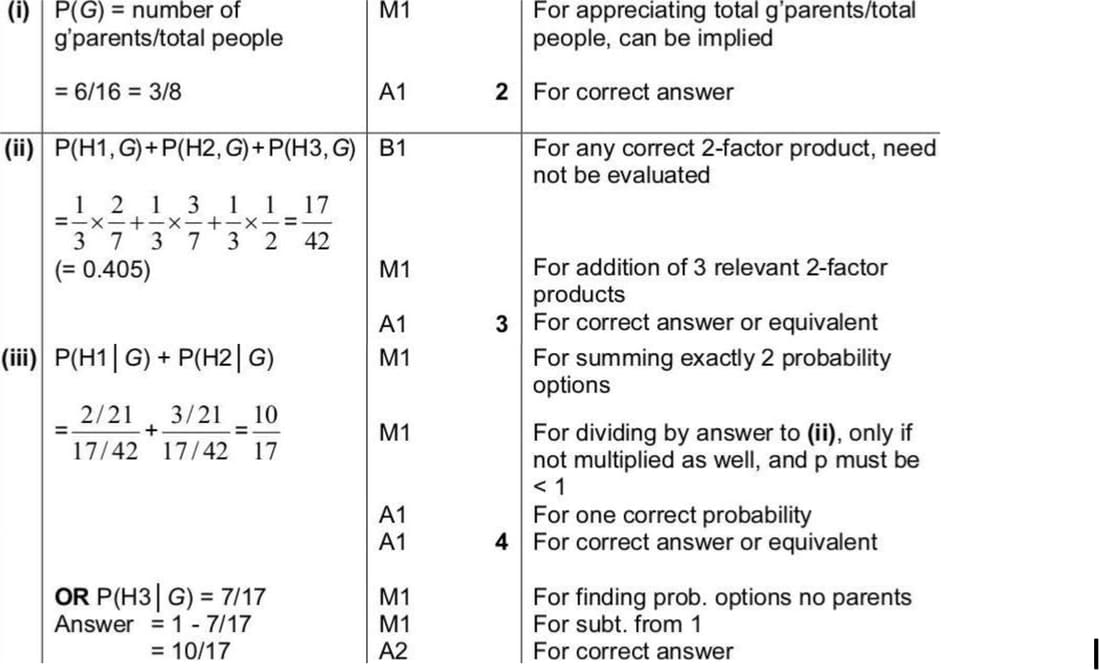
- All the people in all 3 houses meet for a party. One person at the party is chosen at random. Calculate the probability of choosing a grandparent. [2]
- A house is chosen at random. Then a person in that house is chosen at random. Using a tree diagram, or otherwise, calculate the probability that the person chosen is a grandparent. [3]
- Given that the person chosen by the method in part (ii) is a grandparent, calculate the probability that there is also a parent living in the house. [4]
Nov 2002 p6 q5
2650
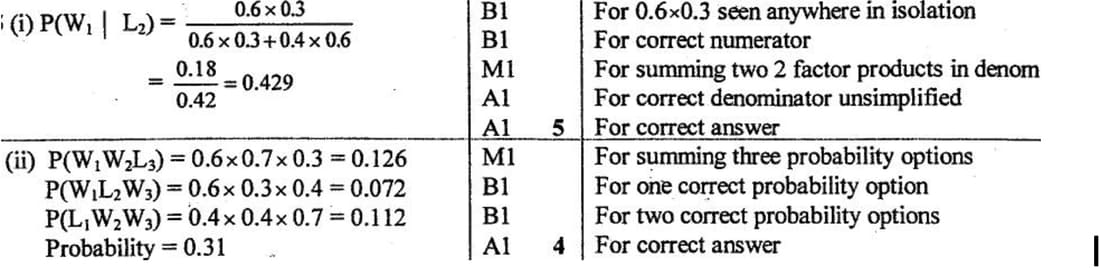
Rachel and Anna play each other at badminton. Each game results in either a win for Rachel or a win for Anna. The probability of Rachel winning the first game is 0.6. If Rachel wins a particular game, the probability of her winning the next game is 0.7, but if she loses, the probability of her winning the next game is 0.4. By using a tree diagram, or otherwise,
- find the conditional probability that Rachel wins the first game, given that she loses the second,
- find the probability that Rachel wins 2 games and loses 1 game out of the first three games they play.
June 2022 p52 q7
2651
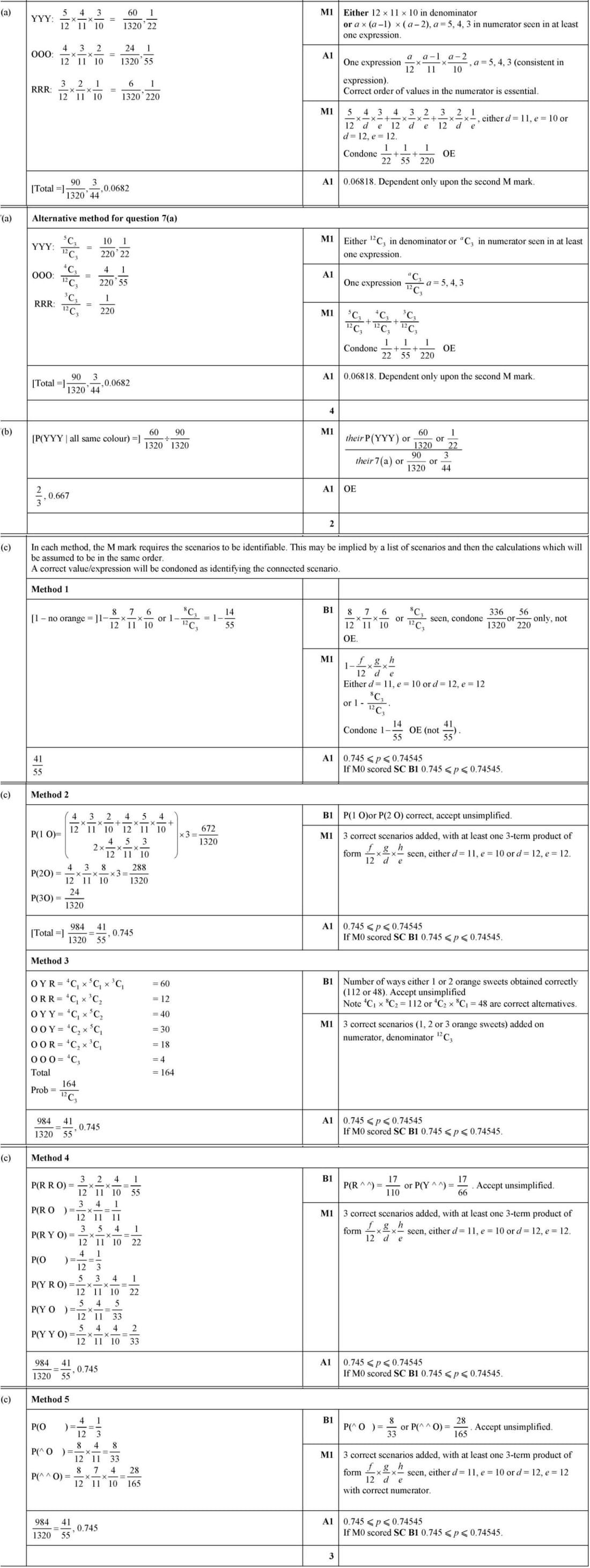
Hanna buys 12 hollow chocolate eggs that each contain a sweet. The eggs look identical but Hanna knows that 3 contain a red sweet, 4 contain an orange sweet and 5 contain a yellow sweet. Each of Hanna’s three children in turn randomly chooses and eats one of the eggs, keeping the sweet it contained.
(a) Find the probability that all 3 eggs chosen contain the same colour sweet.
(b) Find the probability that all 3 eggs chosen contain a yellow sweet, given that all three children have the same colour sweet.
(c) Find the probability that at least one of Hanna’s three children chooses an egg that contains an orange sweet.
June 2022 p51 q6
2652
Janice is playing a computer game. She has to complete level 1 and level 2 to finish the game. She is allowed at most two attempts at any level.
- For level 1, the probability that Janice completes it at the first attempt is 0.6. If she fails at her first attempt, the probability that she completes it at the second attempt is 0.3.
- If Janice completes level 1, she immediately moves on to level 2.
- For level 2, the probability that Janice completes it at the first attempt is 0.4. If she fails at her first attempt, the probability that she completes it at the second attempt is 0.2.
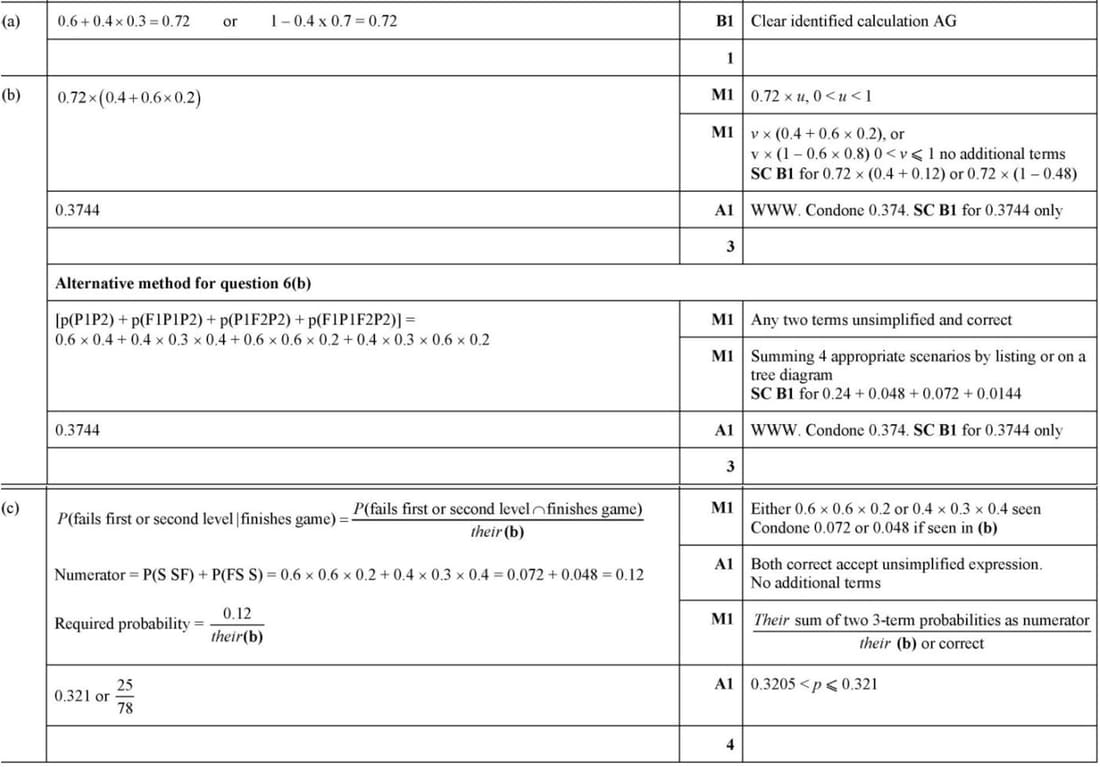
(a) Show that the probability that Janice moves on to level 2 is 0.72.
(b) Find the probability that Janice finishes the game.
(c) Find the probability that Janice fails exactly one attempt, given that she finishes the game.