Exam-Style Problems
⬅ Back to SubchapterNov 2023 p33 q5
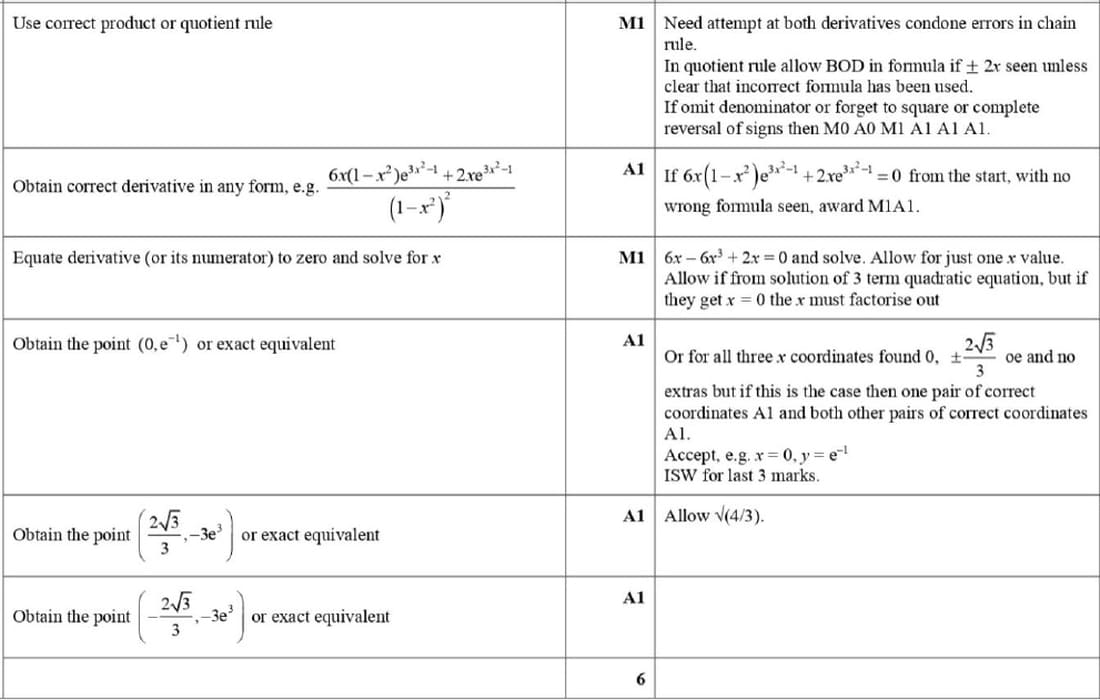
Find the exact coordinates of the stationary points of the curve \(y = \frac{e^{3x^2-1}}{1-x^2}\).
June 2020 p31 q4
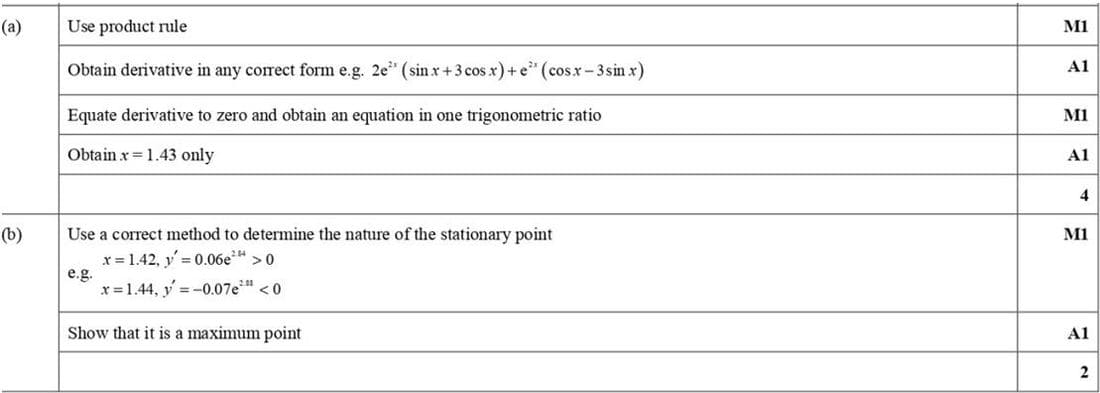
The curve with equation \(y = e^{2x}(\sin x + 3 \cos x)\) has a stationary point in the interval \(0 \leq x \leq \pi\).
(a) Find the \(x\)-coordinate of this point, giving your answer correct to 2 decimal places.
(b) Determine whether the stationary point is a maximum or a minimum.
Nov 2019 p32 q2
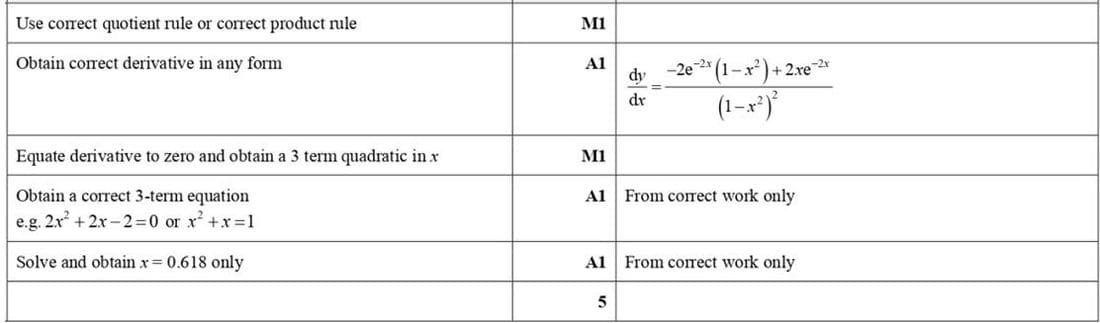
The curve with equation \(y = \frac{e^{-2x}}{1-x^2}\) has a stationary point in the interval \(-1 < x < 1\). Find \(\frac{dy}{dx}\) and hence find the \(x\)-coordinate of this stationary point, giving the answer correct to 3 decimal places.
June 2018 p31 q3
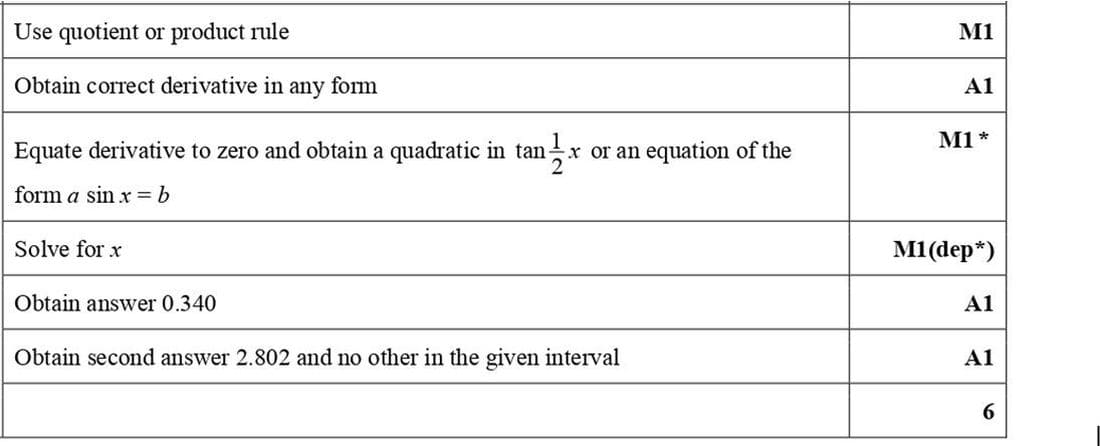
A curve has equation \(y = \frac{e^{3x}}{\tan \frac{1}{2}x}\). Find the \(x\)-coordinates of the stationary points of the curve in the interval \(0 < x < \pi\). Give your answers correct to 3 decimal places.
Nov 2017 p32 q4
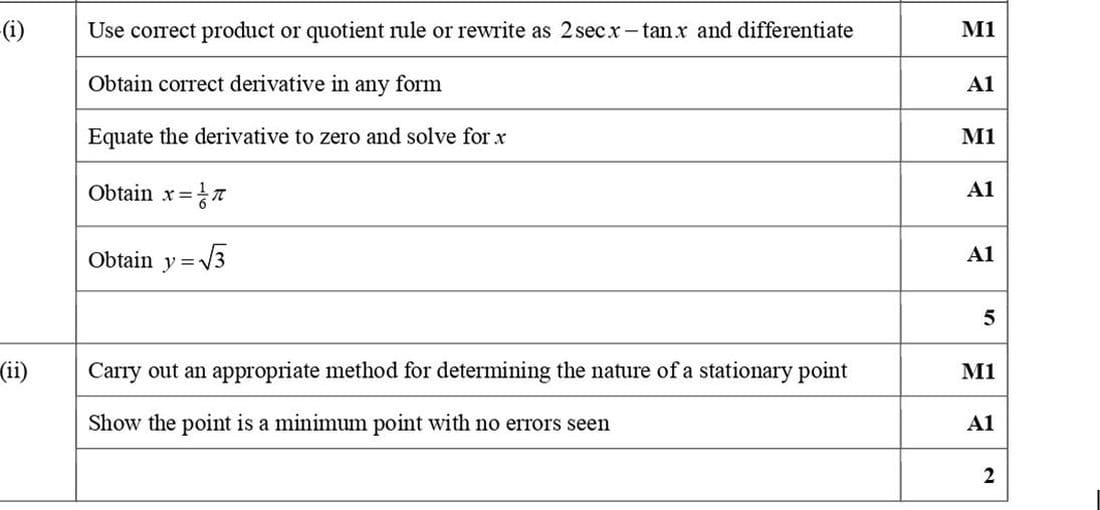
The curve with equation \(y = \frac{2 - \\sin x}{\\cos x}\) has one stationary point in the interval \(-\frac{1}{2}\pi < x < \frac{1}{2}\pi\).
(i) Find the exact coordinates of this point.
(ii) Determine whether this point is a maximum or a minimum point.
Nov 2016 p33 q2
The equation of a curve is \(y = \frac{\sin x}{1 + \cos x}\), for \(-\pi < x < \pi\). Show that the gradient of the curve is positive for all \(x\) in the given interval.

June 2016 p32 q4
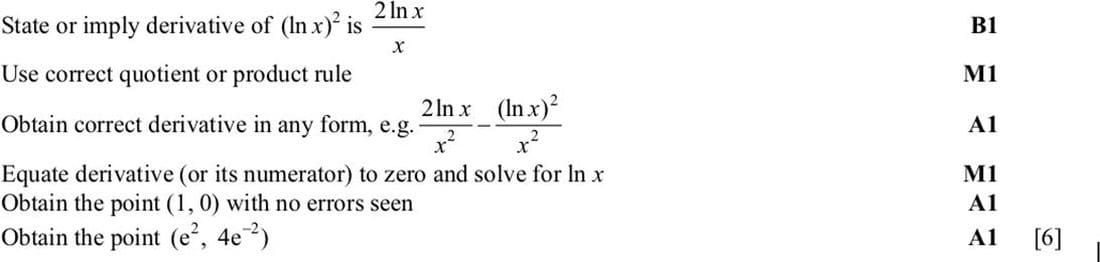
The curve with equation \(y = \frac{{(\ln x)^2}}{x}\) has two stationary points. Find the exact values of the coordinates of these points.
June 2016 p31 q5
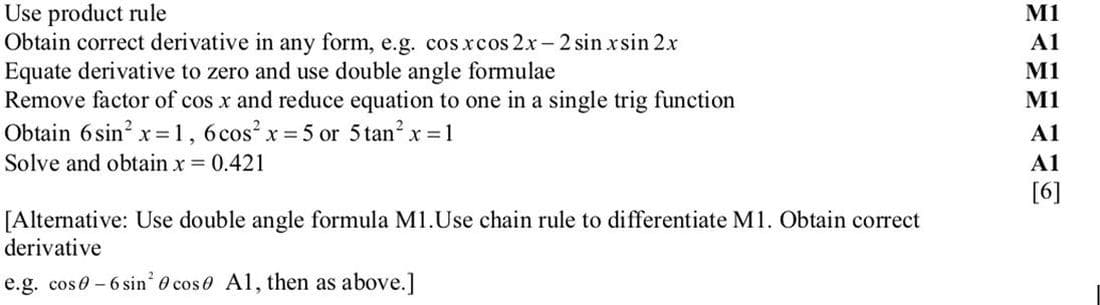
The curve with equation \(y = \\sin x \\cos 2x\) has one stationary point in the interval \(0 < x < \frac{1}{2} \pi\). Find the x-coordinate of this point, giving your answer correct to 3 significant figures.
June 2015 p33 q4
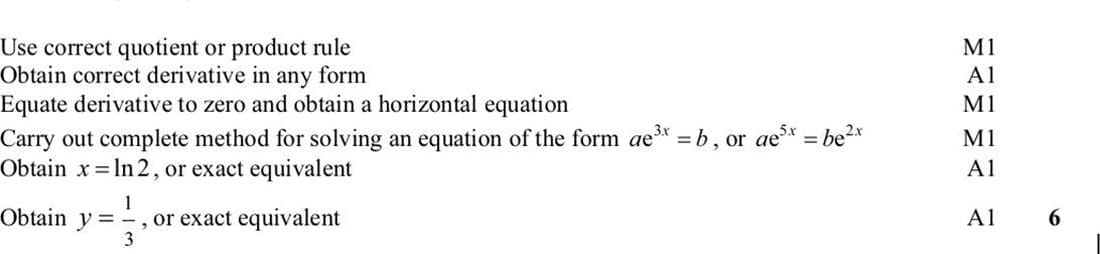
The curve with equation \(y = \frac{e^{2x}}{4 + e^{3x}}\) has one stationary point. Find the exact values of the coordinates of this point.
June 2015 p32 q3
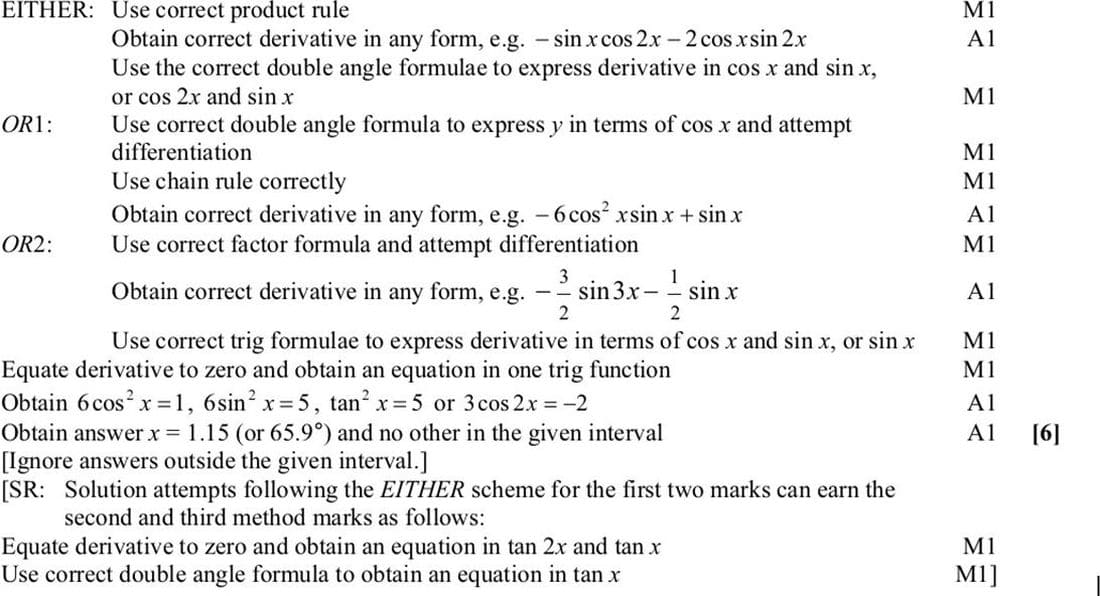
A curve has equation \(y = \cos x \cos 2x\). Find the \(x\)-coordinate of the stationary point on the curve in the interval \(0 < x < \frac{1}{2}\pi\), giving your answer correct to 3 significant figures.
June 2015 p31 q4
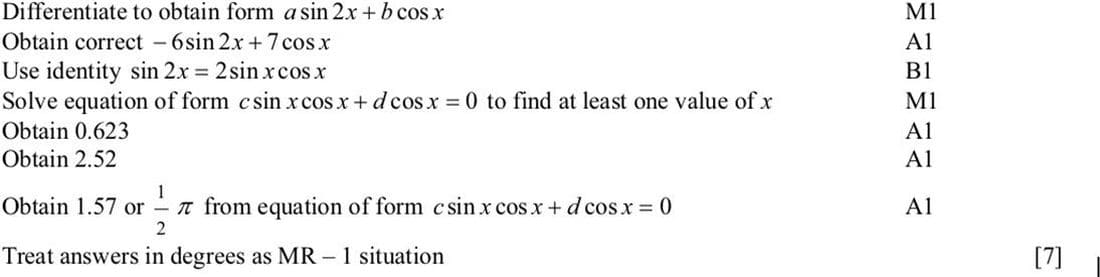
The equation of a curve is
\(y = 3 \cos 2x + 7 \sin x + 2\).
Find the \(x\)-coordinates of the stationary points in the interval \(0 \leq x \leq \pi\). Give each answer correct to 3 significant figures.
Nov 2022 p32 q3
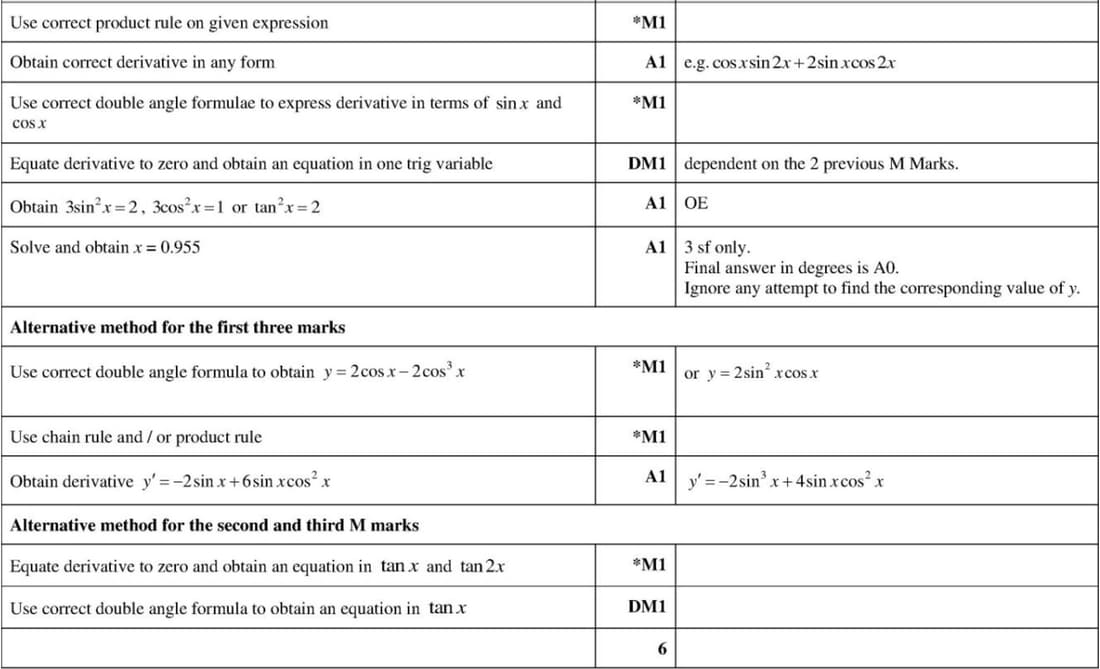
The equation of a curve is \(y = \sin x \sin 2x\). The curve has a stationary point in the interval \(0 < x < \frac{1}{2}\pi\).
Find the \(x\)-coordinate of this point, giving your answer correct to 3 significant figures.
Nov 2013 p31 q1
The equation of a curve is \(y = \frac{1+x}{1+2x}\) for \(x > -\frac{1}{2}\). Show that the gradient of the curve is always negative.

June 2012 p33 q4
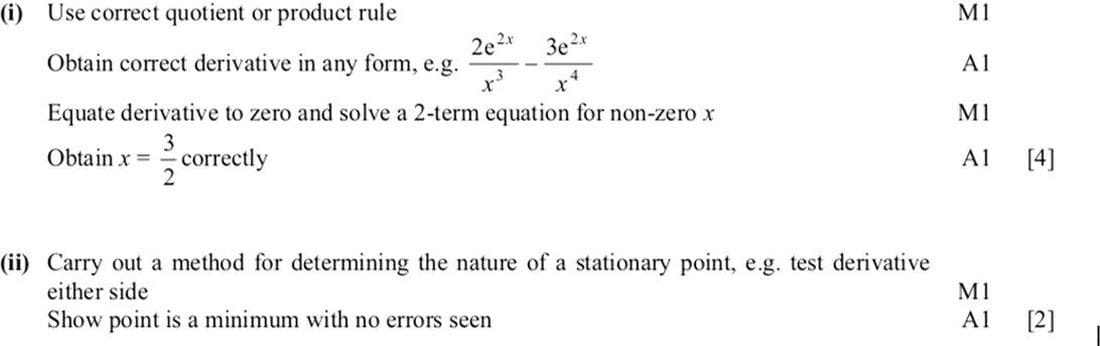
The curve with equation \(y = \frac{e^{2x}}{x^3}\) has one stationary point.
- Find the \(x\)-coordinate of this point.
- Determine whether this point is a maximum or a minimum point.
June 2012 p32 q6
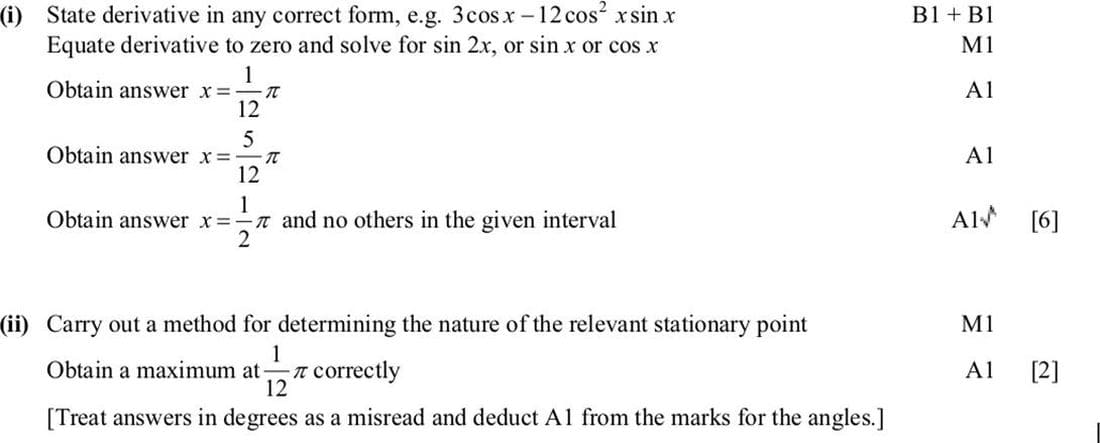
The equation of a curve is \(y = 3 \sin x + 4 \cos^3 x\).
(i) Find the \(x\)-coordinates of the stationary points of the curve in the interval \(0 < x < \pi\).
(ii) Determine the nature of the stationary point in this interval for which \(x\) is least.
Nov 2011 p33 q2
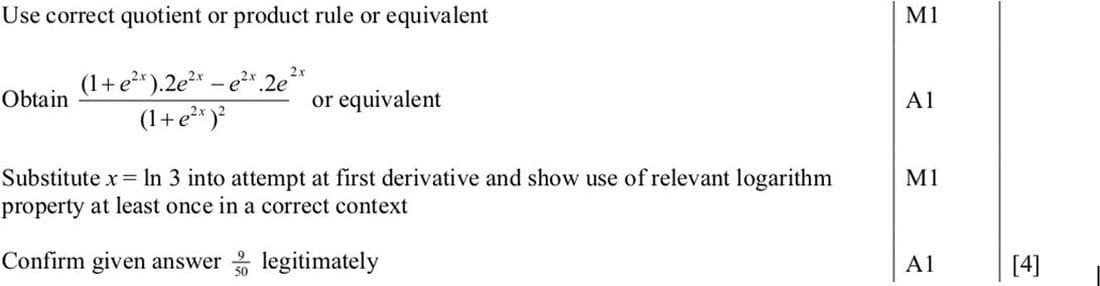
The equation of a curve is \(y = \frac{e^{2x}}{1 + e^{2x}}\). Show that the gradient of the curve at the point for which \(x = \ln 3\) is \(\frac{9}{50}\).
June 2011 p33 q2
The curve \(y = \frac{\ln x}{x^3}\) has one stationary point. Find the x-coordinate of this point.

Nov 2009 p31 q4
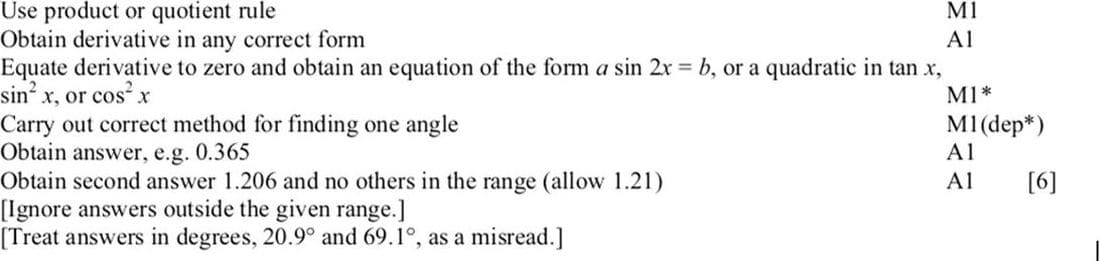
A curve has equation \(y = e^{-3x} \tan x\). Find the x-coordinates of the stationary points on the curve in the interval \(-\frac{1}{2}\pi < x < \frac{1}{2}\pi\). Give your answers correct to 3 decimal places.
Nov 2008 p3 q3
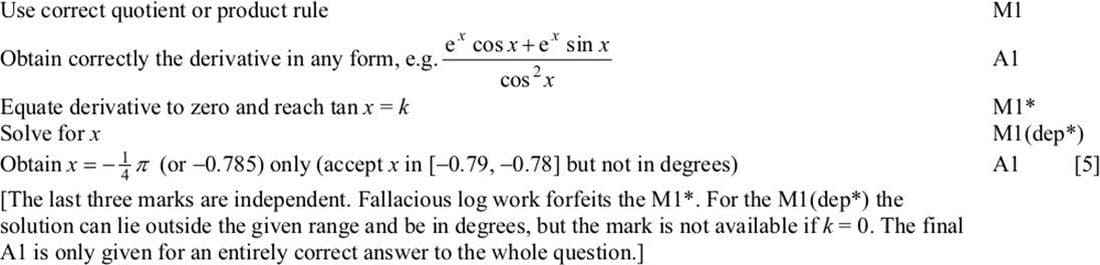
The curve \(y = \frac{e^x}{\cos x}\), for \(-\frac{1}{2}\pi < x < \frac{1}{2}\pi\), has one stationary point. Find the \(x\)-coordinate of this point.
Nov 2007 p3 q4
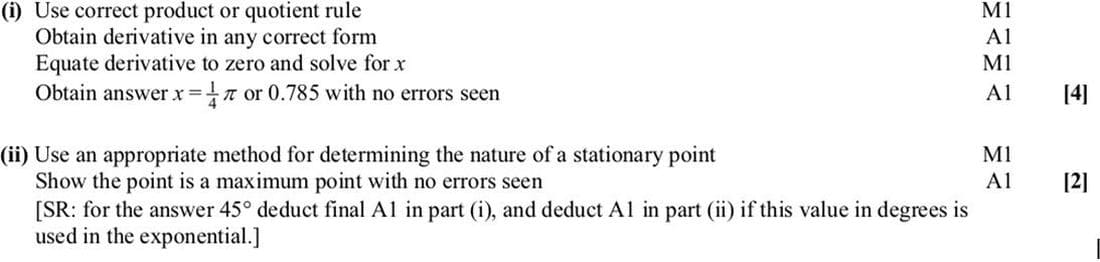
The curve with equation \(y = e^{-x} \sin x\) has one stationary point for which \(0 \leq x \leq \pi\).
(i) Find the \(x\)-coordinate of this point.
(ii) Determine whether this point is a maximum or a minimum point.
Nov 2006 p3 q3
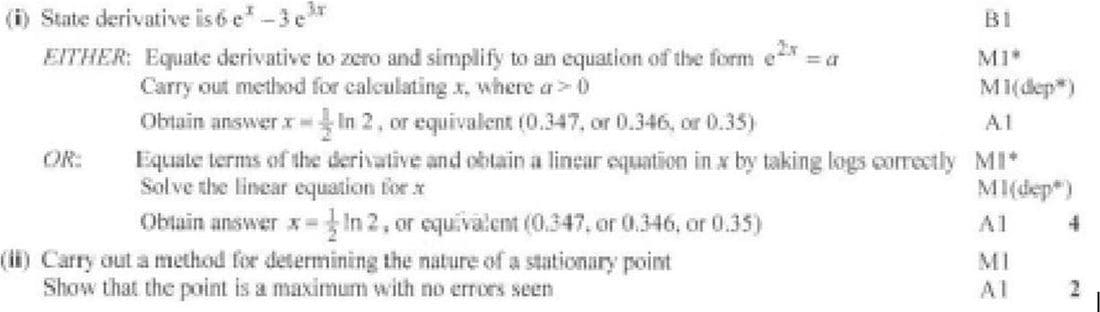
The curve with equation \(y = 6e^x - e^{3x}\) has one stationary point.
(i) Find the \(x\)-coordinate of this point.
(ii) Determine whether this point is a maximum or a minimum point.
Nov 2005 p3 q3
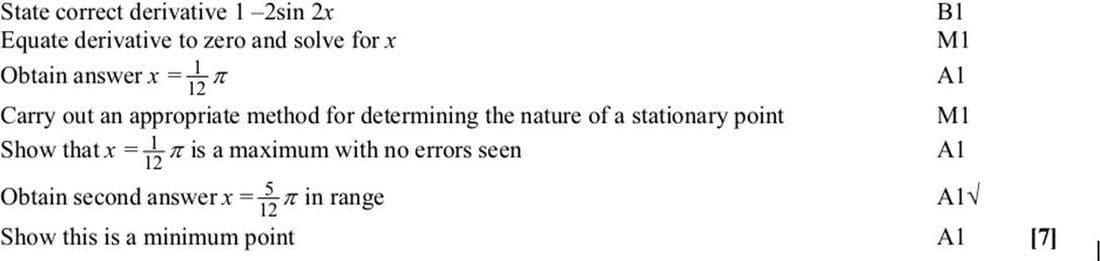
The equation of a curve is \(y = x + \\cos 2x\). Find the \(x\)-coordinates of the stationary points of the curve for which \(0 \leq x \leq \pi\), and determine the nature of each of these stationary points.
June 2022 p33 q4
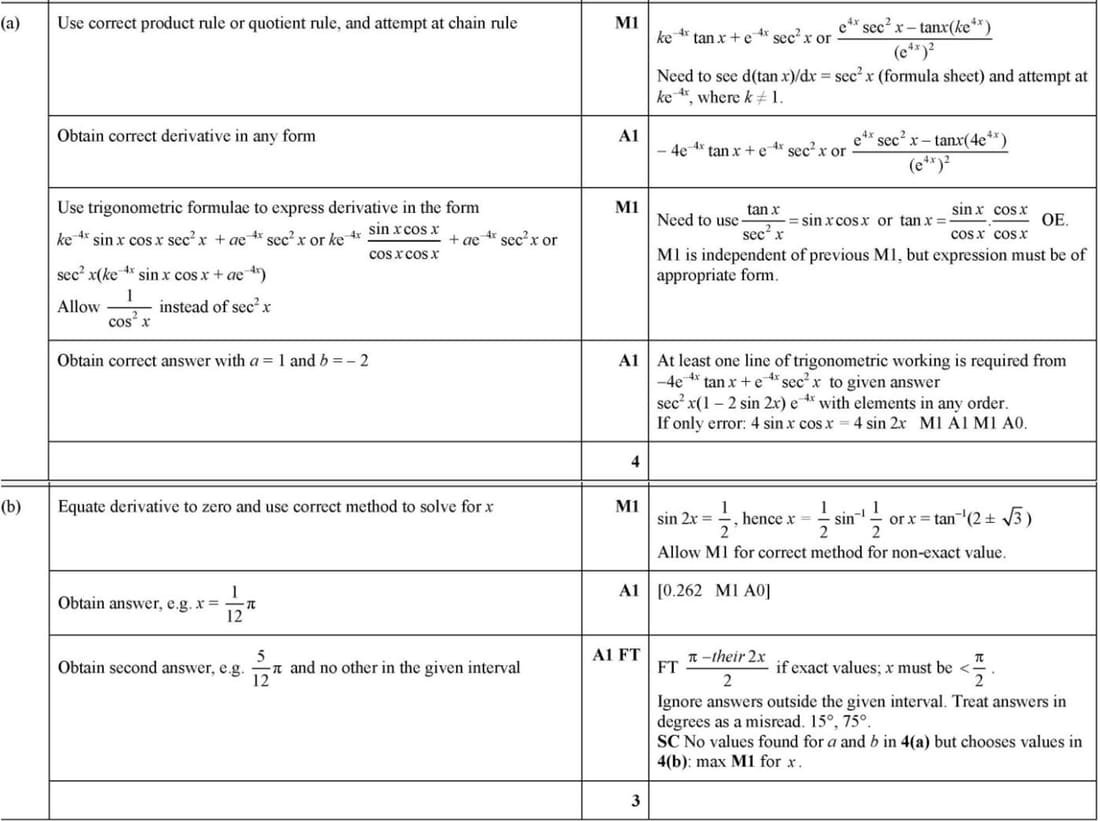
The curve \(y = e^{-4x} \tan x\) has two stationary points in the interval \(0 \leq x < \frac{1}{2} \pi\).
(a) Obtain an expression for \(\frac{dy}{dx}\) and show it can be written in the form \(\sec^2 x (a + b \sin 2x) e^{-4x}\), where \(a\) and \(b\) are constants.
(b) Hence find the exact \(x\)-coordinates of the two stationary points.
Nov 2002 p3 q4
The curve \(y = e^x + 4e^{-2x}\) has one stationary point.
(i) Find the \(x\)-coordinate of this point.
(ii) Determine whether the stationary point is a maximum or a minimum point.

June 2002 p3 q5
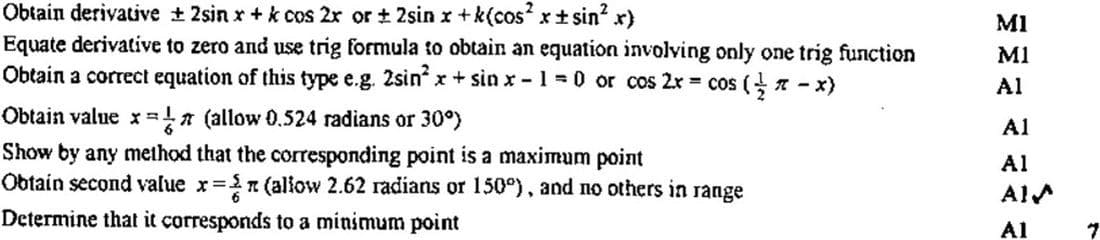
The equation of a curve is \(y = 2 \cos x + \sin 2x\). Find the \(x\)-coordinates of the stationary points on the curve for which \(0 < x < \pi\), and determine the nature of each of these stationary points.
June 2022 p32 q4
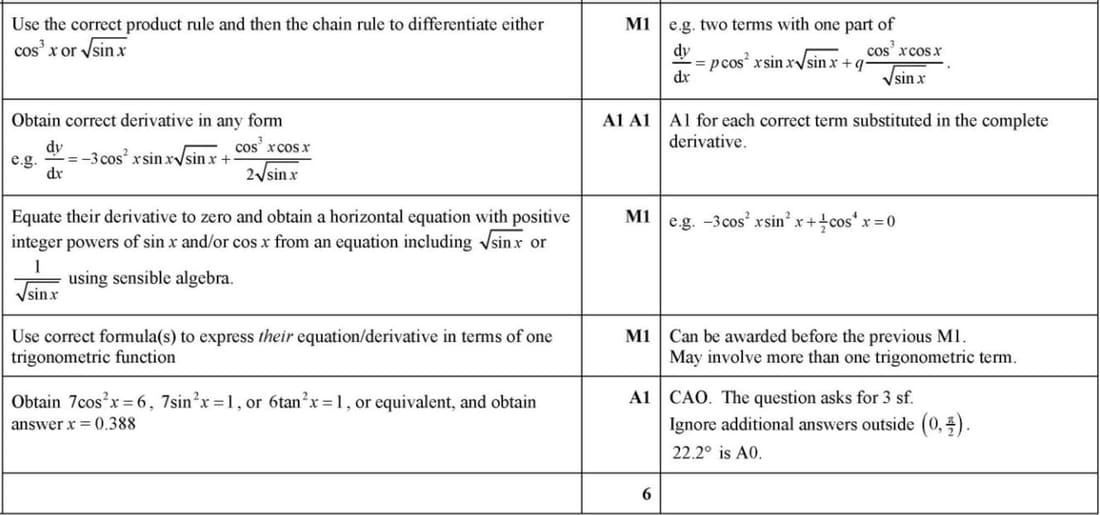
The equation of a curve is \(y = \cos^3 x \sqrt{\sin x}\). It is given that the curve has one stationary point in the interval \(0 < x < \frac{1}{2}\pi\).
Find the \(x\)-coordinate of this stationary point, giving your answer correct to 3 significant figures.
Nov 2021 p31 q3
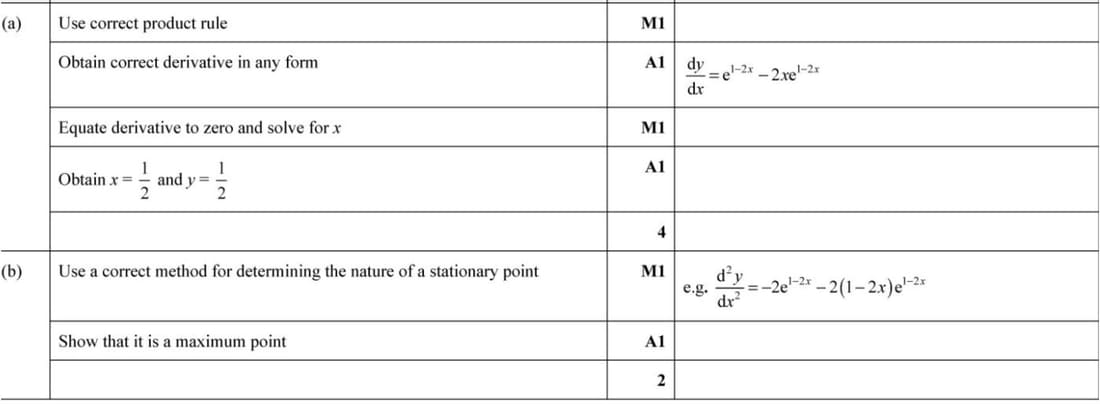
The curve with equation \(y = xe^{1-2x}\) has one stationary point.
(a) Find the coordinates of this point.
(b) Determine whether the stationary point is a maximum or a minimum.
June 2021 p33 q8
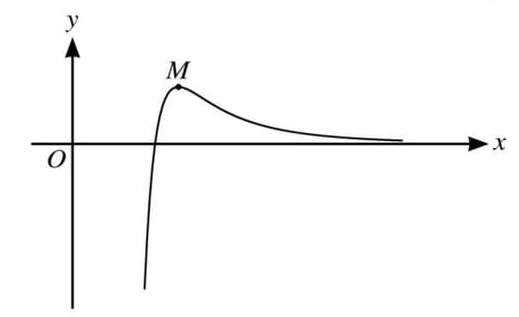
The diagram shows the curve \(y = \frac{\ln x}{x^4}\) and its maximum point \(M\).
Find the exact coordinates of \(M\).
June 2021 p32 q8
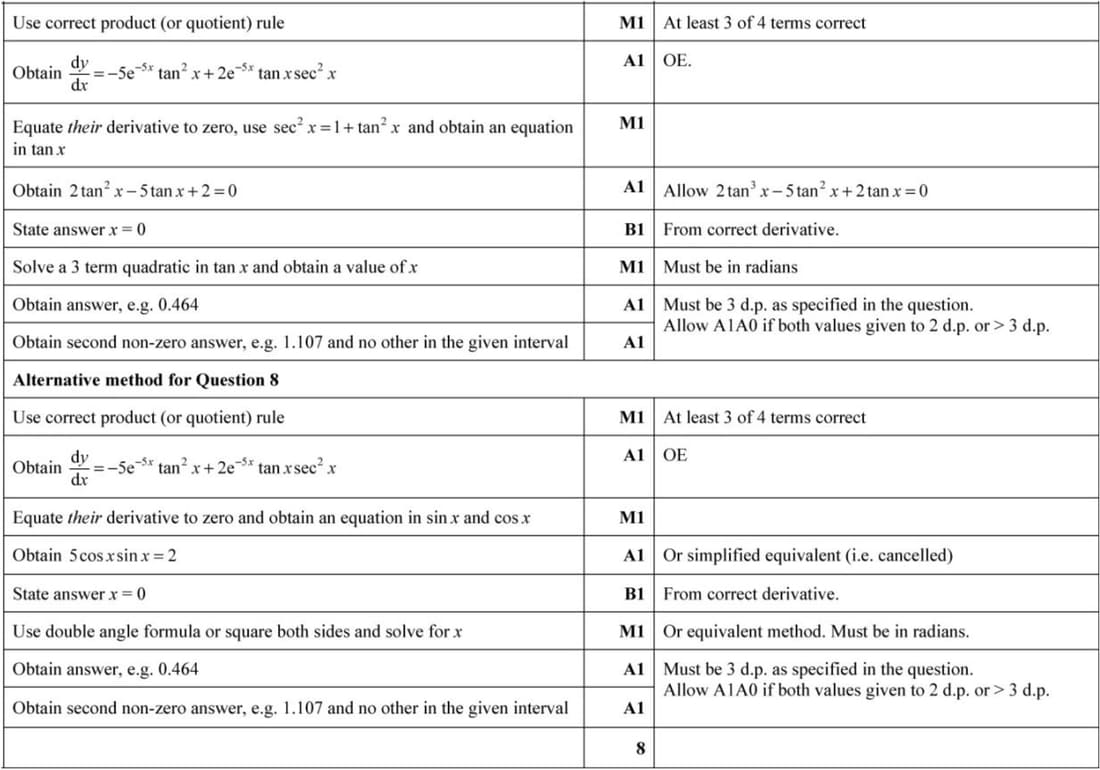
The equation of a curve is \(y = e^{-5x} \tan^2 x\) for \(-\frac{1}{2}\pi < x < \frac{1}{2}\pi\).
Find the \(x\)-coordinates of the stationary points of the curve. Give your answers correct to 3 decimal places where appropriate.
June 2021 p31 q9
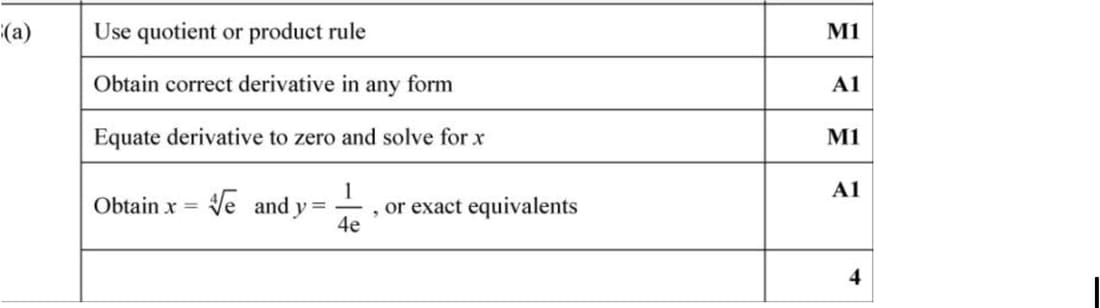
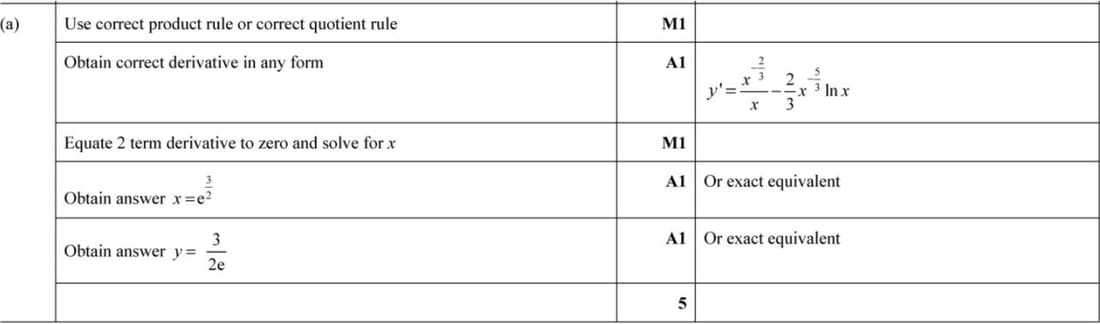
The equation of a curve is \(y = x^{-\frac{2}{3}} \ln x\) for \(x > 0\). The curve has one stationary point.
Find the exact coordinates of the stationary point.
June 2020 p32 q4
A curve has equation \(y = \\cos x \\sin 2x\).
Find the \(x\)-coordinate of the stationary point in the interval \(0 < x < \frac{1}{2} \pi\), giving your answer correct to 3 significant figures.
June 2020 p33 q4
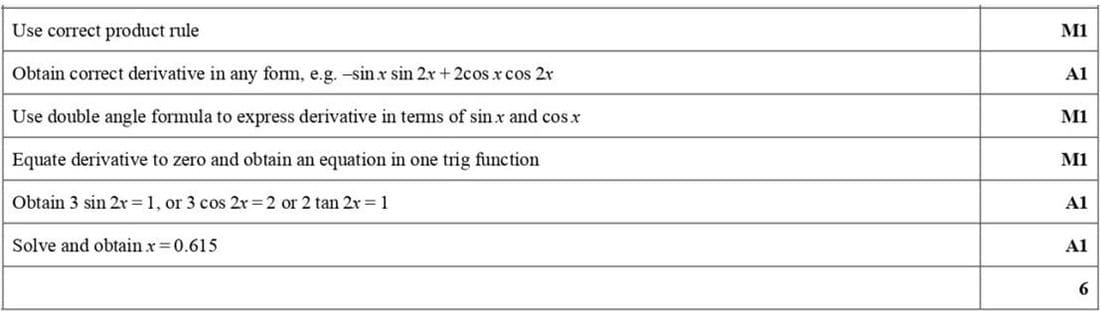
The equation of a curve is \(y = x \arctan\left(\frac{1}{2}x\right)\).
(a) Find \(\frac{dy}{dx}\).
(b) The tangent to the curve at the point where \(x = 2\) meets the y-axis at the point with coordinates \((0, p)\). Find \(p\).
Nov 2015 p33 q3
A curve has equation
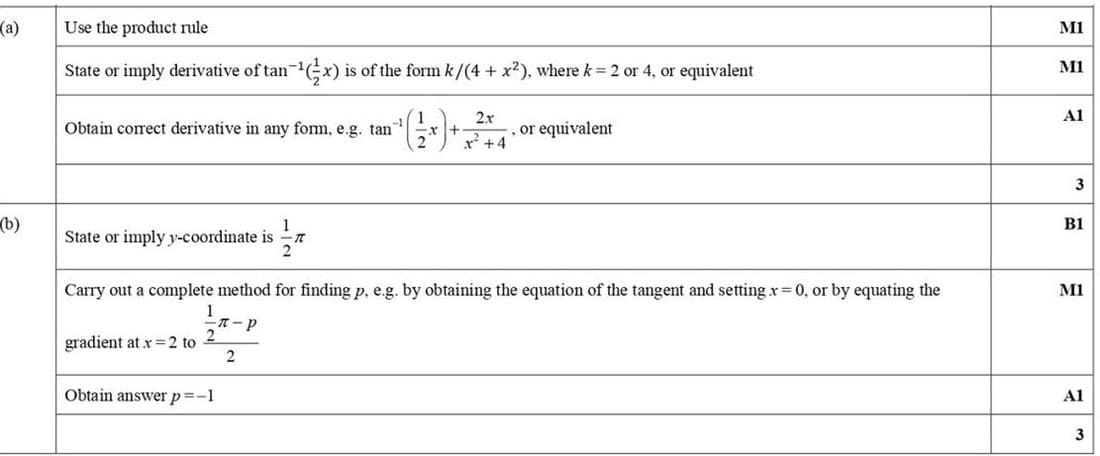
\(y = \frac{2 - \tan x}{1 + \tan x}\).
Find the equation of the tangent to the curve at the point for which \(x = \frac{1}{4} \pi\), giving the answer in the form \(y = mx + c\) where \(c\) is correct to 3 significant figures.
June 2007 p3 q3
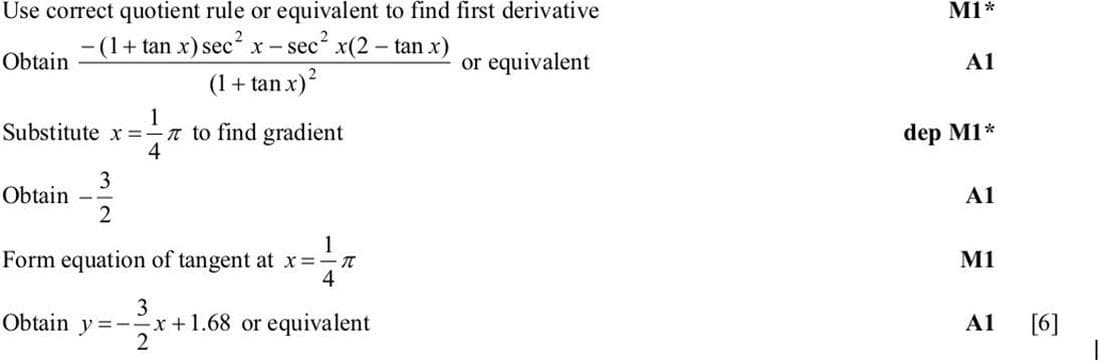
The equation of a curve is \(y = x \sin 2x\), where \(x\) is in radians. Find the equation of the tangent to the curve at the point where \(x = \frac{1}{4} \pi\).

June 2013 p32 q6
By differentiating \(\frac{1}{\cos x}\), show that the derivative of \(\sec x\) is \(\sec x \tan x\). Hence show that if \(y = \ln(\sec x + \tan x)\) then \(\frac{dy}{dx} = \sec x\).

June 2010 p31 q9
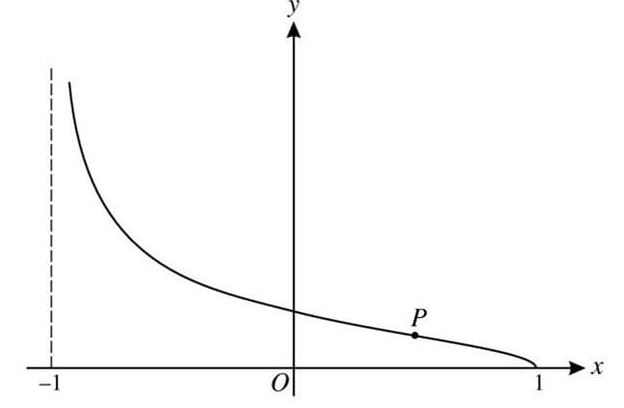
The diagram shows the curve \(y = \sqrt{\left( \frac{1-x}{1+x} \right)}\).
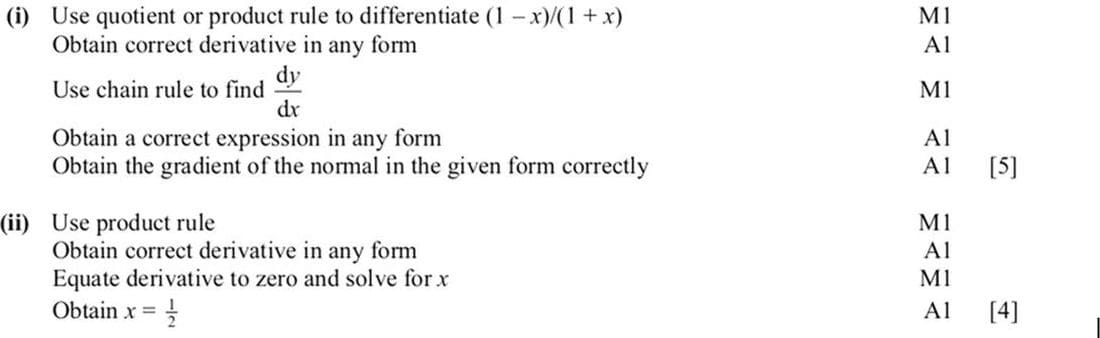
(i) By first differentiating \(\frac{1-x}{1+x}\), obtain an expression for \(\frac{dy}{dx}\) in terms of \(x\). Hence show that the gradient of the normal to the curve at the point \((x, y)\) is \((1+x)\sqrt{1-x^2}\). [5]
(ii) The gradient of the normal to the curve has its maximum value at the point \(P\) shown in the diagram. Find, by differentiation, the \(x\)-coordinate of \(P\). [4]
Nov 2009 p32 q5
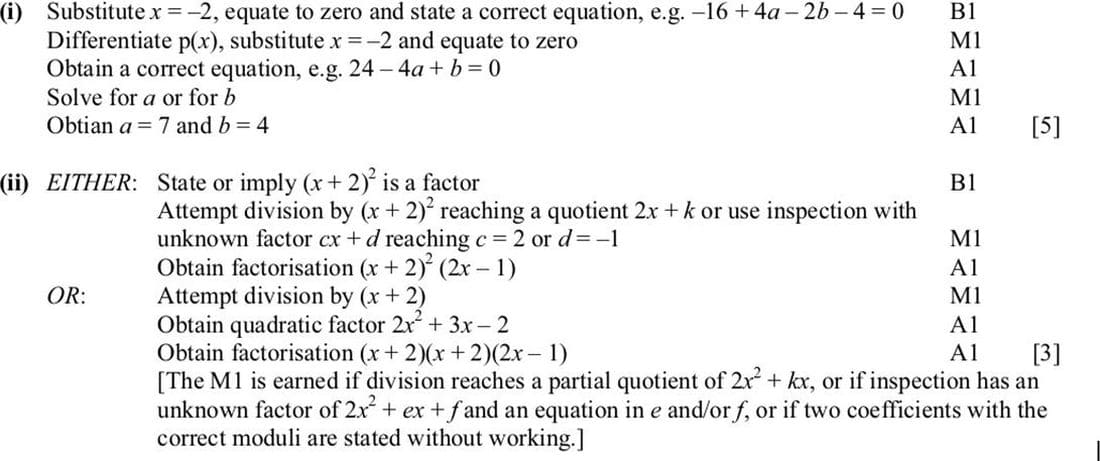
The polynomial \(2x^3 + ax^2 + bx - 4\), where \(a\) and \(b\) are constants, is denoted by \(p(x)\). The result of differentiating \(p(x)\) with respect to \(x\) is denoted by \(p'(x)\). It is given that \((x + 2)\) is a factor of \(p(x)\) and of \(p'(x)\).
(i) Find the values of \(a\) and \(b\).
(ii) When \(a\) and \(b\) have these values, factorise \(p(x)\) completely.
Nov 2023 p31 q1
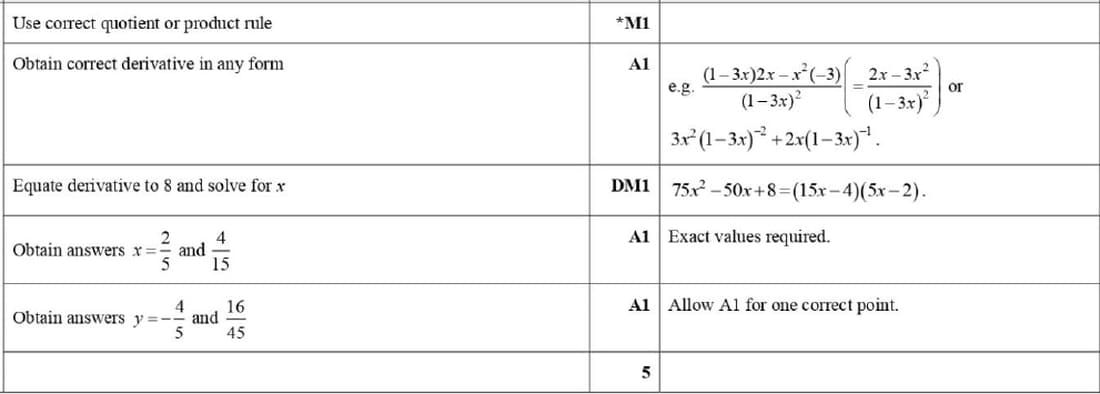
Find the exact coordinates of the points on the curve \(y = \frac{x^2}{1 - 3x}\) at which the gradient of the tangent is equal to 8.
June 2019 p33 q7
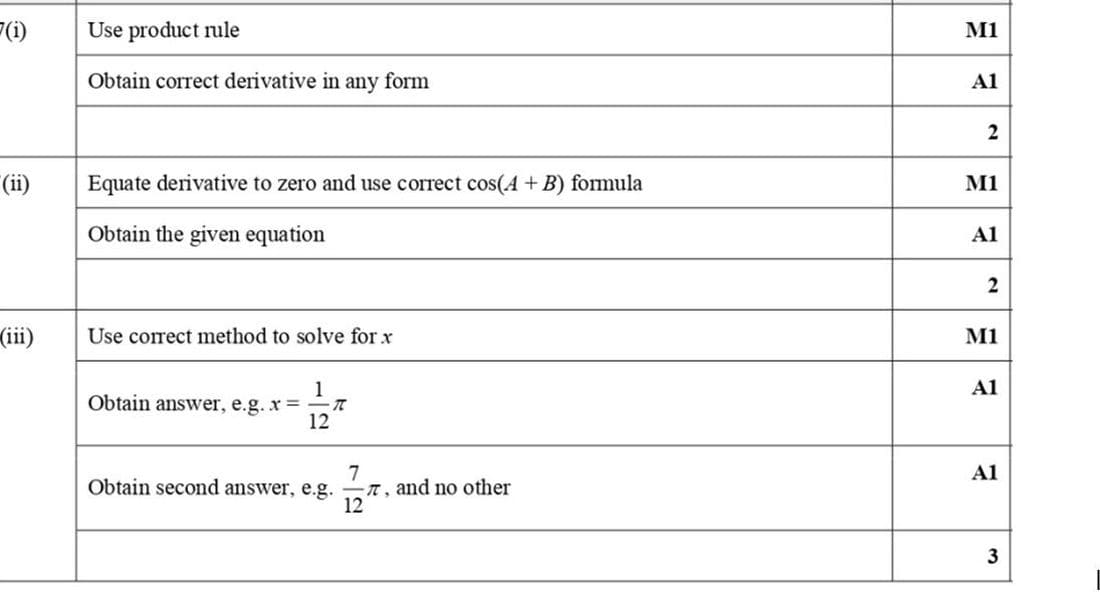
The curve \(y = \\sin(x + \frac{1}{3}\pi) \\cos x\) has two stationary points in the interval \(0 \leq x \leq \pi\).
(i) Find \(\frac{dy}{dx}\).
(ii) By considering the formula for \(\cos(A + B)\), show that, at the stationary points on the curve, \(\cos(2x + \frac{1}{3}\pi) = 0\).
(iii) Hence find the exact \(x\)-coordinates of the stationary points.
June 2011 p31 q2
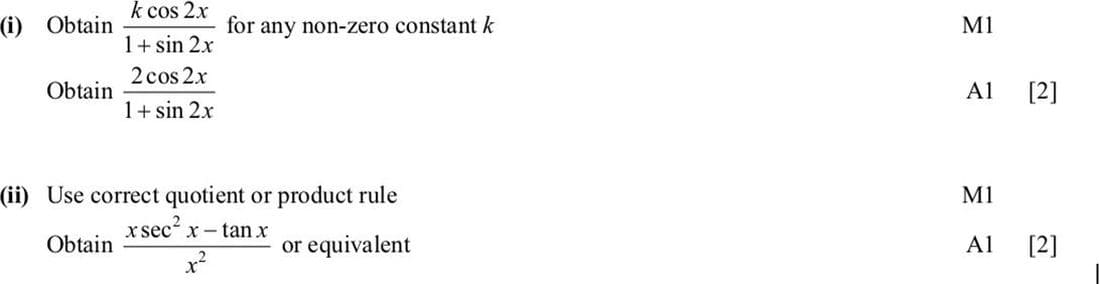
Find \(\frac{dy}{dx}\) in each of the following cases:
- \(y = \ln(1 + \sin 2x)\),
- \(y = \frac{\tan x}{x}\).
June 2019 p33 q4
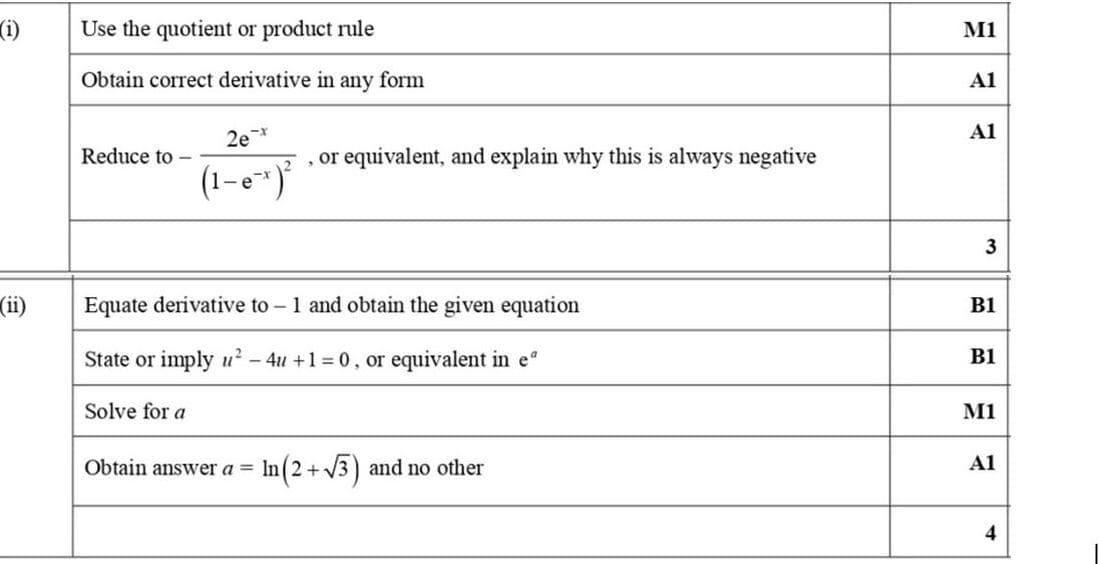
The equation of a curve is \(y = \frac{1 + e^{-x}}{1 - e^{-x}}\), for \(x > 0\).
(i) Show that \(\frac{dy}{dx}\) is always negative.
(ii) The gradient of the curve is equal to \(-1\) when \(x = a\). Show that \(a\) satisfies the equation \(e^{2a} - 4e^{a} + 1 = 0\). Hence find the exact value of \(a\).
June 2019 p32 q4
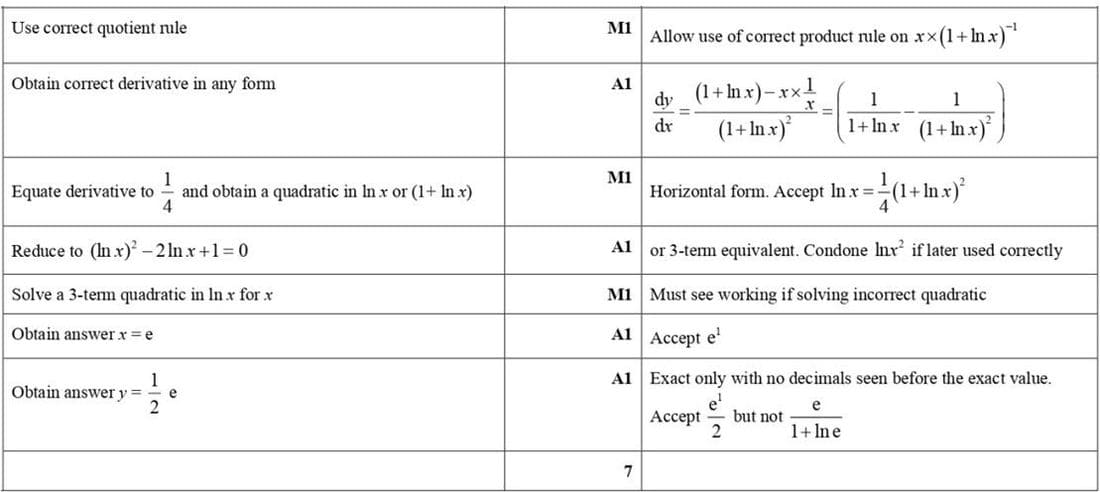
Find the exact coordinates of the point on the curve \(y = \frac{x}{1 + \ln x}\) at which the gradient of the tangent is equal to \(\frac{1}{4}\).
June 2017 p33 q5
A curve has equation \(y = \frac{2}{3} \ln(1 + 3 \cos^2 x)\) for \(0 \leq x \leq \frac{1}{2} \pi\).
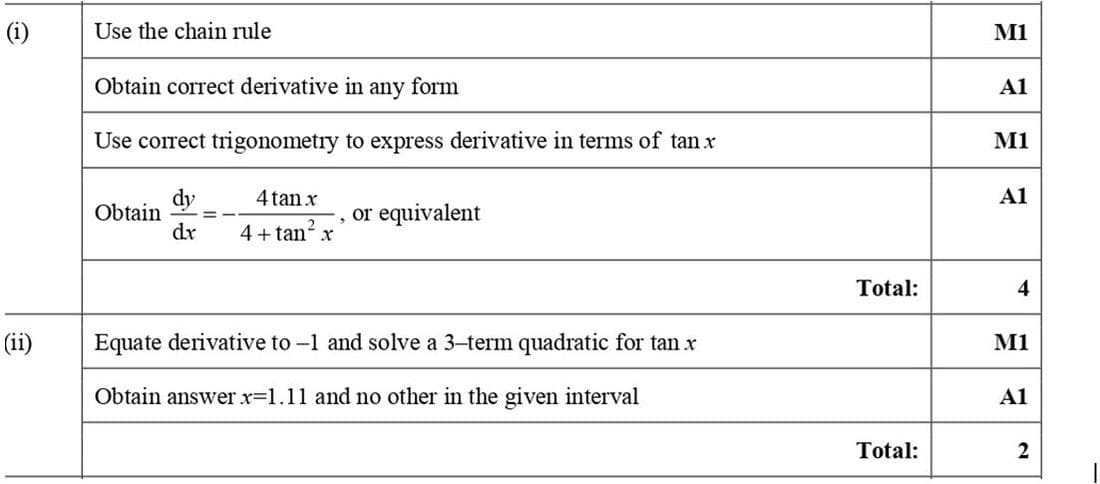
(i) Express \(\frac{dy}{dx}\) in terms of \(\tan x\).
(ii) Hence find the \(x\)-coordinate of the point on the curve where the gradient is \(-1\). Give your answer correct to 3 significant figures.
Feb/Mar 2017 p32 q5
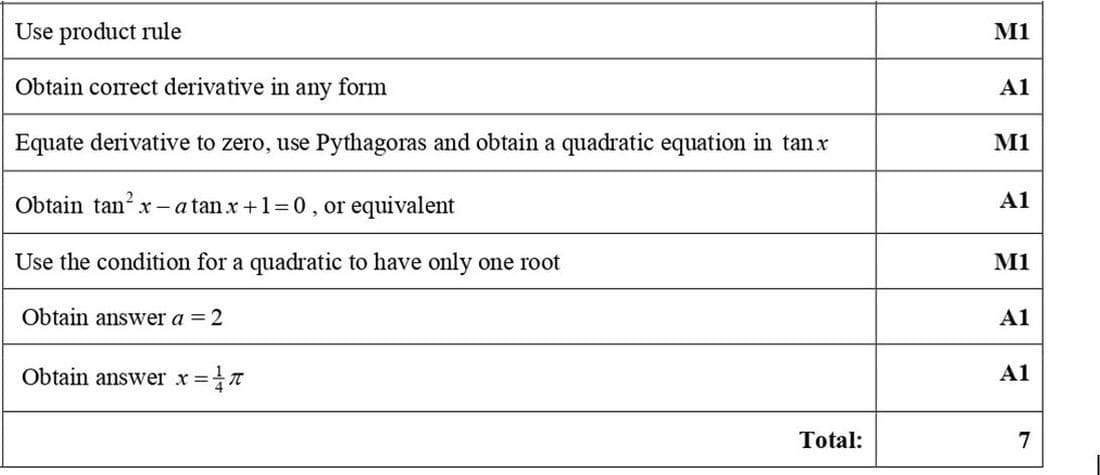
The curve with equation \(y = e^{-ax} \tan x\), where \(a\) is a positive constant, has only one point in the interval \(0 < x < \frac{1}{2}\pi\) at which the tangent is parallel to the \(x\)-axis. Find the value of \(a\) and state the exact value of the \(x\)-coordinate of this point.
Nov 2015 p31 q5
The equation of a curve is \(y = e^{-2x} \tan x\), for \(0 \leq x < \frac{1}{2} \pi\).
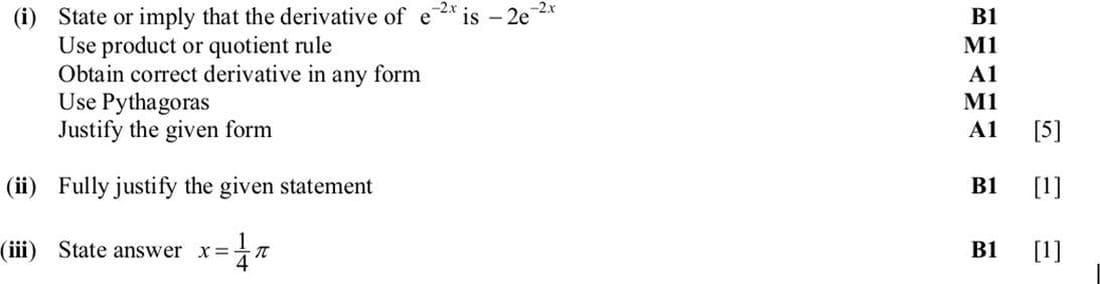
(i) Obtain an expression for \(\frac{dy}{dx}\) and show that it can be written in the form \(e^{-2x}(a + b \tan x)^2\), where \(a\) and \(b\) are constants.
(ii) Explain why the gradient of the curve is never negative.
(iii) Find the value of \(x\) for which the gradient is least.
June 2014 p32 q5
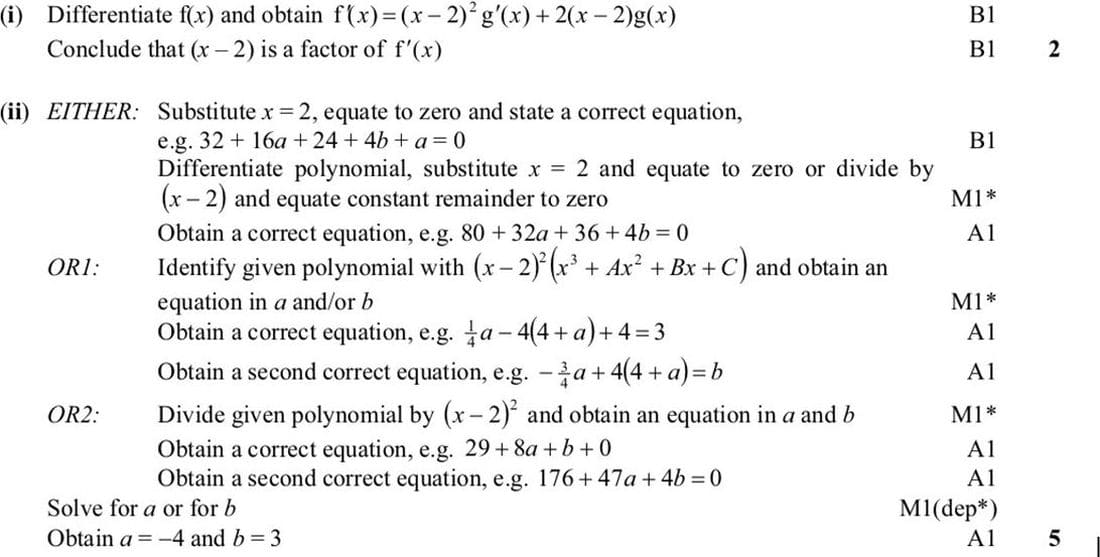
(i) The polynomial \(f(x)\) is of the form \((x - 2)^2 g(x)\), where \(g(x)\) is another polynomial. Show that \((x - 2)\) is a factor of \(f'(x)\).
(ii) The polynomial \(x^5 + ax^4 + 3x^3 + bx^2 + a\), where \(a\) and \(b\) are constants, has a factor \((x - 2)^2\). Using the factor theorem and the result of part (i), or otherwise, find the values of \(a\) and \(b\).
June 2014 p31 q10
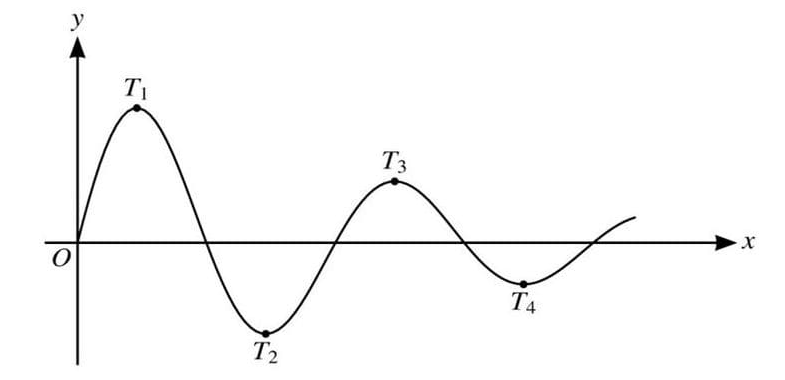
The diagram shows the curve \(y = 10e^{-\frac{1}{2}x} \sin 4x\) for \(x \geq 0\). The stationary points are labelled \(T_1, T_2, T_3, \ldots\) as shown.
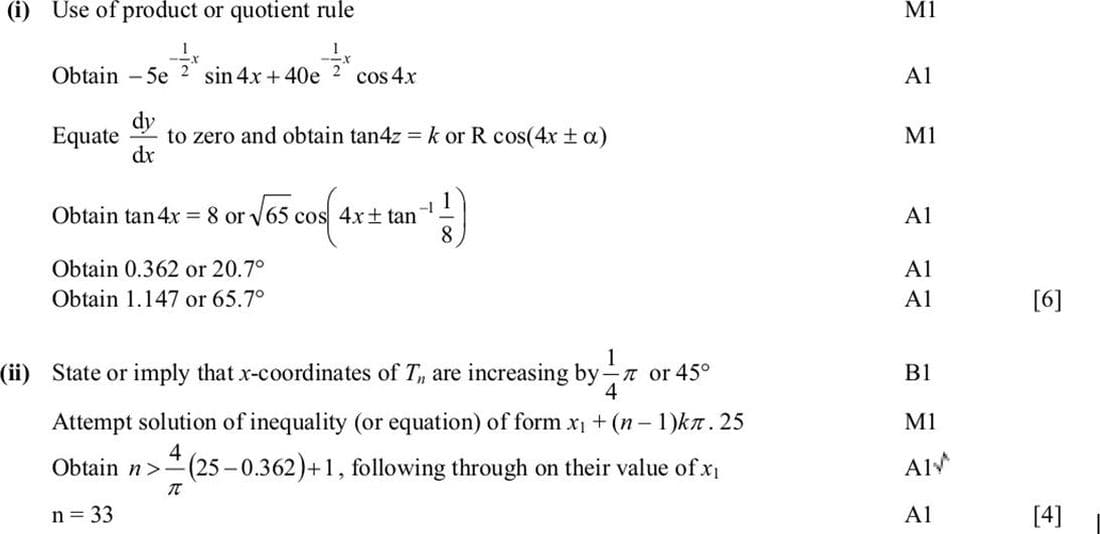
(i) Find the \(x\)-coordinates of \(T_1\) and \(T_2\), giving each \(x\)-coordinate correct to 3 decimal places.
(ii) It is given that the \(x\)-coordinate of \(T_n\) is greater than 25. Find the least possible value of \(n\).