Exam-Style Problems
⬅ Back to SubchapterProblem 275
275
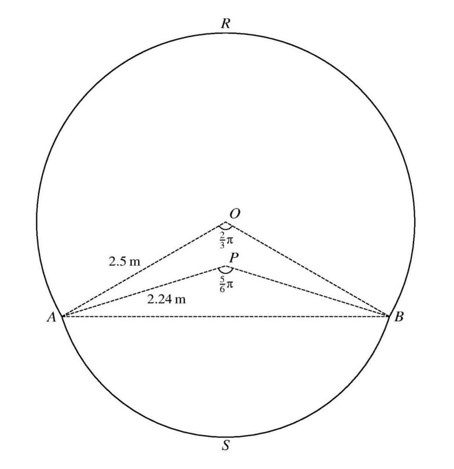
The diagram shows a cross-section RASB of the body of an aircraft. The cross-section consists of a sector OARB of a circle of radius 2.5 m, with centre O, a sector PASB of another circle of radius 2.24 m with centre P and a quadrilateral OAPB. Angle AOB = \(\frac{2\pi}{3}\) and angle APB = \(\frac{5\pi}{6}\).
(a) Find the perimeter of the cross-section RASB, giving your answer correct to 2 decimal places.
(b) Find the difference in area of the two triangles AOB and APB, giving your answer correct to 2 decimal places.
(c) Find the area of the cross-section RASB, giving your answer correct to 1 decimal place.
Problem 276
276
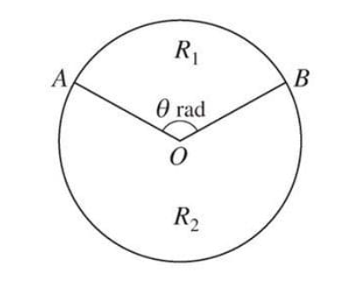
The diagram shows a circle with centre O. The circle is divided into two regions, R1 and R2, by the radii OA and OB, where angle AOB = \theta radians. The perimeter of the region R1 is equal to the length of the major arc AB.
(i) Show that \(\theta = \pi - 1\).
(ii) Given that the area of region R1 is 30 cm2, find the area of region R2, correct to 3 significant figures.
Problem 277
277
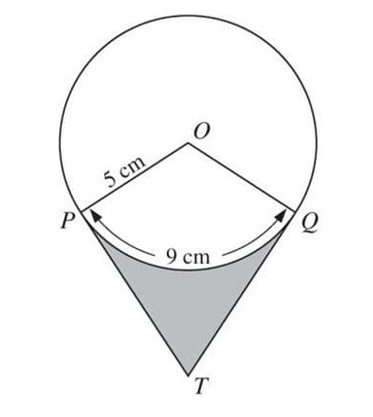
In the diagram, the circle has centre O and radius 5 cm. The points P and Q lie on the circle, and the arc length PQ is 9 cm. The tangents to the circle at P and Q meet at the point T. Calculate
(i) angle POQ in radians,
(ii) the length of PT,
(iii) the area of the shaded region.
Problem 278
278
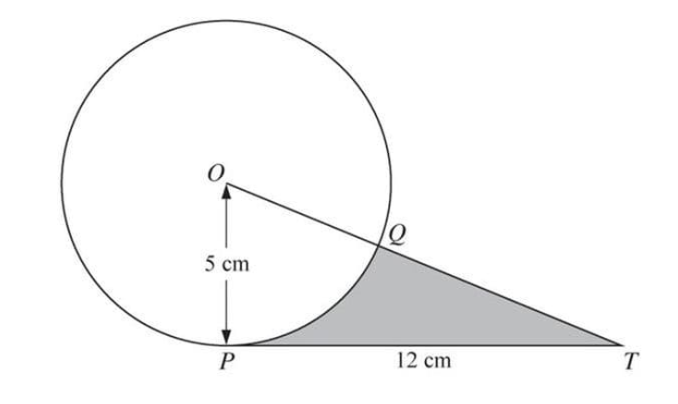
The diagram shows a circle with centre O and radius 5 cm. The point P lies on the circle, PT is a tangent to the circle and PT = 12 cm. The line OT cuts the circle at the point Q.
(i) Find the perimeter of the shaded region.
(ii) Find the area of the shaded region.
Problem 279
279
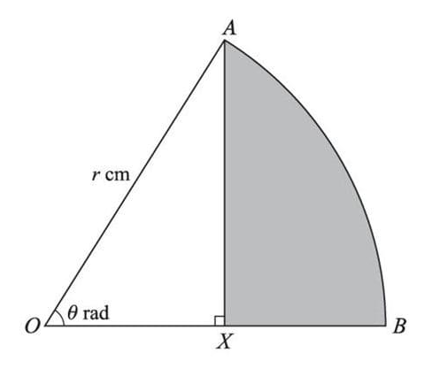
In the diagram, AB is an arc of a circle, centre O and radius r cm, and angle AOB = θ radians. The point X lies on OB and AX is perpendicular to OB.
(i) Show that the area, A cm², of the shaded region AXB is given by
\(A = \frac{1}{2}r^2(\theta - \sin \theta \cos \theta)\).
(ii) In the case where r = 12 and θ = \(\frac{1}{6}\pi\), find the perimeter of the shaded region AXB, leaving your answer in terms of \(\sqrt{3}\) and \(\pi\).