Exam-Style Problems
⬅ Back to SubchapterProblem 269
269
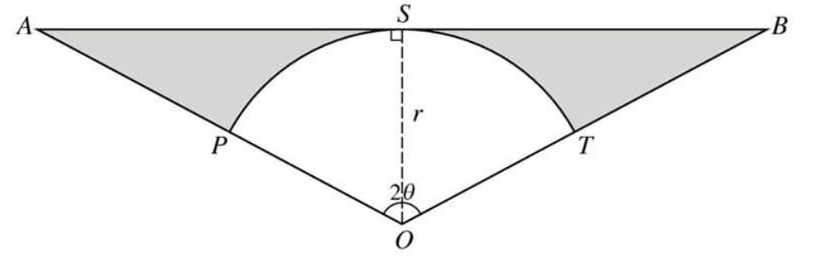
In the diagram, OAB is an isosceles triangle with OA = OB and angle AOB = 2\theta radians. Arc PST has centre O and radius r, and the line ASB is a tangent to the arc PST at S.
(i) Find the total area of the shaded regions in terms of r and \(\theta\).
(ii) In the case where \(\theta = \frac{1}{3}\pi\) and \(r = 6\), find the total perimeter of the shaded regions, leaving your answer in terms of \(\sqrt{3}\) and \(\pi\).
Problem 270
270
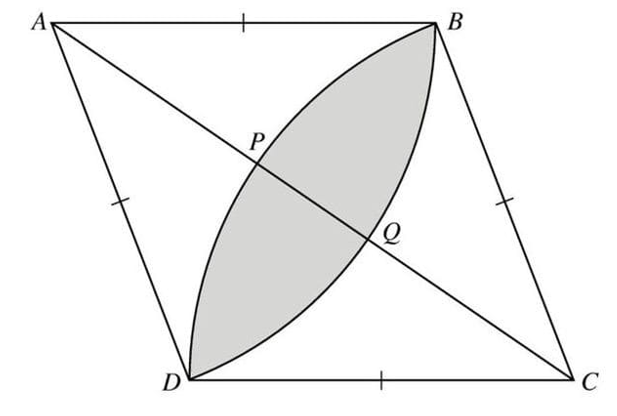
The diagram shows a rhombus ABCD. Points P and Q lie on the diagonal AC such that BPD is an arc of a circle with centre C and BQD is an arc of a circle with centre A. Each side of the rhombus has length 5 cm and angle BAD = 1.2 radians.
(i) Find the area of the shaded region BPDQ.
(ii) Find the length of PQ.
Problem 272
272
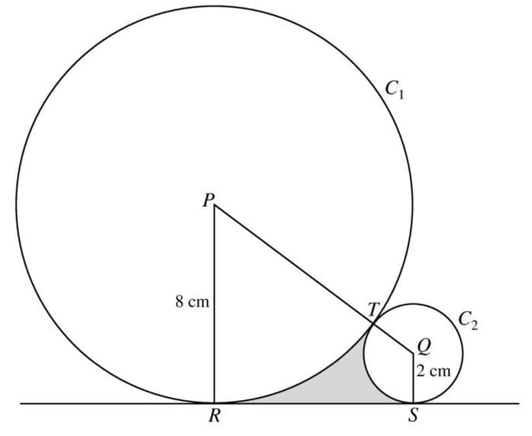
The diagram shows two circles, \(C_1\) and \(C_2\), touching at the point \(T\). Circle \(C_1\) has centre \(P\) and radius 8 cm; circle \(C_2\) has centre \(Q\) and radius 2 cm. Points \(R\) and \(S\) lie on \(C_1\) and \(C_2\) respectively, and \(RS\) is a tangent to both circles.
(i) Show that \(RS = 8\) cm.
(ii) Find angle \(RPQ\) in radians correct to 4 significant figures.
(iii) Find the area of the shaded region.
Problem 273
273
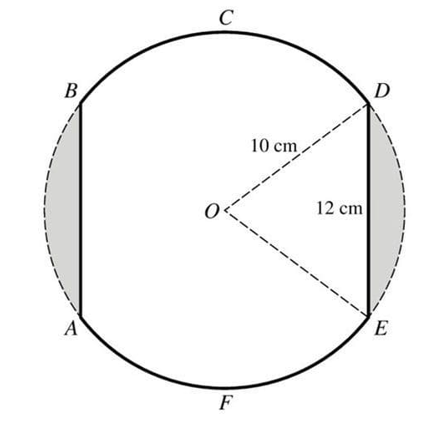
The diagram shows a metal plate ABCDEF which has been made by removing the two shaded regions from a circle of radius 10 cm and centre O. The parallel edges AB and ED are both of length 12 cm.
- Show that angle DOE is 1.287 radians, correct to 4 significant figures.
- Find the perimeter of the metal plate.
- Find the area of the metal plate.
Problem 274
274
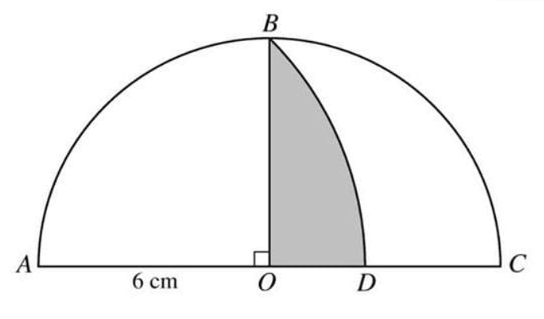
The diagram shows a semicircle ABC with centre O and radius 6 cm. The point B is such that angle BOA is 90° and BD is an arc of a circle with centre A. Find
- the length of the arc BD,
- the area of the shaded region.