Exam-Style Problems
⬅ Back to SubchapterProblem 264
264
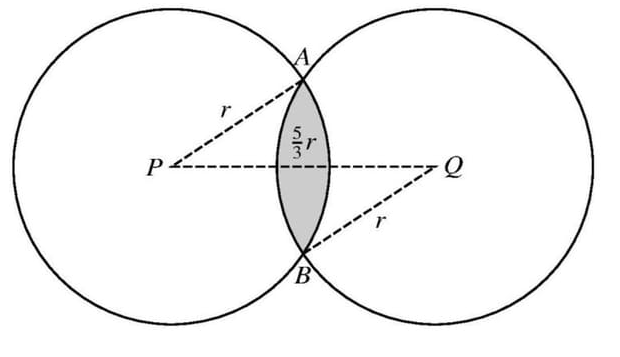
The diagram shows two identical circles intersecting at points A and B and with centres at P and Q. The radius of each circle is \(r\) and the distance \(PQ\) is \(\frac{5}{3}r\).
(a) Find the perimeter of the shaded region in terms of \(r\).
(b) Find the area of the shaded region in terms of \(r\).
Problem 265
265
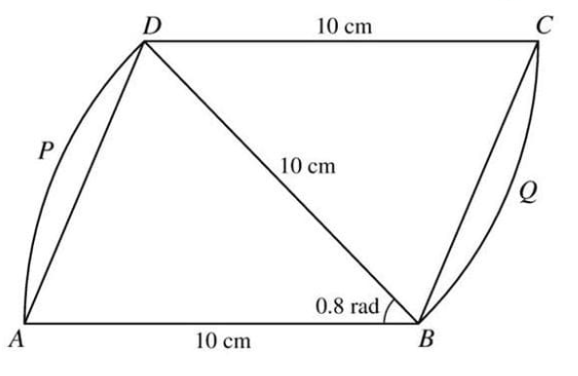
In the diagram, ABCD is a parallelogram with AB = BD = DC = 10 cm and angle ABD = 0.8 radians. APD and BQC are arcs of circles with centres B and D respectively.
- Find the area of the parallelogram ABCD.
- Find the area of the complete figure ABQCDP.
- Find the perimeter of the complete figure ABQCDP.
Problem 266
266
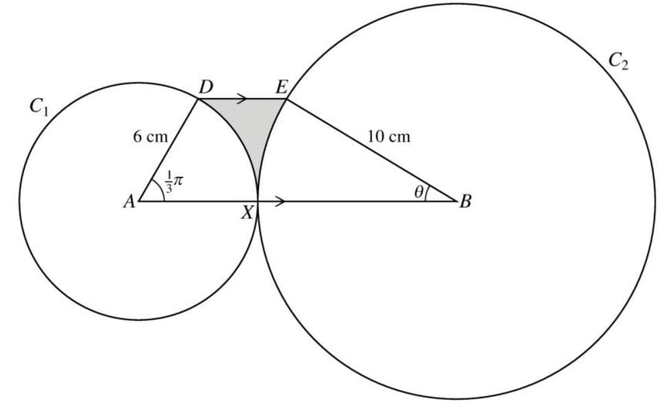
The diagram shows a circle \(C_1\) touching a circle \(C_2\) at a point \(X\). Circle \(C_1\) has centre \(A\) and radius 6 cm, and circle \(C_2\) has centre \(B\) and radius 10 cm. Points \(D\) and \(E\) lie on \(C_1\) and \(C_2\) respectively and \(DE\) is parallel to \(AB\). Angle \(DAX = \frac{1}{3}\pi\) radians and angle \(EBX = \theta\) radians.
(i) By considering the perpendicular distances of \(D\) and \(E\) from \(AB\), show that the exact value of \(\theta\) is \(\sin^{-1}\left(\frac{3\sqrt{3}}{10}\right)\).
(ii) Find the perimeter of the shaded region, correct to 4 significant figures.
Problem 267
267
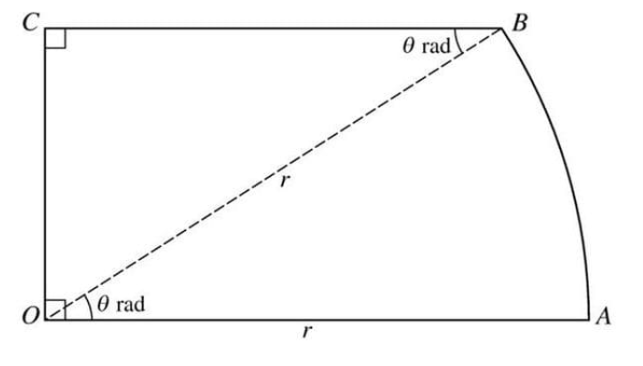
The diagram represents a metal plate OABC, consisting of a sector OAB of a circle with centre O and radius r, together with a triangle OCB which is right-angled at C. Angle AOB = \(\theta\) radians and OC is perpendicular to OA.
(i) Find an expression in terms of r and \(\theta\) for the perimeter of the plate.
(ii) For the case where r = 10 and \(\theta = \frac{1}{5}\pi\), find the area of the plate.
Problem 268
268
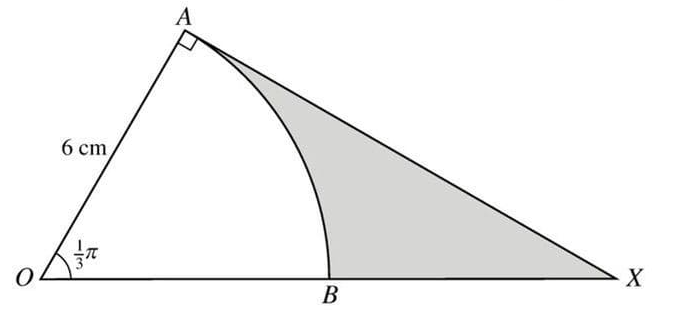
In the diagram, AB is an arc of a circle, centre O and radius 6 cm, and angle AOB = \(\frac{1}{3} \pi\) radians. The line AX is a tangent to the circle at A, and OBX is a straight line.
- Show that the exact length of AX is \(6 \sqrt{3}\) cm.
- Find, in terms of \(\pi\) and \(\sqrt{3}\),
- the area of the shaded region,
- the perimeter of the shaded region.