Exam-Style Problems
⬅ Back to SubchapterProblem 254
254
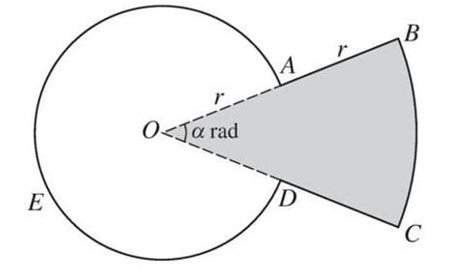
The diagram shows a metal plate made by fixing together two pieces, OABCD (shaded) and OAED (unshaded). The piece OABCD is a minor sector of a circle with centre O and radius 2r. The piece OAED is a major sector of a circle with centre O and radius r. Angle AOD is \(\alpha\) radians. Simplifying your answers where possible, find, in terms of \(\alpha\), \(\pi\) and \(r\),
(i) the perimeter of the metal plate,
(ii) the area of the metal plate.
It is now given that the shaded and unshaded pieces are equal in area.
(iii) Find \(\alpha\) in terms of \(\pi\).
Problem 255
255
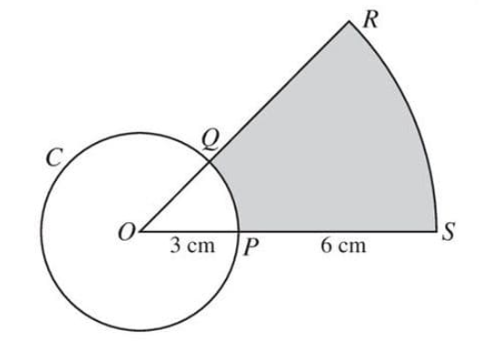
The diagram shows a circle C with centre O and radius 3 cm. The radii OP and OQ are extended to S and R respectively so that ORS is a sector of a circle with centre O. Given that PS = 6 cm and that the area of the shaded region is equal to the area of circle C,
- show that angle POQ = \frac{1}{4}\pi radians,
- find the perimeter of the shaded region.
Problem 256
256
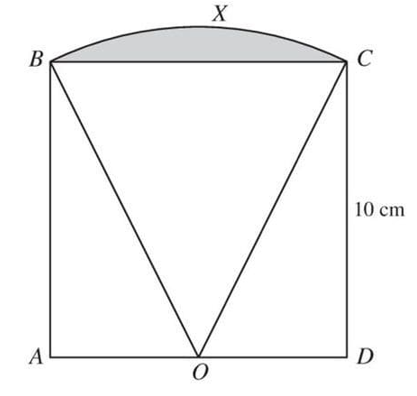
The diagram shows a square ABCD of side 10 cm. The mid-point of AD is O and BXC is an arc of a circle with centre O.
- Show that angle BOC is 0.9273 radians, correct to 4 decimal places.
- Find the perimeter of the shaded region.
- Find the area of the shaded region.
Problem 257
257
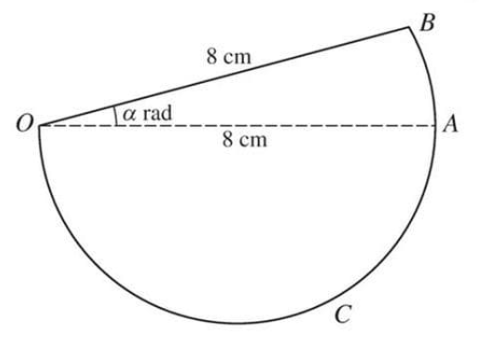
In the diagram, OAB is a sector of a circle with centre O and radius 8 cm. Angle BOA is \(\alpha\) radians. OAC is a semicircle with diameter OA. The area of the semicircle OAC is twice the area of the sector OAB.
(i) Find \(\alpha\) in terms of \(\pi\).
(ii) Find the perimeter of the complete figure in terms of \(\pi\).
Problem 258
258
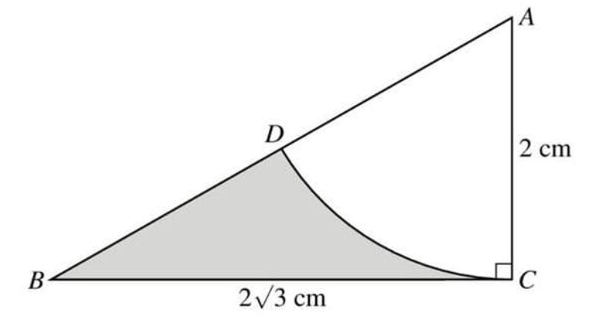
In the diagram, D lies on the side AB of triangle ABC and CD is an arc of a circle with centre A and radius 2 cm. The line BC is of length \(2\sqrt{3}\) cm and is perpendicular to AC. Find the area of the shaded region BDC, giving your answer in terms of \(\pi\) and \(\sqrt{3}\).