Exam-Style Problems
⬅ Back to SubchapterProblem 247
247
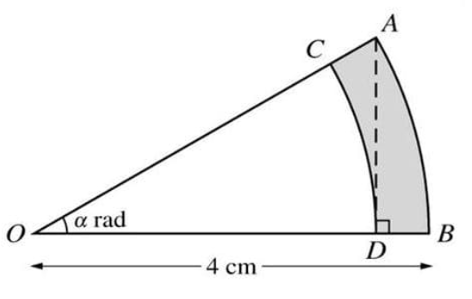
In the diagram, AB is an arc of a circle with centre O and radius 4 cm. Angle AOB is \(\alpha\) radians. The point D on OB is such that AD is perpendicular to OB. The arc DC, with centre O, meets OA at C.
(i) Find an expression in terms of \(\alpha\) for the perimeter of the shaded region ABDC.
(ii) For the case where \(\alpha = \frac{1}{6}\pi\), find the area of the shaded region ABDC, giving your answer in the form \(k\pi\), where \(k\) is a constant to be determined.
Problem 249
249
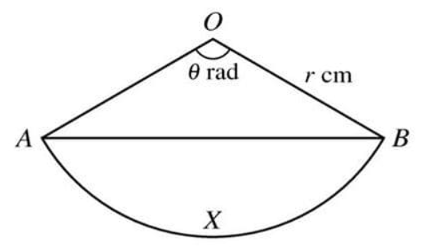
The diagram shows a sector of a circle with radius r cm and centre O. The chord AB divides the sector into a triangle AOB and a segment AXB. Angle AOB is θ radians.
(i) In the case where the areas of the triangle AOB and the segment AXB are equal, find the value of the constant p for which θ = p \, \sin \, θ.
(ii) In the case where r = 8 and θ = 2.4, find the perimeter of the segment AXB.
Problem 250
250
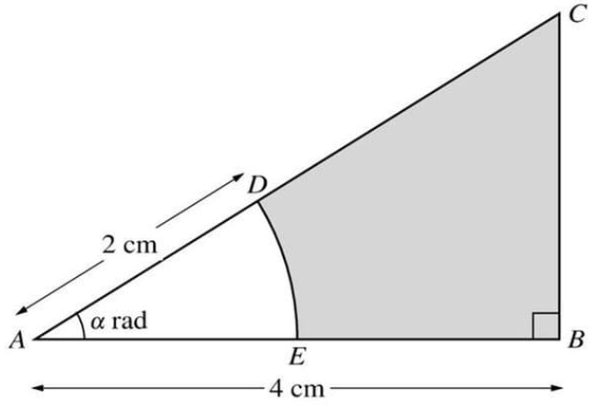
The diagram shows triangle ABC in which AB is perpendicular to BC. The length of AB is 4 cm and angle CAB is \(\alpha\) radians. The arc DE with centre A and radius 2 cm meets AC at D and AB at E. Find, in terms of \(\alpha\),
(i) the area of the shaded region,
Problem 252
252
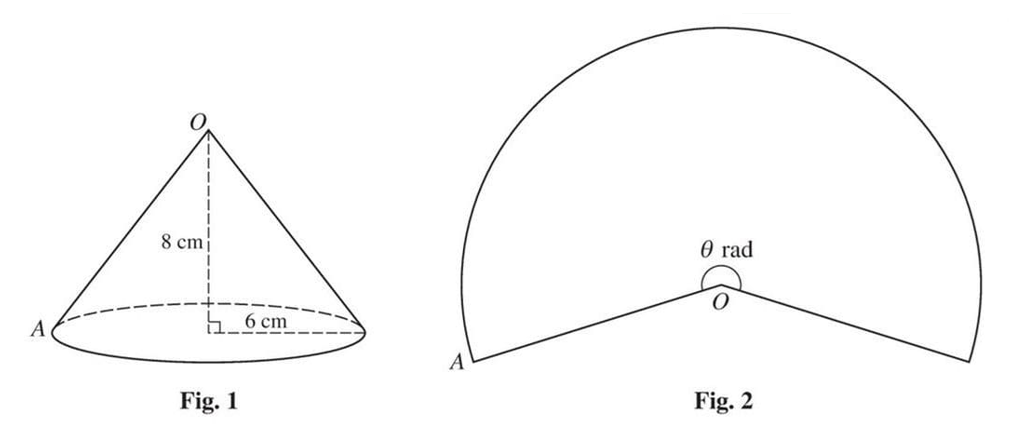
Fig. 1 shows a hollow cone with no base, made of paper. The radius of the cone is 6 cm and the height is 8 cm. The paper is cut from A to O and opened out to form the sector shown in Fig. 2. The circular bottom edge of the cone in Fig. 1 becomes the arc of the sector in Fig. 2. The angle of the sector is \(\theta\) radians. Calculate
(i) the value of \(\theta\),
(ii) the area of paper needed to make the cone.
Problem 253
253
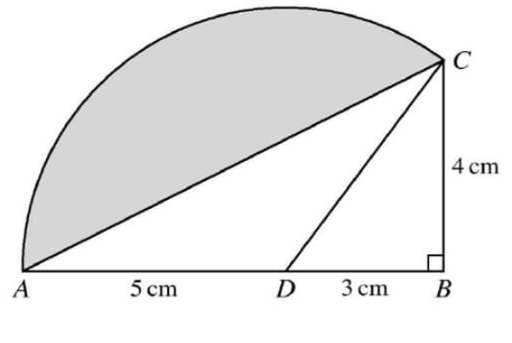
The diagram shows triangle ABC in which angle B is a right angle. The length of AB is 8 cm and the length of BC is 4 cm. The point D on AB is such that AD = 5 cm. The sector DAC is part of a circle with centre D.
(a) Find the perimeter of the shaded region.
(b) Find the area of the shaded region.