Exam-Style Problems
⬅ Back to SubchapterJune 2011 p61 q2
When Ted is looking for his pen, the probability that it is in his pencil case is 0.7. If his pen is in his pencil case he always finds it. If his pen is somewhere else, the probability that he finds it is 0.2. Given that Ted finds his pen when he is looking for it, find the probability that it was in his pencil case.

Nov 2010 p63 q3
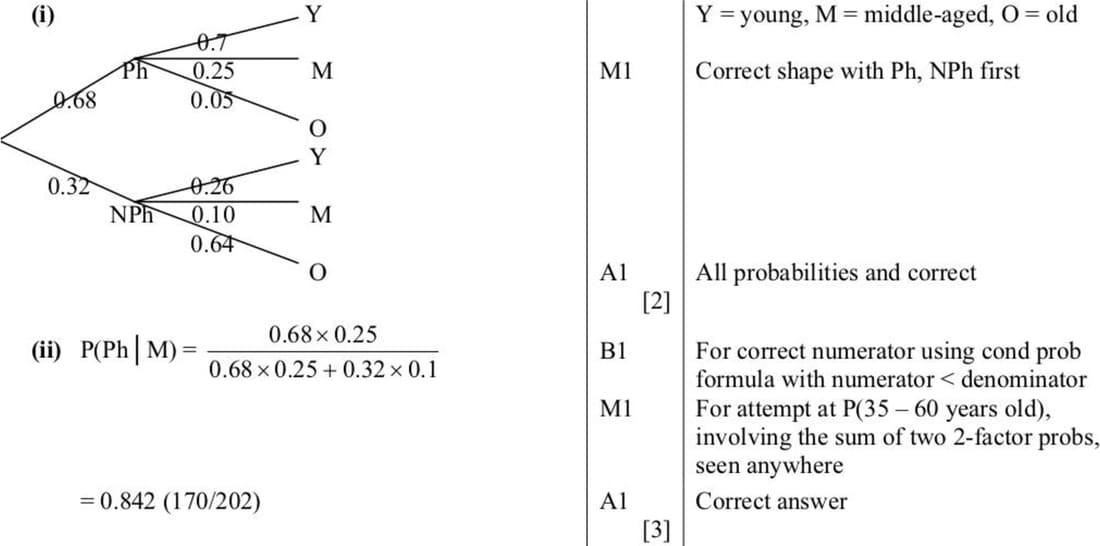
It was found that 68% of the passengers on a train used a cell phone during their train journey. Of those using a cell phone, 70% were under 30 years old, 25% were between 30 and 65 years old and the rest were over 65 years old. Of those not using a cell phone, 26% were under 30 years old and 64% were over 65 years old.
(i) Draw a tree diagram to represent this information, giving all probabilities as decimals.
(ii) Given that one of the passengers is 45 years old, find the probability of this passenger using a cell phone during the journey.
Nov 2010 p62 q3
A fair five-sided spinner has sides numbered 1, 2, 3, 4, 5. Raj spins the spinner and throws two fair dice. He calculates his score as follows:
- If the spinner lands on an even-numbered side, Raj multiplies the two numbers showing on the dice to get his score.
- If the spinner lands on an odd-numbered side, Raj adds the numbers showing on the dice to get his score.
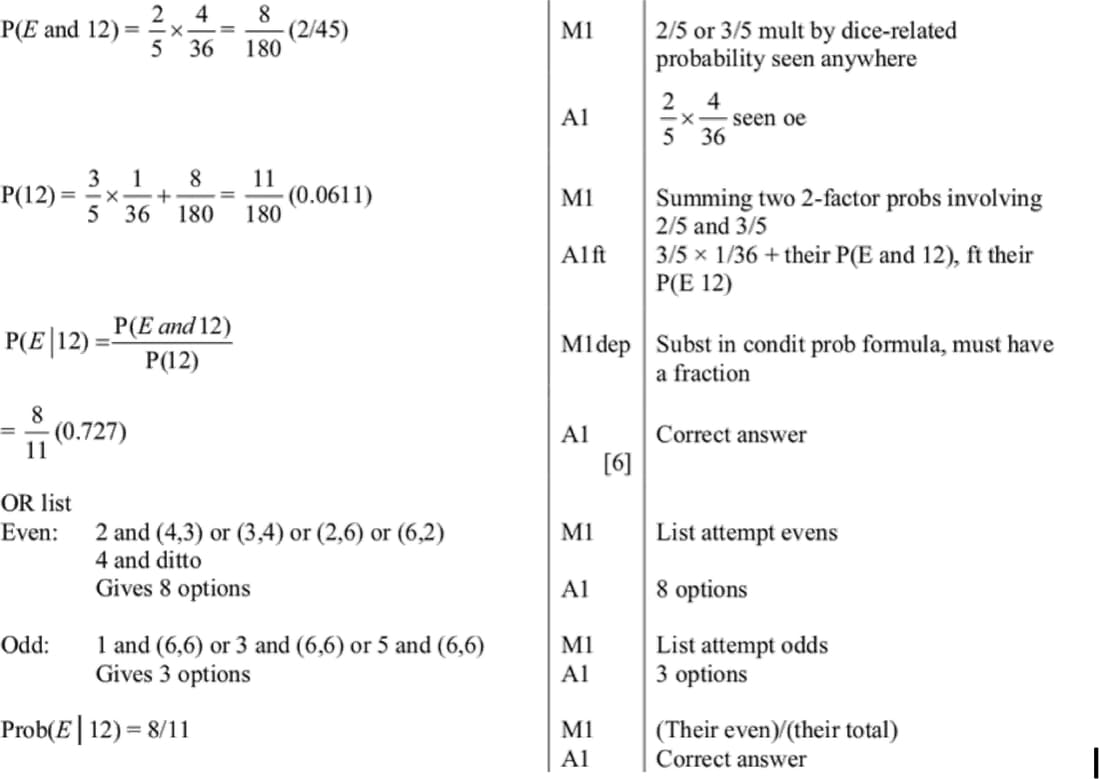
Given that Raj’s score is 12, find the probability that the spinner landed on an even-numbered side.
June 2010 p62 q6
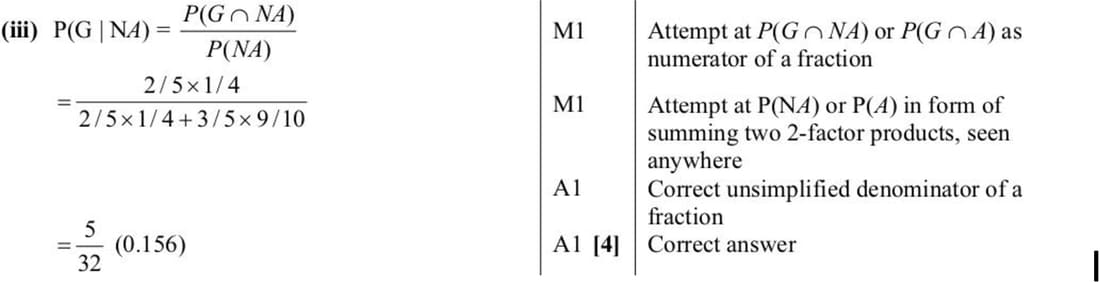
When the farmer’s dog is let loose, it chases either the ducks with probability \(\frac{3}{5}\) or the geese with probability \(\frac{2}{5}\). If the dog chases the ducks there is a probability of \(\frac{1}{10}\) that they will attack the dog. If the dog chases the geese there is a probability of \(\frac{3}{4}\) that they will attack the dog. Given that the dog is not attacked, find the probability that it was chasing the geese.
June 2010 p61 q7
In a television quiz show Peter answers questions one after another, stopping as soon as a question is answered wrongly.
- The probability that Peter gives the correct answer himself to any question is 0.7.
- The probability that Peter gives a wrong answer himself to any question is 0.1.
- The probability that Peter decides to ask for help for any question is 0.2.
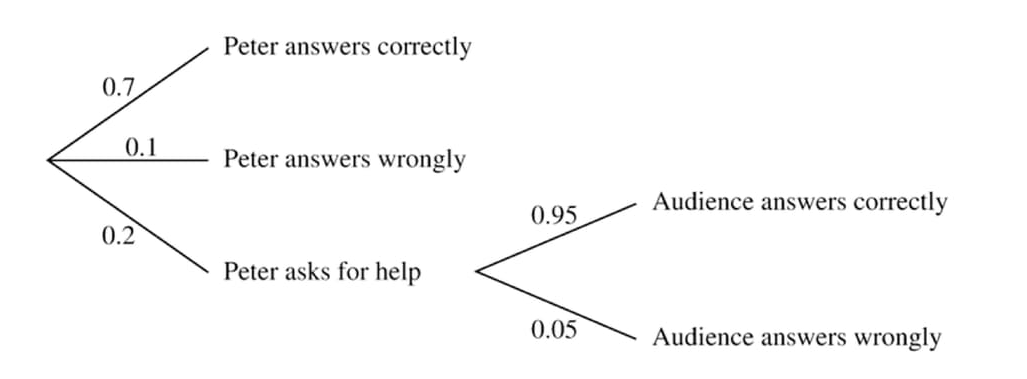
On the first occasion that Peter decides to ask for help he asks the audience. The probability that the audience gives the correct answer to any question is 0.95. This information is shown in the tree diagram below.
(i) Show that the probability that the first question is answered correctly is 0.89.
On the second occasion that Peter decides to ask for help he phones a friend. The probability that his friend gives the correct answer to any question is 0.65.
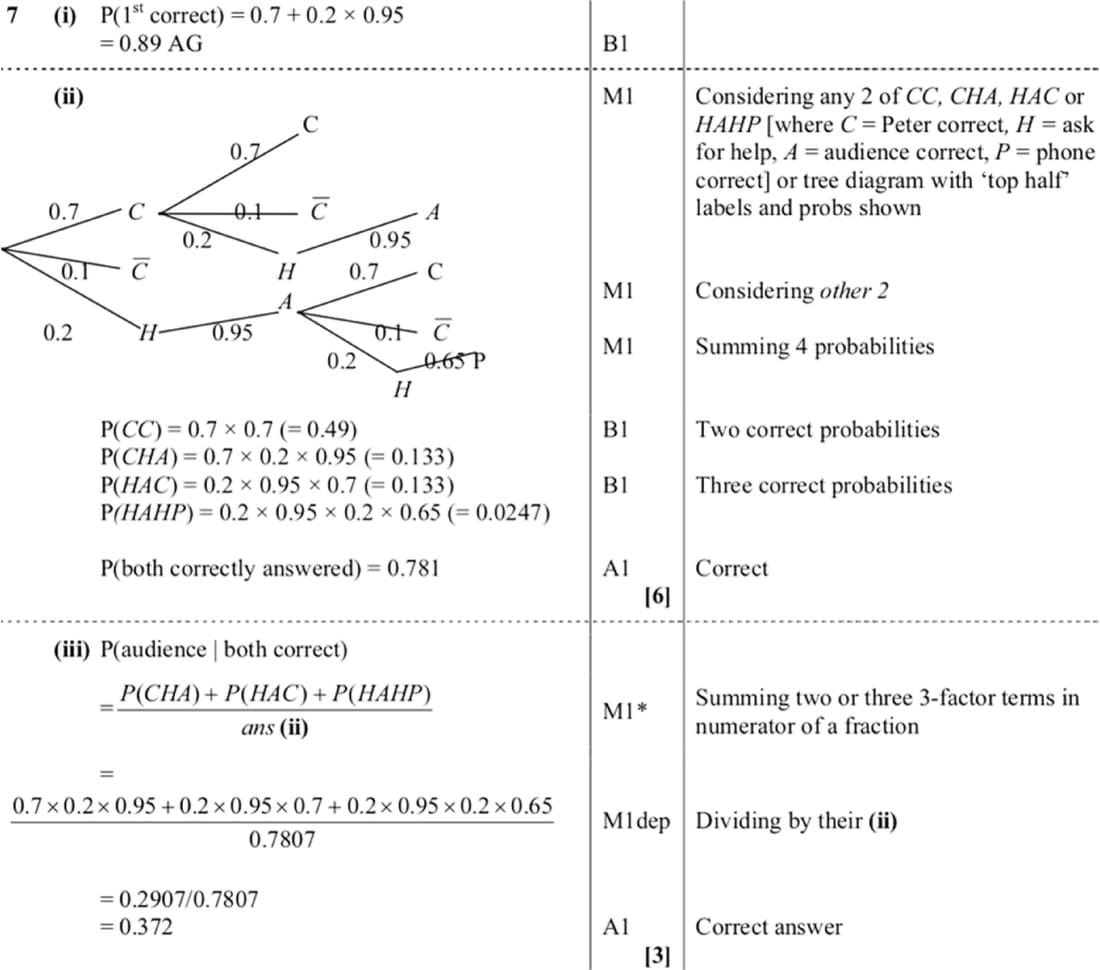
(ii) Find the probability that the first two questions are both answered correctly.
(iii) Given that the first two questions were both answered correctly, find the probability that Peter asked the audience.