Exam-Style Problems
⬅ Back to SubchapterProblem 186
186
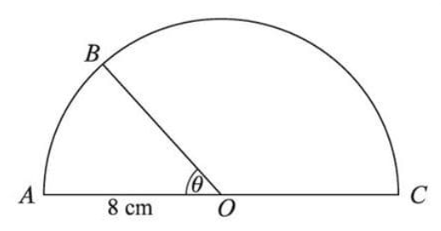
The diagram shows a semicircle ABC with centre O and radius 8 cm. Angle AOB = \(\theta\) radians.
(i) In the case where \(\theta = 1\), calculate the area of the sector BOC.
(ii) Find the value of \(\theta\) for which the perimeter of sector AOB is one half of the perimeter of sector BOC.
(iii) In the case where \(\theta = \frac{1}{3}\pi\), show that the exact length of the perimeter of triangle ABC is \((24 + 8\sqrt{3})\) cm.
Problem 187
187
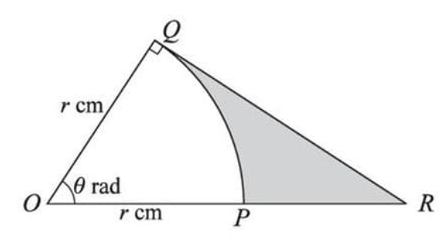
In the diagram, OPQ is a sector of a circle, centre O and radius r cm. Angle QOP = θ radians. The tangent to the circle at Q meets OP extended at R.
(i) Show that the area, A cm², of the shaded region is given by A = \frac{1}{2}r^2(\tan \theta - \theta).
(ii) In the case where θ = 0.8 and r = 15, evaluate the length of the perimeter of the shaded region.
Problem 188
188
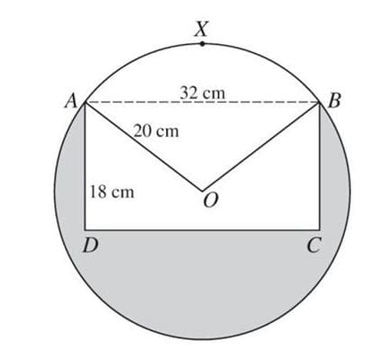
The diagram shows the circular cross-section of a uniform cylindrical log with centre O and radius 20 cm. The points A, X, and B lie on the circumference of the cross-section and AB = 32 cm.
- Show that angle AOB = 1.855 radians, correct to 3 decimal places.
- Find the area of the sector AXBO.
The section AXBCD, where ABCD is a rectangle with AD = 18 cm, is removed.
- Find the area of the new cross-section (shown shaded in the diagram).
Problem 189
189
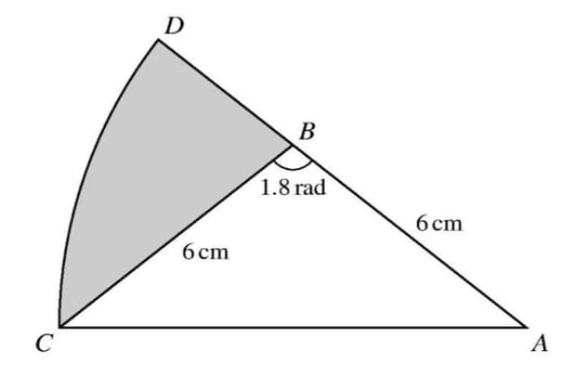
The diagram shows triangle ABC with AB = BC = 6 cm and angle ABC = 1.8 radians. The arc CD is part of a circle with centre A and ABD is a straight line.
(a) Find the perimeter of the shaded region.
(b) Find the area of the shaded region.
Problem 190
190
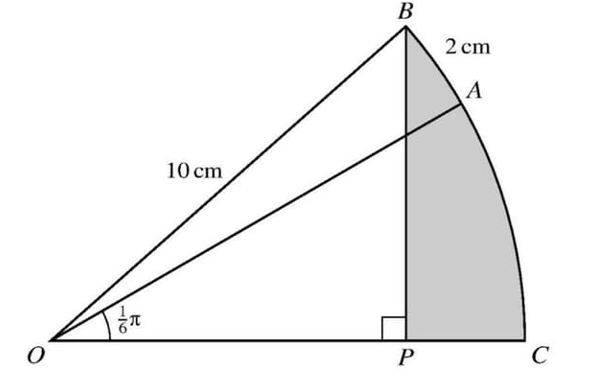
The diagram shows a sector OBAC of a circle with centre O and radius 10 cm. The point P lies on OC and BP is perpendicular to OC. Angle AOC = \(\frac{1}{6} \pi\) and the length of the arc AB is 2 cm.
(a) Find the angle BOC.
(b) Hence find the area of the shaded region BPC giving your answer correct to 3 significant figures.