Exam-Style Problems
⬅ Back to SubchapterProblem 226
226
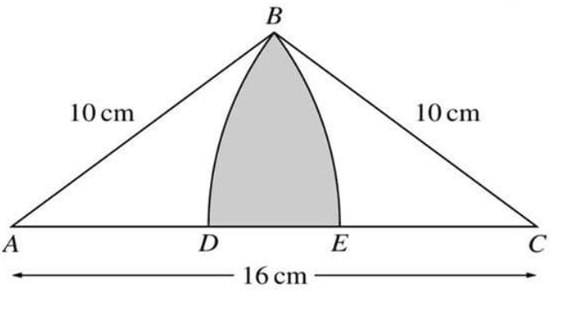
The diagram shows an isosceles triangle ABC in which AC = 16 ext{ cm} and AB = BC = 10 ext{ cm}. The circular arcs BE and BD have centres at A and C respectively, where D and E lie on AC.
(i) Show that angle BAC = 0.6435 radians, correct to 4 decimal places.
(ii) Find the area of the shaded region.
Problem 227
227
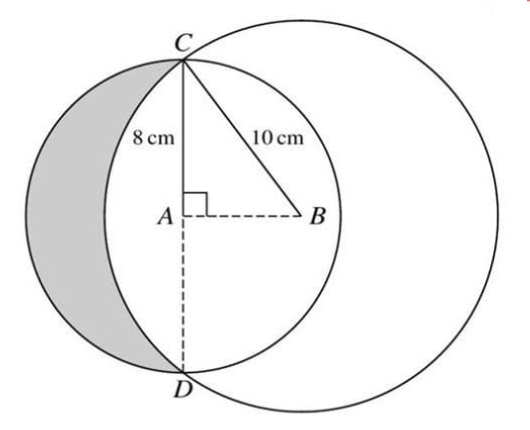
The diagram shows two circles with centres A and B having radii 8 cm and 10 cm respectively. The two circles intersect at C and D where CAD is a straight line and AB is perpendicular to CD.
(i) Find angle ABC in radians.
(ii) Find the area of the shaded region.
Problem 228
228
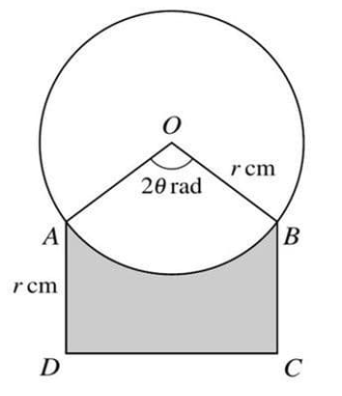
The diagram shows a circle with radius r cm and centre O. Points A and B lie on the circle and ABCD is a rectangle. Angle AOB = 2θ radians and AD = r cm.
(i) Express the perimeter of the shaded region in terms of r and θ.
(ii) In the case where r = 5 and θ = \(\frac{1}{6} \pi\), find the area of the shaded region.
Problem 229
229
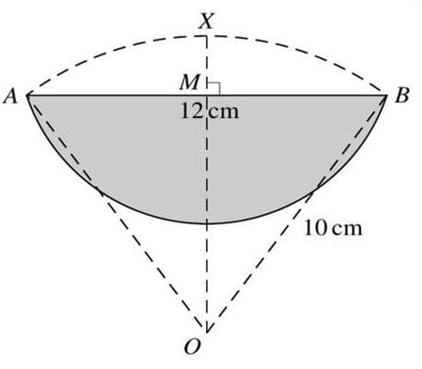
In the diagram, \(OAXB\) is a sector of a circle with centre \(O\) and radius 10 cm. The length of the chord \(AB\) is 12 cm. The line \(OX\) passes through \(M\), the mid-point of \(AB\), and \(OX\) is perpendicular to \(AB\). The shaded region is bounded by the chord \(AB\) and by the arc of a circle with centre \(X\) and radius \(XA\).
(i) Show that angle \(AXB\) is 2.498 radians, correct to 3 decimal places.
(ii) Find the perimeter of the shaded region.
(iii) Find the area of the shaded region.
Problem 230
230
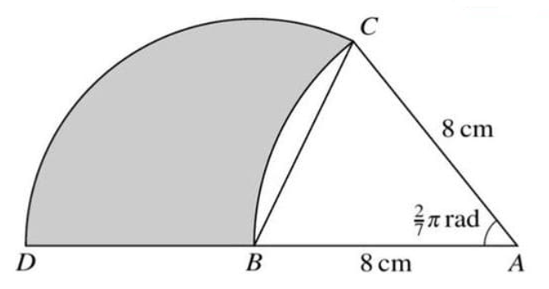
In the diagram, \(AB = AC = 8 \text{ cm}\) and angle \(CAB = \frac{2}{7} \pi\) radians. The circular arc \(BC\) has centre \(A\), the circular arc \(CD\) has centre \(B\) and \(ABD\) is a straight line.
(i) Show that angle \(CBD = \frac{9}{14} \pi\) radians.
(ii) Find the perimeter of the shaded region.