Exam-Style Problems
⬅ Back to Subchapter
Browsing as Guest. Progress, bookmarks and attempts are disabled.
Log in to track your work.
June 2014 p32 q5
1690
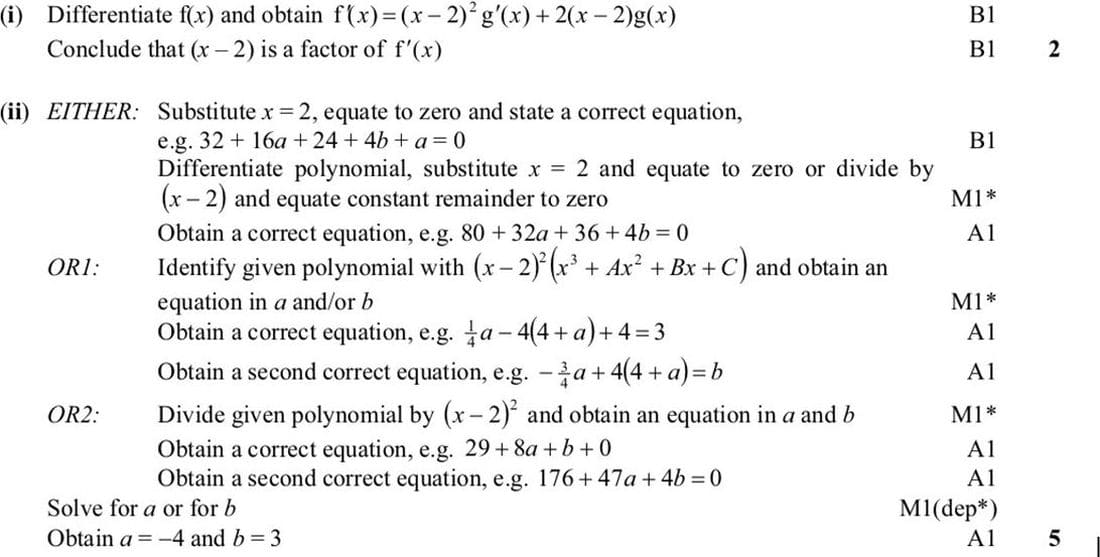
(i) The polynomial \(f(x)\) is of the form \((x - 2)^2 g(x)\), where \(g(x)\) is another polynomial. Show that \((x - 2)\) is a factor of \(f'(x)\).
(ii) The polynomial \(x^5 + ax^4 + 3x^3 + bx^2 + a\), where \(a\) and \(b\) are constants, has a factor \((x - 2)^2\). Using the factor theorem and the result of part (i), or otherwise, find the values of \(a\) and \(b\).
Log in to record attempts.
June 2014 p31 q10
1691
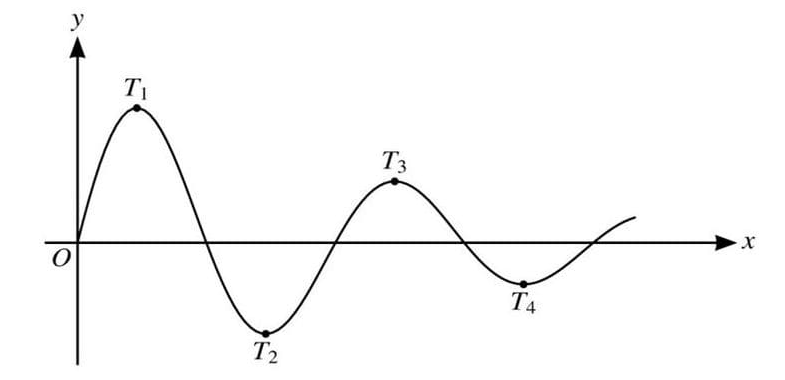
The diagram shows the curve \(y = 10e^{-\frac{1}{2}x} \sin 4x\) for \(x \geq 0\). The stationary points are labelled \(T_1, T_2, T_3, \ldots\) as shown.
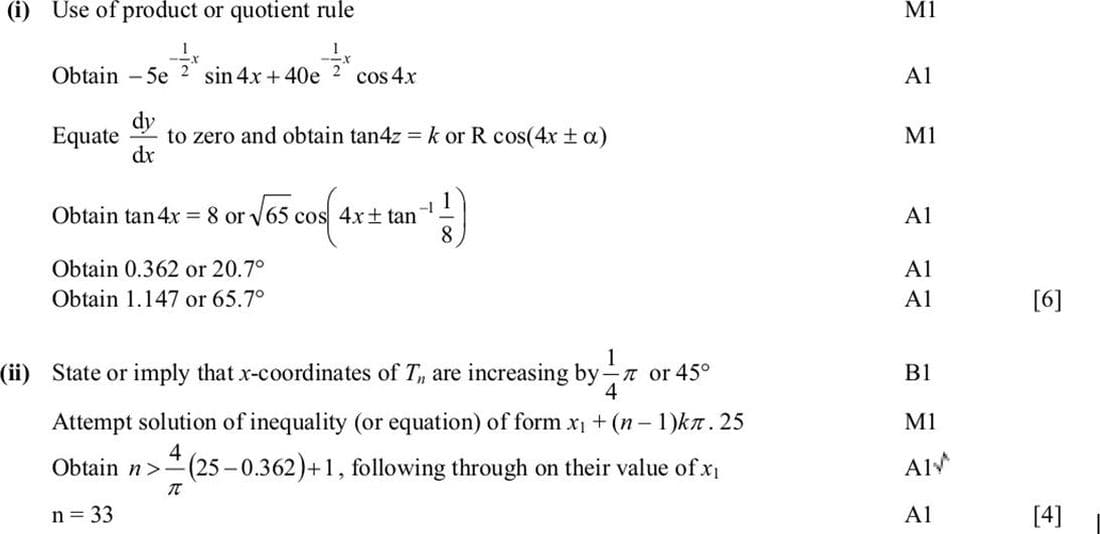
(i) Find the \(x\)-coordinates of \(T_1\) and \(T_2\), giving each \(x\)-coordinate correct to 3 decimal places.
(ii) It is given that the \(x\)-coordinate of \(T_n\) is greater than 25. Find the least possible value of \(n\).
Log in to record attempts.