Exam-Style Problems
⬅ Back to SubchapterJune 2019 p33 q4
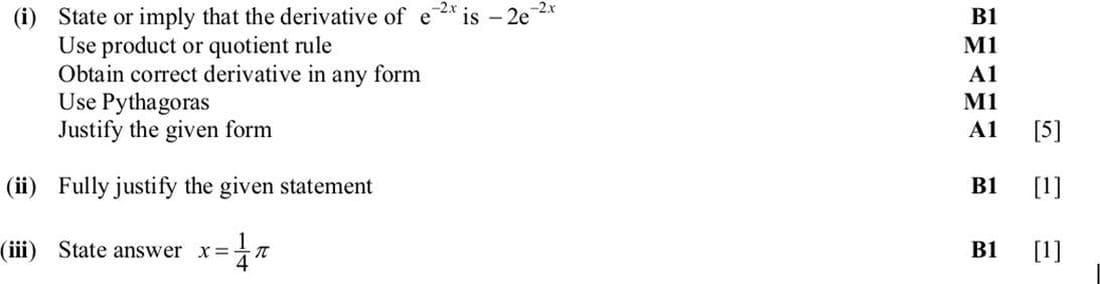
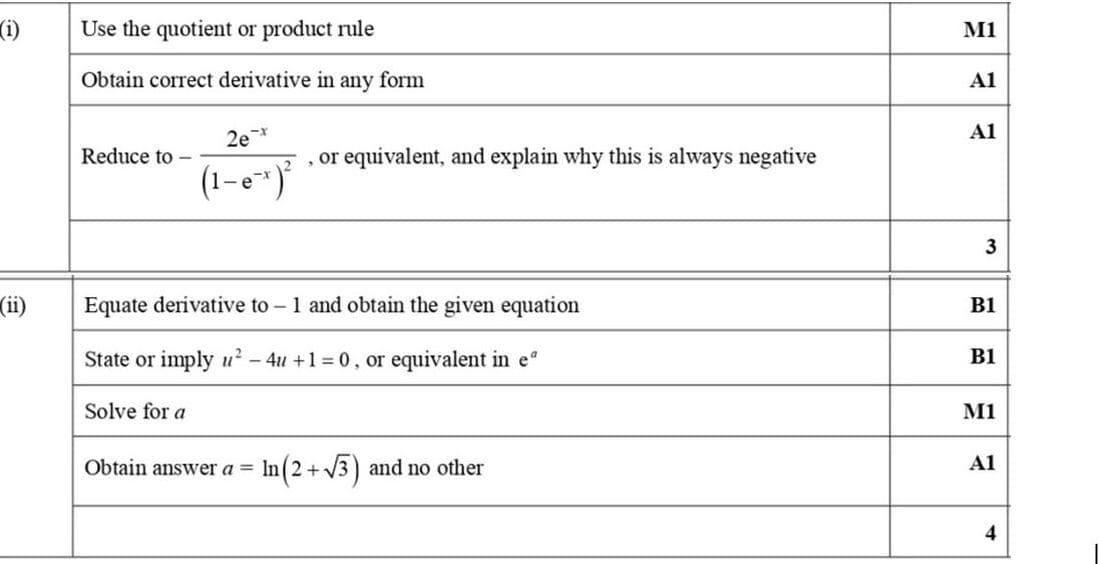
The equation of a curve is \(y = \frac{1 + e^{-x}}{1 - e^{-x}}\), for \(x > 0\).
(i) Show that \(\frac{dy}{dx}\) is always negative.
(ii) The gradient of the curve is equal to \(-1\) when \(x = a\). Show that \(a\) satisfies the equation \(e^{2a} - 4e^{a} + 1 = 0\). Hence find the exact value of \(a\).
June 2019 p32 q4
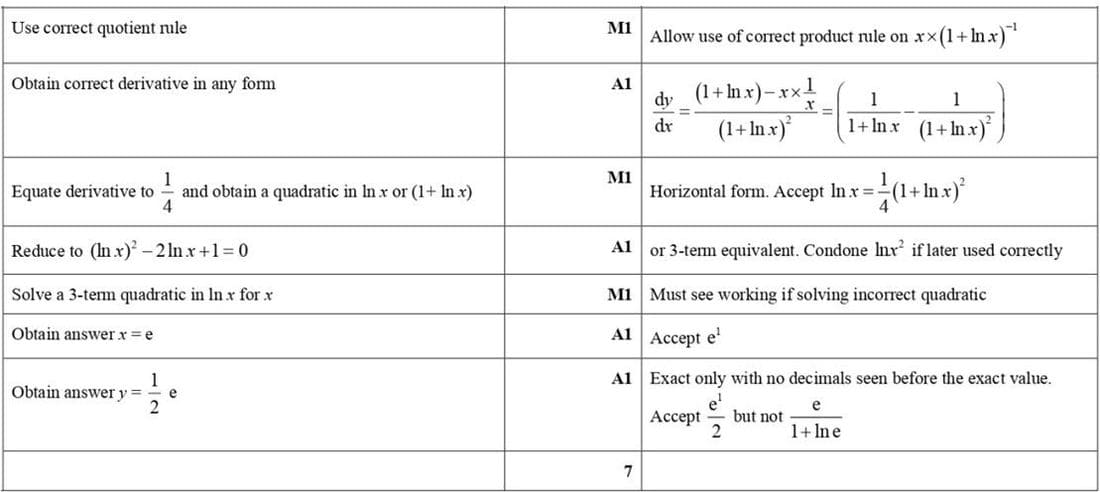
Find the exact coordinates of the point on the curve \(y = \frac{x}{1 + \ln x}\) at which the gradient of the tangent is equal to \(\frac{1}{4}\).
June 2017 p33 q5
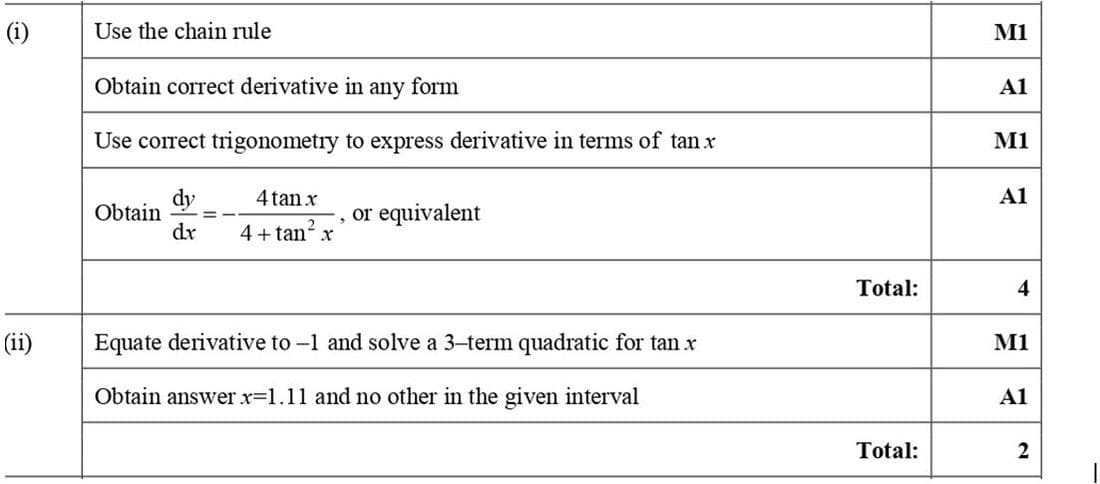
A curve has equation \(y = \frac{2}{3} \ln(1 + 3 \cos^2 x)\) for \(0 \leq x \leq \frac{1}{2} \pi\).
(i) Express \(\frac{dy}{dx}\) in terms of \(\tan x\).
(ii) Hence find the \(x\)-coordinate of the point on the curve where the gradient is \(-1\). Give your answer correct to 3 significant figures.
Feb/Mar 2017 p32 q5
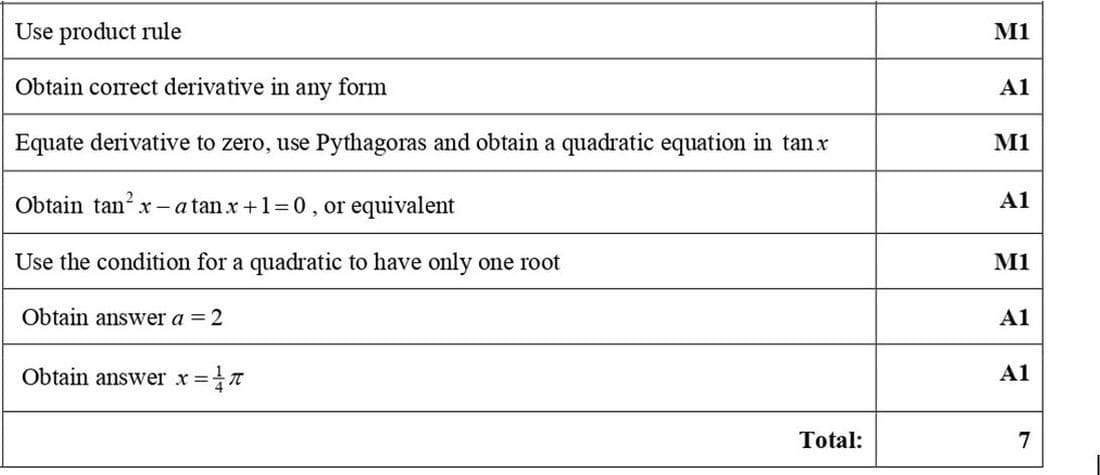
The curve with equation \(y = e^{-ax} \tan x\), where \(a\) is a positive constant, has only one point in the interval \(0 < x < \frac{1}{2}\pi\) at which the tangent is parallel to the \(x\)-axis. Find the value of \(a\) and state the exact value of the \(x\)-coordinate of this point.
Nov 2015 p31 q5
The equation of a curve is \(y = e^{-2x} \tan x\), for \(0 \leq x < \frac{1}{2} \pi\).
(i) Obtain an expression for \(\frac{dy}{dx}\) and show that it can be written in the form \(e^{-2x}(a + b \tan x)^2\), where \(a\) and \(b\) are constants.
(ii) Explain why the gradient of the curve is never negative.
(iii) Find the value of \(x\) for which the gradient is least.