Exam-Style Problems
⬅ Back to SubchapterProblem 216
216
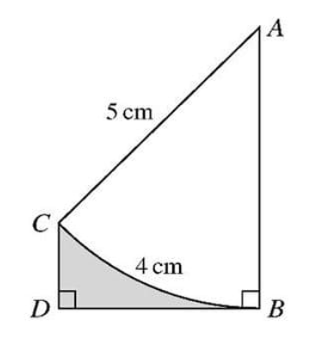
The diagram shows an arc BC of a circle with centre A and radius 5 cm. The length of the arc BC is 4 cm. The point D is such that the line BD is perpendicular to BA and DC is parallel to BA.
(i) Find angle BAC in radians.
(ii) Find the area of the shaded region BDC.
Problem 217
217
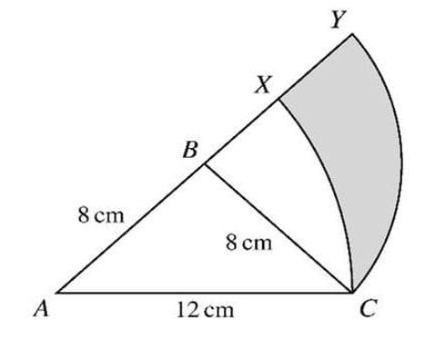
The diagram shows an isosceles triangle ACB in which AB = BC = 8 ext{ cm} and AC = 12 ext{ cm}. The arc XC is part of a circle with centre A and radius 12 ext{ cm}, and the arc YC is part of a circle with centre B and radius 8 ext{ cm}. The points A, B, X and Y lie on a straight line.
(i) Show that angle CBY = 1.445 radians, correct to 4 significant figures.
(ii) Find the perimeter of the shaded region.
Problem 218
218
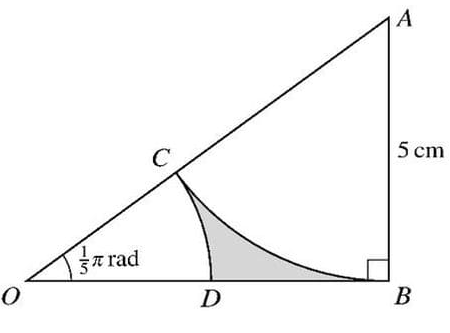
The diagram shows a triangle OAB in which angle ABO is a right angle, angle AOB = \frac{1}{5}\pi radians and AB = 5 \text{ cm}. The arc BC is part of a circle with centre A and meets OA at C. The arc CD is part of a circle with centre O and meets OB at D. Find the area of the shaded region.
Problem 219
219
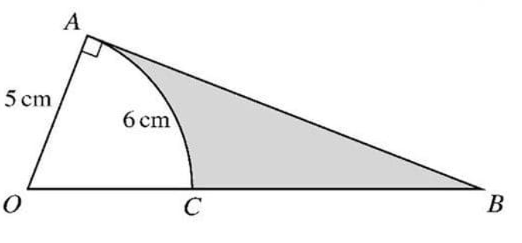
The diagram shows a triangle OAB in which angle OAB = 90° and OA = 5 cm. The arc AC is part of a circle with centre O. The arc has length 6 cm and it meets OB at C. Find the area of the shaded region.
Problem 220
220
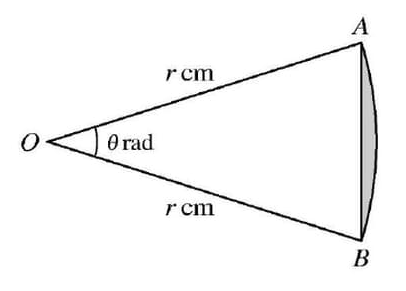
The diagram shows a sector OAB of a circle with centre O and radius r cm. Angle AOB = θ radians. It is given that the length of the arc AB is 9.6 cm and that the area of the sector OAB is 76.8 cm².
(a) Find the area of the shaded region.
(b) Find the perimeter of the shaded region.