Exam-Style Problems
⬅ Back to SubchapterJune 2010 p31 q9
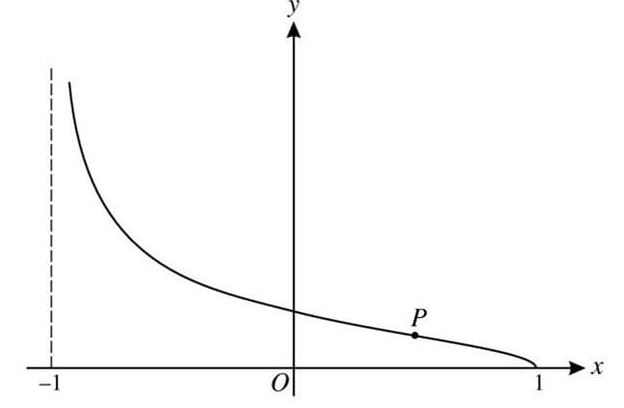
The diagram shows the curve \(y = \sqrt{\left( \frac{1-x}{1+x} \right)}\).
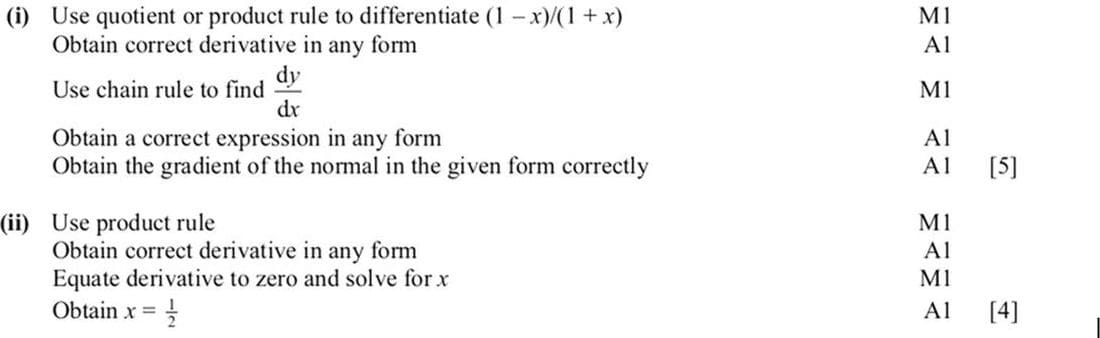
(i) By first differentiating \(\frac{1-x}{1+x}\), obtain an expression for \(\frac{dy}{dx}\) in terms of \(x\). Hence show that the gradient of the normal to the curve at the point \((x, y)\) is \((1+x)\sqrt{1-x^2}\). [5]
(ii) The gradient of the normal to the curve has its maximum value at the point \(P\) shown in the diagram. Find, by differentiation, the \(x\)-coordinate of \(P\). [4]
Nov 2009 p32 q5
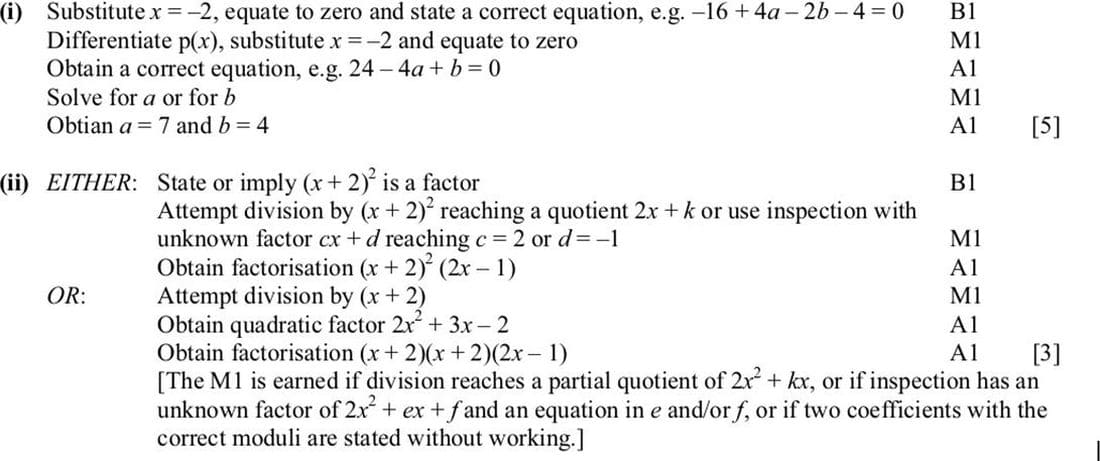
The polynomial \(2x^3 + ax^2 + bx - 4\), where \(a\) and \(b\) are constants, is denoted by \(p(x)\). The result of differentiating \(p(x)\) with respect to \(x\) is denoted by \(p'(x)\). It is given that \((x + 2)\) is a factor of \(p(x)\) and of \(p'(x)\).
(i) Find the values of \(a\) and \(b\).
(ii) When \(a\) and \(b\) have these values, factorise \(p(x)\) completely.
Nov 2023 p31 q1
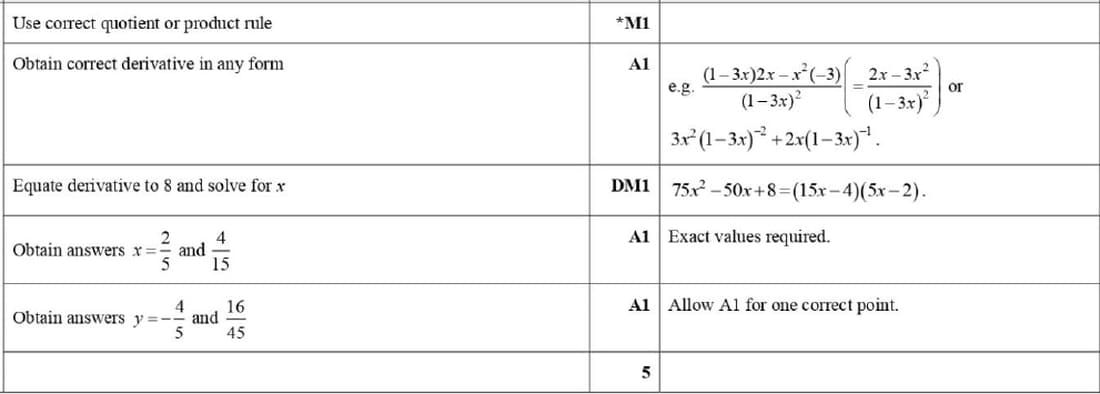
Find the exact coordinates of the points on the curve \(y = \frac{x^2}{1 - 3x}\) at which the gradient of the tangent is equal to 8.
June 2019 p33 q7
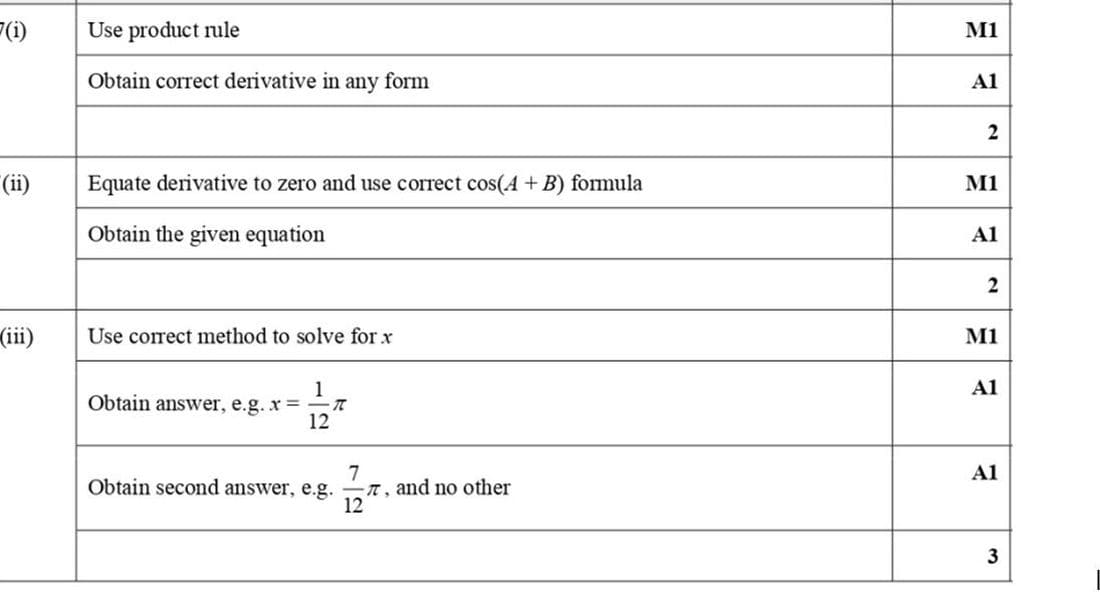
The curve \(y = \\sin(x + \frac{1}{3}\pi) \\cos x\) has two stationary points in the interval \(0 \leq x \leq \pi\).
(i) Find \(\frac{dy}{dx}\).
(ii) By considering the formula for \(\cos(A + B)\), show that, at the stationary points on the curve, \(\cos(2x + \frac{1}{3}\pi) = 0\).
(iii) Hence find the exact \(x\)-coordinates of the stationary points.
June 2011 p31 q2
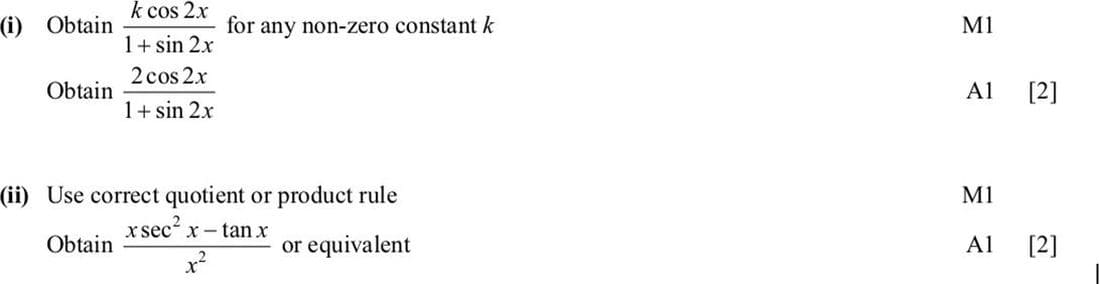
Find \(\frac{dy}{dx}\) in each of the following cases:
- \(y = \ln(1 + \sin 2x)\),
- \(y = \frac{\tan x}{x}\).