Exam-Style Problems
⬅ Back to SubchapterJune 2020 p32 q4
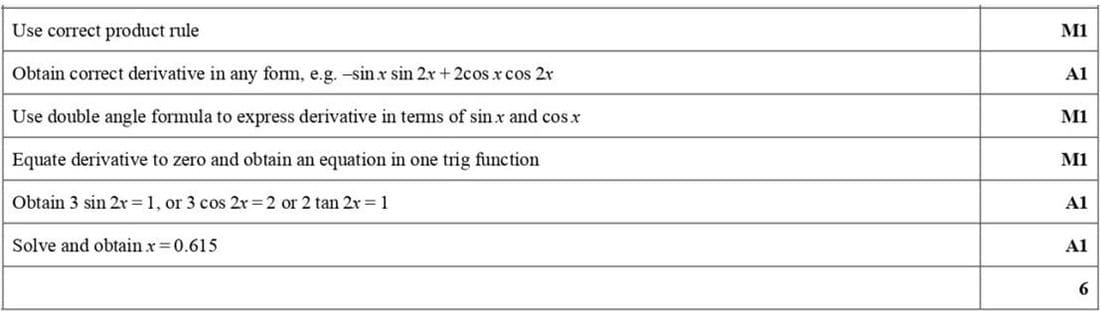
A curve has equation \(y = \\cos x \\sin 2x\).
Find the \(x\)-coordinate of the stationary point in the interval \(0 < x < \frac{1}{2} \pi\), giving your answer correct to 3 significant figures.
June 2020 p33 q4
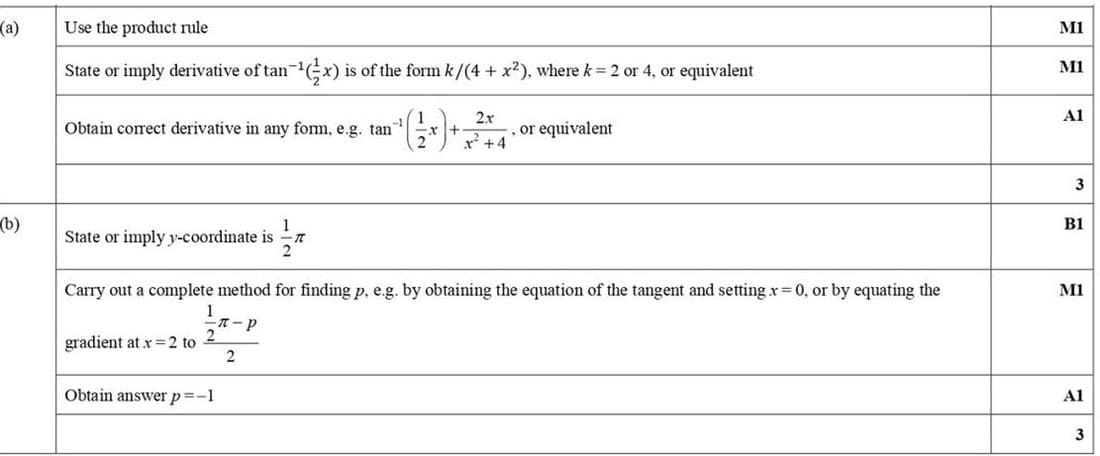
The equation of a curve is \(y = x \arctan\left(\frac{1}{2}x\right)\).
(a) Find \(\frac{dy}{dx}\).
(b) The tangent to the curve at the point where \(x = 2\) meets the y-axis at the point with coordinates \((0, p)\). Find \(p\).
Nov 2015 p33 q3
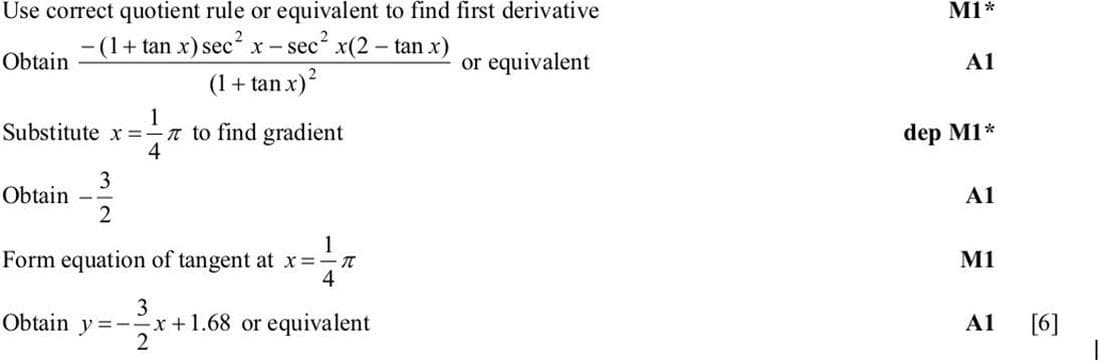
A curve has equation
\(y = \frac{2 - \tan x}{1 + \tan x}\).
Find the equation of the tangent to the curve at the point for which \(x = \frac{1}{4} \pi\), giving the answer in the form \(y = mx + c\) where \(c\) is correct to 3 significant figures.
June 2007 p3 q3
The equation of a curve is \(y = x \sin 2x\), where \(x\) is in radians. Find the equation of the tangent to the curve at the point where \(x = \frac{1}{4} \pi\).

June 2013 p32 q6
By differentiating \(\frac{1}{\cos x}\), show that the derivative of \(\sec x\) is \(\sec x \tan x\). Hence show that if \(y = \ln(\sec x + \tan x)\) then \(\frac{dy}{dx} = \sec x\).
