Exam-Style Problems
⬅ Back to SubchapterProblem 206
206
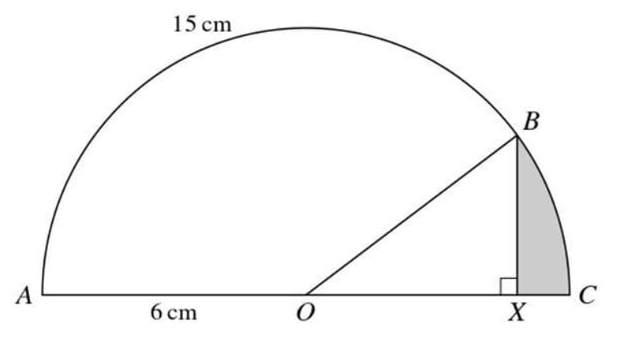
In the diagram, ABC is a semicircle with diameter AC, centre O and radius 6 cm. The length of the arc AB is 15 cm. The point X lies on AC and BX is perpendicular to AX.
Find the perimeter of the shaded region BXC.
Problem 207
207
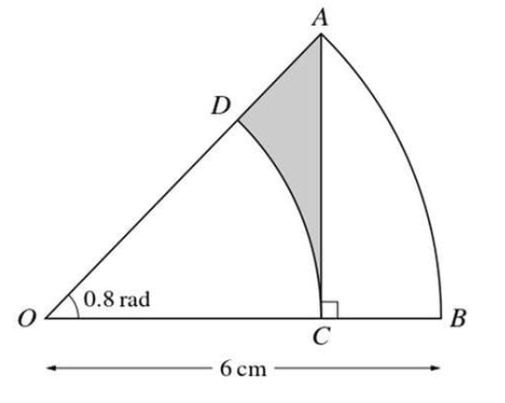
The diagram shows a sector AOB which is part of a circle with centre O and radius 6 cm and with angle AOB = 0.8 radians. The point C on OB is such that AC is perpendicular to OB. The arc CD is part of a circle with centre O, where D lies on OA.
Find the area of the shaded region.
Problem 208
208
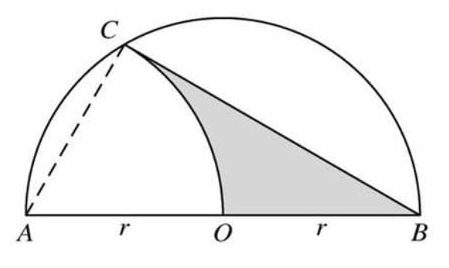
The diagram shows a semicircle ACB with centre O and radius r. Arc OC is part of a circle with centre A.
(i) Express angle CAO in radians in terms of \(\\pi\).
(ii) Find the area of the shaded region in terms of r, \(\\pi\) and \(\\sqrt{3}\), simplifying your answer.
Problem 209
209
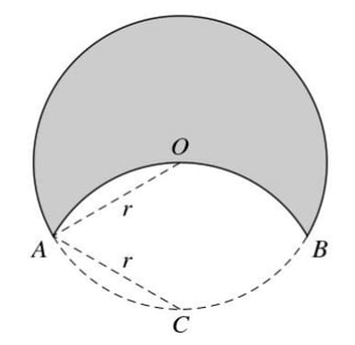
The diagram shows a motif formed by the major arc \(AB\) of a circle with radius \(r\) and centre \(O\), and the minor arc \(AOB\) of a circle, also with radius \(r\) but with centre \(C\). The point \(C\) lies on the circle with centre \(O\).
(a) Given that angle \(ACB = k\pi\) radians, state the value of the fraction \(k\).
(b) State the perimeter of the shaded motif in terms of \(\pi\) and \(r\).
(c) Find the area of the shaded motif, giving your answer in terms of \(\pi\), \(r\) and \(\sqrt{3}\).
Problem 210
210
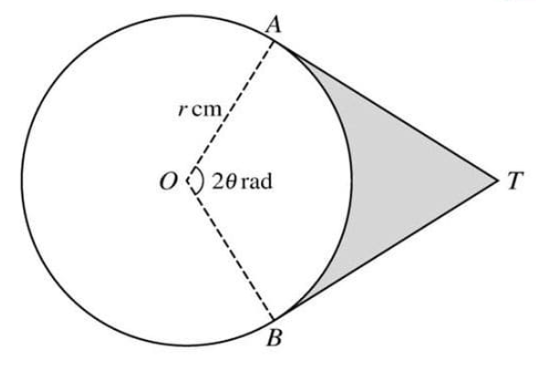
The diagram shows a circle with centre O and radius r cm. Points A and B lie on the circle and angle AOB = 2\theta radians. The tangents to the circle at A and B meet at T.
(i) Express the perimeter of the shaded region in terms of r and \theta.
(ii) In the case where r = 5 and \theta = 1.2, find the area of the shaded region.