Exam-Style Problems
⬅ Back to SubchapterNov 2006 p3 q3
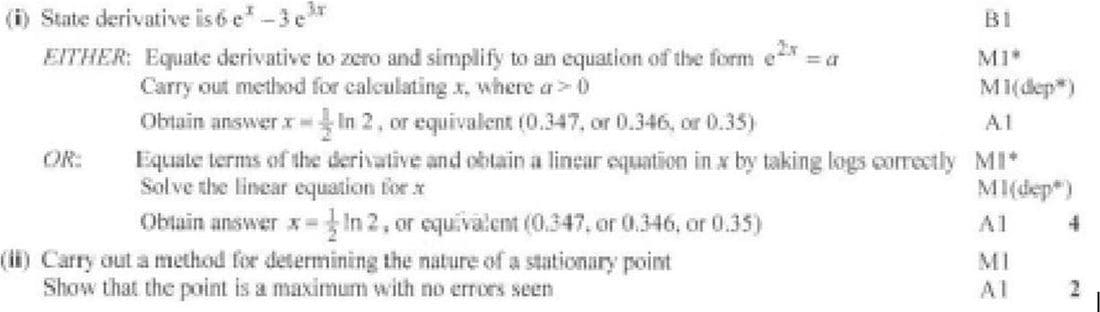
The curve with equation \(y = 6e^x - e^{3x}\) has one stationary point.
(i) Find the \(x\)-coordinate of this point.
(ii) Determine whether this point is a maximum or a minimum point.
Nov 2005 p3 q3
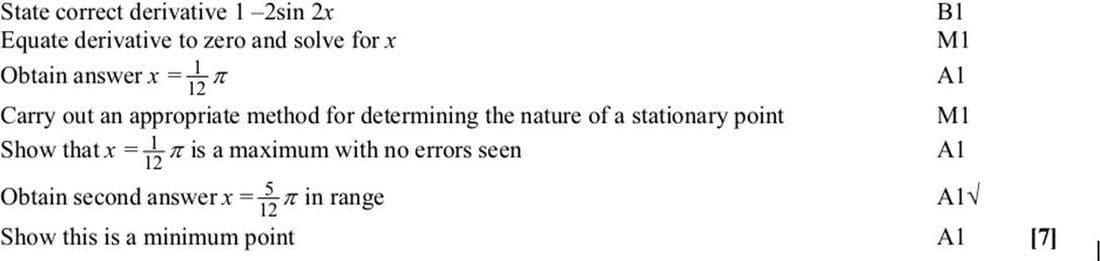
The equation of a curve is \(y = x + \\cos 2x\). Find the \(x\)-coordinates of the stationary points of the curve for which \(0 \leq x \leq \pi\), and determine the nature of each of these stationary points.
June 2022 p33 q4
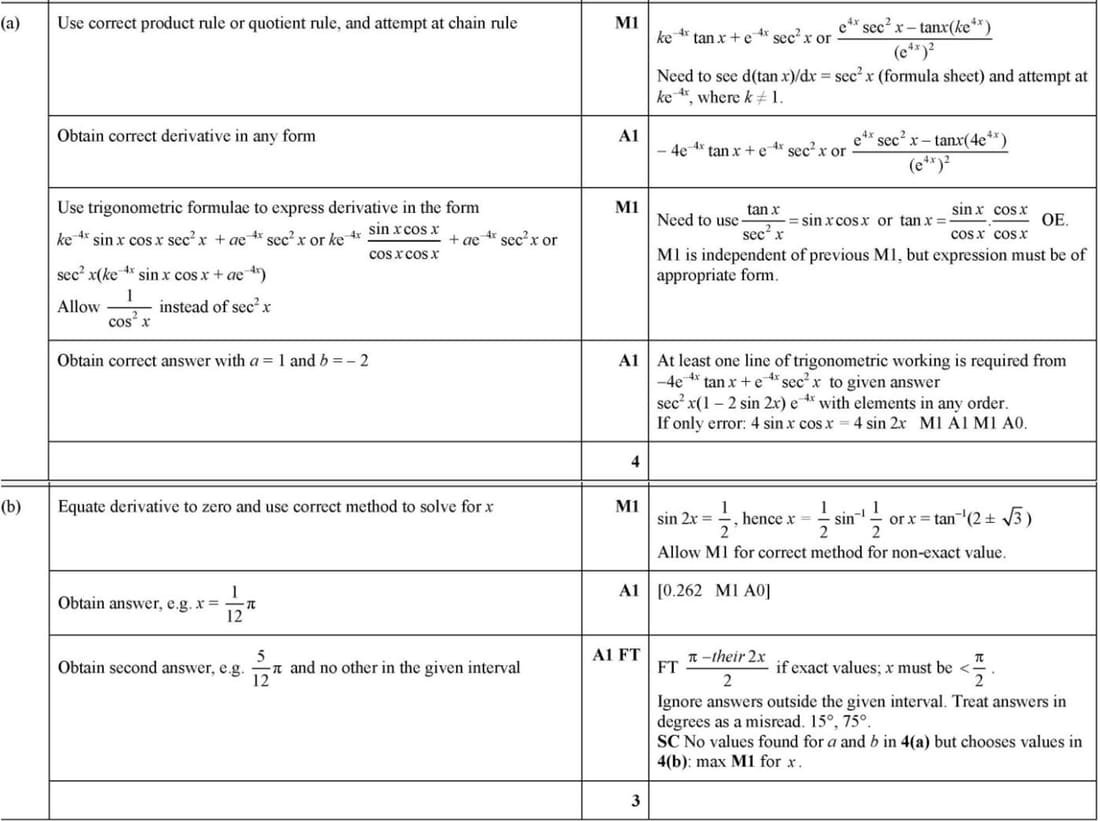
The curve \(y = e^{-4x} \tan x\) has two stationary points in the interval \(0 \leq x < \frac{1}{2} \pi\).
(a) Obtain an expression for \(\frac{dy}{dx}\) and show it can be written in the form \(\sec^2 x (a + b \sin 2x) e^{-4x}\), where \(a\) and \(b\) are constants.
(b) Hence find the exact \(x\)-coordinates of the two stationary points.
Nov 2002 p3 q4
The curve \(y = e^x + 4e^{-2x}\) has one stationary point.
(i) Find the \(x\)-coordinate of this point.
(ii) Determine whether the stationary point is a maximum or a minimum point.

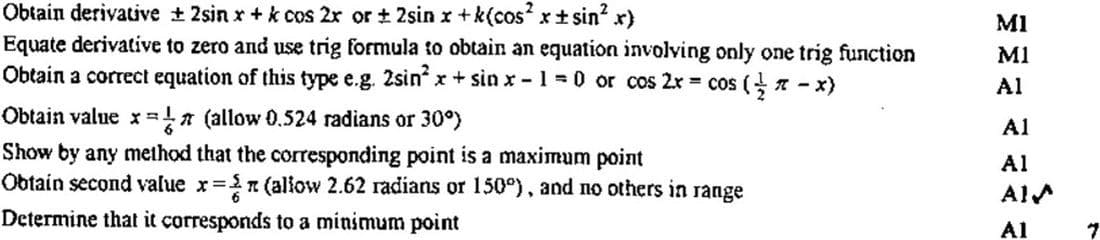
June 2002 p3 q5
The equation of a curve is \(y = 2 \cos x + \sin 2x\). Find the \(x\)-coordinates of the stationary points on the curve for which \(0 < x < \pi\), and determine the nature of each of these stationary points.