Exam-Style Problems
⬅ Back to SubchapterNov 2011 p33 q2
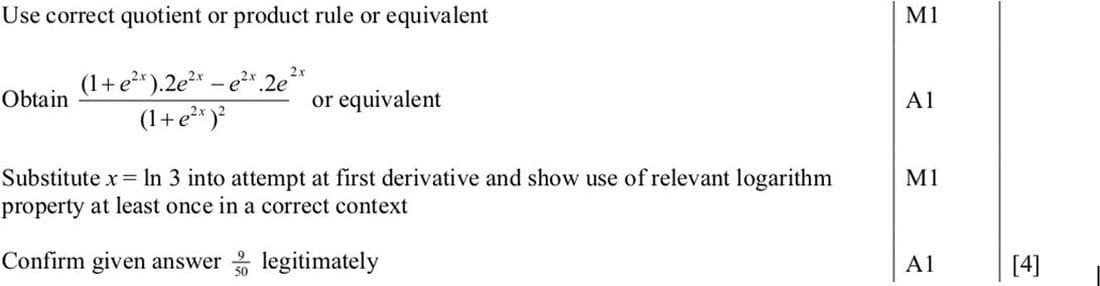
The equation of a curve is \(y = \frac{e^{2x}}{1 + e^{2x}}\). Show that the gradient of the curve at the point for which \(x = \ln 3\) is \(\frac{9}{50}\).
June 2011 p33 q2
The curve \(y = \frac{\ln x}{x^3}\) has one stationary point. Find the x-coordinate of this point.

Nov 2009 p31 q4
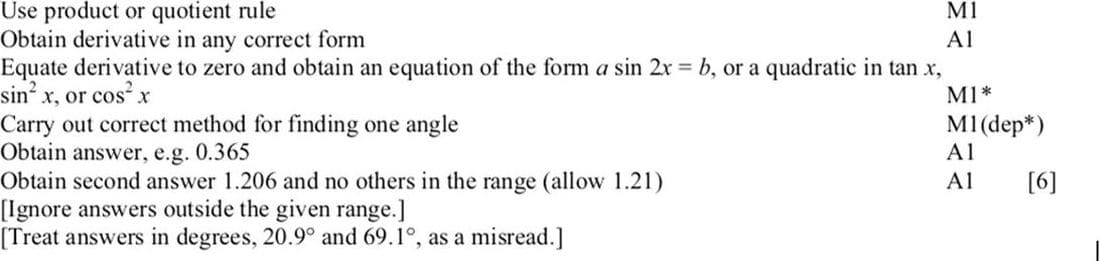
A curve has equation \(y = e^{-3x} \tan x\). Find the x-coordinates of the stationary points on the curve in the interval \(-\frac{1}{2}\pi < x < \frac{1}{2}\pi\). Give your answers correct to 3 decimal places.
Nov 2008 p3 q3
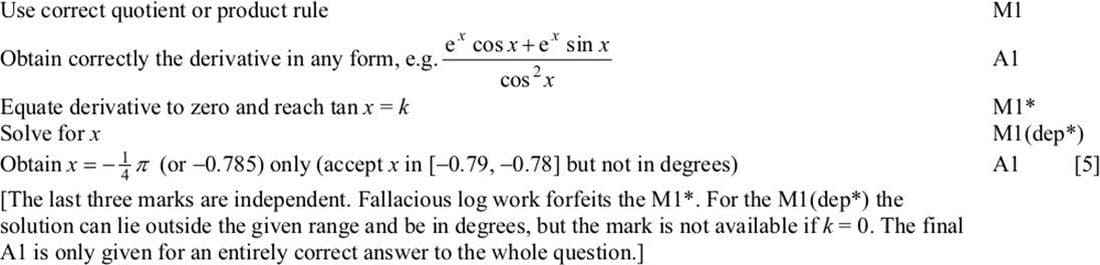
The curve \(y = \frac{e^x}{\cos x}\), for \(-\frac{1}{2}\pi < x < \frac{1}{2}\pi\), has one stationary point. Find the \(x\)-coordinate of this point.
Nov 2007 p3 q4
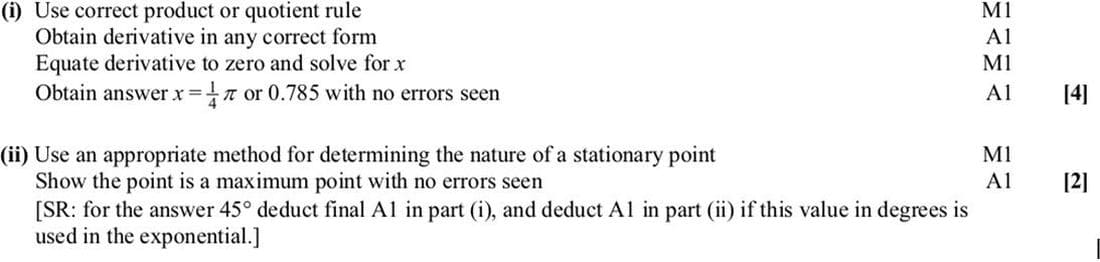
The curve with equation \(y = e^{-x} \sin x\) has one stationary point for which \(0 \leq x \leq \pi\).
(i) Find the \(x\)-coordinate of this point.
(ii) Determine whether this point is a maximum or a minimum point.