Browsing as Guest. Progress, bookmarks and attempts are disabled.
Log in to track your work.
Nov 2005 p6 q5
3063
A box contains 300 discs of different colours. There are 100 pink discs, 100 blue discs and 100 orange discs. The discs of each colour are numbered from 0 to 99. Five discs are selected at random, one at a time, with replacement. Find
the probability that no orange discs are selected,
the probability that exactly 2 discs with numbers ending in a 6 are selected,
the probability that exactly 2 orange discs with numbers ending in a 6 are selected,
the mean and variance of the number of pink discs selected.
Solution
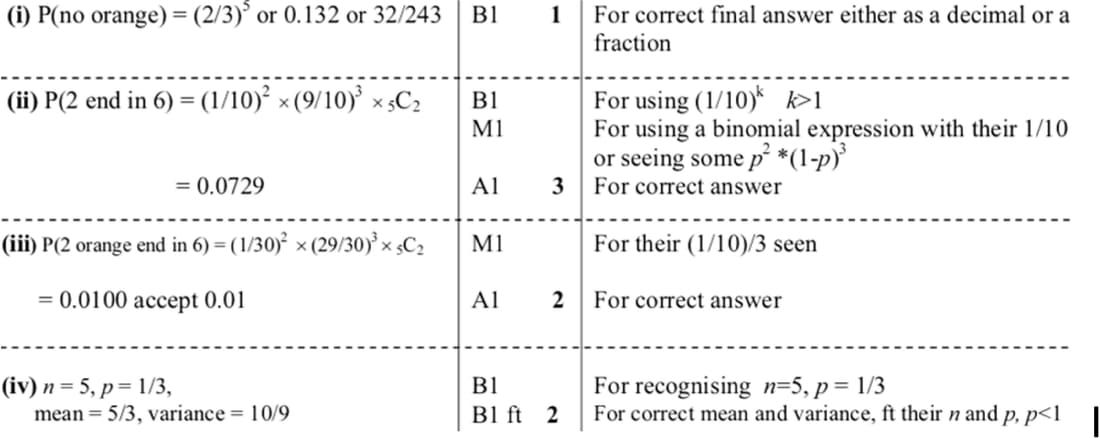
(i) The probability of selecting a non-orange disc is \(\frac{200}{300} = \frac{2}{3}\). Since the selection is with replacement, the probability that no orange discs are selected in 5 draws is \(\left( \frac{2}{3} \right)^5\).
(ii) The probability of selecting a disc with a number ending in 6 is \(\frac{10}{100} = \frac{1}{10}\). Using the binomial distribution, the probability of selecting exactly 2 such discs in 5 draws is \(\binom{5}{2} \left( \frac{1}{10} \right)^2 \left( \frac{9}{10} \right)^3\).
(iii) The probability of selecting an orange disc with a number ending in 6 is \(\frac{10}{300} = \frac{1}{30}\). Using the binomial distribution, the probability of selecting exactly 2 such discs in 5 draws is \(\binom{5}{2} \left( \frac{1}{30} \right)^2 \left( \frac{29}{30} \right)^3\).
(iv) The probability of selecting a pink disc is \(\frac{100}{300} = \frac{1}{3}\). For a binomial distribution with \(n = 5\) and \(p = \frac{1}{3}\), the mean is \(np = 5 \times \frac{1}{3} = \frac{5}{3}\) and the variance is \(np(1-p) = 5 \times \frac{1}{3} \times \frac{2}{3} = \frac{10}{9}\).