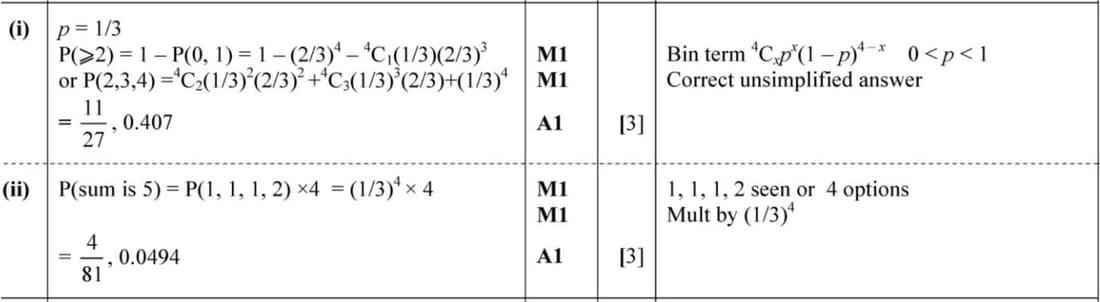
(i) Let the probability of landing on a 3 be \(p = \frac{1}{3}\). We need to find the probability of getting at least two 3s in four spins. This is given by:
\(P(\geq 2) = 1 - P(0, 1) = 1 - \left(\frac{2}{3}\right)^4 - 4 \cdot \binom{4}{1} \left(\frac{1}{3}\right) \left(\frac{2}{3}\right)^3\)
Alternatively, calculate directly:
\(P(2, 3, 4) = \binom{4}{2} \left(\frac{1}{3}\right)^2 \left(\frac{2}{3}\right)^2 + \binom{4}{3} \left(\frac{1}{3}\right)^3 \left(\frac{2}{3}\right) + \left(\frac{1}{3}\right)^4\)
Thus, \(P(\geq 2) = \frac{11}{27}\) or 0.407.
(ii) To find the probability that the sum of the four scores is 5, consider the combination (1, 1, 1, 2). There are 4 permutations of this combination:
\(P(\text{sum is 5}) = P(1, 1, 1, 2) \times 4 = \left(\frac{1}{3}\right)^4 \times 4\)
Thus, \(P(\text{sum is 5}) = \frac{4}{81}\) or 0.0494.