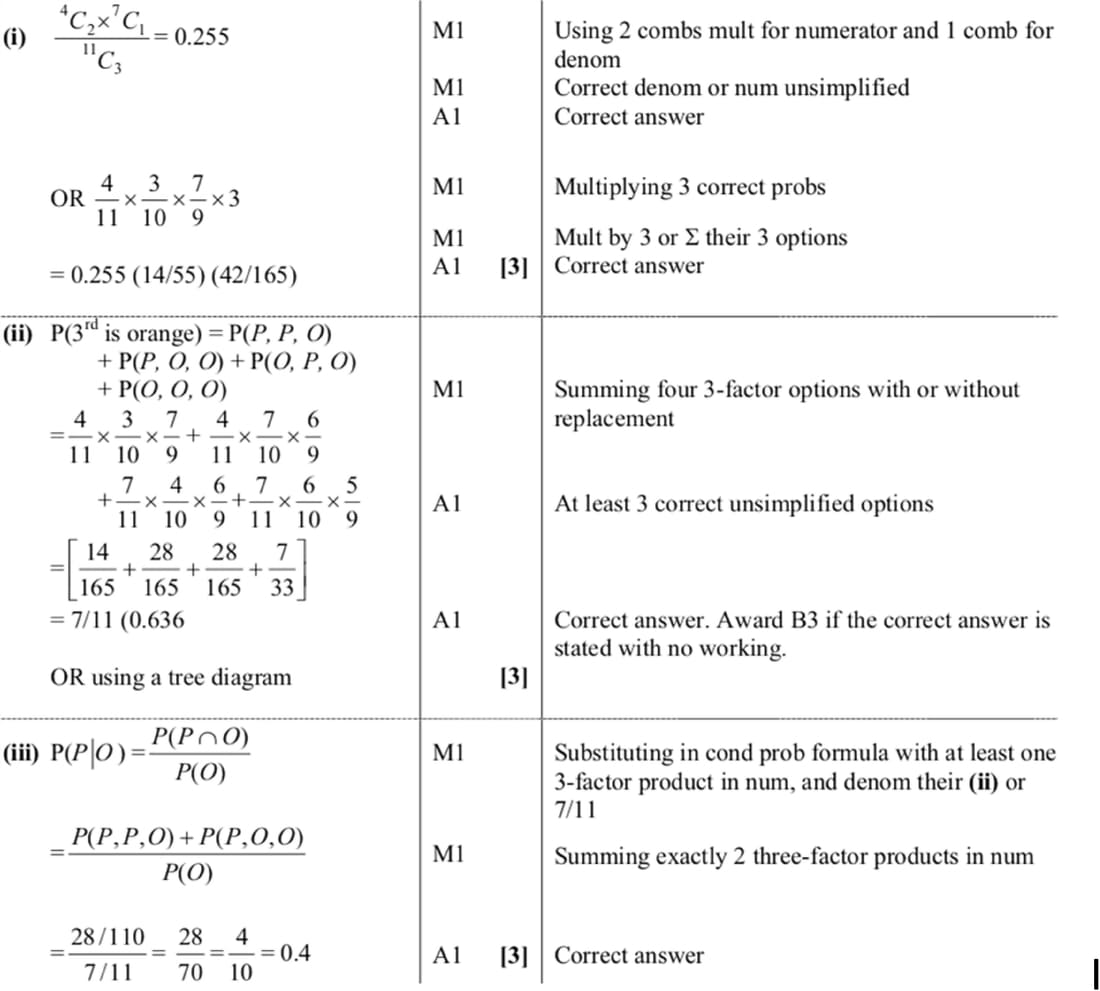
(i) The probability of selecting 2 pears and 1 orange can be calculated using combinations:
\(\frac{{^4C_2 \times ^7C_1}}{{^{11}C_3}} = \frac{6 \times 7}{165} = 0.255\)
Alternatively, using probabilities:
\(\frac{4}{11} \times \frac{3}{10} \times \frac{7}{9} \times 3 = 0.255\)
(ii) The probability that the third fruit is an orange can be calculated by considering different sequences:
\(P(O) = P(P, P, O) + P(P, O, O) + P(O, P, O) + P(O, O, O)\)
\(= \frac{4}{11} \times \frac{3}{10} \times \frac{7}{9} + \frac{4}{11} \times \frac{7}{10} \times \frac{6}{9} + \frac{7}{11} \times \frac{4}{10} \times \frac{6}{9} + \frac{7}{11} \times \frac{6}{10} \times \frac{5}{9}\)
\(= \frac{14}{165} + \frac{28}{165} + \frac{28}{165} + \frac{7}{33} = \frac{7}{11}\)
(iii) The probability that the first fruit was a pear, given that the third fruit is an orange, is calculated using conditional probability:
\(P(P | O) = \frac{P(P \cap O)}{P(O)}\)
\(= \frac{P(P, P, O) + P(P, O, O)}{P(O)}\)
\(= \frac{\frac{4}{11} \times \frac{3}{10} \times \frac{7}{9} + \frac{4}{11} \times \frac{7}{10} \times \frac{6}{9}}{\frac{7}{11}}\)
\(= \frac{28/110 + 28/70}{7/11} = 0.4\)