9709 P63 - Jun 2015 - Q2
2614
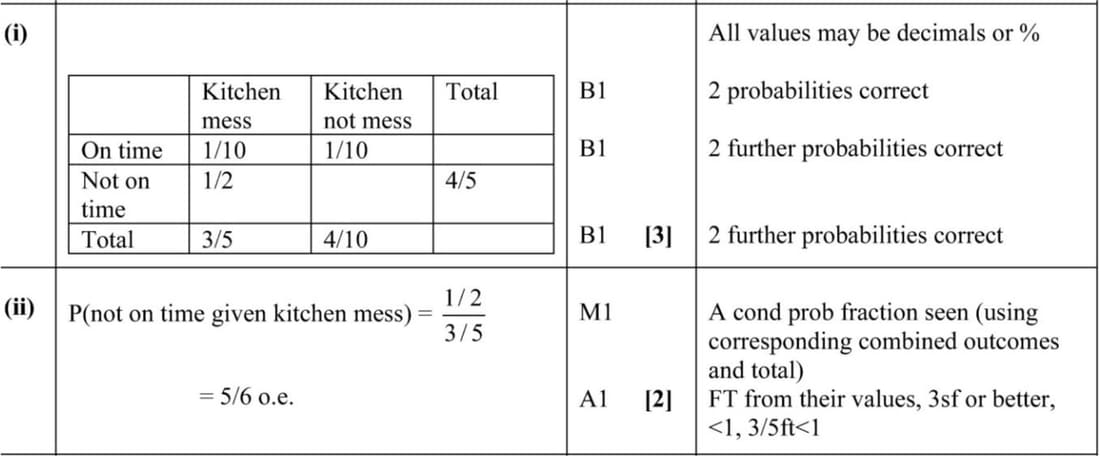
When Joanna cooks, the probability that the meal is served on time is \(\frac{1}{5}\). The probability that the kitchen is left in a mess is \(\frac{3}{5}\). The probability that the meal is not served on time and the kitchen is not left in a mess is \(\frac{3}{10}\). Some of this information is shown in the following table.
| Kitchen left in a mess | Kitchen not left in a mess | Total | |
|---|---|---|---|
| Meal served on time | \(\frac{1}{5}\) | ||
| Meal not served on time | \(\frac{3}{10}\) | ||
| Total | 1 |
(i) Copy and complete the table.
(ii) Given that the kitchen is left in a mess, find the probability that the meal is not served on time.