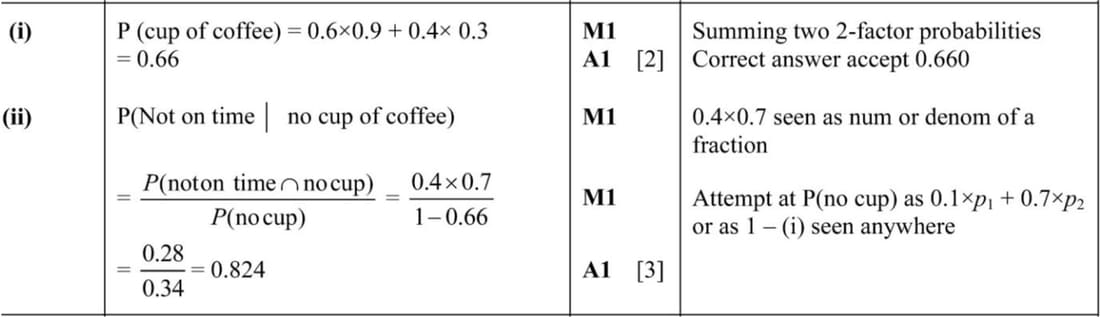
(i) To find the probability that Sam gets a cup of coffee, we use the law of total probability:
\(P( ext{cup of coffee}) = P( ext{on time}) \times P( ext{coffee | on time}) + P( ext{not on time}) \times P( ext{coffee | not on time})\)
\(= 0.6 \times 0.9 + 0.4 \times 0.3\)
\(= 0.54 + 0.12 = 0.66\)
(ii) To find the probability that the bus is not on time given that Sam does not get a cup of coffee, we use Bayes' theorem:
\(P( ext{not on time | no cup}) = \frac{P( ext{not on time} \cap ext{no cup})}{P( ext{no cup})}\)
First, calculate \(P( ext{not on time} \cap ext{no cup})\):
\(P( ext{not on time} \cap ext{no cup}) = P( ext{not on time}) \times P( ext{no cup | not on time})\)
\(= 0.4 \times 0.7 = 0.28\)
Next, calculate \(P( ext{no cup})\):
\(P( ext{no cup}) = 1 - P( ext{cup of coffee}) = 1 - 0.66 = 0.34\)
Finally, substitute these into Bayes' theorem:
\(P( ext{not on time | no cup}) = \frac{0.28}{0.34} \approx 0.824\)