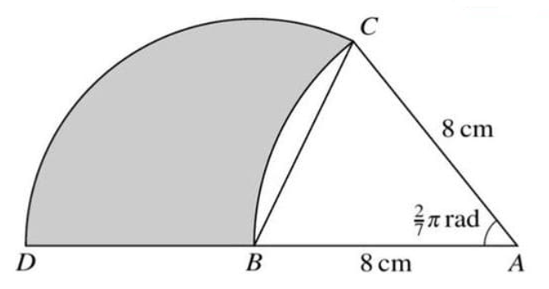
(i) To find \(\angle CBD\), we first find \(\angle ABC\). Since \(\angle CAB = \frac{2}{7} \pi\), and \(\triangle ABC\) is isosceles with \(AB = AC\), the remaining angle \(\angle ABC\) is:
\(\angle ABC = \pi - \angle CAB = \pi - \frac{2}{7} \pi = \frac{5}{7} \pi\)
Since \(ABD\) is a straight line, \(\angle CBD = \pi - \angle ABC = \pi - \frac{5}{7} \pi = \frac{9}{14} \pi\).
(ii) To find the perimeter of the shaded region, we need to calculate the lengths of \(BC\), arc \(CD\), and arc \(CB\).
Using the sine rule in \(\triangle ABC\):
\(\frac{\sin \frac{\pi}{7}}{8} = \frac{\sin \frac{2\pi}{7}}{BC}\)
Solving for \(BC\), we find \(BC \approx 6.94 \text{ cm}\).
The length of arc \(CD\) is given by:
\(\text{arc } CD = BC \times \frac{9\pi}{14} \approx 6.94 \times \frac{9\pi}{14} \approx 14.02 \text{ cm}\)
The length of arc \(CB\) is given by:
\(\text{arc } CB = 8 \times \frac{2\pi}{7} \approx 7.18 \text{ cm}\)
Thus, the perimeter of the shaded region is:
\(6.94 + 14.02 + 7.18 = 28.1 \text{ cm}\)