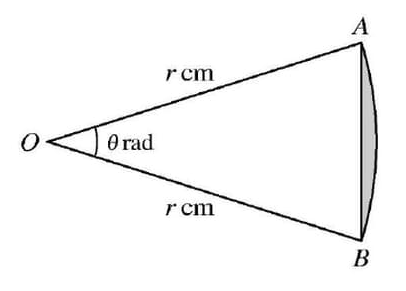
(a) To find the area of the shaded region, we first need to find the radius r and angle θ.
We have the equations:
\(\frac{1}{2} r^2 \theta = 76.8\)
\(r \theta = 9.6\)
From the second equation, \(\theta = \frac{9.6}{r}\).
Substitute \(\theta\) in the first equation:
\(\frac{1}{2} r^2 \left( \frac{9.6}{r} \right) = 76.8\)
\(\frac{1}{2} r \times 9.6 = 76.8\)
\(4.8r = 76.8\)
\(r = 16\)
Now, substitute \(r = 16\) back to find \(\theta\):
\(\theta = \frac{9.6}{16} = 0.6 \text{ radians}\)
The area of triangle \(\Delta OAB\) is:
\(\frac{1}{2} \times 16^2 \times \sin(0.6) \approx 4.53 \text{ cm}^2\)
The area of the shaded region is:
\(76.8 - 72.27 = 4.53 \text{ cm}^2\)
(b) To find the perimeter of the shaded region, we need the length of AB and the arc length.
Using the cosine rule or sine rule, we find:
\(AB = 2 \times 16 \times \sin(0.3) \approx 9.46 \text{ cm}\)
The perimeter is:
\(9.6 + 9.46 = 19.1 \text{ cm}\)