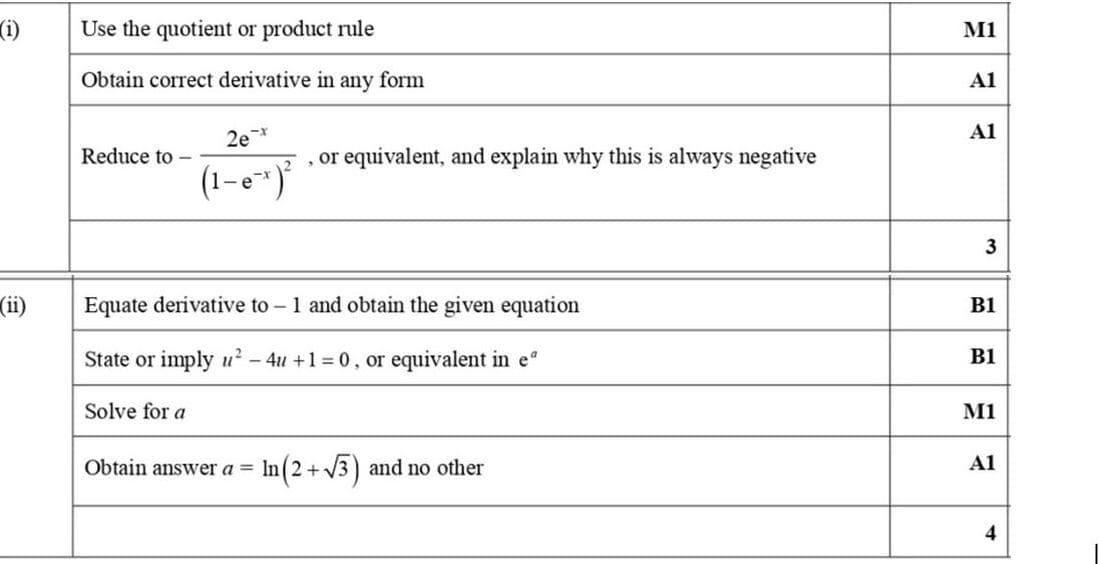
(i) Differentiate \(y = \frac{1 + e^{-x}}{1 - e^{-x}}\) using the quotient rule:
\(\frac{dy}{dx} = \frac{(1 - e^{-x})(-e^{-x}) - (1 + e^{-x})(-e^{-x})}{(1 - e^{-x})^2}\)
Simplify to \(\frac{dy}{dx} = \frac{-2e^{-x}}{(1 - e^{-x})^2}\).
Since \(e^{-x} > 0\) for \(x > 0\), \(-2e^{-x} < 0\). Therefore, \(\frac{dy}{dx}\) is always negative.
(ii) Set \(\frac{dy}{dx} = -1\):
\(\frac{-2e^{-a}}{(1 - e^{-a})^2} = -1\)
Simplify to \(2e^{-a} = (1 - e^{-a})^2\)
Let \(u = e^{-a}\), then \(2u = (1 - u)^2\)
Expand and simplify: \(2u = 1 - 2u + u^2\)
Rearrange to \(u^2 - 4u + 1 = 0\)
Solving this quadratic equation gives \(u = 2 \pm \sqrt{3}\)
Since \(u = e^{-a} > 0\), choose \(u = 2 - \sqrt{3}\)
Thus, \(e^{-a} = 2 - \sqrt{3}\)
\(a = -\ln(2 - \sqrt{3}) = \ln(2 + \sqrt{3})\)