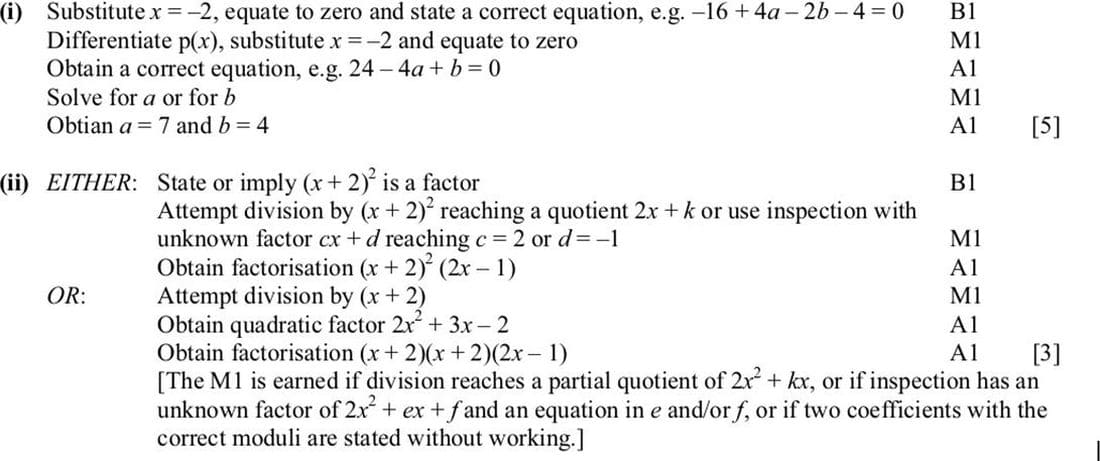
(i) Since \((x + 2)\) is a factor of \(p(x)\), substituting \(x = -2\) into \(p(x)\) gives:
\(-16 + 4a - 2b - 4 = 0\)
\(4a - 2b = 20\) (Equation 1)
Differentiating \(p(x)\), we get \(p'(x) = 6x^2 + 2ax + b\).
Since \((x + 2)\) is a factor of \(p'(x)\), substituting \(x = -2\) into \(p'(x)\) gives:
\(24 - 4a + b = 0\)
\(-4a + b = -24\) (Equation 2)
Solving Equations 1 and 2 simultaneously:
From Equation 2: \(b = 4a - 24\)
Substitute into Equation 1:
\(4a - 2(4a - 24) = 20\)
\(4a - 8a + 48 = 20\)
\(-4a = -28\)
\(a = 7\)
Substitute \(a = 7\) into \(b = 4a - 24\):
\(b = 4(7) - 24 = 4\)
Thus, \(a = 7\) and \(b = 4\).
(ii) With \(a = 7\) and \(b = 4\), \(p(x) = 2x^3 + 7x^2 + 4x - 4\).
Since \((x + 2)\) is a factor, \((x + 2)^2\) is also a factor.
Attempt division by \((x + 2)^2\):
\(p(x) = (x + 2)^2(2x - 1)\)
Thus, the factorisation is \((x + 2)^2(2x - 1)\).