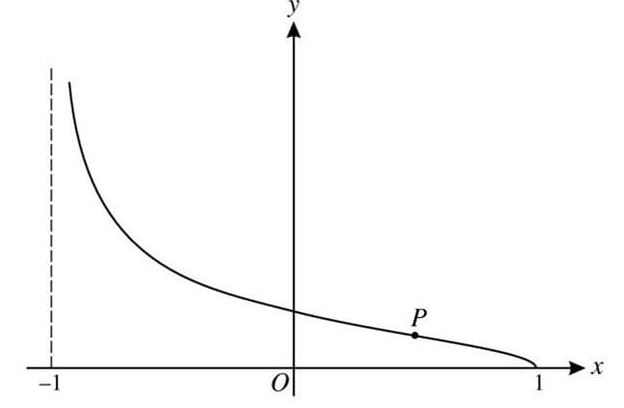
(i) Differentiate \(\frac{1-x}{1+x}\) using the quotient rule:
\(\frac{d}{dx} \left( \frac{1-x}{1+x} \right) = \frac{(1+x)(-1) - (1-x)(1)}{(1+x)^2} = \frac{-1-x-1+x}{(1+x)^2} = \frac{-2}{(1+x)^2}\).
Now, use the chain rule to find \(\frac{dy}{dx}\):
\(y = \sqrt{u}\) where \(u = \frac{1-x}{1+x}\).
\(\frac{dy}{du} = \frac{1}{2\sqrt{u}}\).
\(\frac{dy}{dx} = \frac{dy}{du} \cdot \frac{du}{dx} = \frac{1}{2\sqrt{\frac{1-x}{1+x}}} \cdot \frac{-2}{(1+x)^2} = \frac{-1}{(1+x)\sqrt{\frac{1-x}{1+x}}}\).
The gradient of the normal is the negative reciprocal of \(\frac{dy}{dx}\):
\(\text{Gradient of normal} = (1+x)\sqrt{1-x^2}\).
(ii) Differentiate the gradient of the normal \((1+x)\sqrt{1-x^2}\) using the product rule:
Let \(u = 1+x\) and \(v = \sqrt{1-x^2}\).
\(\frac{du}{dx} = 1\), \(\frac{dv}{dx} = \frac{-x}{\sqrt{1-x^2}}\).
\(\frac{d}{dx}((1+x)\sqrt{1-x^2}) = u \frac{dv}{dx} + v \frac{du}{dx} = (1+x)\left(\frac{-x}{\sqrt{1-x^2}}\right) + \sqrt{1-x^2}\).
Set \(\frac{d}{dx}((1+x)\sqrt{1-x^2}) = 0\) and solve for \(x\):
\((1+x)\left(\frac{-x}{\sqrt{1-x^2}}\right) + \sqrt{1-x^2} = 0\).
\(-x(1+x) + (1-x^2) = 0\).
\(-x - x^2 + 1 - x^2 = 0\).
\(1 - x - 2x^2 = 0\).
Solving gives \(x = \frac{1}{2}\).