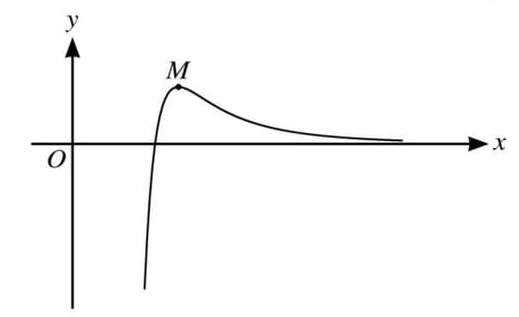
To find the maximum point \(M\) of the curve \(y = \frac{\ln x}{x^4}\), we first find the derivative \(y'\) using the quotient rule.
The quotient rule states that if \(y = \frac{u}{v}\), then \(y' = \frac{u'v - uv'}{v^2}\).
Here, \(u = \ln x\) and \(v = x^4\).
Thus, \(u' = \frac{1}{x}\) and \(v' = 4x^3\).
Applying the quotient rule:
\(y' = \frac{\left(\frac{1}{x}\right)x^4 - (\ln x)(4x^3)}{(x^4)^2} = \frac{x^3 - 4x^3 \ln x}{x^8} = \frac{x^3(1 - 4 \ln x)}{x^8} = \frac{1 - 4 \ln x}{x^5}\).
To find the maximum, set \(y' = 0\):
\(\frac{1 - 4 \ln x}{x^5} = 0\).
This implies \(1 - 4 \ln x = 0\).
Solving for \(x\), we get \(\ln x = \frac{1}{4}\).
Thus, \(x = e^{1/4} = \sqrt[4]{e}\).
Substitute \(x = \sqrt[4]{e}\) back into the original equation to find \(y\):
\(y = \frac{\ln(\sqrt[4]{e})}{(\sqrt[4]{e})^4} = \frac{\frac{1}{4}}{e} = \frac{1}{4e}\).
Therefore, the coordinates of \(M\) are \(\left( \sqrt[4]{e}, \frac{1}{4e} \right)\).