Browsing as Guest. Progress, bookmarks and attempts are disabled.
Log in to track your work.
9709 P3 - Nov 2007 - Q4
1602
The curve with equation \(y = e^{-x} \sin x\) has one stationary point for which \(0 \leq x \leq \pi\).
(i) Find the \(x\)-coordinate of this point.
(ii) Determine whether this point is a maximum or a minimum point.
Solution
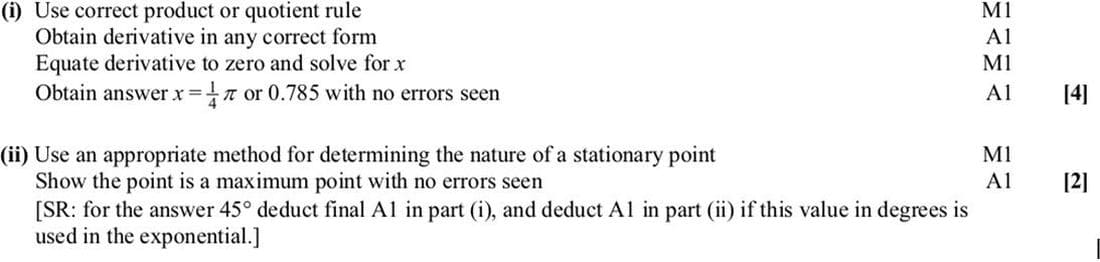
(i) To find the stationary point, we need to differentiate \(y = e^{-x} \sin x\) and set the derivative to zero. Using the product rule, \(\frac{dy}{dx} = e^{-x} \cos x - e^{-x} \sin x\). Setting \(\frac{dy}{dx} = 0\), we have:
\(e^{-x} (\cos x - \sin x) = 0\)
Since \(e^{-x} \neq 0\), we solve \(\cos x = \sin x\).
This gives \(x = \frac{\pi}{4}\) within the interval \(0 \leq x \leq \pi\).
(ii) To determine the nature of the stationary point, we examine the second derivative or the sign change of the first derivative around \(x = \frac{\pi}{4}\). The second derivative test or analyzing the behavior of \(\frac{dy}{dx}\) shows that it is a maximum point.