Differentiation – Application
Applications of Differentiation — Optimisation (Year 12, 9709)
We use differentiation to find maximum or minimum values of quantities in practical problems (e.g. volume, area, cost).
1. General Method (Word Problems)
- Introduce a variable (often \(x\) or \(h\)) and express the quantity (e.g. volume) as a function of that variable.
- Differentiate to find \(\dfrac{dQ}{dx}\) (where \(Q\) is the quantity).
- Set \(\dfrac{dQ}{dx} = 0\) to find stationary points.
- Use the second derivative or gradient change to decide if it is a maximum or minimum.
2. Example — Cone with Fixed Slant Height
The diagram shows a solid cone which has a slant height of \(15\) cm and a vertical height of \(h\) cm.
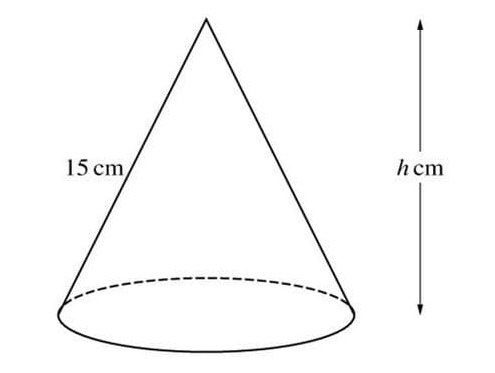
(i) Show that the volume, \(V \,\text{cm}^3\), of the cone is given by \[ V = \frac{1}{3}\pi(225h - h^3). \] [The volume of a cone of radius \(r\) and vertical height \(h\) is \(\dfrac{1}{3}\pi r^2 h\).]
(ii) Given that \(h\) can vary, find the value of \(h\) for which \(V\) has a stationary value. Determine, showing all necessary working, the nature of this stationary value.
Part (i): Expressing the Volume in Terms of \(h\)
Let the radius of the base be \(r\) cm. We know:
- slant height \(= 15\) cm
- vertical height \(= h\) cm
- radius \(= r\) cm
These form a right-angled triangle, so by Pythagoras: \[ r^2 + h^2 = 15^2 = 225 \quad\Rightarrow\quad r^2 = 225 - h^2. \] Volume of the cone: \[ V = \frac{1}{3}\pi r^2 h = \frac{1}{3}\pi(225 - h^2)h = \frac{1}{3}\pi(225h - h^3). \] Hence the required expression is shown.
Part (ii): Stationary Value of the Volume
Step 1: Differentiate \(V\) with respect to \(h\).
\[ V = \frac{1}{3}\pi(225h - h^3) \] \[ \frac{dV}{dh} = \frac{1}{3}\pi(225 - 3h^2) = \pi(75 - h^2). \]
Step 2: Find stationary points by setting \(\dfrac{dV}{dh}=0\).
\[ \pi(75 - h^2) = 0 \quad\Rightarrow\quad 75 - h^2 = 0 \quad\Rightarrow\quad h^2 = 75 \quad\Rightarrow\quad h = \sqrt{75} = 5\sqrt{3}\ \text{cm} \] (We take the positive value because \(h\) is a length.)
Step 3: Determine the nature of the stationary value (max / min).
Find the second derivative: \[ \frac{dV}{dh} = \pi(75 - h^2) \quad\Rightarrow\quad \frac{d^2V}{dh^2} = -2\pi h. \] At \(h = 5\sqrt{3}\): \[ \frac{d^2V}{dh^2} = -2\pi (5\sqrt{3}) = -10\pi\sqrt{3} < 0. \] Since the second derivative is negative, the stationary point is a maximum.
3. Quick Exam Tips for Applications
- Use geometry (Pythagoras, similar triangles) to link variables first.
- Express the quantity (e.g. \(V, A, S\)) in terms of a single variable.
- Differentiate carefully and show \(\dfrac{dQ}{dx} = 0\) clearly.
- Use \(\dfrac{d^2Q}{dx^2}\) to justify “maximum” or “minimum”.
- State units in your final answer where appropriate.