Trigonometry – The cosecant, secant and cotangent ratios
The Cosecant, Secant, and Cotangent Ratios
In trigonometry, the cosecant, secant, and cotangent functions are the reciprocals of the three primary trigonometric ratios: sine, cosine, and tangent.
These relationships are defined as: \[ \csc \theta = \frac{1}{\sin \theta}, \qquad \sec \theta = \frac{1}{\cos \theta}, \qquad \cot \theta = \frac{1}{\tan \theta}. \]
1. Relationship between Sine and Cosecant
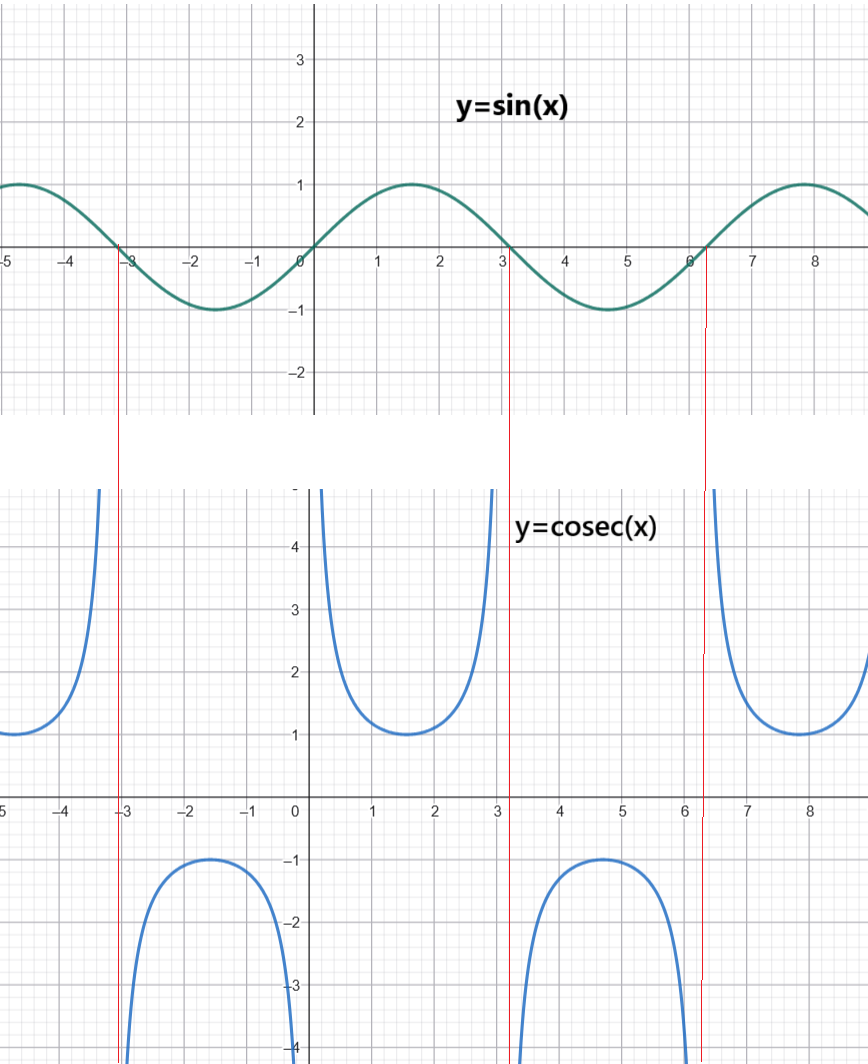
The graph of \(y = \csc \theta\) is derived from \(y = \sin \theta\) by taking the reciprocal of each sine value. Wherever \(\sin \theta = 0\), the cosecant function is undefined, resulting in vertical asymptotes at those points.
2. Relationship between Cosine and Secant
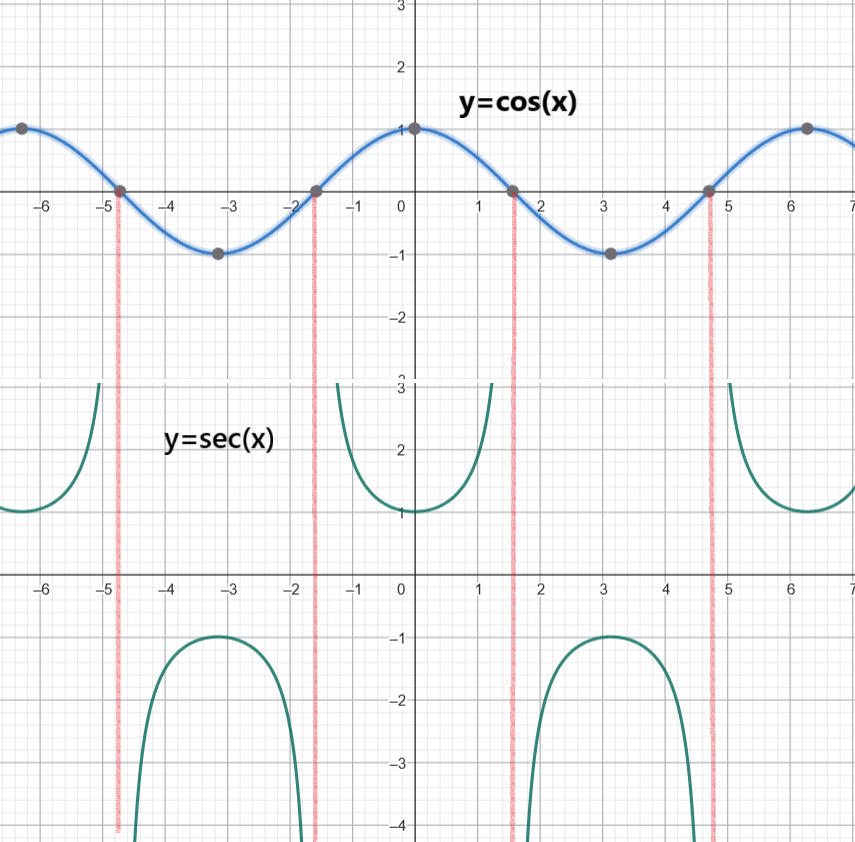
The secant function is the reciprocal of the cosine function: \[ \sec \theta = \frac{1}{\cos \theta}. \] Like the cosecant graph, the secant graph has vertical asymptotes where \(\cos \theta = 0\). The curves of \(\sec \theta\) occur where \(\cos \theta\) reaches its maximum and minimum values.
3. Relationship between Tangent and Cotangent
The cotangent function is the reciprocal of tangent: \[ \cot \theta = \frac{1}{\tan \theta}. \] It is undefined where \(\tan \theta = 0\), producing vertical asymptotes at those points. The graph of \(\cot \theta\) decreases from \(+\infty\) to \(-\infty\) between its asymptotes.

4. Important Observations
- \(\sin \theta\) and \(\csc \theta\) have the same period of \(360^\circ\) (or \(2\pi\) radians).
- \(\cos \theta\) and \(\sec \theta\) also share the same period \(360^\circ\) (or \(2\pi\) radians).
- \(\tan \theta\) and \(\cot \theta\) both have period \(180^\circ\) (or \(\pi\) radians).
- The reciprocal graphs have asymptotes where their corresponding base functions are zero.
5. Reciprocal Identities Summary
\[ \sin \theta = \frac{1}{\csc \theta}, \qquad \cos \theta = \frac{1}{\sec \theta}, \qquad \tan \theta = \frac{1}{\cot \theta}. \]