Continuous densities, moments and percentiles — 9709 S2
Normalise a density and compute probabilities and moments by integration.
Notes and key methods
A density f is nonnegative and integrates to one over its support. Probabilities are areas: \(P(a<X<b)=\int_a^b f(x)\,dx\). A density may be larger than 1; a probability cannot.
Use \(E(X)=\int xf(x)\,dx\), \(E(X^2)=\int x^2f(x)\,dx\) and \(\operatorname{Var}(X)=E(X^2)-E(X)^2\). A median m solves \(\int_{-\infty}^m f(x)\,dx=1/2\).
Check the conditions
State the full support and put f(x)=0 outside it.
The density must be nonnegative throughout its support.
Three worked examples
Example 1 · Continuous densities and moments
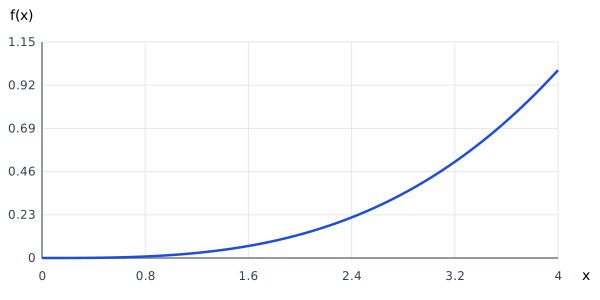
X has density \(f(x)=kx^{3}\) for \(0\le x\le 4\) and zero elsewhere.
Use the labelled scales alongside the numerical method.
Find k.
Find E(X).
Find Var(X).
Find the median of X.
Show the reasoning
(a)
\(k\frac{4^{4}}{4}=1\implies k=\frac{1}{64}\)
Answer: \(\frac{1}{64}\).
(b)
\(\int_0^L xf(x)\,dx=\frac{16}{5}\)
Answer: \(\frac{16}{5}\).
(c)
\(E(X^2)-E(X)^2=\frac{32}{75}\)
Answer: \(\frac{32}{75}\).
(d)
\((m/4)^{4}=1/2\implies m=42^{-1/4}\)
Answer: \(3.36358566101486\).
Example 2 · Continuous densities and moments
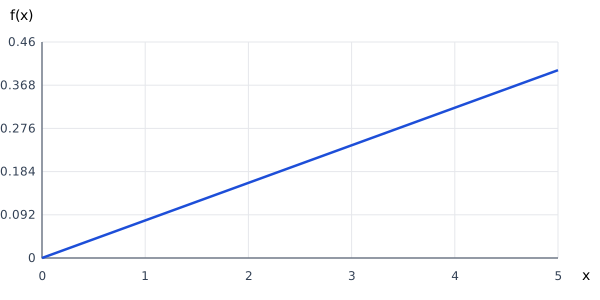
X has density \(f(x)=kx^{1}\) for \(0\le x\le 5\) and zero elsewhere.
Use the labelled scales alongside the numerical method.
Find k.
Find E(X).
Find Var(X).
Find the median of X.
Show the reasoning
(a)
\(k\frac{5^{2}}{2}=1\implies k=\frac{2}{25}\)
Answer: \(\frac{2}{25}\).
(b)
\(\int_0^L xf(x)\,dx=\frac{10}{3}\)
Answer: \(\frac{10}{3}\).
(c)
\(E(X^2)-E(X)^2=\frac{25}{18}\)
Answer: \(\frac{25}{18}\).
(d)
\((m/5)^{2}=1/2\implies m=52^{-1/2}\)
Answer: \(3.53553390593274\).
Example 3 · Continuous densities and moments
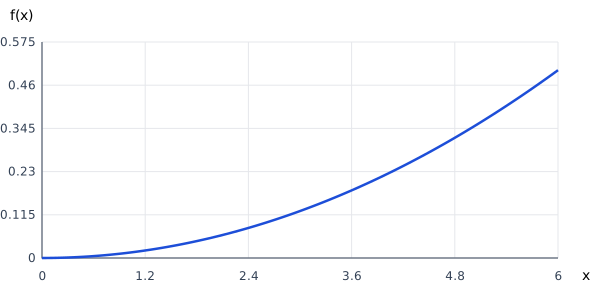
X has density \(f(x)=kx^{2}\) for \(0\le x\le 6\) and zero elsewhere.
Use the labelled scales alongside the numerical method.