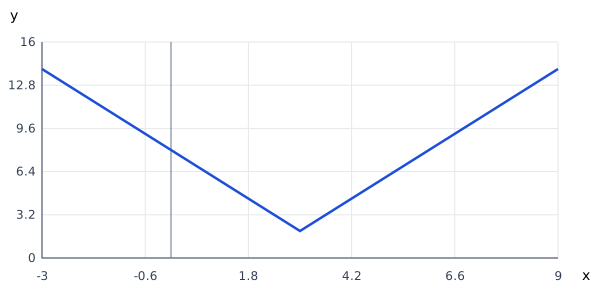
Use distance from a vertex to solve a modulus equation or inequality. Split equal absolute values into the two signed linear equations.
Notes and key methods
For \(f(x)=a|x-h|+k\), a>0, the vertex is (h,k), the least value is k, and the two slopes are −a and a.
For d>0, \(|x-h|<d\) means h−d<x<h+d; the reversed strict inequality gives the two exterior intervals. Use closed endpoints for ≤ or ≥. A graph verifies which side of the boundary is required.
For real U,V, \(|U|=|V|\) is equivalent to U=V or U=−V. Solve both equations and remove duplicate roots. Squaring is also valid for this equality, but can hide the useful linear factors.
When solving an inequality, split at the zeros of the expressions inside the moduli or compare squared nonnegative sides. Test an interval, rather than carrying an equality argument over without checking the sign.
Check the conditions
The coefficient a and distance d are positive.
Check whether boundary points are included.
Both expressions are real.
An inequality requires sign analysis after finding its boundaries.
Three worked examples
Example 1 · Linear modulus graphs and inequalities