Translate a logarithm into an exponent and combine positive arguments. Use ln and the exponential as inverse operations. Find a logarithmic domain, asymptote and exponential inverse.
Notes and key methods
For a>0, a≠1 and x>0, \(\log_a x=y\) means aʸ=x. The product, quotient and power laws are \(\log_a(uv)=\log_a u+\log_a v\), \(\log_a(u/v)=\log_a u-\log_a v\), and \(\log_a(u^r)=r\log_a u\) when the real expressions are defined.
Natural logarithms use base e. Exponential and logarithmic graphs are inverse reflections in y=x. The logarithm argument must remain positive; combining expressions does not remove that original restriction.
The natural logarithm ln has base e. For real u, ln(eᵘ)=u; for x>0, eˡⁿˣ=x. The exponential takes every real input, while ln requires a positive one.
The usual logarithm laws hold for positive arguments. Isolate an exponential before taking ln, and keep parentheses when an entire quotient or power is inside the logarithm.
For \(y=k\ln(a(x-h))+b\), with a,k>0, the domain is x>h and the vertical asymptote is x=h. The height is b where the logarithm argument is 1.
Rearranging gives \(x=h+e^{(y-b)/k}/a\). The inverse has all real inputs and outputs greater than h. A translated logarithm approaches its asymptote but never reaches it.
Check the conditions
Logarithm arguments are positive.
The base is positive and different from one.
Natural logarithms require positive arguments.
The exponential is defined for every real input.
The logarithm argument must be positive.
Both a and k are positive in these examples.
Three worked examples
Example 1 · Logarithms and index laws
Let a=\(3\), \(p = 81\), \(q = 9\). Work exactly, using index laws.
Find logₐ p.
Find logₐ(pq).
Find logₐ(p/q).
Find logₐ(p²/q).
Show the reasoning
(a)
Apply the product, quotient or power law to positive arguments.
4
Answer: \(4\).
(b)
Apply the product, quotient or power law to positive arguments.
4+2=6
Answer: \(6\).
(c)
Apply the product, quotient or power law to positive arguments.
4−2=2
Answer: \(2\).
(d)
Apply the product, quotient or power law to positive arguments.
2(4)−2=6
Answer: \(6\).
Example 2 · Natural logarithms and exponentials
Let a=\(e\), \(p = e^{5}\), \(q = e^{3}\). Work exactly, using index laws.
Find logₐ p.
Find logₐ(pq).
Find logₐ(p/q).
Find logₐ(p²/q).
Show the reasoning
(a)
Apply the product, quotient or power law to positive arguments.
5
Answer: \(5\).
(b)
Apply the product, quotient or power law to positive arguments.
5+3=8
Answer: \(8\).
(c)
Apply the product, quotient or power law to positive arguments.
5−3=2
Answer: \(2\).
(d)
Apply the product, quotient or power law to positive arguments.
2(5)−3=7
Answer: \(7\).
Example 3 · Logarithmic graphs and inverse rules
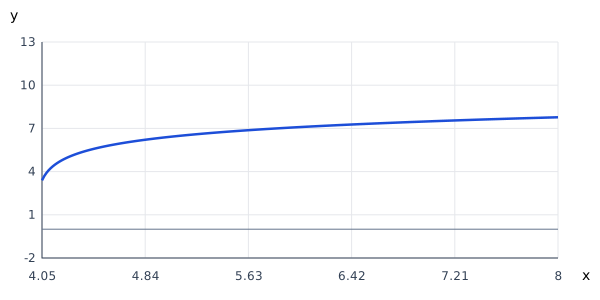
\(f{\left(x \right)} = \log{\left(4 x - 16 \right)} + 5\), with a=4, h=4, b=5.
Use the labelled scales alongside the numerical method.
State the domain and vertical asymptote.
Find the inverse function and its domain.
Find the input whose output is b.
Find the gradient where a(x−h)=1.
Show the reasoning
(a)
Require a(x−h)>0 with a>0.
Answer: \(\left(4, \infty\right)\); \(x = 4\)
(b)
Isolate the logarithm, exponentiate, solve for the original input and exchange the variables.