Find every change of direction before adding distances across three intervals.
Syllabus 4.2
Notes and key methods
A quadratic velocity can have two distinct zeros in the modelled time interval. Factor or solve the velocity equation, order its admissible roots and test the sign on all resulting intervals.
Integrate each interval separately for distance. The middle integral may be negative while the two outer ones are positive; its magnitude must be added, rather than cancelled. A position antiderivative provides a consistent way to check all three integrals and the final net displacement.
Check the conditions
Choose and retain a positive direction; distinguish signed quantities from magnitudes.
Use SI units and \(\displaystyle g= \frac{10m}{s^{2}}\) wherever gravity is relevant.
Apply only the model and time interval stated in the question.
Three worked examples
Example 1 · A quadratic velocity with two reversals
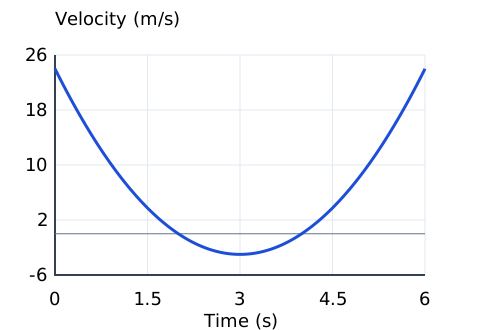
A particle has velocity \(v=\left(t - 4\right) \left(3 t - 6\right)\) m/s for \(0\le t\le 6\), with t in seconds. Its initial position is zero.
Use the labelled time and displacement or velocity axes, with the stated units.
Find both direction-reversal times and identify the velocity sign in each resulting interval.
Find the total displacement over the stated interval.
Find the total distance travelled, showing the interval contributions.
Find the total distance travelled over the stated interval in m.
Show the reasoning
(a)
The factored velocity has distinct roots 2 and 4. The positive leading coefficient makes it positive outside the two roots and negative between them.
Answer: 2 s and 4 s; signs +, −, + in chronological order.
(b)
An antiderivative of velocity is \(t^{3} - 9 t^{2} + 24 t\). Evaluation from 0 to 6 gives \(36\) m.
Answer: \(36\) m.
(c)
The signed integrals over the three intervals are \(20\), \(-4\), \(20\) m. The middle one is negative, so distance adds its magnitude to the other two, giving \(44\) m.
Answer: \(44\) m.
(d)
Split at both reversal times and add the absolute values of all three integrals.
The three signed stage integrals are \(20\), \(-4\), \(20\) m. Adding their magnitudes gives \(44\) m.
Answer: \(44\).
Example 2 · A quadratic velocity with two reversals
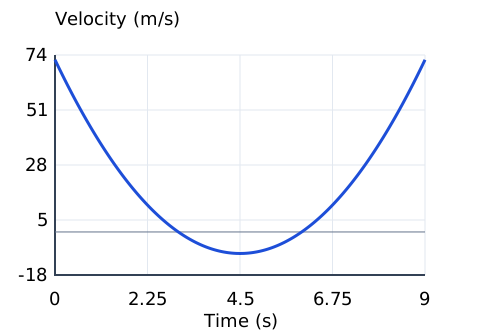
A particle has velocity \(v=\left(t - 6\right) \left(4 t - 12\right)\) m/s for \(0\le t\le 9\), with t in seconds. Its initial position is zero.
Use the labelled time and displacement or velocity axes, with the stated units.
Find both direction-reversal times and identify the velocity sign in each resulting interval.
Find the total displacement over the stated interval.
Find the total distance travelled, showing the interval contributions.
Find the total distance travelled over the stated interval in m.
Show the reasoning
(a)
The factored velocity has distinct roots 3 and 6. The positive leading coefficient makes it positive outside the two roots and negative between them.
Answer: 3 s and 6 s; signs +, −, + in chronological order.
(b)
An antiderivative of velocity is \(\displaystyle \frac{4 t^{3}}{3} - 18 t^{2} + 72 t\). Evaluation from 0 to 9 gives \(162\) m.
Answer: \(162\) m.
(c)
The signed integrals over the three intervals are \(90\), \(-18\), \(90\) m. The middle one is negative, so distance adds its magnitude to the other two, giving \(198\) m.
Answer: \(198\) m.
(d)
Split at both reversal times and add the absolute values of all three integrals.
The three signed stage integrals are \(90\), \(-18\), \(90\) m. Adding their magnitudes gives \(198\) m.
Answer: \(198\).
Example 3 · A quadratic velocity with two reversals
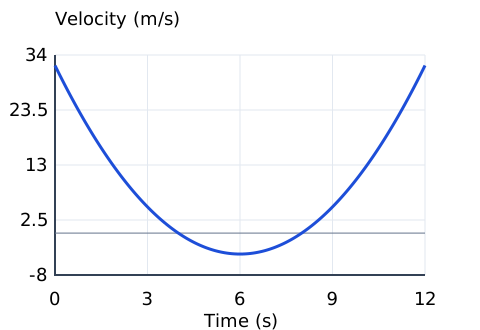
A particle has velocity \(v=\left(t - 8\right) \left(t - 4\right)\) m/s for \(0\le t\le 12\), with t in seconds. Its initial position is zero.
Use the labelled time and displacement or velocity axes, with the stated units.
Find both direction-reversal times and identify the velocity sign in each resulting interval.
Find the total displacement over the stated interval.
Find the total distance travelled, showing the interval contributions.
Find the total distance travelled over the stated interval in m.
Show the reasoning
(a)
The factored velocity has distinct roots 4 and 8. The positive leading coefficient makes it positive outside the two roots and negative between them.
Answer: 4 s and 8 s; signs +, −, + in chronological order.
(b)
An antiderivative of velocity is \(\displaystyle \frac{t^{3}}{3} - 6 t^{2} + 32 t\). Evaluation from 0 to 12 gives \(96\) m.
Answer: \(96\) m.
(c)
The signed integrals over the three intervals are \(\displaystyle \frac{160}{3}\), \(\displaystyle - \frac{32}{3}\), \(\displaystyle \frac{160}{3}\) m. The middle one is negative, so distance adds its magnitude to the other two, giving \(\displaystyle \frac{352}{3}\) m.
Answer: \(\displaystyle \frac{352}{3}\) m.
(d)
Split at both reversal times and add the absolute values of all three integrals.
The three signed stage integrals are \(\displaystyle \frac{160}{3}\), \(\displaystyle - \frac{32}{3}\), \(\displaystyle \frac{160}{3}\) m. Adding their magnitudes gives \(\displaystyle \frac{352}{3}\) m.
Answer: \(\displaystyle \frac{352}{3}\).
Common mistakes
Include both admissible velocity zeros, not only the first.
Take the absolute value of each sign-consistent displacement before summing distance.