Use the along-plane component of weight as the accelerating force.
Syllabus 4.4
Notes and key methods
On a fixed smooth incline, the only along-plane force on a freely sliding particle is Mg sin α. Newton’s second law gives acceleration g sin α down the plane. Perpendicular acceleration is zero, so the reaction is Mg cos α.
The acceleration does not depend on mass in this model, but the normal reaction does. For travel from rest under this constant acceleration, use \(\displaystyle v^{2}\)=2as or s=at²/2. Smooth does not mean horizontal and does not mean that the particle has no acceleration.
Check the conditions
Choose and retain a positive direction; distinguish signed quantities from magnitudes.
Use SI units and \(\displaystyle g= \frac{10m}{s^{2}}\) wherever gravity is relevant.
Apply only the model and time interval stated in the question.
Three worked examples
Example 1 · Motion down a smooth incline
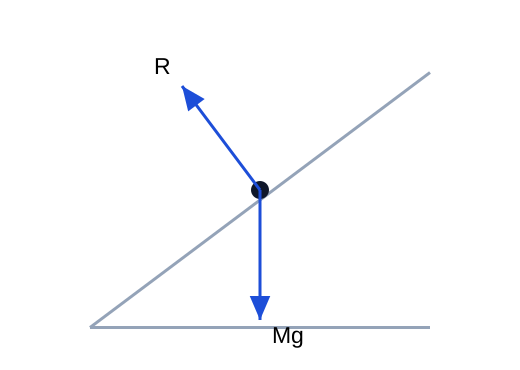
A 4 kg particle starts from rest and slides 9 m down a line of greatest slope of a smooth fixed plane. The acute angle α satisfies \(\displaystyle \sin\alpha=\frac{3}{5},\quad\cos\alpha=\frac{4}{5}\). It meets no obstacle. Use \(\displaystyle g= \frac{10m}{s^{2}}\).
Schematic force diagram for the selected particle; arrow lengths are not a force scale.
Find the acceleration down the plane in \(\displaystyle \frac{m}{s^{2}}\).
Find its speed after the stated distance, in m/s to 3 significant figures.
Find the normal reaction in N.
Find the travel time in s, to 3 significant figures.
Show the reasoning
(a)
Resolve the weight down the plane and divide by mass.
Ma=Mg sin α gives \(\displaystyle a=\)\(6\) \(\displaystyle \frac{m}{s^{2}}\).
Answer: \(6\).
(b)
Use the constant downslope acceleration and the positive speed root.
Using \(\displaystyle v^{2}\)=2as gives \(10.4\) m/s.
Answer: \(10.4\).
(c)
Use zero acceleration perpendicular to the fixed plane.
Normal balance gives \(\displaystyle R=Mg \cos \alpha =\)\(32\) N.
Answer: \(32\).
(d)
Use the stated start from rest and the positive square root for elapsed time.
From L=at²/2, take the positive time \(1.73\) s.
Answer: \(1.73\).
Example 2 · Motion down a smooth incline
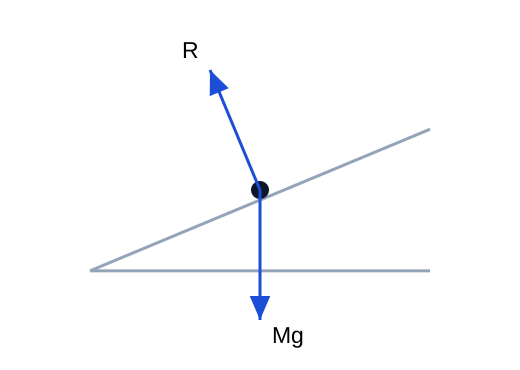
A 5 kg particle starts from rest and slides 10 m down a line of greatest slope of a smooth fixed plane. The acute angle α satisfies \(\displaystyle \sin\alpha=\frac{5}{13},\quad\cos\alpha=\frac{12}{13}\). It meets no obstacle. Use \(\displaystyle g= \frac{10m}{s^{2}}\).
Schematic force diagram for the selected particle; arrow lengths are not a force scale.
Find the acceleration down the plane in \(\displaystyle \frac{m}{s^{2}}\).
Find its speed after the stated distance, in m/s to 3 significant figures.
Find the normal reaction in N.
Find the travel time in s, to 3 significant figures.
Show the reasoning
(a)
Resolve the weight down the plane and divide by mass.
Ma=Mg sin α gives \(\displaystyle a=\)\(\displaystyle \frac{50}{13}\) \(\displaystyle \frac{m}{s^{2}}\).
Answer: \(\displaystyle \frac{50}{13}\).
(b)
Use the constant downslope acceleration and the positive speed root.
Using \(\displaystyle v^{2}\)=2as gives \(8.77\) m/s.
Answer: \(8.77\).
(c)
Use zero acceleration perpendicular to the fixed plane.
Normal balance gives \(\displaystyle R=Mg \cos \alpha =\)\(\displaystyle \frac{600}{13}\) N.
Answer: \(\displaystyle \frac{600}{13}\).
(d)
Use the stated start from rest and the positive square root for elapsed time.
From L=at²/2, take the positive time \(2.28\) s.
Answer: \(2.28\).
Example 3 · Motion down a smooth incline
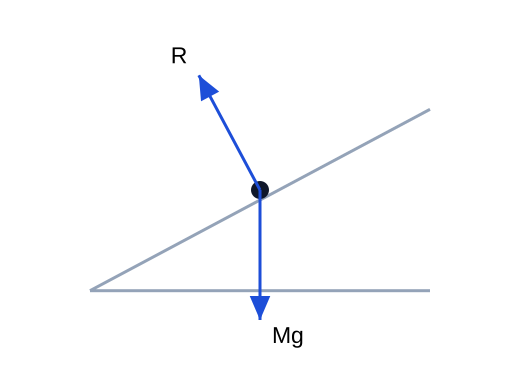
A 6 kg particle starts from rest and slides 3 m down a line of greatest slope of a smooth fixed plane. The acute angle α satisfies \(\displaystyle \sin\alpha=\frac{8}{17},\quad\cos\alpha=\frac{15}{17}\). It meets no obstacle. Use \(\displaystyle g= \frac{10m}{s^{2}}\).
Schematic force diagram for the selected particle; arrow lengths are not a force scale.
Find the acceleration down the plane in \(\displaystyle \frac{m}{s^{2}}\).
Find its speed after the stated distance, in m/s to 3 significant figures.
Find the normal reaction in N.
Find the travel time in s, to 3 significant figures.
Show the reasoning
(a)
Resolve the weight down the plane and divide by mass.
Ma=Mg sin α gives \(\displaystyle a=\)\(\displaystyle \frac{80}{17}\) \(\displaystyle \frac{m}{s^{2}}\).
Answer: \(\displaystyle \frac{80}{17}\).
(b)
Use the constant downslope acceleration and the positive speed root.
Using \(\displaystyle v^{2}\)=2as gives \(5.31\) m/s.
Answer: \(5.31\).
(c)
Use zero acceleration perpendicular to the fixed plane.
Normal balance gives \(\displaystyle R=Mg \cos \alpha =\)\(\displaystyle \frac{900}{17}\) N.
Answer: \(\displaystyle \frac{900}{17}\).
(d)
Use the stated start from rest and the positive square root for elapsed time.
From L=at²/2, take the positive time \(1.13\) s.
Answer: \(1.13\).
Common mistakes
Use Mg sin α for the downslope component, not the full weight.