Split the graph at v=0 before calculating total distance.
Syllabus 4.2
Notes and key methods
A velocity sign change means reversal of direction. The area below the time axis contributes negatively to displacement but positively to distance. A zero velocity at one instant is not a finite interval of rest.
For a straight velocity graph crossing zero, find the crossing time before computing the two triangle areas. Distance is the sum of their magnitudes; displacement is their signed sum. The average speed and magnitude of average velocity can therefore differ.
Check the conditions
Choose and retain a positive direction; distinguish signed quantities from magnitudes.
Use SI units and \(\displaystyle g= \frac{10m}{s^{2}}\) wherever gravity is relevant.
Apply only the model and time interval stated in the question.
Three worked examples
Example 1 · Reversal and signed graph areas
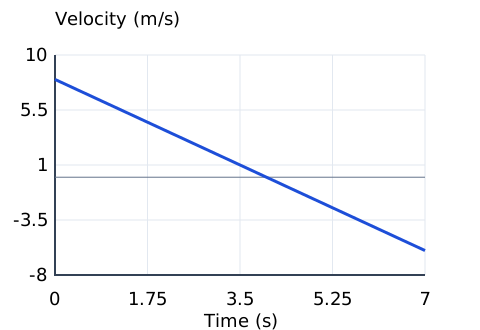
A particle has velocity \(\displaystyle \frac{8m}{s}\) at \(\displaystyle t=0\) and constant acceleration \(\displaystyle - \frac{2m}{s^{2}}\) until \(\displaystyle t=7 s\). Positive means right.
Use the labelled time and displacement or velocity axes, with the stated units.
Find the time of reversal in s.
Find the final signed velocity in m/s.
Find the total displacement in m.
Find the total distance travelled in m.
Show the reasoning
(a)
Locate the velocity zero within the stated interval.
The equation \(\displaystyle 8-2t=0\) gives \(\displaystyle t=4 s\).
Answer: \(4\).
(b)
Use the signed velocity rule after the reversal.
Substitute the full end time to obtain \(\displaystyle - \frac{6m}{s}\), directed left.
Answer: \(-6\).
(c)
Add the velocity graph areas with their signs.
Positive area \(16\) minus the below-axis magnitude \(9\) gives \(7\) m.
Answer: \(7\).
(d)
Split at the zero of velocity and add positive path lengths.
Add the magnitudes of the two triangle areas: \(25\) m.
Answer: \(25\).
Example 2 · Reversal and signed graph areas
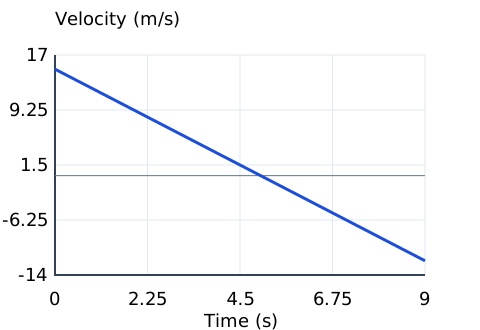
A particle has velocity \(\displaystyle \frac{15m}{s}\) at \(\displaystyle t=0\) and constant acceleration \(\displaystyle - \frac{3m}{s^{2}}\) until \(\displaystyle t=9 s\). Positive means right.
Use the labelled time and displacement or velocity axes, with the stated units.
Find the time of reversal in s.
Find the final signed velocity in m/s.
Find the total displacement in m.
Find the total distance travelled in m.
Show the reasoning
(a)
Locate the velocity zero within the stated interval.
The equation \(\displaystyle 15-3t=0\) gives \(\displaystyle t=5 s\).
Answer: \(5\).
(b)
Use the signed velocity rule after the reversal.
Substitute the full end time to obtain \(\displaystyle - \frac{12m}{s}\), directed left.
Answer: \(-12\).
(c)
Add the velocity graph areas with their signs.
Positive area \(\displaystyle \frac{75}{2}\) minus the below-axis magnitude \(24\) gives \(\displaystyle \frac{27}{2}\) m.
Answer: \(\displaystyle \frac{27}{2}\).
(d)
Split at the zero of velocity and add positive path lengths.
Add the magnitudes of the two triangle areas: \(\displaystyle \frac{123}{2}\) m.
Answer: \(\displaystyle \frac{123}{2}\).
Example 3 · Reversal and signed graph areas
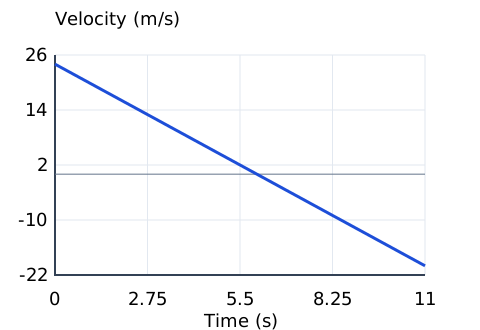
A particle has velocity \(\displaystyle \frac{24m}{s}\) at \(\displaystyle t=0\) and constant acceleration \(\displaystyle - \frac{4m}{s^{2}}\) until \(\displaystyle t=11 s\). Positive means right.
Use the labelled time and displacement or velocity axes, with the stated units.
Find the time of reversal in s.
Find the final signed velocity in m/s.
Find the total displacement in m.
Find the total distance travelled in m.
Show the reasoning
(a)
Locate the velocity zero within the stated interval.
The equation \(\displaystyle 24-4t=0\) gives \(\displaystyle t=6 s\).
Answer: \(6\).
(b)
Use the signed velocity rule after the reversal.
Substitute the full end time to obtain \(\displaystyle - \frac{20m}{s}\), directed left.
Answer: \(-20\).
(c)
Add the velocity graph areas with their signs.
Positive area \(72\) minus the below-axis magnitude \(50\) gives \(22\) m.
Answer: \(22\).
(d)
Split at the zero of velocity and add positive path lengths.
Add the magnitudes of the two triangle areas: \(122\) m.
Answer: \(122\).
Common mistakes
Do not cancel areas when calculating total distance.
Locate the zero crossing before dividing the motion into directional stages.